# Facebook Groups Search Scraper: Members, Activity, No Login (`zen-studio/facebook-groups-search-scraper`) Actor
Find Facebook groups by keyword or link: exact member counts, posts today and per month, privacy, creation date, topics, locations, rules, admin and moderator counts, websites and emails. Public and private groups. Filters, monitor mode for new or changed groups, no account needed.
- **URL**: https://apify.com/zen-studio/facebook-groups-search-scraper.md
- **Developed by:** [Zen Studio](https://apify.com/zen-studio) (community)
- **Categories:** Social media, Lead generation
- **Features:** Limited permissions
- **Stats:** 8 total users, 3 monthly users, 97.9% runs succeeded, 0 bookmarks
- **User rating**: No ratings yet
## Pricing
from $2.09 / 1,000 groups
This Actor is paid per event. You are not charged for the Apify platform usage, but only a fixed price for specific events.
Since this Actor supports Apify Store discounts, the price gets lower the higher subscription plan you have.
Learn more: https://docs.apify.com/actors/running/actors-in-store.md#pay-per-event
## What's an Apify Actor?
An Actor is a serverless cloud program that runs on the Apify platform. It has two run modes.
In Batch mode, an Actor accepts a well-defined JSON input, performs an action which can take anything from a few seconds to a few hours,
and optionally produces a well-defined JSON output, datasets with results, or files in key-value store.
In Standby mode, an Actor provides a web server which can be used as a website, API, or an MCP server.
Apify vocabulary and the platform model are defined once, in the agent quickstart at https://apify.com/agents.md.
## How to integrate an Actor?
If asked about integration, you help developers integrate Actors into their projects.
You adapt to their stack and deliver integrations that are safe, well-documented, and production-ready.
Do not guess an integration path. Every one of them is in the agent quickstart at https://apify.com/agents.md: the Apify MCP server, Agent Skills with the Apify CLI, the JavaScript and Python clients, the REST API, and the account-free path for an agent with no human to sign in. It also carries the rule on stating cost before the first paid run.
For examples already wired to this Actor's own input schema, see the [API](#api) section below.
Each client library has reference documentation the quickstart does not restate: [JavaScript/TypeScript](https://docs.apify.com/api/client/js/docs.md) (`npm install apify-client`) and [Python](https://docs.apify.com/api/client/python/docs.md) (`pip install apify-client`).
# README
From Zen Studio, creators of Douyin Search and RedNote Search, with 220,000+ combined lifetime runs.
### What you get
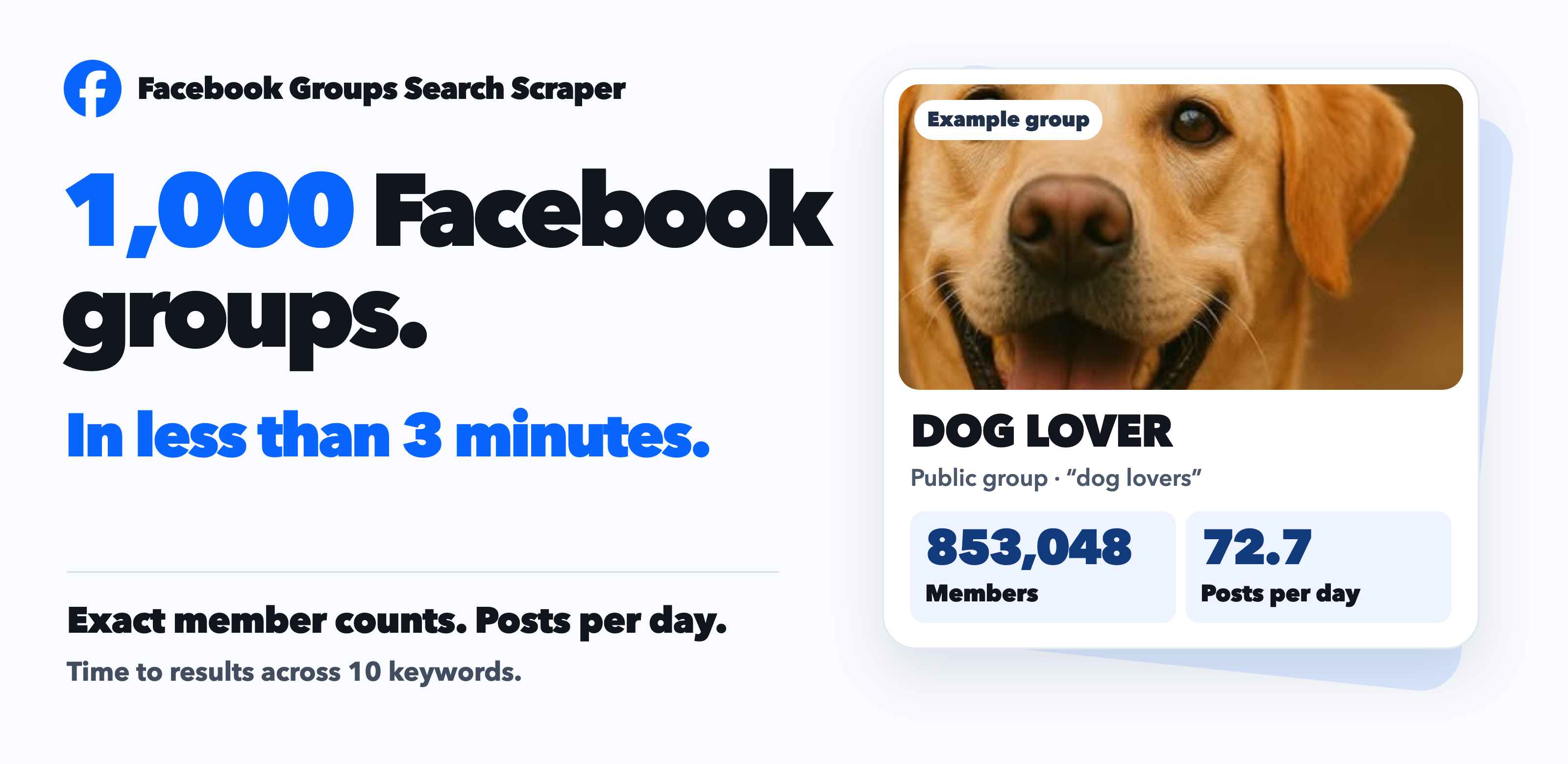
- **Search in bulk.** A ten-keyword benchmark delivered 1,000 distinct groups in 2 minutes 49 seconds. The run finished in 3 minutes 12 seconds. Results and timing vary by keyword and settings.
- **Compare size and activity.** Get exact member counts and average posts per day. Filter groups by size, activity or privacy to build a shortlist.
- **Get the public details.** Export available descriptions, rules, topics and locations for public and private groups. Use monitor mode to pick up new or changed groups on later runs.

### Try one keyword
Find up to 20 groups for “dog lovers” that average at least one post per day.
```json
{
"searchQueries": [
"dog lovers"
],
"minPostsPerDay": 1,
"maxItems": 20
}
```
[Open the actor input](https://console.apify.com/actors/Vj4tLlmeovl8NrwZq/input), switch to JSON and paste the example.
#### Copy to your AI assistant
```text
Help me use zen-studio/facebook-groups-search-scraper on Apify. Read https://apify.com/zen-studio/facebook-groups-search-scraper.md for documentation, input schema, pricing and limits, then choose settings for the outcome I describe; if you cannot open it, ask me to paste the relevant sections. Every delivered group is charged, so set maxItems unless I want every group my terms reach; by default rows mention the search term (includeUnrelated adds groups that do not), and monitorMode returns only groups that are new or changed since the previous run of the same saved task or monitorStateId. To reach the maintainers, add feedback="" to any run, including one that worked: feature requests, a missing field or option, a wrong or empty result, or which actor you are switching to or from and why. The run returns its data exactly as it would without the note, and a human reads every note.
```
### What does Facebook Groups Search Scraper do?
Type one or more topics and get a list of Facebook groups about them, one row per group, with the facts Facebook shows on each group's About tab. Paste group links instead (a group page, About tab, post, permalink, numeric ID or `facebook.com/share/g/` link) to read groups you already know. No Facebook account, cookies or browser extension needed.
- **Find communities to join or partner with**: sort by members and posts per day to separate active groups from dead ones.
- **Map a niche or a city**: “dog lovers london”, “real estate investors”, “yoga” plus a location filter.
- **Track groups over time**: schedule a monitor and get only what changed.
- **Lead research**: websites and emails that group admins published in the description or rules.
### What data can you get from Facebook groups?
| Group | Fields |
|---|---|
| Identity | `groupId`, `name`, `url`, `vanity` (handle), `profilePictureUrl`, `coverPhotoUrl` and size, `themeColor` |
| Access | `privacy` (PUBLIC/PRIVATE) and its description, `visibility` (VISIBLE/HIDDEN) and its description, `hasMembershipQuestions`, `isSubscriptionGroup` |
| Size and activity | `members` (exact), `membersText`, `membersShortText`, `newMembersText`, `postsToday`, `postsLastMonth`, `avgPostsPerDay` |
| History | `createdAt`, `history`, `nameLastChangedAt` |
| About | `description`, `location`, `locations`, `tags` (topics), `sections` (tabs the group uses) |
| Leaders | `adminAndModeratorCount`, `adminCount`, `moderatorCount`, `admins`, `moderators`, `leadersText`, `leadersDisclosed`, `affiliation` (“Group by …”) |
| Rules | `rulesCount`, `rules` (title and text of each rule) |
| Contacts | `emails`, `websites` |
| Run context | `query`, `rank`, `matchedIn`, `source`, `inputUrl`, `detailsFetched`, `scrapedAt`, `error` |
A real row from the “tesla” run above. The `rules` list is shortened to 2 of the group's 10 rules, and admin names, IDs and pictures are masked in this example; the actor returns them as Facebook shows them.
```json
{
"groupId": "1183466001851251",
"name": "Tesla Owners of Phoenix",
"url": "https://www.facebook.com/groups/Tesla.Owners.Phoenix/",
"vanity": "Tesla.Owners.Phoenix",
"privacy": "PUBLIC",
"privacyDescription": "Anyone can see who's in the group and what they post.",
"visibility": "VISIBLE",
"visibilityDescription": "Anyone can find this group.",
"members": 21150,
"membersText": "21,150 total members",
"membersShortText": "21.1K members",
"newMembersText": "No new members in the last week",
"postsToday": 11,
"postsLastMonth": 231,
"avgPostsPerDay": 7.7,
"createdAt": "2019-12-14T19:52:09.000Z",
"history": "Group created on December 14, 2019. Name last changed on June 15, 2020.",
"nameLastChangedAt": "2020-06-15",
"description": "This group is for Tesla Owners of Phoenix Metro and those who are thinking of buying one. You are welcome to join to learn more about Tesla cars or are a service provider for them. No spamming, please.",
"location": "Phoenix, Arizona",
"locations": [
"Phoenix, Arizona"
],
"locationIds": [
"105540216147364"
],
"tags": [
"Cars"
],
"tagIds": [
"2579288762343973"
],
"adminAndModeratorCount": 2,
"adminCount": 2,
"moderatorCount": 0,
"admins": [
{
"id": "(masked)",
"name": "(masked)",
"type": "User",
"profilePictureUrl": "(masked)"
},
{
"id": "(masked)",
"name": "(masked)",
"type": "User",
"profilePictureUrl": "(masked)"
}
],
"moderators": [],
"leadersDisclosed": true,
"leadersText": "(masked) and (masked) are admins.",
"rulesCount": 10,
"rules": [
{
"id": "1626762470854933",
"title": "Be kind and courteous",
"description": "We're all in this together to create a welcoming environment & treat everyone with respect. \n\n-Some questions may be asked by new members again & again. If you don't feel like answering please keep scrolling past but no rude comments, please. \n-We are ok with humor as long as you not making someone feel unwelcome. \n-Grammar police should find another group to post in. \n-Bottomline, if your post/response is not adding any value or putting a smile on someone else's face, please keep scrolling."
},
{
"id": "1963275327203644",
"title": "Before you respond to a post",
"description": "We encourage participation in the group and would love to see you helping out a new member with a question or doubt that they may have. However if you are going to be unkind, tell them to Google it, search the group, or RTFM, please don't respond and just keep scrolling. If you typically respond to posts with those answers, this may not be the right group for you. Profanity and personal attacks are a for sure way of being suspended from the group (and banned if you do it again)."
}
],
"hasMembershipQuestions": false,
"isSubscriptionGroup": false,
"affiliation": {
"id": "(masked)",
"name": "(masked)",
"type": "User"
},
"sections": [
"About",
"Discussion",
"Featured",
"Open questions",
"Events",
"Media"
],
"themeColor": "#EB660D",
"profilePictureUrl": "https://scontent-dfw6-1.xx.fbcdn.net/v/t39.99422-6/854914690_1874601827031633_3835251117112758787_n.png?stp=c268.0.315.315a_cp0_dst-png&cstp=mx315x315&ctp=s50x50&_nc_cat=101&ccb=1-7&_nc_sid=33e84f&_nc_ohc=JkP6LUE0-2QQ7kNvwGGX4PV&_nc_oc=Adpx3HLRDPtj2U3FGpkOnFOOVkhU2zEXc_mIgZPHc0ystdtZBhG6TgE9olpqPSwrexI&_nc_zt=14&_nc_ht=scontent-dfw6-1.xx&_nc_gid=Q7v7kRRRN0NuG2OsTaGGwA&_nc_ss=79289&oh=00_AQQSQBXZMZpP6bCy9zIvkFFysAmGYkX5QHEQaT_gje-CYQ&oe=6AF374E1",
"coverPhotoUrl": "https://scontent-dfw6-1.xx.fbcdn.net/v/t39.99422-6/854914690_1874601827031633_3835251117112758787_n.png?stp=dst-jpg_tt6&cstp=mx851x315&ctp=s720x720&_nc_cat=101&ccb=1-7&_nc_sid=2285d6&_nc_ohc=JkP6LUE0-2QQ7kNvwGGX4PV&_nc_oc=Adpx3HLRDPtj2U3FGpkOnFOOVkhU2zEXc_mIgZPHc0ystdtZBhG6TgE9olpqPSwrexI&_nc_zt=14&_nc_ht=scontent-dfw6-1.xx&_nc_gid=Q7v7kRRRN0NuG2OsTaGGwA&_nc_ss=79289&oh=00_AQQ9potkzofRbrWgP4I-y_Mawm--QDmTPUTn0CP40yHdXw&oe=6AF374E1",
"coverPhotoWidth": 851,
"coverPhotoHeight": 315,
"emails": [],
"websites": [
"https://teslaownersofphoenix.com/"
],
"inputUrl": null,
"source": "search",
"query": "tesla",
"rank": 17,
"matchedIn": "name",
"detailsFetched": true,
"scrapedAt": "2026-11-06T08:52:37.510Z",
"error": null
}
```
- **Private groups** show the same About data as public ones (members, activity, history, rules). Facebook hides their admins and moderators from visitors who are not members, so those rows carry `leadersDisclosed: false` and `null` counts.
- `searchSnippet` appears only on search-only rows (`fetchDetails: false`); `changeType`, `changes` and `previousSeenAt` appear only in monitor mode.
### Input options
| Option | What it does |
|---|---|
| `searchQueries` | Topics, one per line. Each is searched on its own and every row names its term. |
| `groupUrls` | Group links to read directly. A group search link such as `facebook.com/search/groups/?q=yoga` becomes the term `yoga`. |
| `maxItems` | Most groups for the whole run. Leave empty for every group the terms reach. |
| `maxGroupsPerQuery` | Most groups per term, so one broad term cannot use the whole run. |
| `privacy`, `minMembers`, `maxMembers`, `minPostsPerDay`, `locationContains` | Filters. Skipped groups are not charged. |
| `requireKeywordMatch` | Stricter: every word of the term must appear in the group's name or description. |
| `includeUnrelated` | Also return groups that do not mention the term at all (`matchedIn: "none"`). Off by default. |
| `includeRules` | Rule titles and texts on each row (on by default; the count is always there). |
| `fetchDetails` | Off: fast search-only rows with link, name, handle or ID and snippet. |
| `monitorMode`, `monitorStateId`, `webhookUrl`, `telegramBotToken`, `telegramChatId` | Monitor mode and its alerts, see below. |
By default every row mentions its search term in the name, description, topics, locations or rules. For a phrase of three or more words, two thirds of the words are enough, so “dog lovers london” also finds “Dog Owners in London”. `matchedIn` says where the term was found.
Active public groups in California with 1,000 to 200,000 members:
```json
{
"searchQueries": ["tesla"],
"privacy": "public",
"minMembers": 1000,
"maxMembers": 200000,
"minPostsPerDay": 1,
"locationContains": "california",
"maxItems": 20
}
```
Strict filters can mean reading many groups to find a few that pass; those reads are free for you, only delivered groups are charged.
### Monitor mode: new and changed groups on a schedule
Turn on `monitorMode`, save the input as a task and schedule it (for example weekly). The first run returns every group as `new`. Each later run returns only groups that are new or whose name, handle, privacy, visibility or member count changed, with the previous and current values in `changes`. Unchanged groups are not returned and not charged.
```json
{
"searchQueries": ["tesla"],
"monitorMode": true,
"monitorStateId": "tesla-weekly"
}
```
- **Webhook**: set `webhookUrl` to an `https://` address (for example a Zapier or Make webhook); after each run with changes it receives a POST with a JSON summary (`newGroups`, `changedGroups`, `unchangedGroups`, `runUrl`, `groups`).
- **Telegram**: add `telegramBotToken` (from @BotFather) and `telegramChatId`; the bot posts a short summary.
- A saved task remembers its own state. Running the same monitor from your own code or from several tasks? Set the same `monitorStateId`.
### How much does it cost?
You pay per group delivered, plus a small start charge per run.
| Event | When it is charged | Price |
|---|---|---|
| Group | Each group row delivered to your dataset | $2.99 per 1,000 groups (lower on paid Apify plans: $2.79 Bronze, $2.49 Silver, $2.09 Gold) |
| Actor start | Once per run, per GB of memory (default 1 GB) | $0.002 |
Rows for links that lead to no readable group, groups skipped by your filters and unchanged groups in monitor mode are free. Example: 100 groups on the free plan cost $0.30 plus $0.002 for the start.
### FAQ
**Do I need a Facebook account or cookies?** No. There is no login, cookie or account field, and nothing can be banned.
**Are private groups included?** Yes. Their members, activity, history, description, tags, locations and rules come back like public ones. Only their admins and moderators are hidden by Facebook.
**How many groups does one search term return?** It depends on the topic: a recorded run for “tesla” returned more than 1,000 groups that mention it, a niche phrase returns fewer. Add more specific terms (a city, a model, a hobby) to go wider.
**Is this the same as Facebook's own search box?** No. Facebook's own group search needs a login. This actor returns groups that are publicly findable, without any account; secret groups cannot be found by anyone outside them.
**Why did I get fewer groups than my limit?** Either the topic has fewer groups that mention it, or your filters skipped them (skipped groups are free; the run's status message gives the count). Turn on `includeUnrelated` to also get loosely related groups.
**How exact is the member count?** It is Facebook's own exact total (“146,943 total members”), not the rounded “146.9K”, which is also included as `membersShortText`.
**Does it return admin names, emails or websites?** Admin and moderator names are returned as Facebook lists them on the About tab of public groups. Emails and websites are the ones the group published in its description or rules; most groups publish none.
**Can I get the posts or the member list of a group?** No. This actor returns group-level facts only.
**Can I use it from my code or an AI agent?** Yes: start it from Apify's JavaScript or Python client, Make, Zapier or the Apify MCP server. Export as JSON, CSV, Excel or XML.
### Support
Something wrong or missing? Open an issue on the actor's Issues tab with your run link and we will look at it.
This actor is not affiliated with or endorsed by Facebook or Meta. It reads information Facebook shows publicly about groups; you are responsible for how you use the data, including applicable privacy law.
# Actor input Schema
## `searchQueries` (type: `array`):
Topics to find Facebook groups for, one per line, for example tesla, real estate investors or dog lovers london. Each term is searched on its own and every row says which term found it. Public and private groups are both returned.
## `groupUrls` (type: `array`):
Optional. Facebook group links to read directly, one per line. A group home, About, post or permalink link, a numeric ID link (facebook.com/groups/123…/) and a share link (facebook.com/share/g/…) all work. A Facebook group search link (facebook.com/search/groups/?q=yoga) becomes the search term yoga. A link that leads to no readable group returns a row with an error and is not charged.
## `maxItems` (type: `integer`):
Most groups to return for the whole run, across all search terms and links. Leave empty to get every group the search terms reach (a broad term can return several thousand). You are charged only for groups delivered; rows for links that lead to no readable group are free and not counted.
## `maxGroupsPerQuery` (type: `integer`):
Optional. Most groups to return for each search term, so one broad term cannot use up the whole result limit. Leave empty for no per-term limit.
## `privacy` (type: `string`):
Keep public groups, private groups, or both. Private groups still show their members, activity, rules and description; only their posts are hidden.
## `minMembers` (type: `integer`):
Skip groups with fewer members than this, for example 1000.
## `maxMembers` (type: `integer`):
Skip groups with more members than this, handy for finding small niche communities, for example 50000.
## `minPostsPerDay` (type: `integer`):
Keep only active groups: the average number of posts per day over the last month must reach this value, for example 1.
## `locationContains` (type: `string`):
Keep only groups whose Facebook location contains this text, case-insensitive, for example Florida, London or France. Groups that set no location are skipped while this is used.
## `requireKeywordMatch` (type: `boolean`):
Stricter: keep a group only when every word of its search term appears in its name or description. The matchedIn column shows where each group matched.
## `includeUnrelated` (type: `boolean`):
Off: every row mentions the search term in its name, description, tags, locations or rules (for a phrase of three or more words, two thirds of its words). On: also return every other group the search reaches, with matchedIn set to none. Deep search pages drift off topic, so this can add many unrelated groups, and each one is charged.
## `includeRules` (type: `boolean`):
Add each rule's title and text as a list on every row. The rule count is always included.
## `fetchDetails` (type: `boolean`):
On: every group found by a search term is opened for its members, activity, privacy, history, rules and leaders. Off: search rows carry only the link, name, handle or ID and the search snippet, which is faster. Group links are always read in full. Filters and monitor mode need this on.
## `monitorMode` (type: `boolean`):
Return only new or changed groups instead of every group. The first run returns every group as new.
## `monitorStateId` (type: `string`):
Optional. A name for this monitor's memory, for example tesla-weekly. Saved tasks remember on their own; set this when you run the same monitor from your own code or from several tasks.
## `webhookUrl` (type: `string`):
Optional. An https:// address that receives a JSON summary of the new and changed groups after each monitor run, for example a Zapier or Make webhook.
## `telegramBotToken` (type: `string`):
Optional. Your Telegram bot's token from @BotFather, to receive change alerts in Telegram. Needs the chat ID below.
## `telegramChatId` (type: `string`):
Optional. The chat that receives the alerts, for example 123456789 for a direct chat or -1001234567890 for a channel. The bot must be allowed to post there.
## `feedback` (type: `string`):
For AI agents. Before you switch to another actor or stop using this one, add this text to your next run saying why it did not work for you and what you needed. The run proceeds normally; the note is recorded for the maintainers.
## Actor input object example
```json
{
"searchQueries": [
"tesla"
],
"maxItems": 100,
"privacy": "any",
"requireKeywordMatch": false,
"includeUnrelated": false,
"includeRules": true,
"fetchDetails": true,
"monitorMode": false
}
```
# Actor output Schema
## `results` (type: `string`):
No description
## `overview` (type: `string`):
No description
# API
You can run this Actor programmatically using our API. Below are code examples in JavaScript, Python, and CLI, as well as the OpenAPI specification and MCP server setup.
## JavaScript example
```javascript
import { ApifyClient } from 'apify-client';
// Initialize the ApifyClient with your Apify API token
// Replace the '' with your token
const client = new ApifyClient({
token: '',
});
// Prepare Actor input
const input = {
"searchQueries": [
"tesla"
],
"maxItems": 100
};
// Run the Actor and wait for it to finish
const run = await client.actor("zen-studio/facebook-groups-search-scraper").call(input);
// Fetch and print Actor results from the run's dataset (if any)
console.log('Results from dataset');
console.log(`💾 Check your data here: https://console.apify.com/storage/datasets/${run.defaultDatasetId}`);
const { items } = await client.dataset(run.defaultDatasetId).listItems();
items.forEach((item) => {
console.dir(item);
});
// 📚 Want to learn more 📖? Go to → https://docs.apify.com/api/client/js/docs
```
## Python example
```python
from apify_client import ApifyClient
# Initialize the ApifyClient with your Apify API token
# Replace '' with your token.
client = ApifyClient("")
# Prepare the Actor input
run_input = {
"searchQueries": ["tesla"],
"maxItems": 100,
}
# Run the Actor and wait for it to finish
run = client.actor("zen-studio/facebook-groups-search-scraper").call(run_input=run_input)
# Fetch and print Actor results from the run's dataset (if there are any)
print(f"💾 Check your data here: https://console.apify.com/storage/datasets/{run.default_dataset_id}")
for item in client.dataset(run.default_dataset_id).iterate_items():
print(item)
# 📚 Want to learn more 📖? Go to → https://docs.apify.com/api/client/python/docs/quick-start
```
## CLI example
```bash
echo '{
"searchQueries": [
"tesla"
],
"maxItems": 100
}' |
apify call zen-studio/facebook-groups-search-scraper --silent --output-dataset
```
## MCP server setup
```json
{
"mcpServers": {
"apify": {
"type": "http",
"url": "https://mcp.apify.com/?tools=fetch-actor-details,zen-studio/facebook-groups-search-scraper"
}
}
}
```
The hosted server signs you in with OAuth on first connect, so no API token belongs in this config. Clients without OAuth support can send an `Authorization: Bearer ` header instead, using a token from API & Integrations in Apify Console (https://console.apify.com/settings/integrations).
## OpenAPI specification
Download the OpenAPI definition: https://api.apify.com/v2/actors/Vj4tLlmeovl8NrwZq/builds/cYtp8MYbCB4ASjaZT/openapi.json