

News to Markdown — RAG-Ready News Chunks API
Pricing
from $40.00 / 1,000 markdown chunks
News to Markdown — RAG-Ready News Chunks API
Convert news and announcements into RAG-ready Markdown chunks. Clean JSON for PR, media-monitoring teams and AI agents.
Pricing
from $40.00 / 1,000 markdown chunks
Rating
0.0
(0)
Developer
NexGenData
Maintained by CommunityActor stats
0
Bookmarked
2
Total users
1
Monthly active users
21 hours ago
Last modified
Share
News to Markdown
Convert news and announcements into RAG-ready Markdown chunks. Built for PR, comms, media-monitoring teams and AI agents.
📊 Sample Output
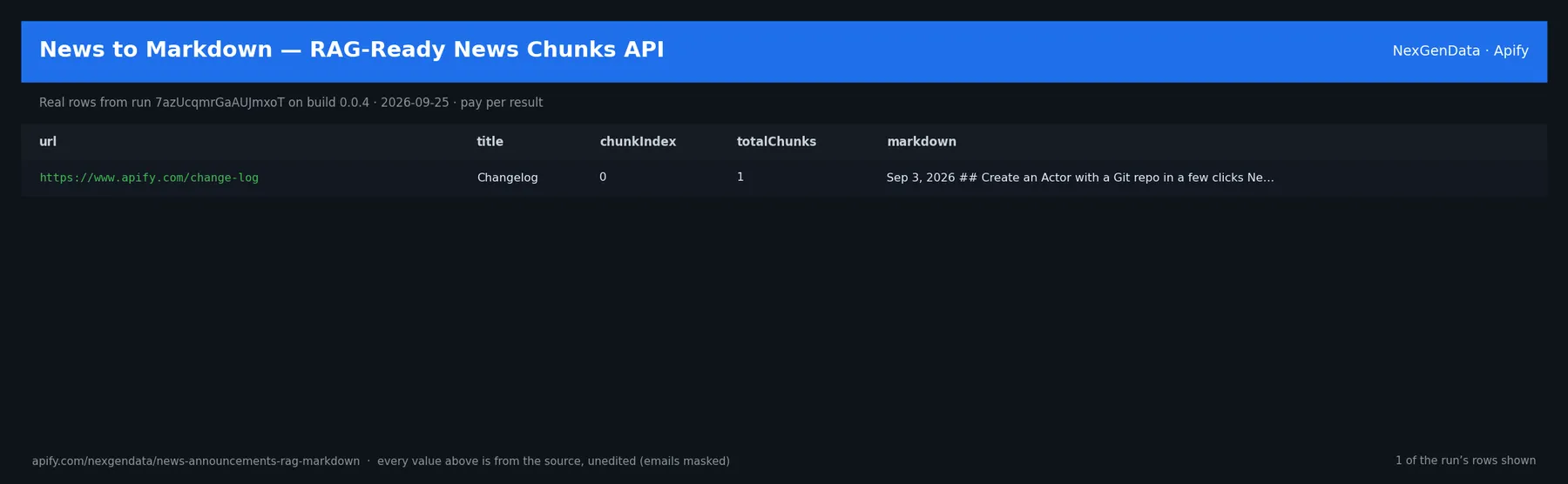
url | title | chunkIndex | totalChunks | markdown |
|---|---|---|---|---|
| https://www.apify.com/change-log | Changelog | 0 | 1 | Sep 3, 2026 ## Create an Actor with a Git repo in a few clicks New Co… |
Real rows from run 7azUcqmrGaAUJmxoT on build 0.0.4 (2026-09-25), unedited apart from masked emails/phones and shortened long text; fields the source does not publish are empty.
🔧 Input reference
| Field | Type | Default | What it does |
|---|---|---|---|
urls | array | ["https://www.apify.com/change-log"] | Direct URLs of press releases / news articles to convert. |
rssFeeds | array | [] | Feed URLs; latest items are fetched and converted. |
maxPerFeed | integer | 10 | How many latest items to take from each feed. |
chunkWords | integer | 800 | Approx words per Markdown chunk for RAG. |
🧾 JSON sample record
One real record from run 7azUcqmrGaAUJmxoT (emails/phones masked, long text shortened):
💰 Pricing
| Event | Price (USD) | When it is charged |
|---|---|---|
Actor Start (apify-actor-start) | $0.005 | Charged when the Actor starts running. Number of events charged depends on Actor memory (one event per GB, minimum one event). |
Markdown chunk (document-record) | $0.04 | Charged per Markdown chunk. |
Pay-per-event: you pay only for what the run delivers. A run that delivers nothing bills no result events (only the actor-start event, when the actor defines one). Example: a run that delivers 100 results costs 100 × $0.04 = $4.00 plus the start fee.
🔗 Related Actors
More from the NexGenData Press releases & news family:
- EIN Presswire Press Releases Scraper — Media API
- GlobeNewswire Press Releases Scraper — Media API
- Google News Scraper — Breaking News Feed API
- PR Newswire Asia Press Releases — Media API
- PRWeb Press Releases Scraper — Media Monitoring API
2 more in this family on the NexGenData Store page.
⏰ Run this as a news corpus (recommended)
Every IP registry actor is a monitoring subscription, not a one-shot lookup. Schedule a weekly sweep and catch new filings as they land:
Weekly cron (0 8 * * 1) turns this into an always-on news corpus.
📊 What you get
Clean JSON, one record per chunk (full output has 6 fields):
accession— Accessioncompany— Companymarkdown— Markdownsource_url— Source urlchunk_index— Chunk indexform— Form
Pricing: $0.04 per chunk (Pay-Per-Event) — about 25 chunks per $1.
🤖 Use with AI agents
Point Claude, the OpenAI Agents SDK, an n8n flow or any MCP-aware client at it and run news and announcements as RAG-ready chunks on demand.
Sample agent prompt:
Agentic payments (x402): Supports agentic payment via x402 — agents can call this actor with USDC, no API key required.
🔗 Related news & media actors
Full media-monitoring stack — monitor every major wire: PR Newswire, Business Wire, GlobeNewswire, PRWeb, EIN Presswire, Brand Mention Monitor
News agent front door: News MCP
Data from public news, press-wire and media sources.


