Markdown Code To Image
Pricing
from $5.00 / 1,000 generated images
Markdown Code To Image
Convert Markdown, code snippets, tables, quotes, and AI answers into polished downloadable PNG images. Batch rendering API for n8n, Make, Zapier, newsletters, docs, and social media.
Pricing
from $5.00 / 1,000 generated images
Rating
0.0
(0)
Developer
AI Coding Radar
Maintained by CommunityActor stats
0
Bookmarked
2
Total users
1
Monthly active users
2 months ago
Last modified
Categories
Share
Markdown & Code to Image API
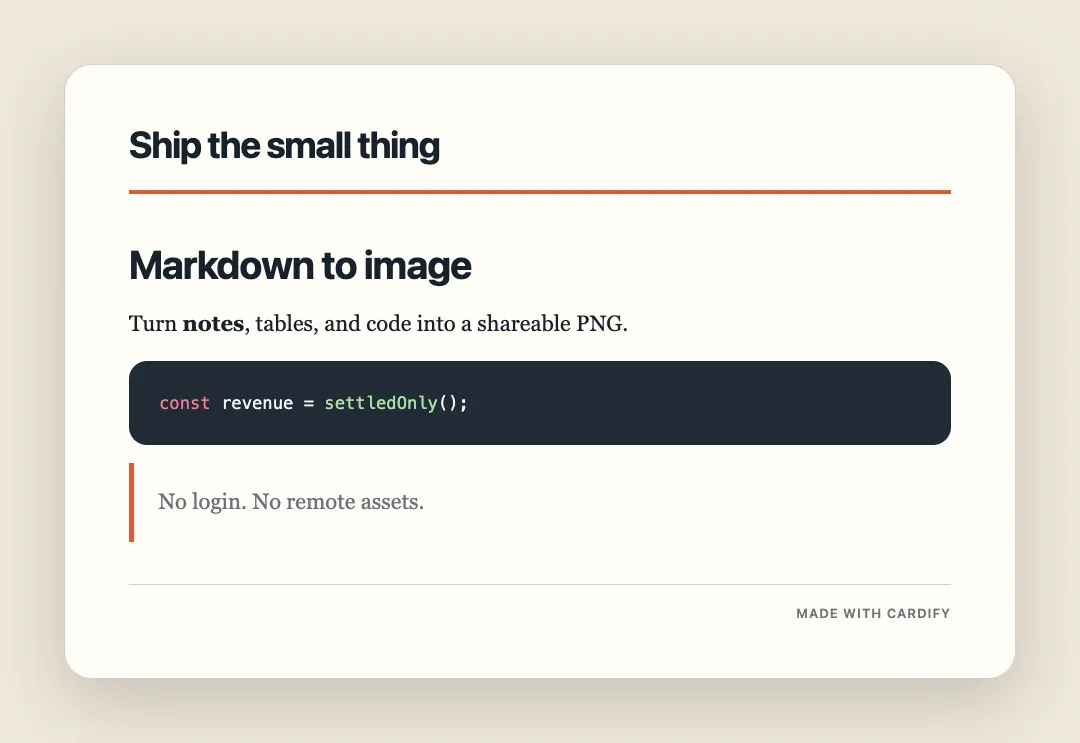
Turn Markdown, code snippets, tables, quotes, and AI answers into polished PNG images through Apify. Use it from the Console, API, n8n, Make, Zapier, or a schedule. It is a rendering API, not a web scraper: no login, proxy, source website, or external API key is required.
- Run the Actor on Apify
- Try the public Markdown-to-PNG example
- Convert a ChatGPT Markdown answer to PNG
- Connect it to an AI agent with Apify MCP
What it is for
- Markdown to image automation for newsletters and social posts.
- Code screenshot generation with syntax highlighting.
- ChatGPT, Claude, or Gemini answer cards without browser copy/paste work.
- Batch quote cards, changelog images, and documentation previews.
Each successful document creates one Dataset record and one PNG in the run's
default key-value store. The Dataset record contains a direct imageUrl.
Storage retention follows the caller's Apify plan and storage settings; copy a
file elsewhere if it needs to be permanent.
Input
Available themes are paper, midnight, terminal, and clean. A run accepts
1-20 documents. Each Markdown value is capped at 12,000 characters and each
rendered image at 16,000 pixels high so oversized input fails explicitly.
Automation API
Set APIFY_TOKEN in your secret manager, then call the synchronous Dataset
endpoint from a shell, n8n HTTP Request node, or Make HTTP module:
The response is an array with one record per generated PNG. Download the
signed imageUrl from each record before the run storage expires. Never put an
Apify token in a workflow exported to a public repository. The generated API
client's empty {} input is also safe: it renders exactly one bounded default
card so a first call produces a visible result instead of failing validation.
Automation recipes
Copy the n8n batch Markdown-to-image API workflow
or the Make batch recipe. Both
send the same validated input body and return one
dataset record per PNG. The examples cover a markdown to image API, a
code screenshot API, and an OG image card without fetching remote assets.
The n8n workflow reads the caller's APIFY_TOKEN environment variable. The
Make recipe keeps bearer authorization in a private Make connection or secret
field. Neither example includes a token, cookie, private webhook URL, or a
signed imageUrl; map each runtime imageUrl to the next automation step.
See examples/README.md for setup, batching limits, and
downstream file handling.
Security and limits
Raw HTML is disabled. Markdown images are replaced with alt text, and the rendering page blocks network requests. This prevents user content from turning the Actor into a request proxy or silently loading tracking pixels. The first version outputs PNG only and uses system fonts; it does not fetch remote fonts, images, Mermaid diagrams, or arbitrary HTML.
Local verification
The smoke command writes /tmp/markdown-code-to-image-smoke.png using local
Chrome. The Apify image uses the official Playwright Chrome base image.
Pricing
The launch price is $0.005 per generated image plus $0.00005 per Actor start.
Platform usage is included. Test runs, free users, and generated image counts
are not creator revenue; only a finalized payout that actually settles is
treated as income.