Review & Rating Monitor
Pricing
Pay per usage
Review & Rating Monitor
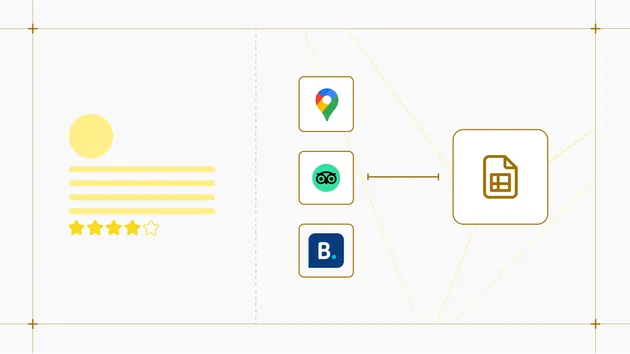
Watch your Google Business locations and get told only when the reputation actually moves — new reviews, how many stars each one was, and whether the average shifted.
Pricing
Pay per usage
Rating
0.0
(0)
Developer

Hussein Al-Mansori
Maintained by CommunityActor stats
0
Bookmarked
2
Total users
1
Monthly active users
18 days ago
Last modified
Categories
Share
Know the moment a bad review lands on any of your locations. Free.
Name your Google Business locations, run it on a schedule, and it publishes a row only when the reputation actually moved — reviews arrived, how many stars each one was, or the average shifted. Nothing happened means nothing in your dataset.
What makes this different from a review scraper
Every other review Actor on the Store hands you the corpus: five thousand reviews to analyse. That is a different job. This one tells you what changed since the last time it looked, which is the thing you act on the same day.
And it does it without reading a single review's text. A Google listing publishes its star breakdown — how many reviews sit at each rating — so subtracting last check's breakdown from this one says how many reviews arrived and at what star rating. One page read, and the row can say "two new reviews, one of them 1-star."
Who this is for
| You are | What you get |
|---|---|
| A multi-location business | One row the moment a 1-star lands, naming which branch |
| An agency managing reputations | Every client's locations in one dataset, only the rows that need answering |
| A franchise operator | Rating drift per site, before it shows up in the monthly report |
What you paste in
Google place IDs, or Maps links containing one — paste the link straight from Google Maps and the Actor lifts the ID out.
Run it on Apify's scheduler — hourly, daily, whatever suits.
Input
| Field | Type | Default | What it does |
|---|---|---|---|
placeIds | list | — | The locations to watch. Place IDs or Maps links. Required. |
onlyReportChanges | boolean | true | Publish a row only when something moved. Turn off to keep a full reputation history. |
stateStoreName | string | review-monitor-state | Where the baseline lives. Change it to run two independent watch lists. |
language | string | en | Which language to read the listing in. |
proxyConfiguration | object | off | Leave off unless Google starts refusing your runs. |
What you get back
negativeAdded is new 1- and 2-star reviews — the number to alert on. changeKinds
carries negative-review as its own value so you can filter a dataset down to the rows that need
answering today, without parsing anything.
Three stars is deliberately not counted as a complaint. It is what people leave when a place was fine, and alerting on it would make the alerts worth ignoring.
How honest a row is
status | Meaning |
|---|---|
verified | Read cleanly. Nothing was uncertain. |
warning | Delivered, but something was uncertain — the reason is on the row. |
failed | The location could not be read. No rating is published, and never a stale one. |
Four rules this Actor does not bend:
- A star breakdown that could not be read is never a star claim. Some listings do not publish one. You get the review count and a warning saying the ratings are unknown — never a guessed 1-star, which is the alert nobody forgives.
- A review being deleted is a deletion. Google removes reviews it judges fake and merchants
win appeals. That is reported as
reviews-removed, never folded into arrivals. - Someone editing their own review is not a new review. One star down and four stars up with the total unchanged is a re-rating, and it is reported as one.
- A page that yields nothing at all is a failure, not "no change". A monitor that silently stopped seeing the listing would report calm forever, which is the worst thing it could do.
Limits
| Limit | Value |
|---|---|
| Locations per run | 200 |
| Time per location | 45 seconds |
| Time per run | 1,800 seconds |
| Smallest rating move reported | 0.05 |
| Reviews in one check before the row is flagged | 50 |
All locations in a run share one browser, opened once and reused. That is what makes checking a long watch list on a schedule affordable.
What this deliberately does not do
- No review text. The star breakdown says how many arrived and at what rating; reading the words is a different and far more expensive job. If you need the text, use a review scraper on the locations this Actor flags.
- No replying to reviews, and no Google Business account access. Public listing data only.
- No discovery: it watches the locations you name.
- No email or SMS. Use Apify's integrations to route a run's dataset wherever you want it.
Pricing
Free. Only Apify's platform usage applies. Two events are defined — location-checked (every
read) and reviews-changed (a real move) — and neither is charged today.
They exist so that adding a price later would be a price change and not a redesign.
FAQ
How does it know what changed? It stores each location's rating, review count and star breakdown in a key-value store on your account, and compares the next check against it. Only those numbers — never review text.
What happens on the first run?
Every location is a baseline row: the starting point, not a change. You are never told a rating
moved on a location the Actor has not seen before.
Where do I find a place ID? You do not need one — paste the location's link from Google Maps and the Actor extracts it.
Why does a row sometimes say the ratings are unknown? Because that listing did not publish its star breakdown. The count is still honest; the stars would be a guess.
Can it tell me what the review said? No. It tells you one arrived and what it was rated. That is deliberate: it is the part that can be checked cheaply enough to run on a schedule.
Will it tell me twice about the same change? It can, in one case: if the row is published but the baseline cannot be saved. That is the deliberate trade — the alternative is losing the alert silently and forever.
Support
Open an issue on the Actor's Apify page. Include the run ID and the place ID.
Not affiliated with, endorsed by, or sponsored by Google.