
CVE Scraper: NVD Vulnerabilities, CVSS & CPE
Pricing
from $0.74 / 1,000 cve scrapeds
CVE Scraper: NVD Vulnerabilities, CVSS & CPE
Scrape the NIST National Vulnerability Database: CVE IDs, descriptions, CVSS v3 scores and vectors, CWE classification, affected CPE configurations and references. No login, no proxy, no browser.
Pricing
from $0.74 / 1,000 cve scrapeds
Rating
0.0
(0)
Developer

Arman Hossain
Maintained by CommunityActor stats
0
Bookmarked
1
Total users
0
Monthly active users
22 days ago
Last modified
Categories
Share
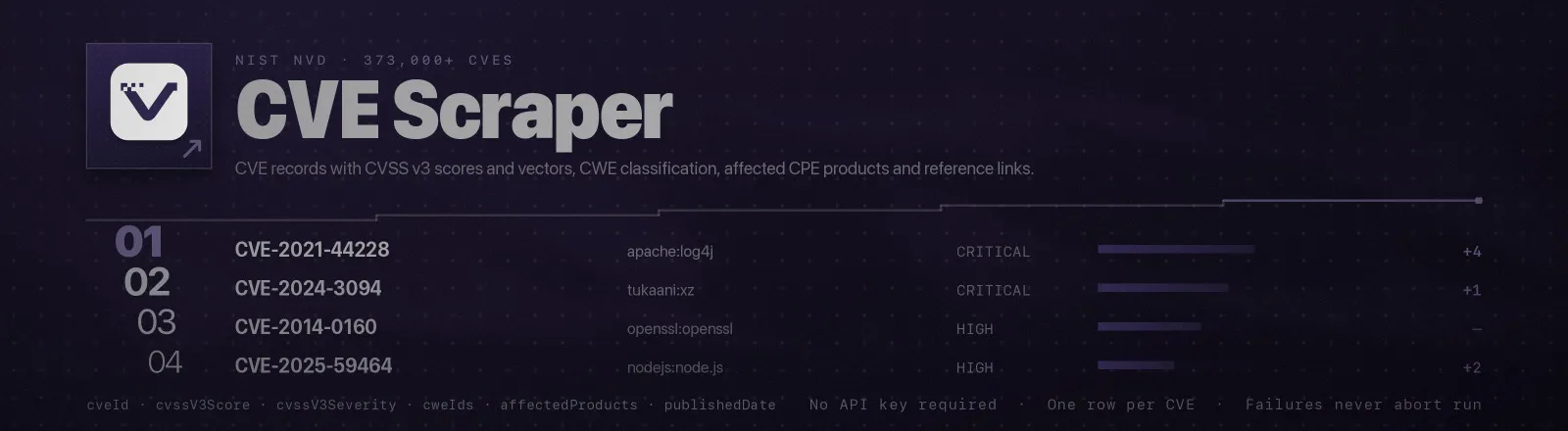
Scrape the NIST National Vulnerability Database: CVE IDs, descriptions, CVSS v3 scores and vectors, CWE classification, affected CPE configurations and references. Give it a keyword and it returns one structured record per CVE.
Agent skill: SKILL.md
What it does
The Actor covers the ~373,000 CVEs in NIST's National Vulnerability Database, and flattens each vulnerability into a single flat dataset row.
For every CVE it resolves:
- the English description and the current NVD analysis status,
- the CVSS v3 base score, severity and vector, preferring NIST's own "Primary" assessment over a vendor's secondary one, along with the exploitability and impact sub-scores,
- the CWE weakness classification,
- every affected CPE configuration, including version ranges, plus a de-duplicated
vendor:productsummary, - every reference URL with its NVD tags (
Patch,Exploit,Vendor Advisory, …).
Filters compose: a keyword, a CPE product, a published-date floor and a minimum CVSS score can all be applied at once. Date ranges longer than NVD's 120-day maximum are split into consecutive windows automatically and paged one after another.
Input
| Field | Type | Required | Default | Description |
|---|---|---|---|---|
keywordSearch | string | - | Keyword search across CVE descriptions. NVD requires all words to match, so microsoft outlook returns only CVEs mentioning both. | |
cveIds | array | [] | Specific CVE identifiers, e.g. CVE-2024-3094. When set, NVD is queried one ID at a time and keywordSearch / cpeName are ignored, the API does not accept them alongside a CVE ID. | |
cpeName | string | - | Return only CVEs affecting this CPE 2.3 product. Must be a complete, well-formed CPE 2.3 URI; NVD rejects partial ones. | |
minCvssScore | integer | 0 | Keep only CVEs with a CVSS v3 base score at or above this value (0-10). Applied locally, so CVEs with no CVSS v3 metric are dropped when this is above 0. | |
publishedFrom | string | - | Only CVEs published on or after this date (YYYY-MM-DD). Ranges longer than 120 days are split into windows automatically. | |
maxResults | integer | 100 | Cap the total CVEs saved across every query. 0 means no limit. | |
nvdApiKey | string | - | Optional free NVD API key. Raises the pace from 5 to 50 requests per 30 seconds. |
Example input
Which combinations make sense
keywordSearch+publishedFromis the workhorse: everything new about a technology you run.cpeName+minCvssScoreis the precise form, exact product, only serious findings. Prefer it to a keyword when you know the CPE, because keyword matching is textual and will catch unrelated mentions.cveIdsis a lookup, not a search. It ignores the other query filters (minCvssScorestill applies locally) and costs one request per ID, so a long list is slow without an API key.- Leaving everything empty is legal and walks the whole database from the oldest CVE forward, combine with
maxResultsor you will be there a while.
Output
One dataset item per CVE. A real record from the example input above, abridged:
cvssV3Score, cvssV3Severity, cvssV3Vector, exploitabilityScore and impactScore are null for CVEs that predate CVSS v3 or are still awaiting analysis.
RUN_SUMMARY
Written to the key-value store as RUN_SUMMARY:
A query unit is one independent piece of work: one CVE-ID lookup, or one 120-day date window, or the single unfiltered query. failures lists any unit that could not be fetched, with the startIndex it stopped at.
Use cases
1. Feed a vulnerability-management pipeline. Pull every serious CVE published since your last sync and hand the dataset to your ticketing system. Schedule it daily and move publishedFrom forward.
2. Alert on CVEs affecting your stack. Pin an exact product with a CPE and watch only that.
3. Security research and reporting. Look up a specific set of CVEs with full CVSS vectors, CWE classification and references for a write-up.
Limits and behaviour
- Rate limits. The public API allows 5 requests per 30 seconds; a free API key raises this to 50. The Actor sleeps 6.5 s between requests without a key and 0.8 s with one. This is baked in, you cannot outrun it, and a large unfiltered pull will take a while.
- 120-day date windows. NVD rejects any published-date range wider than 120 days, and rejects
pubStartDatewithoutpubEndDate. ApublishedFromfar in the past is therefore split into consecutive 120-day windows, each paged independently. - Page size. Requests use NVD's maximum of 2,000 results per page, so most queries finish in one or two requests.
minCvssScoreis applied locally. NVD's API filters by severity band, not by numeric score, so the Actor fetches full pages and drops what falls below your floor. The count that was dropped appears inRUN_SUMMARY.cvesBelowCvssThreshold.- Failures never abort the run. If one date window or CVE lookup fails after three retries. It is logged, recorded in
RUN_SUMMARY.failures, and the run continues with the next. The run only fails outright if every query unit failed. - Retries. 3 attempts with linear backoff. HTTP 403, 429 and 5xx are retried; a malformed query, which NVD reports as a 404 with the reason in a
messageheader, fails immediately rather than burning retries. - De-duplication. A CVE is never written twice, even if it matches several query units.
FAQ
Do I need a proxy? No. Proxy configuration is not required to run this Actor.
Do I need an account on the source? No. You supply no credentials.
What happens if a source is unavailable? It is reported in RUN_SUMMARY.failures and the run continues. Only a total failure of every query aborts the run.
Can I schedule it? Yes, it is designed for scheduled runs. Set publishedFrom to your last sync date and run it daily.
Why is cvssV3Score null on some records? Those CVEs predate CVSS v3 (roughly pre-2016) or are still awaiting NVD analysis. Their status field will say so. Set minCvssScore above 0 to exclude them.
Can I get CVSS v2 scores? Not currently, the Actor reports CVSS v3.1/v3.0 only, matching the fields most vulnerability tooling expects.


