

Semantic Scholar Scraper: Papers, Citations & Influence
Pricing
from $0.37 / 1,000 paper scrapeds
Semantic Scholar Scraper: Papers, Citations & Influence
Search 200M+ papers on Semantic Scholar and get clean metadata: abstracts, AI-written TLDR summaries, citation and influential-citation counts, open-access PDF links and DOI/arXiv/PubMed IDs. One capped, de-duplicated run.
Pricing
from $0.37 / 1,000 paper scrapeds
Rating
0.0
(0)
Developer

Arman Hossain
Maintained by CommunityActor stats
0
Bookmarked
1
Total users
0
Monthly active users
2 months ago
Last modified
Categories
Share
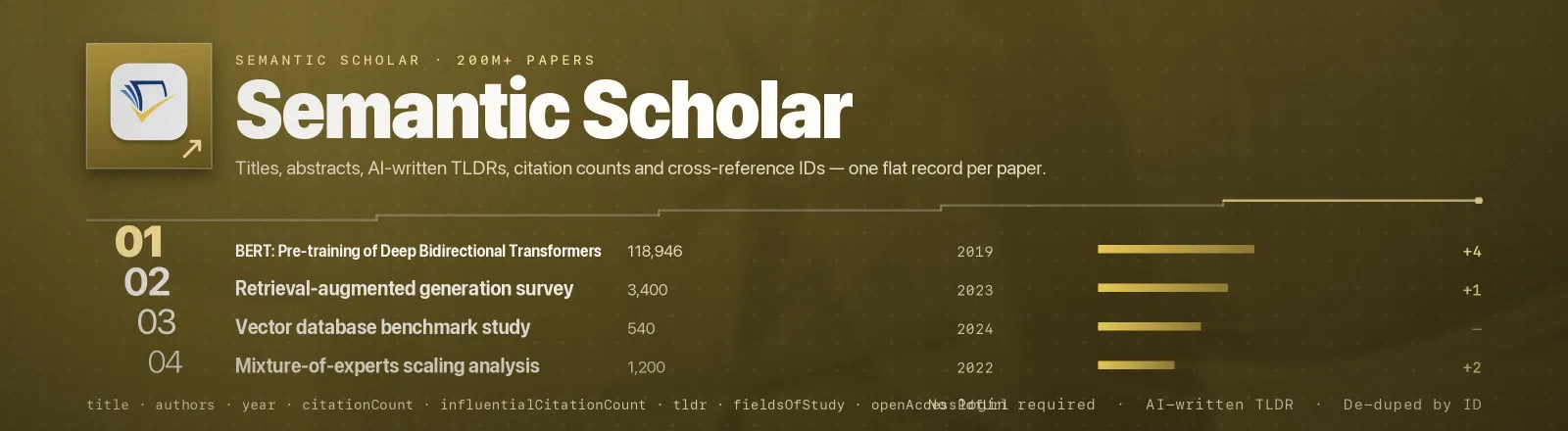
Semantic Scholar Scraper searches the Semantic Scholar corpus of 200M+ papers and returns one clean, flat record per paper, title, abstract, the AI-written TLDR, citation and influential-citation counts, fields of study, open-access PDF link and every cross-reference ID Semantic Scholar holds.
Semantic Scholar publishes this data for programmatic use, so the Actor needs nothing configured at your end: no browser, no proxy, no login. Paste a free API key into apiKey and a large run finishes sooner and more reliably; see Limits.
Agent skill: SKILL.md
What you get
| Output field | Meaning |
|---|---|
paperId, corpusId, url | Semantic Scholar's own identifiers and the paper's S2 page |
doi, arxivId, pubmedId, pubmedCentralId, dblpId | Cross-reference IDs, join straight onto Crossref, arXiv, PubMed or DBLP |
title, abstract | Title and full abstract |
tldr | One-sentence AI summary generated by Semantic Scholar's TLDR model |
year, publicationDate, venue | Publication year, exact date where known, and the venue or conference |
journalName, journalVolume, journalPages | Journal placement where the record has it |
authors, authorIds | Author names in order, plus their S2 author IDs |
citationCount, influentialCitationCount, referenceCount | How often it is cited, how often that citation was load-bearing, and how many works it cites |
fieldsOfStudy, publicationTypes | Subject classification and record type (JournalArticle, Conference, Review…) |
isOpenAccess, openAccessPdfUrl, openAccessStatus, openAccessLicense | Whether a free PDF exists, where, and under which licence |
citations | Papers citing this one, only when includeCitations is on |
scrapedAt | Run timestamp |
A RUN_SUMMARY record in the key-value store holds per-run counts, the filters used, and any query or paper ID that failed.
Common use cases
- Systematic reviews. Sweep a topic, filter by year and citation floor, and export straight to CSV.
- RAG and knowledge bases.
title+abstract+tldr+fieldsOfStudyis a ready-made chunk with metadata attached. - Bibliometrics. Track how
citationCountandinfluentialCitationCountmove for a paper set over months. - Full-text collection. Turn on
openAccessOnlyand you get a list of directly downloadable PDFs. - ID reconciliation. Feed in DOIs from another system and get back arXiv, PubMed and DBLP identifiers for the same works.
Quick start
One topic, the 100 most relevant papers:
Recent, well-cited, open-access work across three topics, 200 papers in total:
Enrich a list of DOIs you already have:
Input
| Field | Type | Default | Notes |
|---|---|---|---|
searchQueries | array | [] | Free-text searches, one per entry. No field syntax, no boolean operators, plain keywords, like the semanticscholar.org search box. Each query paginates independently. |
paperIds | array | [] | Specific papers. S2 hash, bare or prefixed DOI, arXiv:1706.03762, PMID:19872477, or a doi.org / arxiv.org / semanticscholar.org URL. |
fields | array | all seven | Optional fields per record: abstract, tldr, authors, openAccessPdf, fieldsOfStudy, publicationTypes, journal. Core metadata is always fetched. |
includeCitations | boolean | false | Add the list of citing papers to each record. Large payload, off by default. |
year | string | - | 2021, 2015-2020, 2020- or -2015. Search only. |
minCitationCount | integer | 0 | Drop search hits below this citation count. |
openAccessOnly | boolean | false | Keep only papers with a downloadable PDF. |
maxResults | integer | 100 | Papers saved by the whole run, searches and lookups together. Shared out between the requests, not given to each. Ceiling 999. |
apiKey | string | - | Free key from semanticscholar.org/product/api. Strongly recommended. |
At least one of searchQueries or paperIds is required, there is no meaningful "everything" mode. The two combine freely: papers you name are fetched first, the searches then share whatever is left of maxResults, and results are de-duplicated by paperId, so a paper found twice is saved (and charged) once.
Output example
A real record, fetched by DOI:
publicationDate is null for a good share of conference papers, Semantic Scholar only has year for them. tldr is present for most computer-science papers and thinner elsewhere, because the TLDR model was trained on that corpus.
Finding a paper ID
You rarely need one, searching is usually easier, but every form below works in paperIds:
| What you have | What to paste |
|---|---|
| A DOI | 10.18653/v1/N19-1423, or the same thing prefixed, DOI:10.18653/v1/N19-1423 |
| An arXiv paper | arXiv:1706.03762 or https://arxiv.org/abs/1706.03762 |
| A PubMed record | PMID:19872477 or the pubmed.ncbi.nlm.nih.gov URL |
| A Semantic Scholar page | The whole URL, or just the 40-character hash at the end |
The Actor strips URLs down to the identifier itself, so pasting links straight out of a browser is fine.
API example
Limits and behaviour
maxResultsbounds the run, not the query. It is the total number of papers the run may save, so it is also the most you can be charged for. The remaining allowance is divided among the requests still to come, so a query that returns little leaves more for the ones behind it. Requests the cap leaves no room for are never issued, and are listed inRUN_SUMMARY.requestsSkippedrather than dropped quietly. A value outside 1-999 is refused before the first request, never read as "no limit".- Relevance search reaches 999 papers per query and no further. That is why 999 is also the ceiling for
maxResults. To go deeper, split the topic into narrower queries or slice it byyear. - Throttling is the constraint when you run without a key. Semantic Scholar limits how fast it will answer, and at a busy moment that can mean a long wait or no answer at all. The Actor paces itself, retries with a growing gap, and gives up on a bounded budget rather than retrying forever. A request that never gets through is named in
RUN_SUMMARY.failureswith the reason and with however many papers it had already saved, andrequestsThrottledcounts them; a thin run therefore always says why it is thin. A free key removes most of this, get one before running anything large. - Retries distinguish fatal from transient. A malformed request and an unknown paper fail immediately, because retrying cannot help. Throttling and server errors back off, honouring a wait hint when one is given.
- A failing query never aborts the run. It is logged and recorded in
RUN_SUMMARY.failures; the remaining queries continue. The run only errors out if every request fails. - Only requested fields are fetched. The Actor asks for exactly the fields it maps, which keeps responses small; an unrecognised entry in
fieldsis warned about and dropped rather than sent. - Public data only. No credentials beyond the optional key, no personal data, no access-control bypass.
FAQ
Do I need a proxy? No. Proxy configuration is not required to run this Actor.
Do I need a Semantic Scholar account? Not to run it. The free API key is optional, and worth having for large runs: without one a busy moment can leave a query in RUN_SUMMARY.failures.
What happens if a query fails? It is named in RUN_SUMMARY.failures, with the reason and the number of papers it had already saved, and the run continues with the rest. A search that simply matched nothing is listed separately under queriesWithNoMatches, so an empty result is never mistaken for a lost one. The run only errors out when every request failed.
Can I schedule it? Yes. Citation counts move constantly, so re-running a fixed paperIds list on a schedule and diffing citationCount is a common pattern.
What is an "influential" citation? Semantic Scholar's own classifier flags citations where the cited work shapes the citing paper, rather than appearing once in a related-work list. It is usually 5-20% of the total.
Does it fetch full text? No, metadata plus the abstract. openAccessPdfUrl is the direct link when a free PDF exists.
Why is tldr empty for my papers? The TLDR model covers computer science best and thins out in other fields. Nothing is inferred when the API has no TLDR.
Can I integrate it with something else? Yes, Apify API, client libraries, webhooks, scheduled runs, dataset exports (JSON/CSV/Excel) or MCP. Output is structured JSON.


