

UN Comtrade Scraper: Global Trade Flows by Commodity
Pricing
from $0.37 / 1,000 flow scrapeds
UN Comtrade Scraper: Global Trade Flows by Commodity
Scrape UN Comtrade for international trade statistics: imports and exports by reporter, partner, HS commodity code, value and quantity. No login, no proxy, no browser.
Pricing
from $0.37 / 1,000 flow scrapeds
Rating
0.0
(0)
Developer

Arman Hossain
Maintained by CommunityActor stats
0
Bookmarked
2
Total users
1
Monthly active users
2 months ago
Last modified
Categories
Share
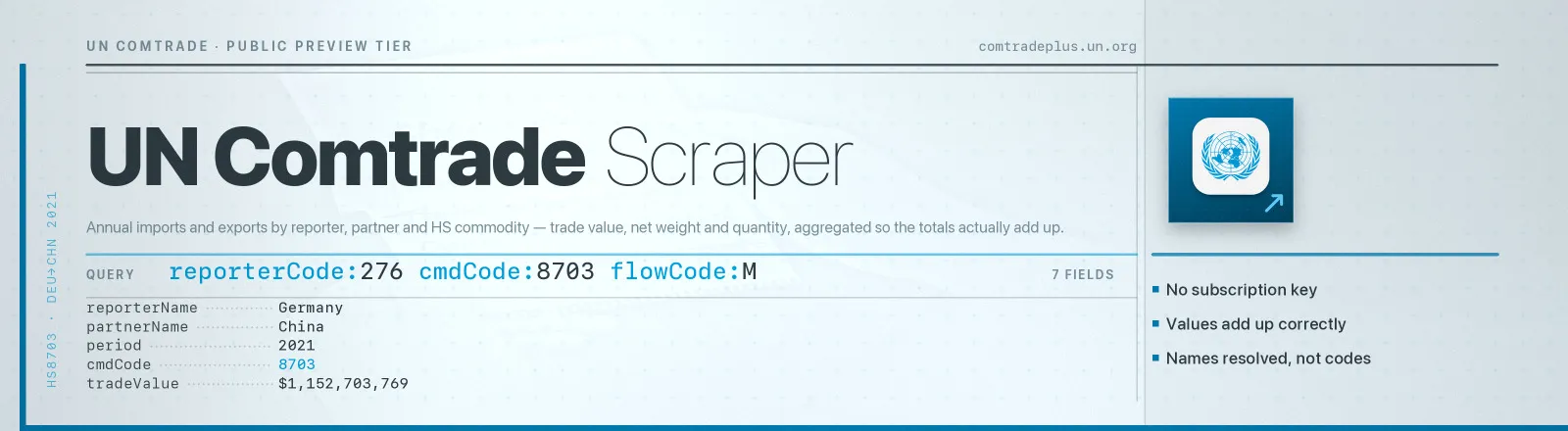
UN Comtrade Scraper pulls annual international trade statistics from UN Comtrade, who imports and exports what, from whom, in which HS commodity category, with trade value, net weight and quantity.
Comtrade is the authoritative record of merchandise trade, compiled from what governments themselves report. This Actor reads its public preview endpoint directly: no browser, no proxies, no login, no subscription key.
On authentication. UN Comtrade's full API (
/data/v1/get/.) requires a paid subscription key. This Actor is built entirely against the free public preview tier (/public/v1/preview/C/A/HS), which is open, verified by direct probe with no credentials. The preview tier returns at most 500 rows per request; see Limits and behaviour for how that is worked around and when it bites.
Agent skill: SKILL.md
What you get
| Output field | Meaning |
|---|---|
reporterCode, reporterName | The country doing the reporting (UN M49 code plus resolved name) |
partnerCode, partnerName | The trading partner; code 0 is Comtrade's "World" aggregate |
period | Calendar year |
flowCode | M = imports, X = exports |
cmdCode, cmdDesc | HS commodity code plus its resolved description |
tradeValue | Reported trade value in USD |
netWeight | Net weight in kg, where reported |
qty, qtyUnit | Quantity and its unit (u items, kg, l, m², …) |
scrapedAt | Run timestamp |
A RUN_SUMMARY record in the key-value store holds per-run counts, the filters used, any request that failed, and how many requests hit the 500-row ceiling.
Common use cases
- Map supply-chain dependencies. Pull one HS code across every reporter and see which countries actually supply it.
- Track tariff and sanction impact. Compare the same reporter/partner/commodity across years either side of a policy change.
- Size an export market. Total imports of your product category by country, straight from customs data.
- Trade-balance analysis. Request
flow: "M,X"and both directions arrive in one pass. - Commodity concentration risk.
AG2expands to all 97 two-digit headings, giving a full profile of a country's trade in one request.
Quick start
One country's total trade with the world:
Full commodity profile, all 97 HS chapters:
Bilateral flows for a specific product:
Input
| Field | Type | Default | Notes |
|---|---|---|---|
reporters | array | - | Required. UN M49 numeric country codes. A label like 842 - USA is accepted; the code is extracted. |
partners | array | ["0"] | Partner country codes. Empty means partner 0, the World aggregate, which is what you want for a country's total trade. |
commodityCodes | array | ["TOTAL"] | TOTAL, AG2/AG4/AG6 for every 2-/4-/6-digit heading, or specific codes like 8703. |
years | array | (current year − 2) | Calendar years. One request per year, the preview tier accepts only one period per call. |
flow | string | M | M imports, X exports, M,X both. |
maxResults | integer | 5000 | Total cap on saved flows. 0 = no limit. |
Country codes
Comtrade uses UN M49 numeric codes, not ISO letters.
| Country | Code | Country | Code | |
|---|---|---|---|---|
| World (aggregate) | 0 | Germany | 276 | |
| USA | 842 | United Kingdom | 826 | |
| China | 156 | Japan | 392 | |
| India | 699 | France | 251 |
The full list is the public Reporters and partnerAreas reference tables, which this Actor also uses to resolve names.
Output example
API example
JavaScript example
Limits and behaviour
- Rows are the aggregate flow, not a breakdown, and that matters. Left alone, the endpoint returns one row per customs procedure × mode of transport × second partner. For German car imports from China in 2021 that is 131 rows summing to $9.2 bn against a true total of $1.15 bn, an 8× overcount for anyone adding up
tradeValue. This Actor always requests the "all procedures, all modes, all origins" aggregate, so one row is one flow and the values add up correctly. - Names are resolved, not returned. The preview tier answers
nullforreporterDesc,partnerDesc,cmdDescandqtyUnitAbbron every single row. This Actor loads the publicReporters,partnerAreasandHSreference tables once per run and fills those names in. If a reference table is unavailable the run continues withnullnames rather than failing. - One year per request. The preview tier rejects multiple periods outright (
"Maximum number of periods for preview is 1"), so work is chunked by year, and by groups of 20 commodity codes, which keeps most requests under the row ceiling. - 500 rows per request is a hard ceiling. A request that comes back with exactly 500 rows was truncated; the Actor logs a warning naming the request and counts it in
RUN_SUMMARY.requestsTruncated. Split by fewer commodity codes or fewer partners to get the rest. - It is slow, by design of the source. The endpoint spends 3-6 s in its query planner before answering. Requests allow 120 s, a 1.5 s pause sits between them, and 429/5xx are retried with exponential backoff, the endpoint throttles with "try again in 2 seconds" under even light load.
- Failures never abort the run. A rejected request is recorded in
RUN_SUMMARY.failuresand the rest continue. The Actor only throws if every request fails, which is what happens if the reporter code itself is invalid, and the API's own explanation is passed through in the error. - Public data only. No authentication, no personal data, no access-control bypass.
FAQ
Do I need a proxy? No. Proxy configuration is not required to run this Actor.
Do I need a Comtrade subscription key? Not for this Actor. The full /data/v1/get/ API does require one; the preview tier this Actor uses does not. The trade-off is the 500-row-per-request ceiling.
Why is the data two years old? Comtrade publishes annual statistics once member states report and the UN validates them, which typically lags 18-24 months. If you leave years empty the Actor defaults to current year − 2 for exactly that reason.
Why is qtyUnit null? Because the reporter did not record a quantity for that flow, the underlying qtyUnitCode is -1. tradeValue is still present and valid.
Why did I get 500 rows exactly? That is the preview ceiling, not the real answer. Check RUN_SUMMARY.requestsTruncated and narrow the query.
What does partner code 0 mean? "World", the sum of all partners. It is the default, and it is what you want for a country's total imports or exports.
What happens if Comtrade is unavailable? The request is retried with backoff, then recorded in RUN_SUMMARY.failures; the run continues with the remaining requests.
Can I schedule it? Yes, it is designed for scheduled runs, though the source updates annually rather than daily.
Can I integrate it with something else? Yes, Apify API, client libraries, webhooks, scheduled runs, dataset exports (JSON/CSV/Excel) or MCP. Output is structured JSON.


