

LinkedIn Jobs Market Intelligence Scraper
Pricing
from $2.80 / 1,000 job results
LinkedIn Jobs Market Intelligence Scraper
Track public LinkedIn job postings to find hiring companies, market demand, job leads, locations, apply URLs, and structured recruiting data.
Pricing
from $2.80 / 1,000 job results
Rating
5.0
(2)
Developer

BOUKAPP
Maintained by CommunityActor stats
0
Bookmarked
8
Total users
3
Monthly active users
23 days ago
Last modified
Categories
Share
What does LinkedIn Jobs Market Intelligence Scraper do?
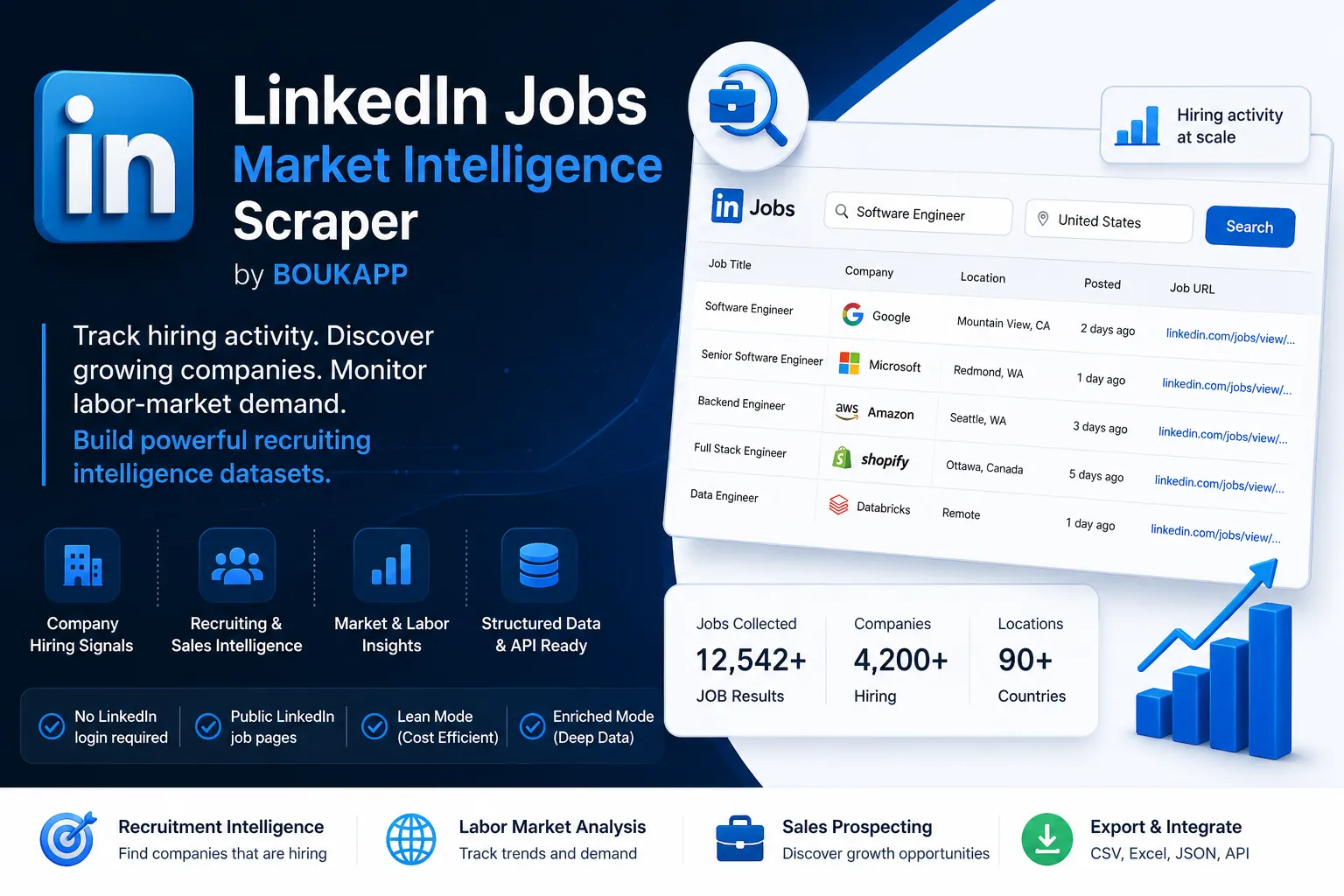
LinkedIn Jobs Market Intelligence Scraper by BOUKAPP helps recruiters, sales teams, and market researchers track hiring activity at scale, discover growing companies, monitor labor-market demand, and generate actionable business intelligence from public LinkedIn job postings. It extracts listings from LinkedIn Jobs and turns them into one structured dataset item per job, including hiring companies, roles, locations, posting dates, application links, and recruiting signals.
Use it to understand which companies are hiring, what roles they need, where they are expanding, and how hiring demand changes over time. Recruiters can monitor talent demand, sales teams can discover companies with active growth signals, analysts can track labor-market trends, and agencies can build focused prospecting or research datasets without manually copying LinkedIn search results.
On Apify, this Actor can be run manually, scheduled, connected to APIs and integrations, monitored in the Console, and combined with proxy rotation for public web data collection. BOUKAPP builds web scrapers, automation tools, and SaaS products for recruitment, lead generation, and business intelligence.
Ideal for
- Recruitment intelligence
- Hiring signal monitoring
- Sales prospecting
- Competitor tracking
- Labor market analysis
- Job board enrichment
Preview
Common Use Cases
Recruiters
Track demand for specific roles, locations, seniority levels, and industries. Use job postings as a signal for where talent demand is rising and which companies may need recruiting support.
Sales teams
Find companies that are actively hiring and may be expanding teams, opening new locations, adopting new tools, or increasing operational capacity. Turn hiring activity into account lists and outreach triggers.
Market intelligence
Monitor job volume, role mix, location trends, hiring velocity, and competitor activity. Build repeatable datasets for labor market reports, dashboards, and strategic research.
Startups and agencies
Validate market demand, identify growing accounts, enrich internal lead databases, and support client research with structured public hiring signals.
Job boards
Collect public job posting data for research, indexing, deduplication, and market coverage analysis. Optional enrichment can provide fuller descriptions and application links when available.
Why This Actor?
- Market intelligence focused: highlights hiring signals, company activity, and trend analysis.
- Built for hiring intelligence and business research, not only job extraction.
- One row per JOB Result: each saved job is a separate dataset item.
- Structured recruiting dataset: consistent fields for jobs, companies, locations, criteria, and application data.
- Company hiring signals: identify organizations currently posting roles.
- Flexible filters: search by title, location, date range, company names, company IDs, work type, job type, and experience level.
- Optional enrichment: request deeper public job details only when your workflow needs them.
- No LinkedIn login or cookies required: the Actor works with public LinkedIn job pages.
- API-ready output: download results or connect them to CRMs, spreadsheets, databases, BI tools, and automations.
Lean Mode (Recommended)
Lean Mode is the default and cheapest way to run the Actor. It collects the core job and company data while reducing runtime, extra public page requests, proxy traffic, and Platform Usage costs.
Recommended Lean Mode settings:
Use Lean Mode when you mainly need job IDs, titles, companies, locations, posting age, job URLs, company URLs, and other fields available from the search results. This is the best starting point for lead generation, hiring activity monitoring, competitor tracking, and cost-controlled market scans.
Enriched Mode
Enable enrichment options when you need deeper public job data such as full descriptions, formatted HTML descriptions, richer apply data, poster details, or numeric company IDs. These fields are useful for job board workflows, AI summarization, detailed recruiting research, and company matching.
Enriched Mode options may require extra public page requests. They can increase runtime, proxy traffic, retries, and Platform Usage costs. Some enriched fields may still be empty when LinkedIn does not expose them publicly for a specific job.
How to use LinkedIn Jobs Market Intelligence Scraper
- Open the Actor on Apify.
- In the Input tab, enter a job title, location, optional LinkedIn geo ID, company names, company IDs, and the number of rows you want.
- Choose optional filters such as posting date, remote or on-site work type, job type, and experience level.
- Keep Lean Mode enabled unless you specifically need enriched fields.
- Start with 10 to 50 rows to validate the result quality and expected cost behavior.
- Run the Actor and wait for the dataset to populate.
- Download results as JSON, CSV, Excel, or connect the Actor to your workflow using Apify integrations or API access.
Input
The Input tab accepts search, filtering, enrichment, and proxy settings. A recommended Lean Mode input looks like this:
title is used as the LinkedIn jobs keyword search. location and geoId control geography, with geoId useful for precise LinkedIn location targeting. companyName and companyId limit the final dataset to selected companies. jobIds enables exact-job mode: the Actor bypasses search pagination and fetches up to 200 unique public LinkedIn job IDs directly. Leave publishedAt empty for any time, or set it to past 24 hours, past week, or past month. rows controls how many final records are saved in search mode.
Keep includeJobDetails, includeDescriptionHtml, includePosterDetails, and includeCompanyNumericId disabled for Lean Mode runs. Enable them only when the additional public data is important enough to justify potentially higher Platform Usage.
Output
Each saved job is pushed to the default Apify dataset. Missing values are stored as empty strings, which makes the output easier to process in spreadsheets, CRMs, enrichment systems, and BI tools. You can download the dataset in various formats such as JSON, HTML, CSV, or Excel.
Data table
| Field | Description |
|---|---|
id | LinkedIn job ID parsed from the job URL. |
publishedAt | Detected posting date or fallback date. |
title | Job title. |
jobUrl | Public LinkedIn job detail URL. |
companyName | Hiring company name. |
companyUrl | Public LinkedIn company URL when available. |
companyId | Numeric LinkedIn company ID when publicly detected. |
companySlug | Public LinkedIn company slug. |
location | Job location text. |
postedTime | LinkedIn posting age text. |
applicationsCount | Visible applicant count text when available. |
description | Plain text job description when available. |
descriptionHtml | Formatted job description HTML when enabled and available. |
contractType | Employment type from LinkedIn job criteria when available. |
experienceLevel | Seniority or experience level when available. |
workType | Job function or workplace-related criteria from LinkedIn. |
sector | Industry or sector text when available. |
applyType | External apply or LinkedIn apply classification when available. |
applyUrl | Best detected application URL when available. |
companyLogo | Company logo image URL when available. |
posterProfileUrl | Public poster profile URL when available and enabled. |
posterFullName | Poster name when available and enabled. |
What Makes This Different?
Unlike generic job scrapers that only collect listings, this Actor is designed for hiring intelligence and market research.
Use it to:
- Track company hiring activity.
- Discover expansion signals.
- Monitor labor-market trends.
- Build recruiting datasets.
- Generate prospecting opportunities from hiring activity.
Each result is normalized and structured for analytics, automation, dashboards, and downstream processing.
Pricing Examples
This Actor uses Pay Per Event + Usage monetization. The primary paid event is the default dataset item event, renamed as JOB Result. One saved job equals one JOB Result, and JOB Result events are charged per dataset item.
Approximate Standard Pricing:
| Saved jobs | Actor event cost |
|---|---|
| 100 jobs | about $0.33 + Platform Usage |
| 1,000 jobs | about $3.30 + Platform Usage |
| 6,000 jobs | about $19.80 + Platform Usage |
| 10,000 jobs | about $33.00 + Platform Usage |
Discounted event pricing may apply by plan:
| Plan tier | Price per 1,000 JOB Result events |
|---|---|
| Starter / Bronze | from $3.20 |
| Scale / Silver | from $3.00 |
| Business / Gold | from $2.80 |
Platform Usage is variable and charged separately because this Actor uses Pay Per Event + Usage. Usage depends on runtime, proxy traffic, retries, result volume, and Enriched Mode options.
Pricing / Cost estimation
How much does it cost to collect public LinkedIn job postings? Cost has two parts:
- JOB Result events: one saved job equals one JOB Result, charged per dataset item.
- Platform Usage: compute, proxy traffic, retries, and other platform resources charged separately by Apify.
The Standard Pricing event price is $3.30 per 1,000 JOB Result events. Starter, Scale, and Business tiers may reduce the event price as shown above. Platform Usage is not fixed because broad searches, slow responses, retries, Residential proxy traffic, and Enriched Mode can all increase resource consumption.
To avoid expensive configurations, test with 10 to 50 rows before scaling. Focused filters are usually more cost-effective than very broad searches. For production monitoring, schedule smaller recurring runs with specific titles, locations, companies, or date ranges instead of one large unrestricted search.
The fastest and most cost-efficient setup is usually Lean Mode with only the enrichment fields you truly need.
Tips or Advanced options
Use exact job titles for cleaner recruiting datasets and broader keywords for market research. Add company names or numeric company IDs when you want competitor tracking or account-based prospecting. Use publishedAt set to the past 24 hours for fresh hiring alerts, and use past week or past month for broader trend analysis.
Disable Enriched Mode options when speed and cost control matter. Enable includeDescriptionHtml only when formatted descriptions are important for downstream parsing, AI summaries, or job board workflows. Inspect a small sample before scaling so you can confirm that filters, locations, and output fields match your use case.
FAQ, disclaimers, and support
Is this Actor affiliated with LinkedIn? No. This is an independent BOUKAPP Actor and is not affiliated with, endorsed by, or sponsored by LinkedIn.
Is it legal to scrape LinkedIn Jobs? Scraping public web data may be permitted in some contexts, but you are responsible for making sure your use case follows applicable laws, LinkedIn's terms, privacy rights, and data protection rules. Do not collect, store, or process personal or sensitive data unless you have a lawful basis.
Why are some fields empty? Public LinkedIn pages do not always expose salary, benefits, poster details, numeric company IDs, descriptions, criteria, or external apply URLs. The Actor keeps the output structure stable and stores unavailable fields as empty strings.
Does this Actor use LinkedIn login, cookies, or private data? No. It is designed for public LinkedIn job pages and does not provide access to private LinkedIn data, verified emails, phone numbers, or account-only information.
Can results vary between runs? Yes. Public websites can change their pages, availability, rate limits, and displayed fields. Use small tests, focused filters, and scheduled monitoring to validate the output for your workflow.
Need higher-volume monitoring, custom workflows, private deployments, CRM enrichment, or tailored scraping solutions? Contact BOUKAPP through the Issues tab or via boukapp.net.


