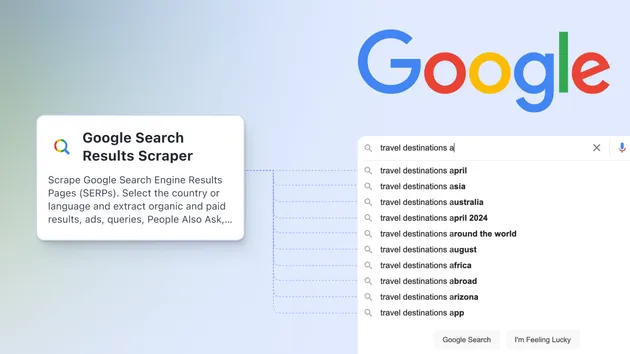
Google Search Scraper
Pricing
from $4.99 / 1,000 results
Google Search Scraper
A robust, high-performance utility designed for developer automation, data integration, and AI training. Features built-in captcha bypass, headful/headless browser execution, and proxy support to scrape Google data seamlessly, reliably, and at scale.
Pricing
from $4.99 / 1,000 results
Rating
0.0
(0)
Developer

Coding Frontned
Maintained by CommunityActor stats
0
Bookmarked
28
Total users
4
Monthly active users
11 days ago
Last modified
Categories
Share
Fetch bounded, localized Google web-search HTML and publish source-backed organic results only. People Also Ask questions, related searches, featured text, and estimated totals are retained as page evidence in the OUTPUT and OUTPUT_SUMMARY records rather than mixed into the result dataset.
Behavior
- Returns at most 100 unique organic results across at most 10 result pages.
- Preserves the original
query,maxItems, localization, time-filter,nfpr,filter, timeout, retry, and proxy inputs, including the legacytime_period,time_period_min, andtime_period_maxaliases. - Uses Apify's
GOOGLE_SERPproxy group by default. Direct mode is useful for local QA, while standard/custom proxy settings remain accepted. - Resolves Google's protected result redirects with bounded, redirect-only probes; destination pages are never scraped.
- Publishes normal rows atomically only after all requested pages are source-backed and valid. A challenge, consent page, oversized response, malformed source, or failed page produces no normal rows.
- Treats Google's explicit no-results page as a successful valid-empty run.
- Normal rows include source type, host, HTTP status, content type, response size, retry/proxy metadata, SHA-256 source hash, extraction method, and stable IDs. Runtime/debug fields are removed before publication.
- Optional failure rows contain exactly
url,error,errorCode, andscrapedAt.
You can download the dataset in various formats such as JSON, HTML, CSV, or Excel.
Input
| Field | Type | Default | Notes |
|---|---|---|---|
query | string | required | 1–300 characters |
maxItems | integer | 10 | 1–100 |
gl | string | us | Two-letter country code |
hl | string | en | Language such as en or en-us |
lr | string | omitted | Result-language filter such as lang_en |
timePeriod | string | none | last_hour, last_day, last_week, last_month, last_year, or custom |
timePeriodMin / timePeriodMax | string | omitted | MM/DD/YYYY, required together for custom |
time_period, time_period_min, time_period_max | aliases | omitted | Backward-compatible snake-case aliases |
nfpr / filter | integer | omitted | Google values 0 or 1 |
requestTimeoutSecs | integer | 45 | 5–120 seconds per page |
maxRequestRetries | integer | 1 | 0–2 retries after the first request |
requestDelayMs | integer | 0 | 0–5000 ms between successful pages |
maxResponseBytes | integer | 6000000 | 1024–12000000 byte response cap |
includeDiagnostics | boolean | true | Emit minimal diagnostics on failure |
proxySessionId | string | omitted | Optional stable proxy session |
proxyConfiguration | object | Google SERP proxy | Apify, custom, or direct settings |
fixtureJson / fixtureFile | string | omitted | Local QA only; fixture files must be under test/fixtures or .actor/fixtures |
Example:
Dataset and run metadata
Each normal row is an organic-result with recordId, position, title, url, domain, searchQuery, searchPage, localization fields, searchUrl, scrapedAt, fieldCoverage, and dataQuality. Optional source-backed fields such as displayedUrl, snippet, date, siteLinks, rating, and reviewCount are omitted when unavailable. Provenance fields identify the exact HTML source and request attempt.
OUTPUT and its identical OUTPUT_SUMMARY alias report status, counts, page-level SERP feature evidence, proxy mode, redirect-resolution count, request attempts, failures, and elapsed time. A failed run is fail-closed: diagnostics may be present, but guessed or partial normal rows are not.
Local verification
The local fixture covers pagination, canonical URL deduplication, and SERP feature capture. qa-inputs/cloud-validation.json exercises bounded direct live access; Google may return a challenge, which is recorded truthfully as a diagnostic rather than bypassed.