
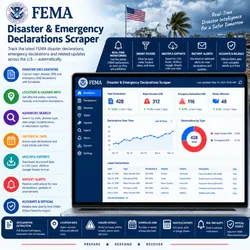
FEMA Disaster & Emergency Declarations Scraper
Pricing
from $2.00 / 1,000 scraped results
FEMA Disaster & Emergency Declarations Scraper
Scrapes recent FEMA disaster declarations with optional state and incident-type filters. Returns disaster notice, type, location, date, FEMA link, and scrape timestamp.
Pricing
from $2.00 / 1,000 scraped results
Rating
0.0
(0)
Developer

Data Pilot
Maintained by CommunityActor stats
0
Bookmarked
2
Total users
1
Monthly active users
a day ago
Last modified
Categories
Share
🚨 FEMA Disaster & Emergency Declarations Scraper is a powerful Apify Actor designed to discover, track, and collect official FEMA Disaster & Emergency Declarations directly from FEMA's OpenFEMA API. This tool provides comprehensive FEMA Disaster & Emergency Declarations intelligence including declaration title, incident type, affected location, declaration date, and direct listing link for any state or incident type. Whether you're building an emergency-response dashboard, tracking disaster trends, or conducting risk research, the FEMA Disaster & Emergency Declarations Scraper delivers actionable FEMA Disaster & Emergency Declarations insights efficiently.
With direct OpenFEMA API integration, OData filtering, automatic historical fallback, and reliable Apify Dataset delivery, the FEMA Disaster & Emergency Declarations Scraper ensures comprehensive FEMA Disaster & Emergency Declarations coverage across any state, incident type, or date window. It focuses on key FEMA Disaster & Emergency Declarations signals including type, location, and date, making it an essential tool for emergency management research and disaster-risk intelligence.
📋 Table of Contents
- Features
- Data Source
- How It Works
- Input
- Output
- Technical Stack
- Data Fields
- Use Cases
- Quick Start
- Configuration
- Performance
- Important Notes
- License & Legal
🔥 Features
- OpenFEMA API Integration – Direct integration with FEMA's official Disaster Declarations Summaries API for accurate FEMA Disaster & Emergency Declarations data.
- State-Level Filtering – Narrow FEMA Disaster & Emergency Declarations results to a specific U.S. state using standard state codes.
- Incident Type Filtering – Filter declarations by incident type (e.g., Fire, Hurricane, Severe Storm) with automatic title-case normalization.
- Configurable Date Window – Search declarations from any number of days back via
daysBack. - OData Query Building – Constructs proper OData
$filterexpressions combining date, state, and incident type conditions. - Automatic Historical Fallback – Falls back to the most recent matching declarations if no results are found within the requested date window.
- Paginated Fetching – Automatically pages through results using
$top/$skipuntilmaxResultsis reached. - Proxy Fallback Handling – Automatically retries without a proxy if a proxied request fails.
- Residential Proxy Support – Optional Apify residential proxy for reliable FEMA Disaster & Emergency Declarations access.
- Retry Logic with Backoff – Automatically retries failed requests with increasing delay between attempts.
- Incremental Dataset Push – Pushes each page's FEMA Disaster & Emergency Declarations records to Apify Dataset immediately.
- Detailed Logging – Comprehensive progress logging for every stage of the FEMA Disaster & Emergency Declarations run.
📊 Data Source
OpenFEMA Disaster Declarations Summaries API
- Authority: Official U.S. Federal Emergency Management Agency (FEMA) open data platform
- Endpoint:
fema.gov/api/open/v2/DisasterDeclarationsSummaries - Coverage: All U.S. states and territories with federally declared disasters and emergencies
- Data: Declaration title, incident type, location, declaration date, and disaster page link
- Access: Public, key-less JSON API
- Update Frequency: Reflects FEMA's current official declarations at time of run
⚙️ How It Works
The FEMA Disaster & Emergency Declarations Scraper accepts an optional state, incident type, and lookback window, then builds an OData filter expression combining all three conditions. It queries the OpenFEMA API in pages, ordered by most recent declaration date, normalizing each result into a clean record with title, incident type, location, date, and a direct link to the disaster's FEMA page. If no declarations are found within the requested date window, the Actor automatically falls back to fetching the most recent historical declarations matching the same state/type filters, so a run never returns empty due to an overly narrow date range. Every batch of FEMA Disaster & Emergency Declarations records is pushed to the Apify Dataset as it's collected.
Key Processing Steps:
- Input Parsing – Accept state, incident type, days-back window, and result cap
- Proxy Setup – Configure Apify residential proxy if enabled
- Filter Construction – Build an OData
$filterexpression from date, state, and incident type - Session Init – Create a Chrome-impersonated HTTP session for reliable API access
- Page Loop – Request successive pages of FEMA Disaster & Emergency Declarations using
$top/$skip - Record Normalization – Build a clean record with notice, type, location, date, and link
- Incremental Push – Push each page's records immediately as they're fetched
- Result Capping – Stop once
maxResultsis reached or no further items are returned - Historical Fallback – Re-query without a date filter if zero results were found initially
- Proxy Fallback – Retry without a proxy if the proxied request fails
- Rate Limiting – Apply a short delay between page requests
- Summary Logging – Report the total number of declarations collected
Key Benefits:
- Pull official FEMA Disaster & Emergency Declarations for any state or incident type without manual searching
- Never come back empty thanks to automatic historical fallback
- Track new federal disaster activity as it's declared
- Feed emergency-response dashboards, risk-assessment tools, or research pipelines
- Automate recurring FEMA Disaster & Emergency Declarations checks as new events are declared
📥 Input
The Actor accepts the following input parameters:
| Field | Type | Default | Description |
|---|---|---|---|
state | string | "" | Two-letter U.S. state code to filter FEMA Disaster & Emergency Declarations by (e.g., "CA", "TX"). |
incidentType | string | "" | Incident type to filter by (e.g., "Fire", "Hurricane", "Severe Storm"). |
daysBack | integer | 90 | Number of days back from today to search for declarations. |
maxResults | integer | 100 | Maximum number of FEMA Disaster & Emergency Declarations records to collect. |
proxyConfiguration | object | {"useApifyProxy": true} | Apify Proxy configuration. |
Example Input:
Search Nationwide for Recent Declarations:
Search a Specific State Only:
📤 Output
The Actor pushes FEMA Disaster & Emergency Declarations records with the following structure:
| Field | Type | Description |
|---|---|---|
notice | string | Official declaration title |
type | string | Incident type (e.g., Fire, Flood, Hurricane) |
location | string | Affected area and state |
date | string | Declaration date (YYYY-MM-DD) |
link | string | Direct URL to the FEMA Disaster & Emergency Declarations page |
scraped_at | string | ISO 8601 timestamp of when the record was scraped |
Example FEMA Disaster & Emergency Declarations Record:
🧰 Technical Stack
- API: OpenFEMA Disaster Declarations Summaries API (JSON, OData-filterable)
- HTTP Client:
curl_cffiwith Chrome TLS fingerprint impersonation for reliable FEMA Disaster & Emergency Declarations access - Query Language: OData
$filter,$orderby,$top,$skipfor filtering and pagination - Date Handling:
date/datetimewith timezone-aware UTC timestamps - Async:
asynciowith executor-run blocking requests for non-blocking page fetching - Proxy: Apify Proxy, optional via
useApifyProxy, with automatic no-proxy fallback on failure - Logging: Apify Actor logging system
- Platform: Apify Actor serverless environment
📊 Data Fields Explained
Identification
- notice / link: The official declaration title and direct link to the FEMA Disaster & Emergency Declarations page
Incident Details
- type: The category of disaster or emergency (e.g., Hurricane, Fire, Flood)
- location: The designated area and state affected
Timing
- date: The official declaration date
- scraped_at: When this FEMA Disaster & Emergency Declarations record was collected
🎯 Use Cases
- Emergency Management – Track active and historical FEMA Disaster & Emergency Declarations by state or type
- Risk Assessment – Analyze disaster frequency and type patterns for insurance or planning purposes
- Academic Research – Study disaster trends and federal response patterns at scale
- News & Media Monitoring – Source authoritative declaration data for disaster reporting
- Nonprofit & Relief Coordination – Identify newly declared disaster areas for aid deployment
- Policy Analysis – Monitor federal disaster response activity over time
- Real Estate & Insurance Research – Cross-reference property locations against declared disaster history
- Alert Systems – Build recurring state or incident-type alerts for new declarations
🚀 Quick Start
1. Prepare Input
Go to Apify Console and enter:
2. Run the Actor
Click Start. The Actor will:
- Build an OData filter from your state, type, and date window
- Query the OpenFEMA API and page through results
- Fall back to historical data automatically if nothing matches the date window
- Push each batch of FEMA Disaster & Emergency Declarations records to the Dataset
3. Monitor Progress
Console shows:
4. View & Download Results
- Results Tab: All FEMA Disaster & Emergency Declarations records
- Export: JSON, CSV, Excel, or HTML
- Filter: By state, incident type, or date
- API Access: Available via the Apify API
⚙️ Configuration
State and type filtered:
Nationwide, most recent:
No filters, broad historical pull:
📈 Performance
Processing Speed
- One request per page of up to 100 declarations, with automatic retry on failures
- 0.3 second delay between page requests to reduce blocking
- Automatic historical fallback adds one additional request only when needed
Resource Usage
- Memory: Low, since no browser instance is launched
- Network: One request per result page, plus a fallback request if applicable
- Proxy: Optional residential proxy tunnel with automatic no-proxy fallback on failure
⚠️ Important Notes
Legal & Compliance
- Fair Use: Respects the OpenFEMA public API and applies pacing delays between requests
- Public Data Only: Retrieves only publicly published FEMA Disaster & Emergency Declarations
- Legal: Not legal, emergency-management, or insurance advice — consult official FEMA resources and qualified professionals for decisions based on this data
Data Quality
- Freshness: Reflects OpenFEMA's published declarations at time of run
- Completeness: Very recent or narrow date windows may trigger the historical fallback if no declarations exist yet
- Accuracy: Sourced directly from FEMA's official OpenFEMA API
- Verification: Cross-check high-stakes figures against the official FEMA disaster page for each declaration
Best Practices
- Combine
stateandincidentTypefilters together for the most targeted FEMA Disaster & Emergency Declarations results - Increase
daysBackfor broader historical coverage, or keep it short for the freshest declarations - Watch the logs for the historical fallback notice, which indicates your date window returned no fresh matches
- Re-run periodically to catch newly issued declarations
- Always verify details directly on the official FEMA disaster page before using them for critical decisions
📄 License & Legal
Terms of Use:
- Use for legitimate research, emergency planning, and risk-assessment purposes
- Respect FEMA's OpenFEMA API terms of use
- Attribute FEMA/OpenFEMA as the original data source where required
- Use data responsibly
Disclaimer: FEMA Disaster & Emergency Declarations Scraper is provided as-is for research and informational purposes. Users are responsible for compliance with OpenFEMA's terms of use. This is not legal, emergency-management, or insurance advice — always verify critical details directly on FEMA's official website.
⚖️ FEMA Disaster & Emergency Declarations Excellence
This Actor is optimized for FEMA Disaster & Emergency Declarations research with:
- ✅ State and incident-type filtered search
- ✅ OData-powered date, state, and type filtering
- ✅ Automatic historical fallback for zero-result windows
- ✅ Incremental, real-time Dataset push
- ✅ Retry logic with proxy fallback
- ✅ Production-ready code


