
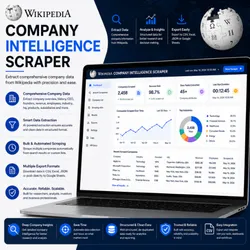
Wikipedia Company Intelligence Scraper
Pricing
from $2.00 / 1,000 scraped results
Wikipedia Company Intelligence Scraper
Extract company descriptions, founding date, headquarters, founders, employees, websites, and developer/parent information using Wikipedia data. Supports multiple companies, AI product mapping, and pay-per-event charging.
Pricing
from $2.00 / 1,000 scraped results
Rating
0.0
(0)
Developer

Data Pilot
Maintained by CommunityActor stats
0
Bookmarked
3
Total users
2
Monthly active users
2 months ago
Last modified
Categories
Share
📚 Wikipedia Company Intelligence Scraper is a powerful Apify Actor designed to discover, track, and collect public company profile data directly from Wikipedia's own API and infobox metadata. This tool provides comprehensive Wikipedia Company Intelligence including founding date, headquarters, founders, employee count, company description, and official website for any company or well-known product name. Whether you're building a company research dashboard, enriching a lead list, or conducting competitive intelligence, the Wikipedia Company Intelligence Scraper delivers actionable Wikipedia Company Intelligence efficiently.
With smart product-to-parent-company resolution, Wikipedia search disambiguation, infobox metadata extraction, and reliable Apify Dataset delivery, the Wikipedia Company Intelligence Scraper ensures comprehensive Wikipedia Company Intelligence coverage across any list of company or product names. It focuses on key Wikipedia Company Intelligence signals including founders, headquarters, and founding date, making it an essential tool for company background research.
📋 Table of Contents
- Features
- Data Source
- How It Works
- Input
- Output
- Technical Stack
- Data Fields
- Use Cases
- Quick Start
- Configuration
- Performance
- Important Notes
- License & Legal
🔥 Features
- Product-to-Parent Resolution – Recognizes well-known AI products (e.g., Claude, ChatGPT, Gemini) and automatically resolves them to their parent company for Wikipedia Company Intelligence.
- Smart Wikipedia Search – Searches Wikipedia with multiple query variations and filters out disambiguation pages and unrelated name pages.
- Infobox Metadata Extraction – Parses Wikipedia's structured infobox table for founding date, headquarters, founders, employee count, and website.
- Parent Company Fallback – If a product page lacks company details, automatically follows the "developer/owner/parent" link to pull data from the parent company's own page.
- Article Summary Extraction – Pulls a clean company description from Wikipedia's REST summary API.
- Text Cleaning – Strips Wikipedia footnote citations and formatting artifacts from every extracted field.
- Batch Processing – Look up any number of company or product names in a single run.
- Configurable Item Cap – Control how many Wikipedia Company Intelligence profiles are collected per run.
- Real-Time Dataset Push – Pushes all collected Wikipedia Company Intelligence records to Apify Dataset in a single batch.
- Graceful Error Handling – Skips a failing lookup without stopping the whole run.
📊 Data Source
Wikipedia Public API & Article Pages
- Authority: Wikipedia's own public MediaWiki search API, REST summary API, and rendered article pages
- Access Method: Direct HTTP requests via
urllib.request, withBeautifulSoupparsing infobox HTML - Coverage: Any company or product with a public Wikipedia article
- Data: Article summary text and structured infobox fields
- Access: Public API and pages, no API key required
- Update Frequency: Reflects each Wikipedia article's current live state at time of run
⚙️ How It Works
The Wikipedia Company Intelligence Scraper accepts a list of company or product names, first checking each against a built-in product-to-parent-company map (e.g., "Claude" → "Anthropic"). For each resolved name, it searches Wikipedia to find the best matching article, filtering out disambiguation and unrelated pages. It then fetches the article's summary description and parses the infobox table for founding date, headquarters, founders, employee count, and website. If the resolved page is a product page lacking company details (like founding date or HQ), the Actor follows the developer/owner/parent link on that infobox to pull the missing fields from the parent company's own Wikipedia page. Every successfully resolved Wikipedia Company Intelligence record is collected and pushed to the Apify Dataset in a single batch at the end of the run.
Key Processing Steps:
- Input Parsing – Accept a list of company or product names, plus a max item count
- Product Mapping Check – Resolve known AI products to their parent company name
- Company Loop – Iterate through each Wikipedia Company Intelligence target
- Wikipedia Search – Find the best matching, non-disambiguation article title
- Summary Fetch – Pull the article's clean description from the REST summary API
- Infobox Parsing – Extract founded date, HQ, founders, employees, and website from the infobox table
- Text Cleaning – Strip citation brackets and formatting artifacts from every field
- Parent Fallback – Follow the developer/owner/parent link if key fields are still missing
- Item Cap Enforcement – Stop collecting once the configured maximum item count is reached
- Dataset Push – Push all collected records from the run in a single batch
Key Benefits:
- Pull Wikipedia Company Intelligence for any company or product name without manual lookup
- Automatically resolve well-known AI products to their actual parent company
- Get clean, citation-free company descriptions and structured infobox facts
- Feed research pipelines, lead enrichment tools, or company background dashboards
- Batch-process long lists of companies or products in a single run
📥 Input
The Actor accepts the following input parameters:
| Field | Type | Default | Description |
|---|---|---|---|
company_names | array | ["Claude"] | List of company or product names to look up. |
search_query | string | "" | Optional single search term, used if company_names is empty. |
maxItems | integer | 10 | Maximum number of Wikipedia Company Intelligence profiles to collect. |
Example Input:
Look Up a Single Company:
Look Up a Known AI Product:
📤 Output
The Actor pushes Wikipedia Company Intelligence records with the following structure:
| Field | Type | Description |
|---|---|---|
company | string | Resolved company name, as titled on Wikipedia |
founded | string | Founding date, as listed in the Wikipedia infobox |
HQ | string | Headquarters location, as listed in the Wikipedia infobox |
funding_total | string | Reserved field; not populated from Wikipedia data (always "N/A") |
last_round | string | Reserved field; not populated from Wikipedia data (always "N/A") |
investors | array | Reserved field; not populated from Wikipedia data (always empty) |
founders | array | List of founder names, as listed in the Wikipedia infobox |
employees | string | Employee count, as listed in the Wikipedia infobox |
description | string | Clean company description from the Wikipedia article summary |
website | string | Official website URL, as listed in the Wikipedia infobox |
Example Wikipedia Company Intelligence Record:
🧰 Technical Stack
- HTTP Client:
urllib.requestfor direct requests to Wikipedia's public APIs and article pages - HTML Parsing:
BeautifulSoupfor infobox table extraction - Text Cleaning:
refor stripping citation brackets and formatting artifacts - JSON Handling:
jsonfor parsing Wikipedia API responses - Async:
asynciofor the Actor's run loop - Logging: Apify Actor logging system
- Platform: Apify Actor serverless environment
📊 Data Fields Explained
Identity
- company: The resolved, canonical company name as titled on Wikipedia
- description: A clean, citation-free summary pulled from the Wikipedia article
Company Details
- founded: The founding date as listed in the infobox
- HQ: The headquarters location as listed in the infobox
- founders: Up to five founder names as listed in the infobox
- employees: The employee count as listed in the infobox
- website: The official company website URL
Reserved Fields
- funding_total, last_round, investors: Included in the output schema for compatibility, but not populated — Wikipedia infoboxes do not reliably expose structured funding data
🎯 Use Cases
- Company Background Research – Quickly pull founding date, HQ, and founders for any company
- Lead Enrichment – Add basic firmographic context to a list of company names
- Product-to-Company Mapping – Resolve well-known AI products to their actual parent company
- Competitive Research – Compare founding dates, HQ locations, and team size across companies
- Academic Research – Study public company information at scale
- Content Research – Source clean, citation-free company descriptions for articles or reports
🚀 Quick Start
1. Prepare Input
Go to Apify Console and enter:
2. Run the Actor
Click Start. The Actor will:
- Resolve any known product names to their parent company
- Search Wikipedia for the best matching article
- Extract description and infobox fields, following the parent link if needed
- Push all results to the Dataset
3. Monitor Progress
Console shows:
4. View & Download Results
- Results Tab: All Wikipedia Company Intelligence records
- Export: JSON, CSV, Excel, or HTML
- Filter: By company name or headquarters
- API Access: Available via the Apify API
⚙️ Configuration
Single company lookup:
Batch lookup with item cap:
Single search query instead of a list:
📈 Performance
Processing Speed
- Two to three lightweight HTTP requests per company (search, summary, infobox, plus an optional parent-page fetch)
- No browser rendering required, so lookups are fast
- Sequential processing keeps requests polite to Wikipedia's servers
Resource Usage
- Memory: Low, since no browser instance is launched
- Network: Two to four requests per company, depending on parent-fallback needs
- Proxy: Not used — Wikipedia's public API does not require one
⚠️ Important Notes
Legal & Compliance
- Fair Use: Uses Wikipedia's public API and applies polite, low-volume request patterns
- Public Data Only: Retrieves only publicly available Wikipedia article and infobox data
- Attribution: Wikipedia content is available under Creative Commons licensing — attribute Wikipedia when republishing descriptions
- Legal: Not legal advice — consult qualified professionals before using this data for compliance-sensitive decisions
Data Quality
- Freshness: Reflects each Wikipedia article's current live state at time of run
- Completeness: Infobox fields vary by article; some companies may have incomplete data, and funding-related fields are never populated
- Accuracy: Sourced directly from Wikipedia, which is community-edited and may contain errors or be out of date
- Verification: Cross-check high-stakes figures against official company sources
Best Practices
- Use well-known company or product names for the most reliable article matches
- Expect
funding_total,last_round, andinvestorsto always return empty — this Actor does not source funding data - Re-run periodically if tracking infobox changes over time
- Batch multiple names together in one run to reduce overhead
- For funding, investor, or financial data, pair this Actor with a dedicated financial data source
📄 License & Legal
Terms of Use:
- Use for legitimate research, enrichment, and analytics purposes
- Respect Wikipedia's Terms of Use and content licensing (CC BY-SA)
- Attribute Wikipedia when republishing extracted descriptions
- Use Wikipedia Company Intelligence data responsibly and in compliance with applicable laws
Disclaimer: Wikipedia Company Intelligence Scraper is provided as-is for research and analytics purposes. Users are responsible for compliance with Wikipedia's terms and all applicable laws. This is not legal advice.
⚖️ Wikipedia Company Intelligence Excellence
This Actor is optimized for Wikipedia Company Intelligence research with:
- ✅ Smart product-to-parent-company resolution
- ✅ Disambiguation-aware Wikipedia search
- ✅ Structured infobox extraction with parent-page fallback
- ✅ Clean, citation-free descriptions
- ✅ Real-time Dataset push
- ✅ Production-ready code


