

Tigros Scraper
Pricing
from $1.70 / 1,000 products
Tigros Scraper
Scrape Tigros grocery products from search queries or category, search, and product URLs, with optional product details.
Pricing
from $1.70 / 1,000 products
Rating
0.0
(0)
Developer

Data Scrapers
Maintained by CommunityActor stats
0
Bookmarked
2
Total users
1
Monthly active users
13 days ago
Last modified
Categories
Features
Share
Tigros Scraper creates a structured dataset of grocery products collected from Tigros. Each dataset item is one product and can include the product id, name, brand, pack size, barcode, category, stock flag, image URL, and price fields when the page sends them. Product details are added only when that input is turned on. Query the source with a search phrase or a Tigros category URL, and limit results with maxItems. Retrieve records through the Apify Dataset API or export them as JSON, CSV, Excel, or XML.
Dataset at a glance
| Property | Value |
|---|---|
| Source | tigros.it |
| Record unit | One grocery product |
| Input methods | Search query or category URL |
| Main identifiers | productId, barcode, url |
| Delivery | Apify Dataset and API |
| Export formats | JSON, CSV, Excel, XML, RSS |
| Update model | Fresh records per Actor run |
| Pricing | $2.00 per 1,000 products on the free plan |
Coverage and available records
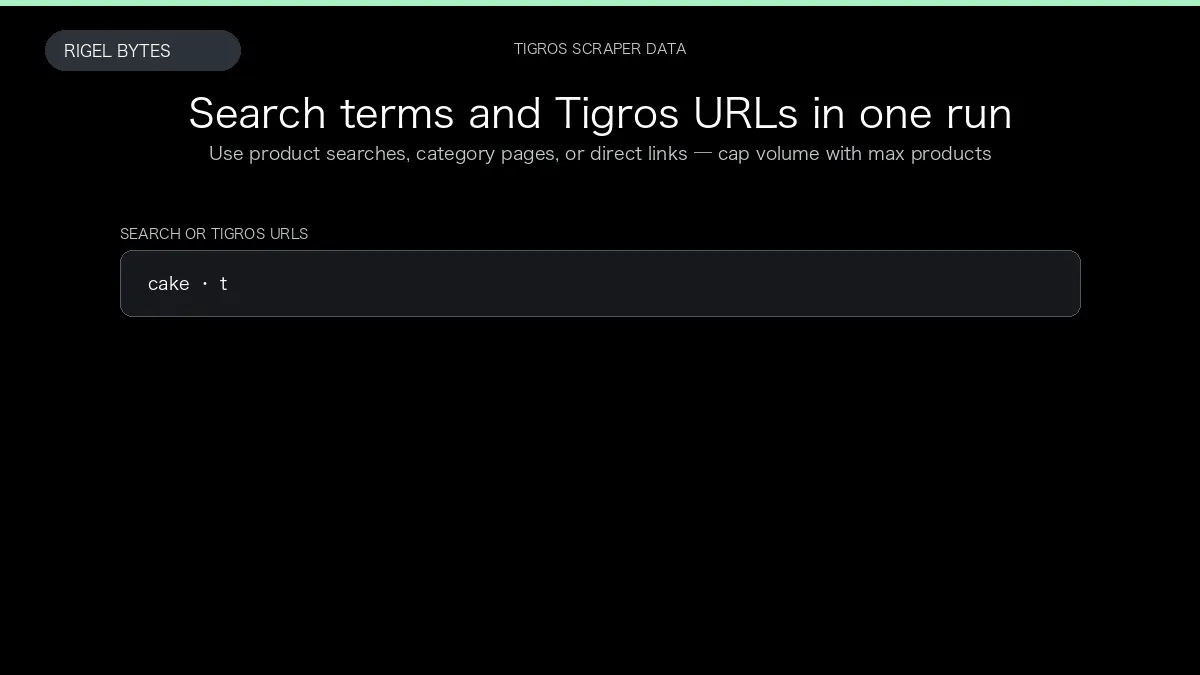
A run can use searchQueries, startUrls, or both. The search prefill is cake. The URL prefill includes a category page and a search URL. scrapeProductDetails defaults to false. maxItems at 0 means no cap. The prefill is 10.
Stored samples from the cake search include brand, pack size, barcode, category, and an in-stock flag. Price fields on those samples are null, so a listing row does not always include a shelf price. Currency on those rows is EUR. The Actor collects public catalog products. It does not collect baskets or accounts.
Data dictionary
| Field | Type | Nullable | Description | Example |
|---|---|---|---|---|
| productId | number | no | Tigros product id. Use this to deduplicate | 7359755 |
| name | string | yes | Product name | CAKE AND CHOC |
| brand | string | yes | Brand | MILKA |
| brandId | number | yes | Brand id | 328 |
| shortDescription | string | yes | Short label | MILKA |
| packSize | string | yes | Pack size | 175 g |
| barcode | string | yes | GTIN / barcode | 7622300784751 |
| slug | string | yes | URL slug | cake-and-choc-milka-gr175 |
| url | string | yes | Product URL | https://www.tigros.it/product/cake-and-choc-milka-gr175 |
| imageUrl | string | yes | Thumbnail | https://www.tigros.it/photo2/2021/12/17/10/main/thumb/pim-00000007622300784751-main-20211206-200240.jpg |
| price | number | yes | Shelf price when the source sends it | null |
| regularPrice | number | yes | Regular price | null |
| unitPrice | number | yes | Unit price | null |
| unit | string | yes | Unit label | null |
| weightUnit | string | yes | Weight unit | KG |
| currency | string | yes | Currency | EUR |
| inPromo | boolean | yes | Promo flag | false |
| inStock | boolean | yes | Stock flag | true |
| available | number | yes | Availability figure from the source | 100000000 |
| categoryId | number | yes | Category id | 1225115105 |
| categoryName | string | yes | Category name | PASTICCERIA SECCA |
Deduplicate on productId. barcode is a second stable key when it is present.
Example dataset record
This record came from the search query cake with product details left off. Price is null on this stored listing.
Query and input reference
| Input | Type | Required | Default | Accepted values | Description |
|---|---|---|---|---|---|
| searchQueries | array | no | none | search text | Prefill is cake |
| startUrls | array | no | none | Tigros URLs | Prefill is a category URL and a search URL |
| scrapeProductDetails | boolean | no | false | true, false | Charge product-details when saved |
| maxItems | integer | no | 0 | 0 or a positive integer | Cap. Prefill is 10 |
| proxyConfiguration | object | no | Apify residential | Apify proxy object | Proxy used for the request |
Minimal request:
Retrieve the data through the API
Data quality and record handling
A product charges product. A detail enrichment charges product-details only when details are requested and returned. Price fields stay null when the listing payload has no price. inStock is a boolean. Deduplicate on productId.
Pricing and cost examples
Platform usage is included. Both events use the same tier prices.
| Plan | Price per event | 1,000 events |
|---|---|---|
| Free | $0.002 | $2.00 |
| Bronze | $0.0019 | $1.90 |
| Silver | $0.0018 | $1.80 |
| Gold, Platinum, Diamond | $0.0017 | $1.70 |
Events are product and product-details. A listing-only run of 1,000 products costs $2.00 on the free plan.
Limitations and responsible data use
Assortment, stock, and prices change by store and by day. A null price means the collected listing did not include one. This is not a historical archive unless you store the dataset yourself. Use the records in line with the site's terms.
Dataset questions
What does one dataset item represent?
One Tigros grocery product.
Which field should I use as a unique identifier?
Use productId. Use barcode when you join to another catalog.
Are fields nullable or conditional?
Price, regular price, and promo fields are null when the source omits them. Details are charged only when scrapeProductDetails is true.
Can I retrieve the records as CSV or JSON?
Yes. Export the dataset as JSON, CSV, Excel, XML, or RSS, or read it from the Dataset API.
What counts as a billable result?
Each saved product charges product. Each saved detail enrichment charges product-details.
Related datasets from Data Scrapers
- Esselunga Scraper for Italian grocery products.
- Carrefour Scraper for Carrefour grocery products.
- Instacart Store Scraper for US grocery items by store.
Data Scrapers support
Need an additional field, record type, or export workflow? Contact Data Scrapers at stardustspotlight@gmail.com. Include a sample source URL, required fields, expected record volume, and preferred delivery format.


