

Amazon Keyword Scraper
Pricing
from $0.67 / 1,000 results
Amazon Keyword Scraper
Amazon Keyword Scraper gets Amazon search-box keyword suggestions in bulk for 10 marketplaces: seed, a-z, a-z + 0-9 or custom expansion, department filter, rank, suggestion type and metadata for every long-tail keyword. Export JSON, CSV or Excel, or use the API.
Pricing
from $0.67 / 1,000 results
Rating
0.0
(0)
Developer

Fast Data API
Maintained by CommunityActor stats
0
Bookmarked
2
Total users
1
Monthly active users
11 days ago
Last modified
Categories
Features
Share
Amazon Keyword Scraper — Search Suggestions, Rank and Marketplace
Amazon Keyword Scraper returns the keyword suggestions Amazon shows in its search box, expanded from your seed keywords into hundreds of long-tail search terms. Each row gives the suggestion, its rank, the expanded query that surfaced it, the marketplace and department, plus Amazon's suggestion type and strategy. Every response is structured JSON — ready to pass directly to an LLM, index into a vector store, or feed an SEO and product-research pipeline. No Amazon account or cookies needed. Start with one keyword, then cover all 10 marketplaces you sell in.
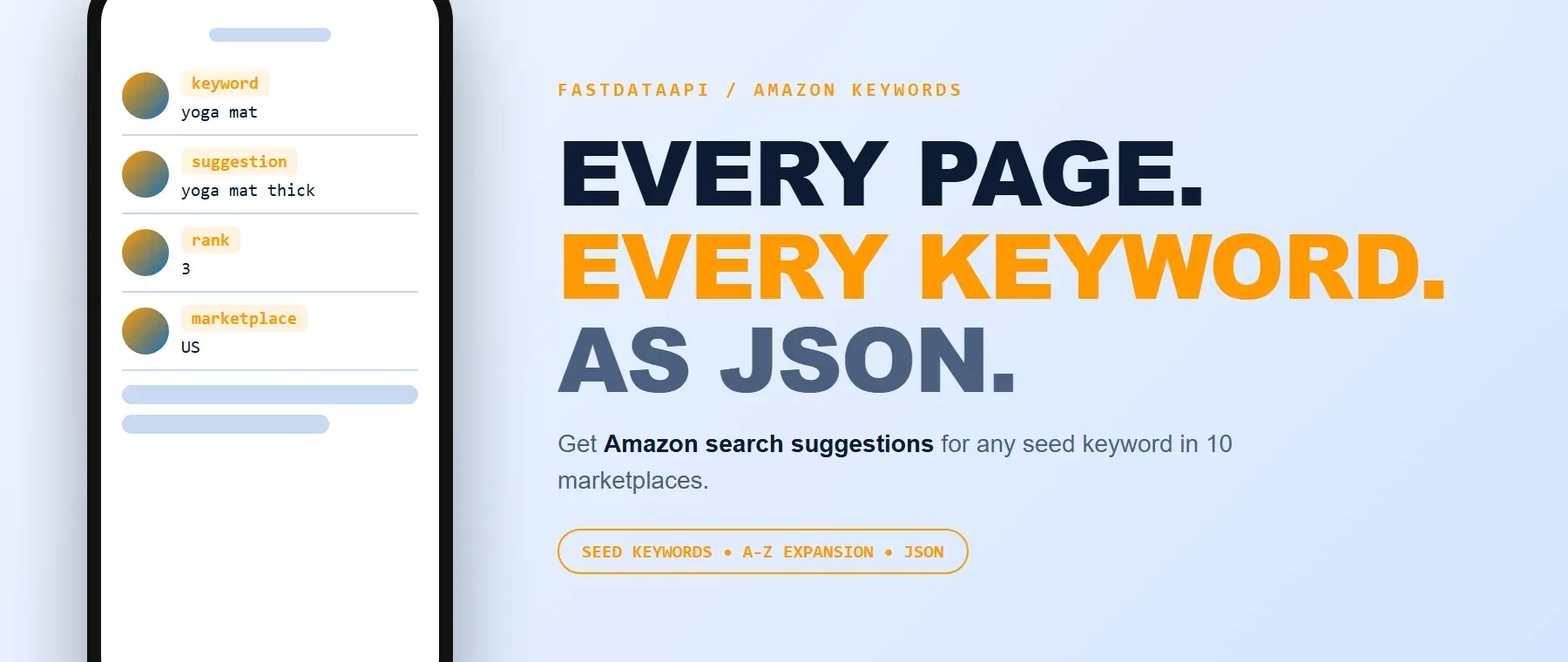
What data can I extract with Amazon Keyword Scraper?
Using this Amazon Keyword API, you will be able to extract the following Amazon keyword data:
| 🔎 Seed keyword | 💡 Suggestion | 🥇 Rank in the dropdown | ⌨️ Expanded query |
|---|---|---|---|
| 🏷️ Suggestion type | 🧩 Suggestion subtype | 🧠 Amazon strategy | 🔖 Reference tag |
| 📍 Marketplace code | 🌐 Amazon host | 🆔 Marketplace ID | 🗂️ Department |
| 🔗 Source address | 🕒 Fetch time (UTC) |
How to use Amazon Keyword Scraper
Sellers, marketers and SEO teams get every long-tail Amazon search term around a product idea from one run.
Copy to your AI assistant:
Amazon Keyword Scraper MCP Server: use these Actors from ChatGPT, Claude or Cursor
Point your AI assistant at this actor and it can read Amazon search suggestions on its own: suggestions, their rank and the expanded query for any keyword in 10 marketplaces. No glue code, no scraping logic in your prompts.
Step by step
- Create a free Apify account.
- Open Amazon Keyword Scraper in the Apify Store.
- Type your Amazon seed keywords and pick the marketplaces.
- Click Start (or send your API request).
- Download or stream your results in JSON, CSV or Excel.
How to scale Amazon Keyword Scraper to bulk
Put every seed keyword in the Keywords list and every store in Marketplaces: one run expands each keyword in each marketplace, three at a time. A recorded run took 3 keywords in 2 marketplaces and returned 300 suggestions (50 per keyword and marketplace) in under 5 seconds. Raise Max suggestions per keyword for deeper lists, or schedule the actor to track how suggestions change over time. Each suggestion row is one row_result event.
✨ Features
Amazon Keyword Scraper fetches clean, structured keyword suggestions from Amazon's search box ⚡. It's ideal for listing keyword research, PPC keyword lists, product-idea validation and comparing search demand between marketplaces.
It extracts, per suggestion:
- Suggestion – the search term exactly as Amazon shows it
- Rank – its position in the dropdown for that query (1 = top)
- Expanded query – the keyword or widened query (e.g. "laptop stand a") that surfaced it
- Marketplace and department – the Amazon store code, marketplace ID and department it came from
- Suggestion type and strategy – Amazon's own type, subtype and strategy labels
- Fetch time – when the suggestion was read, in UTC
⚡ No Amazon account, cookies or browser needed: each query is a light request, and rows appear in the dataset while the run is going.
Use cases 💡
- Amazon seller — collect long-tail search terms to fill titles and backend keywords.
- PPC manager — build keyword lists per marketplace from the suggestions Amazon ranks first.
- Product researcher — check which variants shoppers type after a product word.
- International seller — compare suggestions for one keyword across 10 Amazon stores.
- AI agent builder — give an agent live Amazon search terms as context for listing copy.
Building an AI agent? Connect Amazon Keyword Scraper over MCP and let it call the actor on its own.
Why choose this actor?
- Hundreds of long-tail keywords from one word. A recorded run expanded "laptop" with letters before and after it and returned 486 unique suggestions in 14 seconds; letters plus digits gave 677 for "coffee".
- 14 fields on every suggestion. A recorded row for "laptop stand" came back with the suggestion "laptop stand adjustable", rank 1, the expanded query "laptop stand a", marketplace US, department aps and Amazon's strategy label.
- 10 marketplaces, 4 expansion modes. United States, Canada, United Kingdom, Germany, France, Italy, Spain, India, Australia and Japan, with seed, a-z, a-z + 0-9 or custom suffix expansion and a department filter.
⬇️ Input
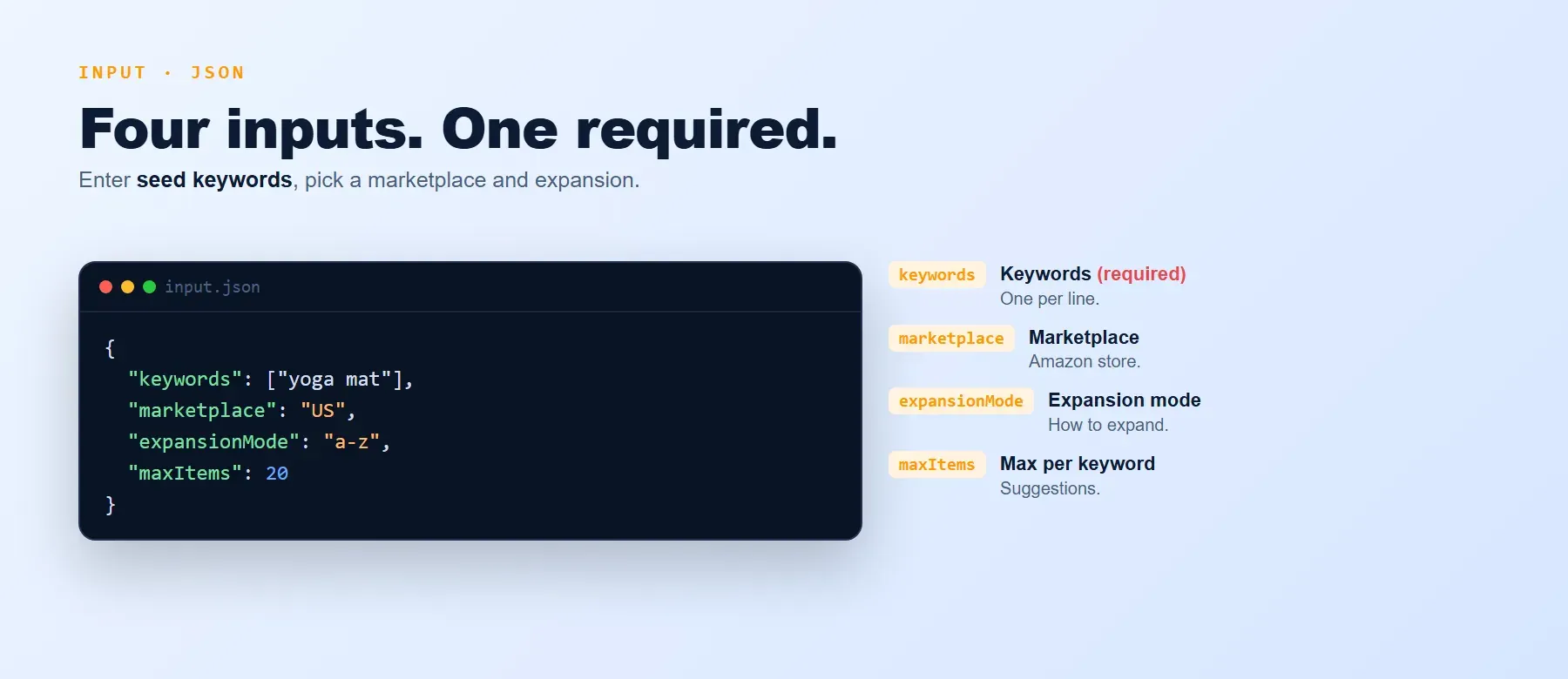
The actor takes a list of seed keywords (required) and expands each one in every chosen Amazon marketplace.
| Parameter | Required | Type | Description | Example value |
|---|---|---|---|---|
keywords | Yes | array | Seed keywords, one per line; duplicates removed (case-insensitive). | ["laptop stand"] |
maxItems | No | integer | Max suggestion rows per keyword in each marketplace. Default 20. | 100 |
marketplace | No | string | Amazon store: US, CA, UK, DE, FR, IT, ES, IN, AU or JP. Default US. Ignored when marketplaces is set. | "US" |
marketplaces | No | array | Several stores in one run (same codes); overrides marketplace. | ["US", "DE"] |
alias | No | string | Amazon department: aps = all departments (default); e.g. stripbooks, electronics, grocery. | "aps" |
expansionMode | No | string | seed (keyword only), a-z (letters after and before, default), a-z-0-9 (letters and digits), custom (your suffixes). | "a-z" |
customSuffixes | No | array | With custom mode: each is added after the keyword. | ["for desk", "for bed"] |
maxSuggestionsPerPrefix | No | integer | Suggestions kept per query, 1-10. Default 10. | 10 |
maxPrefixes | No | integer | Max expanded queries per keyword per marketplace; 0 = no cap (default). | 0 |
dedupeSuggestions | No | boolean | One row per suggestion (default true); false keeps a row each time another query returns it. | true |
requestDelayMs | No | integer | Pause before each query, in ms. Default 0. | 0 |
proxyConfiguration | No | object | Proxy to start with; default none, the actor switches to a proxy by itself when blocked. | {"useApifyProxy": false} |
Free plan limits
Users on the Apify free plan can fetch up to 20 suggestions per run (all keywords together) and 200 suggestions per month. When the limit is reached the run finishes successfully with a status message explaining the limit. Upgrade to any paid Apify plan to remove these limits.
Example input
⬆️ Output
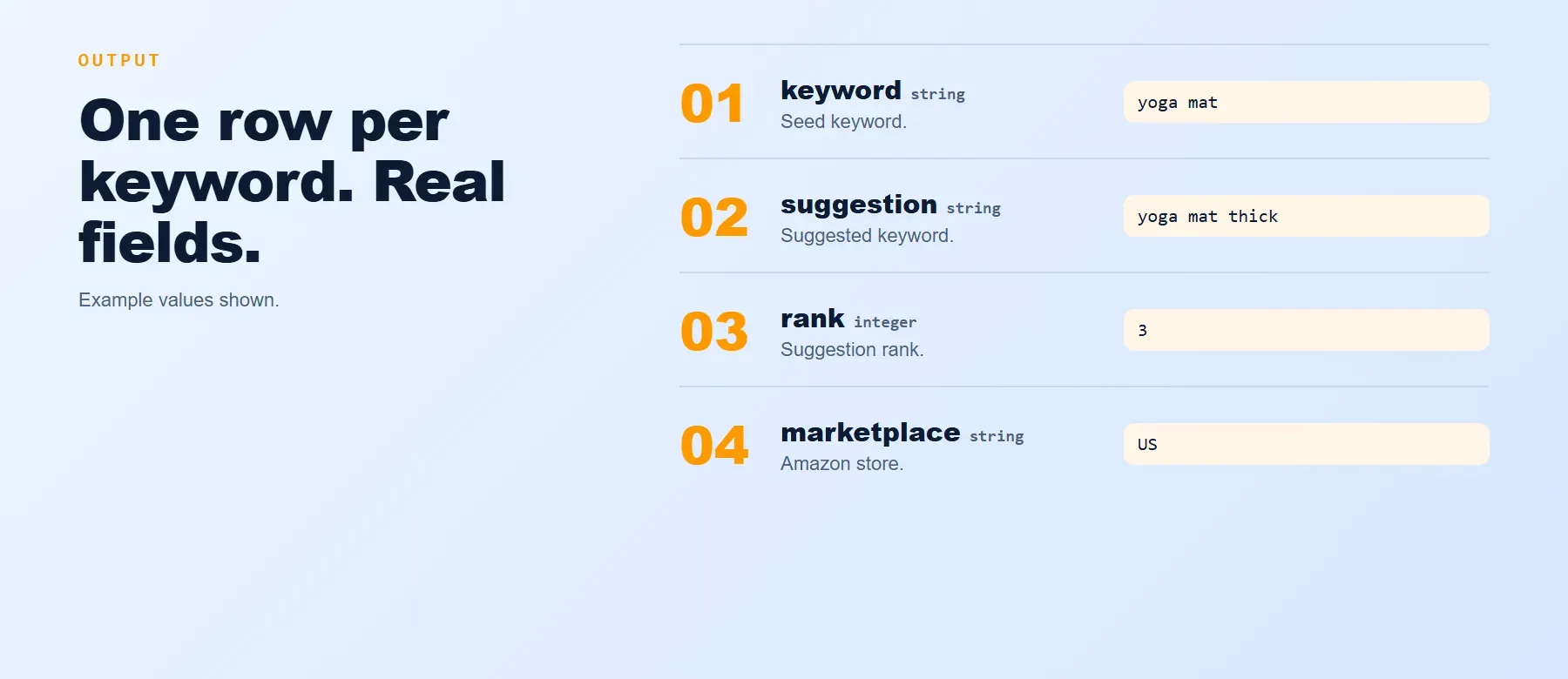
Every suggestion is one typed, normalized JSON item with the same schema on every run. Export it as JSON (default), CSV or Excel; the Output tab shows Overview, Details and Source views of the same rows.
Example output
How does it work?
The actor reads the same public search suggestions any visitor sees while typing in Amazon's search box — no Amazon account, login or cookies. Amazon shows at most 10 suggestions for a query, so the actor widens each keyword with every letter (and digit, if you choose) before and after it, or with your own suffixes, then merges the answers and removes duplicates. It connects directly first; if Amazon blocks a query it retries and switches to a datacenter and then a residential proxy on its own. Rows are saved as soon as each query answers, so the table fills while the run is going. The output schema is normalized and stays the same from run to run, and the log tells you when a keyword has no more suggestions to give.
How do you integrate Amazon Keyword Scraper into your stack?
It works with what you already use: the REST API from any language, MCP for AI agents, and no-code tools.
Using Amazon Keyword Scraper with the Apify API
Works in Go, Ruby, Node.js, cURL — any language that can make an HTTP request.
MCP integration for AI agents
Register the actor once and your agent can look up Amazon search suggestions whenever a task needs them, for example while writing a listing or planning a PPC campaign.
This registers Amazon Keyword Scraper as a tool your agent can call directly. It works in Claude Code, Cursor and Windsurf.
No-code tools (n8n, Make, LangChain)
- n8n — use the Apify node ("Run an Actor") with
fastdataapi/amazon-keyword-scraper, or the HTTP Request node pointed at the run-sync endpoint with your token. - Make — add the Apify app's "Run an Actor" module, then "Get Dataset Items" to pass the suggestions to the next step.
- LangChain — install
langchain-apifyand useApifyActorsTool("fastdataapi/amazon-keyword-scraper")as an agent tool.
Is it legal to scrape Amazon data?
Collecting publicly visible search suggestions is generally legal. Amazon Keyword Scraper returns only public data — the suggestions any visitor sees in Amazon's search box without logging in — and no personal data. Under GDPR, scraping public data is generally permissible, but storing and using it must comply with local data-protection law. Consult legal counsel if your use case involves bulk storage of personal data.
Frequently asked questions
What fields does Amazon Keyword Scraper return?
Each row has the seed keyword, the suggestion, its rank, the expanded query that surfaced it and the marketplace, plus department, Amazon's type and strategy labels and the fetch time. See the data fields section.
Does Amazon Keyword Scraper require an Amazon account or login?
No. Only public search suggestions are read. No credentials or cookies are needed.
How fast does Amazon Keyword Scraper run?
A recorded run returned 20 suggestions for "laptop stand" in about 1 second and 486 for "laptop" in 14 seconds. Data is live, not cached.
What happens if a keyword has no suggestions?
The run still succeeds: the keyword gets no rows, its progress line shows 0 suggestions, and the other keywords continue. An unsupported marketplace code is skipped with a log line.
Can I scrape multiple Amazon keywords at once?
Yes. Put every keyword in the Keywords list and every store in Marketplaces; each keyword is expanded in each marketplace in the same run.
Does Amazon Keyword Scraper work with Claude, ChatGPT, and other AI agent tools?
Yes — Amazon Keyword Scraper is available as an MCP tool. Register it in Claude Code, Cursor or Windsurf with claude mcp add --transport http apify "https://mcp.apify.com?tools=fastdataapi/amazon-keyword-scraper". Any agent that can call an HTTP endpoint can use the REST API directly.
Does Amazon Keyword Scraper return data in a format LLMs can use directly?
Yes. It returns typed, normalized JSON with consistent field names. No HTML parsing, no selectors. Pass it straight to an LLM, index it into a vector store, or feed it to an agent tool — no transformation step.
What happens when Amazon changes its layout or updates its anti-bot system?
This actor is maintained and updated. When Amazon changes, the actor is updated — your calls keep returning the same JSON schema with no changes on your end.
Can I use Amazon Keyword Scraper without managing proxies or browser infrastructure?
Yes. The actor needs no browser, and when Amazon blocks a query it switches to a proxy on its own. You send one request and get structured JSON back. No proxy accounts, no headless browser setup, no maintenance.
Which Amazon keyword fields work best for AI training data and RAG indexing?
For RAG: the suggestion text with its seed keyword and expanded query. For training data: the rank, marketplace and department. All fields are typed primitives — strings and integers — no normalization needed.
Your feedback
Found a bug or missing a field? Let us know on the actor's Issues tab. Every report is read, and fixes ship as new versions of the actor.


