
Mercari Japan Scraper
Pricing
from $0.67 / 1,000 results
Mercari Japan Scraper
Mercari Japan Scraper scrapes Mercari Japan listings in bulk from keywords, search, category, item and Mercari Shops URLs: price in JPY, brand, condition, status, seller, shipping, category, photos and timestamps. Export JSON, CSV or Excel, or use the API.
Pricing
from $0.67 / 1,000 results
Rating
0.0
(0)
Developer

Fast Data API
Maintained by CommunityActor stats
0
Bookmarked
1
Total users
1
Monthly active users
8 days ago
Last modified
Categories
Features
Share
Mercari Japan Scraper — Prices, Brands, Condition, Sellers and Photos
Mercari Japan Scraper extracts listings from Mercari Japan (jp.mercari.com) by keyword or by search, category, item and Mercari Shops product URL. Each listing comes back with its title, price in Japanese yen, brand, condition, sale status, seller, shipping terms, category, size, photos, discounts and auction bids. Every response is structured JSON, ready to pass directly to an LLM, index into a vector store, or feed a resale price-monitoring pipeline. No Mercari account or cookies needed. Start with one keyword, then add every product line you track.
What data can I extract with Mercari Japan Scraper?
Using this Mercari Japan listing API, you will be able to extract the following Mercari Japan listing data:
| 🏷️ Listing title | 💴 Price (JPY) | 🔖 Brand (if set) | ✨ Condition |
|---|---|---|---|
| 🟢 Sale status (on sale, sold, in trade) | 🆔 Listing ID and URL | 👤 Seller ID | 🏪 Shop name and ID (Mercari Shops) |
| 🚚 Shipping payer and method | 🗂️ Category ID | 📏 Size (if set) | 🖼️ Thumbnails and photos |
| 🎟️ Promotions and discount % | 🔨 Auction bids, highest bid and deadline (auctions only) | 🕒 Created and updated time | 🔎 Search, input and match count it came from |
How to use Mercari Japan Scraper
Resellers, sourcing teams and price analysts get a clean table of Mercari Japan listings from one run.
Copy to your AI assistant:
Mercari Japan Scraper MCP Server: use these Actors from ChatGPT, Claude or Cursor
Point your AI assistant at this actor and it can read Mercari Japan on its own: listings by keyword, search, category, item or shop product URL, with prices, brands, condition and sale status. No glue code, no scraping logic in your prompts.
Step by step
- Create a free Apify account.
- Open Mercari Japan Scraper in the Apify Store.
- Type your keywords, or paste Mercari Japan search, category, item or shop product URLs.
- Click Start (or send your API request).
- Download or stream your results in JSON, CSV or Excel.
How to scale Mercari Japan Scraper to bulk
Put many keywords in Search keywords and many URLs in Start URLs: every keyword and every search URL is its own search and gets up to Max listings per input listings, and up to 5 run at the same time. Item and product URLs give one row each. For daily price or sold-out tracking, save the input as a task and schedule it in Apify Console, or call the API in a loop.
✨ Features
Mercari Japan Scraper fetches clean, structured listings from Mercari Japan ⚡. It's ideal for resale price research, sold-price tracking, sourcing Japanese products and watching a brand or category for new listings. It extracts, per listing:
- Title and price – the listing headline and the price in Japanese yen, as text and as a number
- Sale status – on sale, sold out or in trade
- Brand and condition – brand name and the condition grade the seller picked
- Seller or shop – the seller ID, or the shop name and ID for Mercari Shops listings
- Shipping – who pays shipping and the shipping method
- Category and size – the category ID and the size, when set
- Photos – thumbnail and full photo URLs
- Promotions and auctions – discounts with their percentage, and bid count, highest bid and deadline for auctions
⚡ Sort by best match, newest or price, and filter by status and price range, so you collect only the listings you need.
Use cases 💡
- Reseller — compare on-sale and sold prices for a model before buying stock.
- Sourcing agent — find the cheapest on-sale listings for a brand in one price range.
- Market analyst — track how many listings a keyword matches and how prices move.
- Shop owner — watch Mercari Shops rivals' prices and discounts for your products.
- AI agent builder — feed listing titles and prices into a RAG pricing assistant.
Building an AI agent? Connect Mercari Japan Scraper over MCP and let it call the actor on its own.
Why choose this actor?
- Hundreds of listings in seconds. A recorded local run returned 500 listings for the keyword "watch" in about 9 seconds; 3 inputs with 15 listings each came back in 5 seconds.
- Every detail of a listing. A recorded listing came back with its title, price of 16,000 yen, brand Citizen, condition grade, seller ID, shipping payer and method, category, photo links and the time it was listed and updated.
- Five ways in, five filters. Keywords plus search, category, item and Mercari Shops product URLs, filtered by sort, direction, status, minimum and maximum price.
⬇️ Input
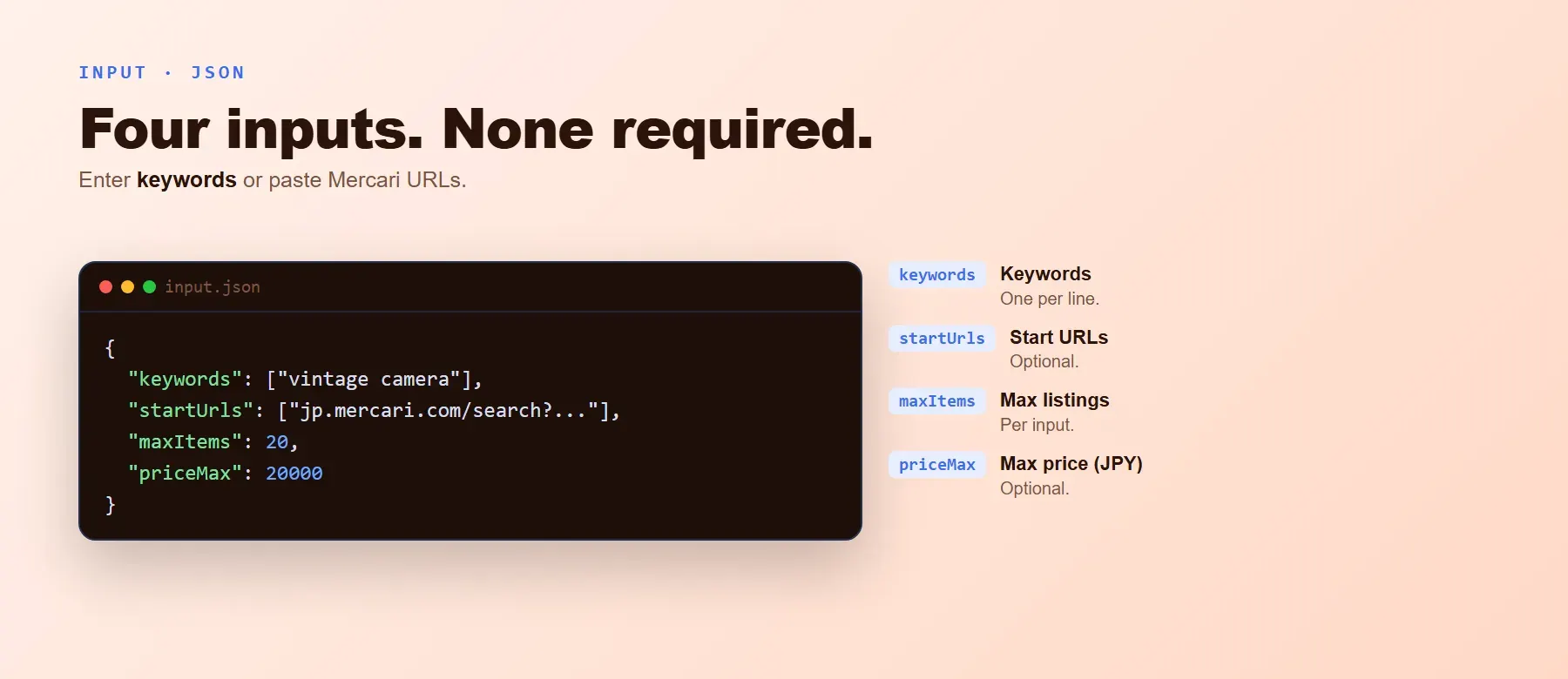
The actor takes Mercari Japan URLs (search, category, item or Mercari Shops product pages), keywords, or both; fill at least one of the two.
| Parameter | Required | Type | Description | Example value |
|---|---|---|---|---|
startUrls | One of startUrls / keywords | array | jp.mercari.com search, category, item (/item/m…) or Mercari Shops product (/shops/product/…) URLs; /en/ URLs work too. Filters in a search URL are used as they are. | [{"url": "https://jp.mercari.com/en/search?keyword=watch"}] |
keywords | One of startUrls / keywords | array | Search terms, Japanese or English; each is its own search. | ["nintendo switch", "ポケモンカード"] |
maxItems | No | integer | Listings per search URL and per keyword. Default 20, minimum 1. | 50 |
sort | No | string | score (best match), created_time (newest) or price. Default score. | "price" |
order | No | string | desc or asc. Default desc. | "asc" |
status | No | array | Any of on_sale, sold_out, trading. Empty = all. | ["on_sale"] |
priceMin | No | integer | Minimum price in JPY. Empty or 0 = no minimum. | 5000 |
priceMax | No | integer | Maximum price in JPY. Empty or 0 = no maximum. | 30000 |
maxRetries | No | integer | Tries per failed request, 1-10. Default 3. | 3 |
maxScanned | No | integer | A search stops after reading this many results. Default 20000, 0 = no stop. | 20000 |
proxyConfiguration | No | object | Optional proxy to start with. Default: no proxy; the actor switches to a proxy by itself when blocked. Residential proxies use Japan unless you pick another country. | {"useApifyProxy": false} |
Accepted URL formats:
- Search:
https://jp.mercari.com/search?keyword=watch&sort=price&order=asc - Category:
https://jp.mercari.com/search?category_id=1731 - Item:
https://jp.mercari.com/item/m61862983984 - Mercari Shops product:
https://jp.mercari.com/shops/product/2JXqvjDMoD3ZpdiVonRBiM
Free plan limits
Users on the Apify free plan can fetch up to 20 listings per run (all inputs together) and 200 listings per month. When the limit is reached the run finishes successfully with a status message explaining the limit. Upgrade to any paid Apify plan to remove these limits.
Example input
⬆️ Output
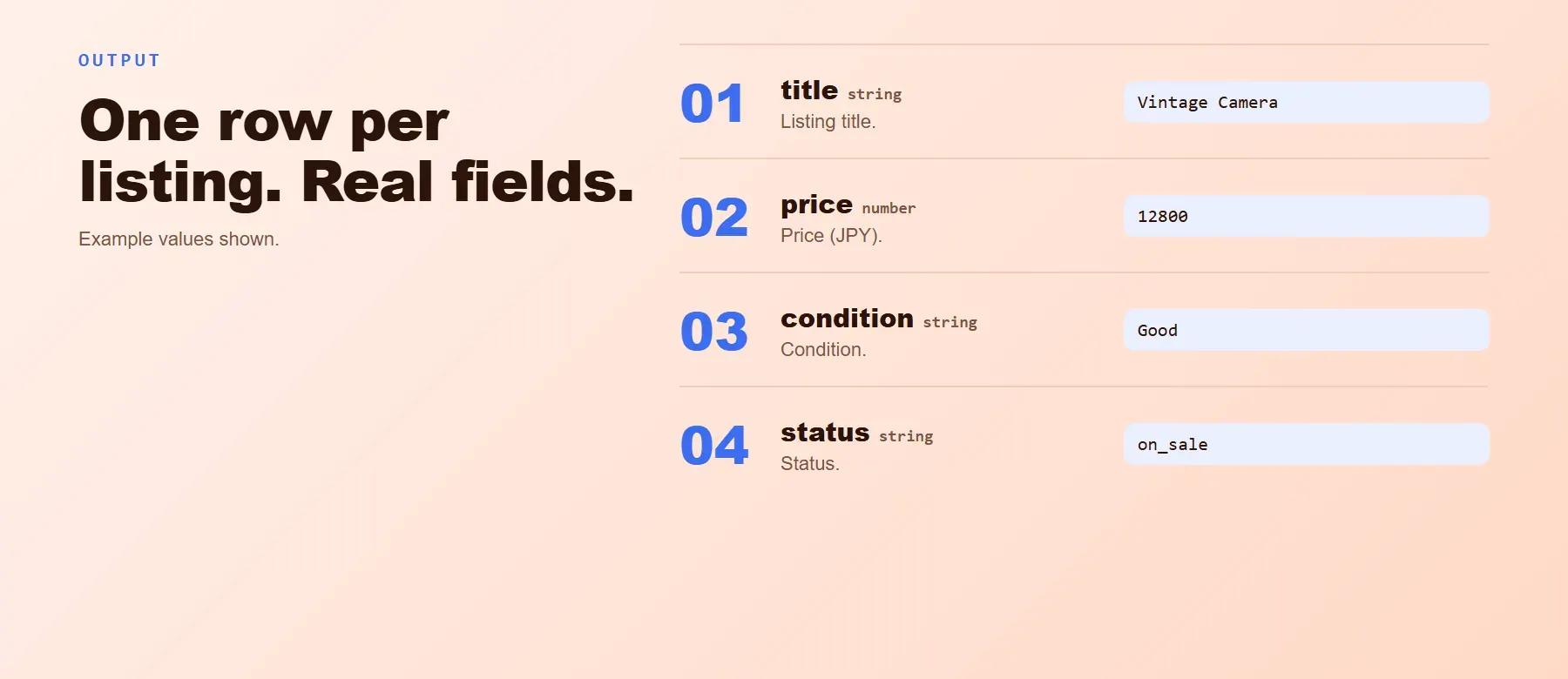
Every listing is one typed, normalized JSON item with the same schema on every run, whether it came from a search, an item URL or a shop product URL. Export it as JSON (default), CSV or Excel; the Output tab also shows Overview, Item, Seller & shipping, Media & promotions and Source views.
Example output
How does it work?
The actor reads public Mercari Japan data: the same listings any visitor sees on jp.mercari.com without logging in. You need no Mercari account, no cookies and no browser. For a keyword or search URL it pages through the results in the order you chose and saves each page of listings as soon as it arrives, so the table fills while the run is going. Item and shop product URLs are read one by one.
Requests start without a proxy. If Mercari blocks a request, the actor retries through a proxy by itself, moving to a residential proxy in Japan when needed, and it remembers what worked for the next run. Failed requests are retried with a pause. The output schema is normalized and stays the same for every kind of input, so your code does not change when you switch from keywords to URLs.
How do you integrate Mercari Japan Scraper into your stack?
Mercari Japan Scraper works with what you already use: the REST API from any language, MCP for AI agents, and no-code tools.
Using Mercari Japan Scraper with the Apify API
Works in Go, Ruby, Node.js, cURL — any language that can make an HTTP request.
MCP integration for AI agents
Register the actor with one command and your agent can search Mercari Japan whenever a task needs listing prices or sale status:
This registers Mercari Japan Scraper as a tool your agent can call directly. It works with Claude Code, Cursor, Windsurf and any other MCP client.
No-code tools (n8n, Make, LangChain)
- n8n — add the Apify node and choose "Run an Actor" with
fastdataapi/mercari-japan-scraper, or use the HTTP Request node pointed at the run-sync endpoint with your token. - Make — use the Apify app's "Run an Actor" module, then "Get Dataset Items" to pass the listings to the next step.
- LangChain — install
langchain-apifyand wrap the actor withApifyActorsTool("fastdataapi/mercari-japan-scraper").
Is it legal to scrape Mercari Japan data?
Scraping publicly available Mercari Japan listing data is generally lawful when you collect only what any visitor can see. Mercari Japan Scraper returns only public listing data — what any user sees without logging in — and no private account data. Listings carry seller IDs, so under GDPR and Japan's personal-information law, storing and using that data must follow local data-protection rules. Consult legal counsel if your use case involves bulk storage of personal data.
Frequently asked questions
What fields does Mercari Japan Scraper return?
Each listing has its title, price in yen, brand, condition and sale status, plus seller or shop, shipping, category, size, photos, promotions and auction details. See the data fields section.
Does Mercari Japan Scraper require a Mercari account or login?
No. Only public listing data is extracted. No credentials or cookies are needed.
How fast does Mercari Japan Scraper run?
A recorded local run returned 500 listings for one keyword in about 9 seconds, and 3 inputs with 15 listings each took 5 seconds. Data is live, not cached.
What happens if a listing doesn't exist or a search finds nothing?
An item URL that can't be loaded is skipped with a warning in the log and no row; a search with no matches is logged as "0 listings matched" and the run still succeeds. URLs that are not Mercari Japan search, category, item or shop product pages are skipped and named in the log.
Can I scrape multiple Mercari Japan searches at once?
Yes. Add many keywords and URLs in one run; each search gets up to its own Max listings per input, and up to 5 run at the same time.
Does Mercari Japan Scraper work with Claude, ChatGPT, and other AI agent tools?
Yes — Mercari Japan Scraper is available as an MCP tool. Register it in Claude Code, Cursor or Windsurf with claude mcp add --transport http apify "https://mcp.apify.com?tools=fastdataapi/mercari-japan-scraper". Any agent that can call an HTTP endpoint can use the REST API directly.
Does Mercari Japan Scraper return data in a format LLMs can use directly?
Yes. It returns typed, normalized JSON with consistent field names. No HTML parsing, no selectors. Pass it straight to an LLM, index it into a vector store, or feed it to an agent tool — no transformation step.
What happens when Mercari changes its site?
This actor is maintained and updated. When Mercari changes, the actor is updated — your calls keep returning the same JSON schema with no changes on your end.
Can I use Mercari Japan Scraper without managing proxies or browser infrastructure?
Yes. The actor starts without a proxy and switches to a proxy on its own when Mercari blocks a request. You send one request and get structured JSON back. No proxy accounts, no headless browser setup, no maintenance.
Which Mercari Japan listing fields work best for AI training data and RAG indexing?
For RAG: the listing title, brand name and shop name. For training data: the price, condition grade, sale status, category and the listed and updated times. Fields are typed — strings, integers, booleans — no normalization needed.
Your feedback
Found a bug or missing a field? Let us know on the actor's Issues tab. Every report is read, and fixes ship in new versions of this actor.


