

Spotify Track Play Counts | Albums, Playlists & Artist Stats
Pricing
from $0.54 / 1,000 delivered rows
Spotify Track Play Counts | Albums, Playlists & Artist Stats
Paste Spotify track, album, artist or playlist links, or search by keyword, and get each track's total play count with its ISRC, popularity, BPM, key, label, UPC and cover, plus artist rows with monthly listeners, followers, world rank, top cities, biography and social links. No login, no API key.
Pricing
from $0.54 / 1,000 delivered rows
Rating
0.0
(0)
Developer

FeedMiner
Maintained by CommunityActor stats
0
Bookmarked
2
Total users
1
Monthly active users
a day ago
Last modified
Categories
Share
🔓 Nothing to connect. No Spotify login, no developer app, no API key, no cookies to paste. Every read is the public catalog Spotify's web player shows a logged-out visitor, so nothing of yours can expire.
⚡ 9 947 rows in 60 seconds. A 10 000-entry playlist read whole on Apify, each row with its play count, ISRC, tempo and key: run FExbx73xEoGIHeJz6, 23 October 2026. Speed varies from run to run; the Performance section has the spread.
💸 $0.90 per 1 000 rows, $0.54 from Gold up. Under each of the five most-used Spotify data Actors on the Store, at every plan tier, as read on 23 October 2026. A track row, an artist row, an album row and a playlist row cost the same, and a dead link or a podcast costs nothing.
🎚️ Play count, ISRC, tempo and key on every track row. Whether the track came from an album, a playlist, an artist's discography, a pasted link or a keyword search, its row carries the total plays, the ISRC, the BPM, the key and its Camelot code, the label and the UPC, in one run with no account.
| FeedMiner • Social data, measured before it is promised | ||
| Spotify Track Play Counts You are here | X Tweet Scraper Search, threads, lists, communities | X Profile Scraper Profiles, their recent posts included |
Copy to your AI assistant
How to scrape play counts from Spotify
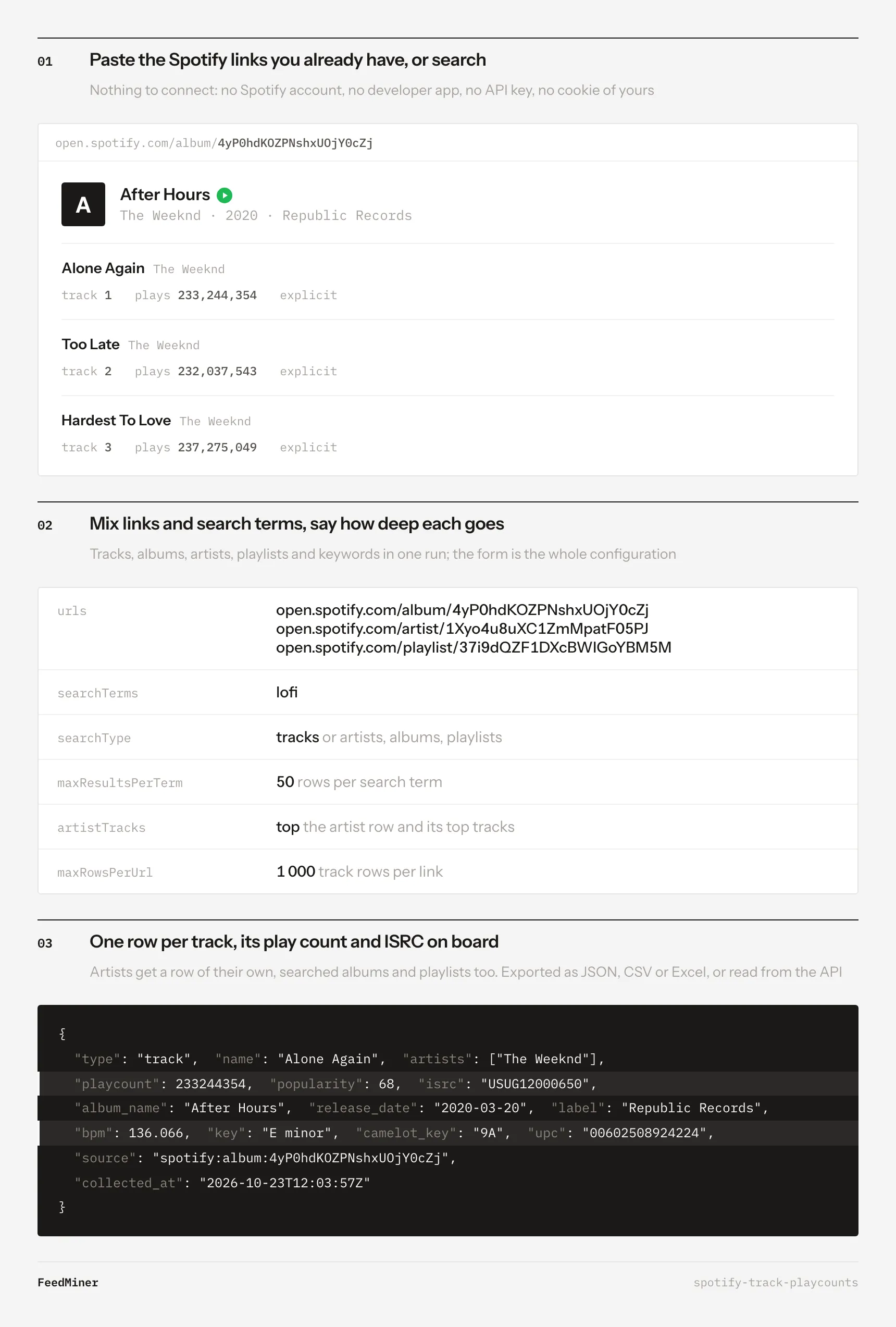
Paste the links you want the play counts of, or type what you would search for. That is the whole input.
One track
One row. A pasted track is read through its album, which is why its row carries the album's name, label and release date as well as the play count, and then looked up for its ISRC, popularity, tempo, key and preview.
However the links were copied
The share button's ?si= tail, a localised intl-xx/ path and the app's spotify: URIs are all read the same way. Duplicates fold, so a column pasted out of a spreadsheet runs unedited.
Search tracks by keyword
Up to 100 tracks per term, in Spotify's own order, each with its play count, ISRC, tempo and key. Every row's source names the term that found it, as spotify:search:lofi, so several terms come back sortable. Spotify's search always answers something, even to a misspelt term, so read the first rows of a new term before trusting a long list.
Find the artists of a scene
One row per artist found, with monthly listeners, followers, world rank, top cities, biography, external links and the artists the profile lists under "Fans also like". A searched artist delivers its own row only; paste its link to get its tracks.
Find playlists to pitch to
One row per playlist found, with its followers, owner, track count and description. Sort on followers, then paste the links of the ones you want into a second run to read their tracks.
Albums, with their total plays
One row per album found: its type, label, UPC, copyright lines, track count and the plays of all its tracks added up.
A playlist, with its curator's context
A playlist's rows carry the date each track was added, and the playlist's own name, owner, followers and description. Raise maxRowsPerUrl for a long playlist: the default of 1 000 is sized for a first look.
An artist roster's audience, and nothing else
One row per artist: monthly listeners, followers, world rank, the top cities the profile lists, the size of the discography, the biography and the links. This is the cheapest way to compare a roster.
Every track an artist is credited on
The artist's row, then every track the artist is credited on, across albums, singles and compilations, newest release first, until the discography ends or maxRowsPerUrl rows are delivered. A compilation contributes this artist's tracks only: the others on it are set aside, counted in the closing line, and not charged. Measured on Apify on 23 October 2026: The Weeknd's row and 420 tracks, 8 set aside, in 6.7 s (run AL0Qv4P4eKiWy2rmu); Johann Sebastian Bach's row and his 10 000 newest credited tracks, with 37 545 tracks by other composers set aside, in 139.6 s (run apxG4UGhntP62P3no). A label's or a compilation series' profile is credited on few of the tracks its releases hold: such a discography stops once it has read ten tracks for each row maxRowsPerUrl allows, delivers the credited tracks it found, and the closing line says it stopped early. Spotify groups some releases with their other editions; such a group is read once, through the edition the player shows, so the tracks the other editions repeat are not delivered twice.
A real mix
A track, an album, an artist with its top tracks, an editorial playlist and a keyword search, in one run. The form's prefill is these four links without the search term. On Apify on 23 October 2026 it delivered 73 rows in 3.6 s (run l7ryxvnOIOgVEjryu): the pasted track and two of the artist's top tracks are on the pasted album, so each came once.
Input parameters
What to read
| Parameter | Type | Default | Description |
|---|---|---|---|
urls | string[] | none | Tracks, albums, artists or playlists, mixed: open.spotify.com links with or without their intl-xx/ part or ?si= tail, or spotify: URIs. Duplicates fold. Podcasts, episodes and audiobooks are set aside before any read. |
searchTerms | string[] | none | Words to search Spotify for, one per entry. Case does not matter, and a term typed twice is searched once. |
At least one link or one search term is needed; both work in the same run.
What a search finds
| Parameter | Type | Default | Description |
|---|---|---|---|
searchType | string | tracks | tracks, artists, albums or playlists: the kind of row each search term delivers. |
maxResultsPerTerm | integer | 50 | The most rows one search term may deliver, from 1 to 1 000. Spotify's search goes no deeper than 1 000 results and repeats some tracks among them, so a track search can end short of a high cap. |
What an artist link brings
| Parameter | Type | Default | Description |
|---|---|---|---|
artistTracks | string | top | none: the artist's row alone. top: the artist's row and the profile's top tracks. discography: the artist's row and every track the artist is credited on, across albums, singles and compilations, newest release first; a compilation's tracks by other artists are left out and not charged; when maxRowsPerUrl cuts, the newest releases are kept. Artists found by a search deliver their own row only. |
How deep a list goes
| Parameter | Type | Default | Description |
|---|---|---|---|
maxRowsPerUrl | integer | 1000 | The most track rows one album, playlist or artist link may deliver, from 1 to 10 000. The artist's own row comes on top. A list longer than this stops there, and the run's closing line says how many links reached the cap. A discography whose releases seldom credit the artist also stops once it has read ten tracks for each row allowed. |
Advanced
| Parameter | Type | Default | Description |
|---|---|---|---|
debugMode | boolean | false | Verbose log lines for support. Leave off. |
maxRowsPerUrl bounds each album, playlist and artist link on its own and maxResultsPerTerm each search term, so together they bound the run's cost before it starts. A pasted track link is always one row, and artistTracks only changes what an artist link brings.
What data can you extract from Spotify?
The track row
What it is: type ("track"), uri, url, name, and artists, the credited artists in Spotify's order.
Its plays: playcount, the total plays across every country; popularity, Spotify's 0-100 score; and collected_at, the moment this run read them.
Its identifiers: isrc, the recording's code, and upc, the release's barcode.
Its release: album_uri, album_name, album_type (ALBUM, SINGLE, EP or COMPILATION), album_total_tracks, release_date at the precision Spotify states it (2020-03-20, 2020-03 or 2020, never a first of January nobody published), label, copyrights (each line with its type, C for the composition and P for the recording) and cover_url.
The track itself: duration_ms, explicit, disc_number, track_number, playable, which says whether it plays in the country the run read from, and preview_url, the 30-second MP3 Spotify plays as a preview.
Its sound: bpm, the tempo to three decimals, key, as G minor or A# major, and camelot_key, the same key on the Camelot wheel DJs mix by, as 6A.
From a playlist: added_at, when the entry joined the playlist, and the playlist's own playlist_name, playlist_owner, playlist_followers and playlist_description.
Where it came from: source, the pasted link or the search that reached this row, as a spotify: URI (spotify:search:lofi for a search).
The artist row
type ("artist"), uri, url, name, verified, followers, monthly_listeners, world_rank, and top_cities: one entry per city the profile lists, most listeners first, each with city, country (ISO code) and listeners. Then the profile around it: albums_count, singles_count and compilations_count, the size of the discography; biography, as plain text; external_links, keyed by site (instagram, twitter, facebook, wikipedia, tiktok…); related_artists, the artists the profile lists under "Fans also like", each with name and uri; image_url, header_image_url and gallery_urls, the profile's pictures. Then source and collected_at, as on a track.
The album row and the playlist row
Only a search delivers them. An album row carries name, artists, playcount (the plays of all its tracks added up), album_type, total_tracks, release_date, label, upc, copyrights and cover_url. A playlist row carries name, description, owner, owner_uri, followers (its saves), total_tracks and image_url. Both also carry type, uri, url, source and collected_at.
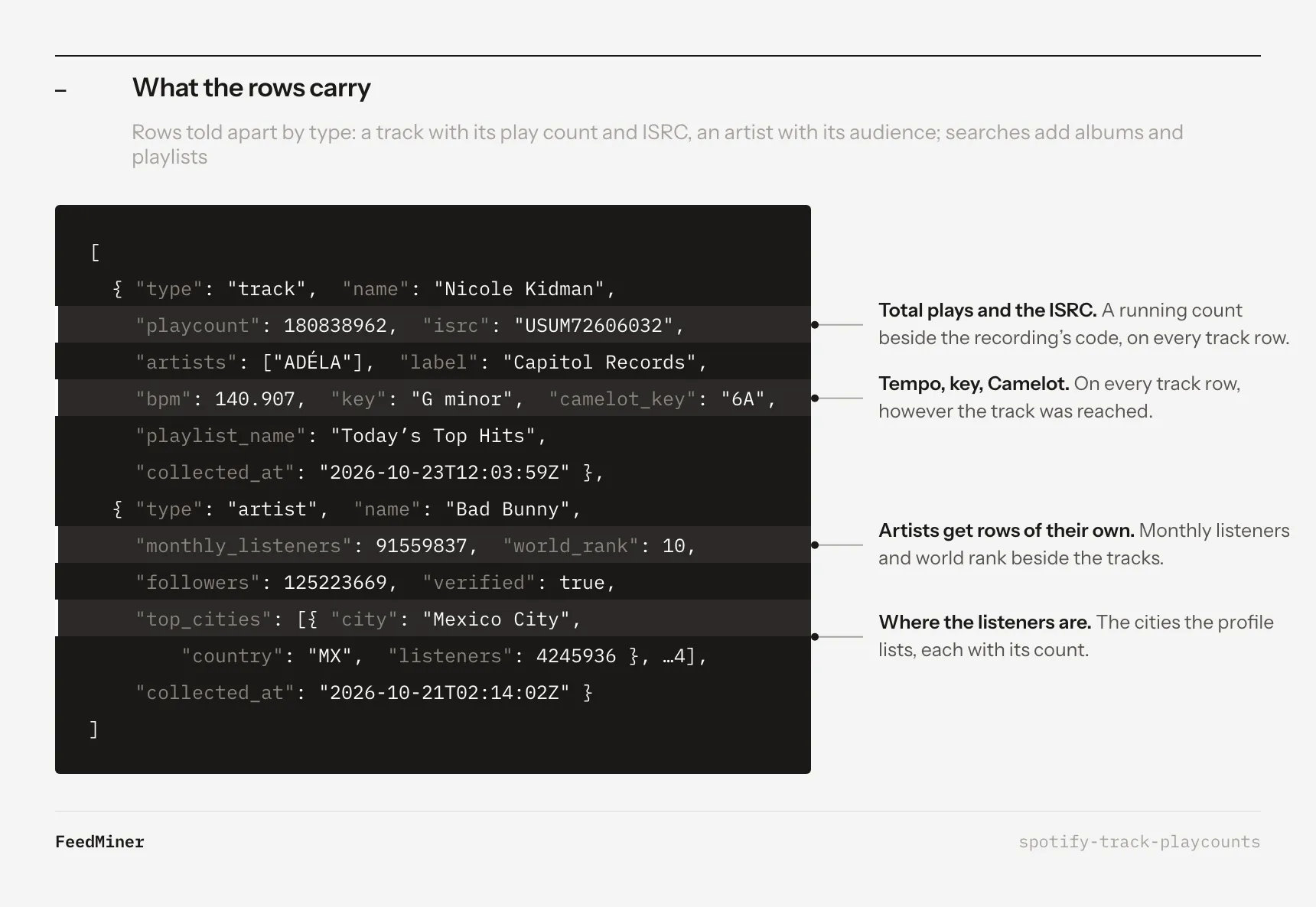
Example rows
A track, as the playlist link of the form's prefill delivered it:
An artist, from the same run, its biography and lists cut short here:
An album, as an album search for after hours found it:
A playlist, as a playlist search for workout found it:
Why some columns are empty on some rows
Each route to a track carries different columns, and this Actor does not invent the missing ones. Every track row, whatever reached it, is looked up for its ISRC, popularity, tempo, key, preview, UPC, album type, cover and copyright lines. Only a playlist link fills added_at and the four playlist_ columns; on the other rows they are empty or null.
Four columns can be empty for a reason that is Spotify's. preview_url is filled only for the tracks Spotify still previews: 367 of the first 1 000 rows of a 10 000-entry playlist on Apify on 23 October 2026 (run FExbx73xEoGIHeJz6). popularity is null on an old copy of a track that Spotify now serves under another id, which is common in old playlists: Spotify keeps the score on the newer copy, and a 0 there would read as unpopular. biography, external_links, header_image_url and gallery_urls are filled where the artist set them up on Spotify. And if Spotify's metadata service does not answer for a row, its looked-up columns stay empty and the run's closing line counts it. A column a route does not carry is null or empty, never a zero that would read as a measurement.
Why a play count comes with the time it was read
playcount is a running total: it is the number of plays at collected_at, and it will be higher tomorrow. Two runs of the same links, a week apart, subtracted track by track on uri, give the plays in between. A playcount of 0 marks a track Spotify serves as unplayable, not one nobody has heard.
What a link or a search that gives nothing tells you
A row is a track, an artist, an album or a playlist, so an input that yields none produces no row and costs nothing. The run's closing line, on the Console, says what happened to it:
| The closing line says | What it means |
|---|---|
| not found on Spotify | nothing lives at that id: a dead, removed or mistyped link. Purge it from your list |
| held no track | the album or playlist exists and is empty |
| found nothing on Spotify | the search term returned no result |
| could not be read from Spotify | Spotify would not serve it after every retry. Run it again |
| stopped short by Spotify | the link or term delivered, then a later page was refused: you have what was read before it |
| reached the per-link row cap | the list is longer than maxRowsPerUrl. Raise it for more |
| reached the per-term cap | the search has more results than maxResultsPerTerm. Raise it for more |
| came without some of their metadata | Spotify's metadata service had nothing for those rows or did not answer: their play counts are there, some looked-up columns are empty |
| not a Spotify link | the entry names no Spotify track, album, artist or playlist |
| a podcast, episode or audiobook | set aside before any read |
| playlist entries that are not tracks | episodes and local files inside a playlist, skipped and not charged |
| tracks that do not credit its artist | tracks by other artists on an artist's compilations, set aside from a discography and not charged |
| already delivered earlier in this run | a track, artist, album or playlist the run had already delivered, for another of your inputs or earlier in the same one: delivered and charged once |
| stopped early: few of the tracks on their releases credit them | an artist link at discography whose releases seldom credit the artist, such as a label's profile: it stopped after reading ten tracks for each row maxRowsPerUrl allows. You have the credited tracks it found; raise maxRowsPerUrl to read deeper |
| Run stopped early | the run was stopped before its end; the line gives how many rows it had delivered |
What this Actor covers
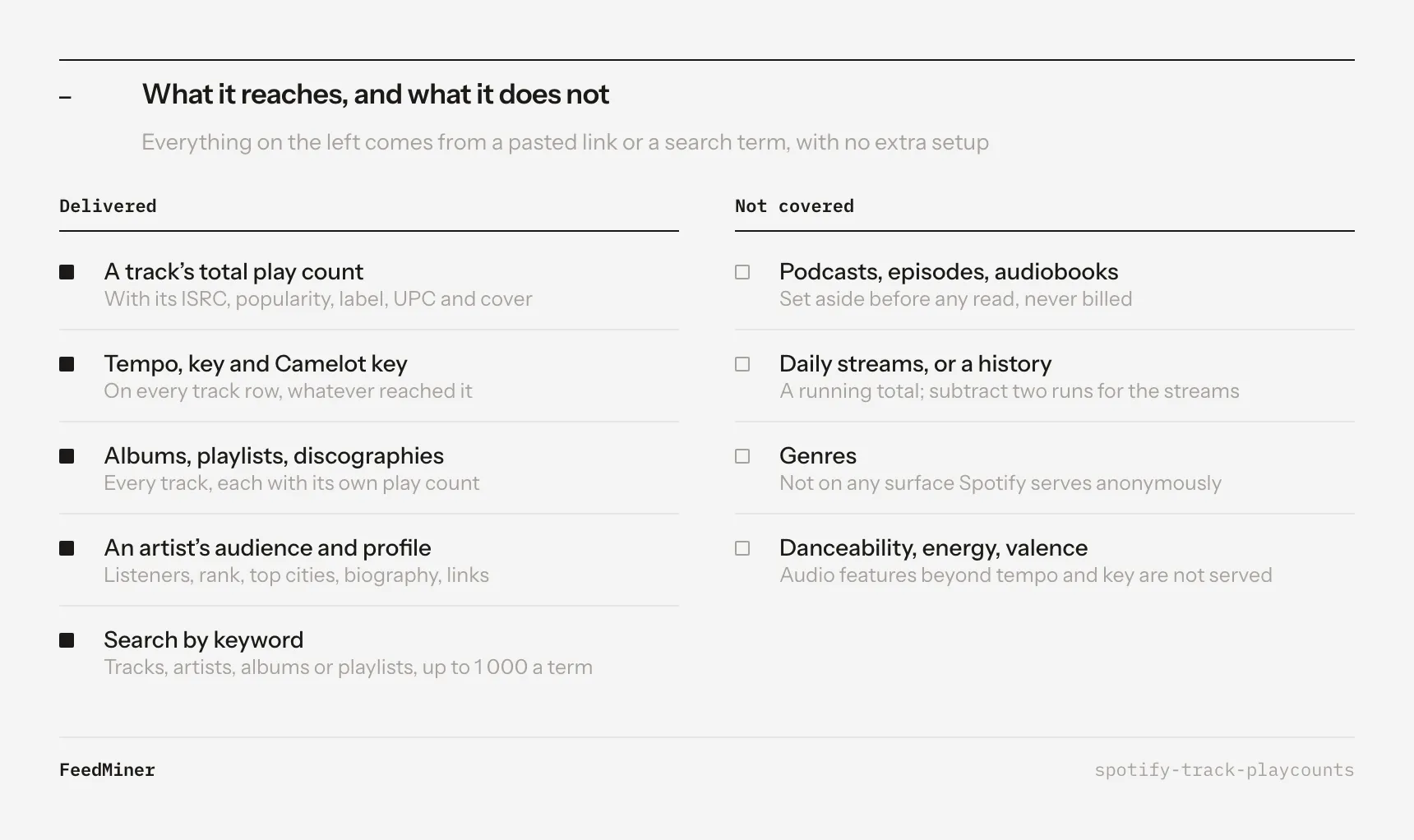
It reads Spotify's public catalog from the links you paste and the terms you search: a track's play count with its ISRC, tempo and key, every track of an album or a playlist, an artist's audience and profile, an artist's top tracks or discography, and albums and playlists found by keyword.
No FeedMiner Actor covers the four things on the right today: podcasts, a stream history, genres, and audio features beyond tempo and key. Spotify serves neither an artist's genres nor danceability, energy or valence on any surface this Actor reads without an account, so it does not deliver them. Say so in the Issues tab if you need one of them. For what people say about a release on X, X Tweet Scraper searches posts by keyword, and X Profile Scraper reads an artist's X profile with its recent posts.
Pricing
| Event | What it is |
|---|---|
row | one delivered row, a track, an artist, an album or a playlist alike |
| Actor start | Apify's own fee, charged once when a run starts |
| Apify plan | Per 1 000 row events |
|---|---|
| Free | $0.90 |
| Bronze | $0.81 |
| Silver | $0.67 |
| Gold, Platinum, Diamond | $0.54 |
One event is one row that reached your dataset, so the price per 1 000 events is the price per 1 000 rows. Apart from the start fee, nothing else is billed: not a dead link, a podcast, an episode or an audiobook, a short link, text that names no Spotify entity, a playlist entry that is not a track, or a search result Spotify would not let the run read.
Each row is billed once per run. A track, an artist, an album or a playlist reached by several of your links or search terms is delivered and billed once, by the first input that reaches it, whose link or term its source names; the closing line counts the rows folded this way. The one exception is a playlist's own track rows: they carry that playlist's name, owner and the date each track joined it, so each pasted playlist gets its own row for a track it holds, beside the one row any other input reaching that track delivers. Every cap counts the rows delivered, so a folded track does not use up a link's or a term's share.
Against the market
The five most-used Spotify data Actors on the Store, read through the Store's API on 23 October 2026, with their price per 1 000 rows on Apify's Free plan and from Gold up:
| Actor | Users, last 30 days | Free plan | Gold and up |
|---|---|---|---|
beatanalytics/spotify-play-count-scraper | 185 | $4.00 | $4.00 |
automation-lab/spotify-scraper | 110 | $5.00, plus $0.005 a run | $2.61, plus $0.005 a run |
sourabhbgp/spotify-scraper | 81 | $3.00 | $2.00 |
eduair94/spotify-scraper | 48 | $1.00 | $0.60 |
augeas/spotify-monthly-listeners | 39 | $4.00 | $3.20 |
| This Actor | $0.90 | $0.54 |
This Actor is under every one of them at every tier: $0.90 against $1.00 at the cheapest of them on the Free plan, $0.81 against $0.90 on Bronze, $0.67 against $0.75 on Silver and $0.54 against $0.60 from Gold up. Store prices and user counts move, which is why this comparison carries its date.
Compare them on two more things than the price. What the run needs to exist: nothing here involves an account, a login or a developer app, on your side or ours. And what you are billed for: a row that reached your dataset, never a link you sent in, a dead id, or a podcast.
What a real run bills
Each line is an input run on Apify on 23 October 2026, its run id beside it, with the rows it delivered, billed at the prices above, plus the start fee once per run:
| Input | Rows | Free | Bronze | Silver | Gold and up |
|---|---|---|---|---|---|
The form's prefill: a track, its album, an artist with its top tracks, a playlist (l7ryxvnOIOgVEjryu) | 73 | $0.07 | $0.06 | $0.05 | $0.04 |
Two terms searched for 50 tracks each (5mNiWWNpxBsdavqME) | 100 | $0.09 | $0.08 | $0.07 | $0.05 |
Nine messy entries (six distinct links with a dead track among them, a duplicate, a podcast, a line that is not a link) and three search terms, two of them the same, 20 results each (Oe2R290BrZbryDYl9) | 114 | $0.10 | $0.09 | $0.08 | $0.06 |
The Weeknd's credited tracks, at discography (AL0Qv4P4eKiWy2rmu) | 421 | $0.38 | $0.34 | $0.28 | $0.23 |
lofi searched to Spotify's depth, 1 000 results asked (I0z0MQJQaZLMPzoSQ) | 881 | $0.79 | $0.71 | $0.59 | $0.48 |
A 10 000-entry playlist (FExbx73xEoGIHeJz6) | 9 947 | $8.95 | $8.06 | $6.66 | $5.37 |
Johann Sebastian Bach's credited tracks at maxRowsPerUrl 10 000 (apxG4UGhntP62P3no) | 10 001 | $9.00 | $8.10 | $6.70 | $5.40 |
Eight composers' credited tracks at maxRowsPerUrl 10 000 each (Y62Tk1a7i95RJCJZb) | 80 008 | $72.01 | $64.81 | $53.61 | $43.20 |
The bill is the row count times the price: in the messy line the dead track, the podcast, the duplicate and the entry that was not a link delivered nothing and cost nothing, and the 4 rows the run had already delivered were not charged again; the 53 entries of the playlist that are not tracks were skipped and not charged, and so were the 37 545 and 333 744 tracks by other composers the discographies set aside.
Free tier
Apify's free plan comes with monthly credits. A first look like the form's prefill, 73 rows, costs $0.07 at the free-plan price plus the start fee, so you can see the output before you commit to anything.
Advanced usage
Measure a release's plays week over week
Schedule the same input weekly on Apify and subtract each track's playcount from the previous run's, joined on uri. Nothing is kept between runs on our side, so your previous dataset is the whole state, and collected_at says exactly when each total was read.
Compare an artist roster
One row per artist, sortable on monthly_listeners, followers or world_rank. top_cities names where each artist's listeners are, with their counts, which is the column a tour or a local campaign is planned on; external_links gives the Instagram, X and Facebook pages to reach them on.
Build a pitch list from a genre
Every playlist Spotify finds for each term, with its followers, owner and description. Keep the ones above the follower count you aim for, then run their links with maxRowsPerUrl to see their tempo, keys and what their curators add lately (added_at).
Prepare a DJ set or a sync brief
bpm, key and camelot_key on every row give the tempo range and the harmonic neighbours; isrc, label and copyrights say who to clear a track with; the play count says how known it is.
Audit a catalogue
Every track the artist is credited on, release by release, each with its play count, ISRC, UPC, label and release date. Group by album_uri to rank releases, sort on release_date for a timeline, or group by label to split a catalogue between labels.
Integrate Spotify data into your stack
Results flow through the Apify API into Python, JavaScript, Google Sheets, Make, Zapier, n8n, Airtable or Slack. Runs can be scheduled, monitored and chained with other Actors, and the dataset reads as JSON, CSV, Excel or XML.
Python
JavaScript
Performance
Measured on Apify on 23 October 2026, at the default 256 MB, the run id beside each. The searches ran on build 0.1.3 and the rest on 0.1.4; neither path has changed since, except that a discography whose releases seldom credit the artist now stops early, which none of these runs met.
| Measure | Value | Measured on |
|---|---|---|
| A first look | 73 rows in 3.6 s | Apify run l7ryxvnOIOgVEjryu: the form's prefill, four links |
| A messy input | 114 rows in 4.1 s | Apify run Oe2R290BrZbryDYl9: nine entries and three search terms, 20 results each |
| Two overlapping search terms | 40 rows in 4.4 s | Apify run LkKcPyaPPqNF1EBlL: daft punk and daft punk get lucky, 20 tracks each; 12 results already delivered were folded, and both terms still delivered 20 |
| A keyword search for tracks | 100 rows in 5.6 s | Apify run 5mNiWWNpxBsdavqME: lofi and Taylor Swift, 50 tracks each |
| A keyword search for artists | 25 rows in 5.4 s | Apify run W3jVUa5pnKVRF5Ds5: rap francais, each artist's profile read |
| A keyword search for albums | 40 rows in 4.5 s | Apify run KBfhB2KdbmzSnfovh: after hours and jazz classics, 20 albums each, every track read for the plays |
| A keyword search for playlists | 30 rows in 3.5 s | Apify run CrBmDtQOR0iQ0xnyo: workout, 30 playlists |
| A track search to Spotify's depth | 881 rows in 39.9 s | Apify run I0z0MQJQaZLMPzoSQ: lofi, 1 000 asked; Spotify's search ends at 881 distinct tracks for it |
| An artist search to Spotify's depth | 981 rows in 51.5 s | Apify run KCxmuSTsKuP7f8eeZ: rap francais, 1 000 asked, every profile read |
| One artist's credited tracks | 421 rows in 6.7 s | Apify run AL0Qv4P4eKiWy2rmu: The Weeknd at discography, 8 tracks set aside |
| A deep playlist | 9 947 rows in 59.6 s | Apify run FExbx73xEoGIHeJz6: a 10 000-entry playlist at maxRowsPerUrl 10 000 |
| A 10 000-track discography | 10 001 rows in 139.6 s, every track crediting the artist | Apify run apxG4UGhntP62P3no: Johann Sebastian Bach at maxRowsPerUrl 10 000, 37 545 tracks by other composers set aside |
| Eight discographies in one run | 80 008 rows in 309.5 s, every track crediting its composer | Apify run Y62Tk1a7i95RJCJZb: eight composers at maxRowsPerUrl 10 000 each, 333 744 tracks by others set aside |
| A run stopped halfway | 7 008 rows kept and billed, stopped at about 48 s | Apify run pW52zW5gMd3JBBzNF: the same eight composers, aborted |
| Peak memory on Apify | 10.8 MB to 104.3 MB | every run above, at the default 256 MB; the eight discographies at once are the 104.3 MB |
| ISRC, tempo, key and UPC on track rows | 1 000 of the first 1 000 rows | Apify run FExbx73xEoGIHeJz6, the 10 000-entry playlist |
| Preview on track rows | 367 of the first 1 000 rows | Apify run FExbx73xEoGIHeJz6: Spotify keeps previews for fewer than half of these tracks |
| Popularity on track rows | 503 of the first 1 000 rows | Apify run FExbx73xEoGIHeJz6, whose many old copies carry none; 72 of 72 on the prefill, Apify run l7ryxvnOIOgVEjryu |
| Rows that came without their metadata | none | every run above that ran to its end |
| Spotify accounts used | none | every run: there is no account to use |
Speed varies with the exit Spotify's servers see, from one run to the next: on Apify the same 10 000-entry playlist took 47.2 s on one run of 23 October 2026 (run 04Y0Osfe01yoKxaTP, build 0.1.3) and 59.6 s on another the same day (run FExbx73xEoGIHeJz6, build 0.1.4), for the same 9 947 rows. When Spotify's metadata service is slow to answer, a row ships without those columns rather than wait, and the closing line counts it. A deep playlist is read a thousand entries a page, and a page that streams slowly holds the run until it ends or is asked again elsewhere. Rows go to the dataset as the run collects them, a playlist page or a hundred tracks of a discography or a search at a time, in writes of 1 000 rows or once the oldest has waited 30 seconds, so a long run never holds its rows until the end, and a run stopped halfway keeps what it had shipped.
FAQ
Do I need a Spotify account, a developer app or an API key? No. There is nothing to connect and nothing to keep alive on your side. Every read is the public catalog Spotify's web player serves a logged-out visitor.
Is the play count the one Spotify shows?
Yes. It is the total Spotify's own web player prints for the track, all countries together, read at the moment in collected_at. It is not an estimate and not a third-party chart.
Where do the ISRC, tempo and key come from? From the same service Spotify's web player reads them from, for every track the run delivers. The tempo and key are the ones the player shows beside a playlist's tracks; the ISRC and the UPC are Spotify's own records of them.
Why is popularity empty on some tracks?
Because the row is an old copy of a track that Spotify now serves under another id, which old playlists often hold. Spotify keeps the score on the newer copy and states 0 on the old one, so the row says nothing rather than a 0 that would read as unpopular. The play count is there all the same.
Can I get daily streams?
Not from one run. The play count is a running total, so the plays over a period are the difference between two runs: schedule the same links and subtract on uri. Nothing is kept between runs on our side.
How deep can it go?
Up to 10 000 track rows per album, playlist or artist link, the most maxRowsPerUrl allows, and up to 1 000 results per search term, the depth Spotify's search itself stops at. A list longer than your cap stops there, and the closing line says how many links or terms reached it.
How relevant is a search? As relevant as Spotify's own search bar, in the same order. Spotify's search always answers something, even to a misspelt term, so check the first rows of a new term.
What if I stop a run halfway?
You keep what it had written and pay for that only. When the platform signals the stop, the Actor writes the rows it still holds and ends with "Run stopped early", followed by the count delivered. A run killed without that signal loses the rows not yet written, and is never billed for them. On Apify on 23 October 2026, a run reading eight composers' discographies was stopped at about 48 seconds: it kept the 7 008 rows it had shipped and was billed for those 7 008 (run pW52zW5gMd3JBBzNF).
Why did the same track come back twice? Because one of your pasted playlists holds it and another of your inputs reaches it too, or because two of your pasted playlists hold it. A playlist's rows carry that playlist's own name, owner and date added, so each pasted playlist gets its own row for a track it holds, beside the one row any other input reaching that track delivers. Apart from that, a track, an artist, an album or a playlist comes once per run, however many of your links and terms reach it, and the closing line says how many rows were folded that way.
My spotify.link short link was set aside.
Short links are not read: the run counts them as "not a Spotify link". Open the short link once and paste the open.spotify.com address it lands on.
Why is playable false on a track I can play?
Because playable answers for the country the run read from, which this Actor does not pin, and that need not be yours. The play count itself is global and does not depend on it.
Is the data live?
Yes. Every run reads Spotify at that moment. Nothing is cached and nothing is kept between runs, which is why collected_at is on every row.
What does it not do? It does not read podcasts, episodes or audiobooks, does not carry genres or audio features beyond tempo and key (danceability, energy, valence and the like), does not keep a stream history, and does not download audio.
Support
- Found something off in the output, or need a field that is missing? Open the Issues tab on this Actor's page with the input you ran and what you expected. Issues are read daily.
- Need a custom variant, such as a different bound, a filter or a column this one does not carry? Ask in the Issues tab; FeedMiner builds on request.
Legal compliance
This Actor collects only public data, the same catalog any visitor can see on open.spotify.com without signing in. Artist names, biographies, links, track credits and audience figures can relate to identifiable people, so processing information about people in the EU, the UK or California requires a lawful basis under GDPR or CCPA. Use the data for market research, analytics and business intelligence, not for spam or harassment. FeedMiner is not affiliated with Spotify.
FeedMiner · Fast, honestly priced scrapers, kept alive when platforms change.
Spotify Track Play Counts · X Tweet Scraper · All FeedMiner Actors


