
CAREMAP Healthcare Discovery and Evidence Actor
Pricing
from $10.00 / 1,000 healthcare organization results
CAREMAP Healthcare Discovery and Evidence Actor
CAREMAP discovers healthcare organizations and services from public sources, then structures the information with source-backed evidence, access details, and verification status. It helps users understand where care may be available and how reliable the available information is.
Pricing
from $10.00 / 1,000 healthcare organization results
Rating
0.0
(0)
Developer

Francisca Omeagu-Umoh
Maintained by CommunityActor stats
0
Bookmarked
2
Total users
1
Monthly active users
a month ago
Last modified
Categories
Share
CAREMAP
Healthcare discovery with evidence, not just listings
CAREMAP discovers non-governmental organizations in Nigeria that offer free or subsidized healthcare services from public sources, then structures the evidence behind those claims.
Instead of simply saying:
"This non-governmental organization provides maternal health services."
CAREMAP helps answer:
"What does this organization publicly claim to provide, where is it located, how can people access it, and what evidence supports the claim?"
Why CAREMAP exists
Healthcare information about services provided by non-governmental organizations in Nigeria is scattered across organization websites, directories, program pages, announcements, and other public sources.
A directory can tell you that an organization exists.
CAREMAP goes further by connecting:
Organization → Service → Location → Access → Evidence
It also preserves uncertainty.
If information cannot be publicly verified, CAREMAP does not treat that as proof that the service does not exist. It reports the information as not publicly verified.
What CAREMAP extracts
Depending on the available public evidence, CAREMAP can identify:
- Organization name and description
- Organization type
- Health areas
- Services
- Target populations
- Locations
- Public contact information
- Website information
- Appointment requirements
- Referral requirements
- Other publicly documented access requirements
- Supporting source URLs
- Evidence snippets
- Evidence status
- Last verification timestamp
Evidence model
Every important claim can carry evidence describing:
- The claim
- Source URL
- Source type
- Source tier
- Source title
- Evidence snippet
- Date checked
- Evidence status
Evidence statuses
source_backed
The claim is supported by at least one public source.
independently_corroborated
The same service claim is supported by independent source types, such as an established directory and the organization's official website.
conflicting
Available sources contain materially different information.
stale
The available evidence is too old to confidently represent the current situation.
not_publicly_verified
CAREMAP could not find sufficient public evidence to support the claim.
Not publicly verified does not mean the service does not exist.
The same principle governs what happens when a whole search comes back empty — see "When no NGOs are found" below.
Source hierarchy
CAREMAP distinguishes sources rather than treating every webpage as equally authoritative.
Current source tiers include:
- Official government registry
- Organization official website
- Official organization social account
- Established directory
- News or third-party source
- Unverified mention
Current discovery pipeline
For the current MVP, CAREMAP can:
- Discover relevant healthcare organizations from public directories.
- Filter results by health area and location.
- Open organization profiles.
- Extract organization information and public contact details.
- Discover the organization's official website when available.
- Crawl relevant pages on that website.
- Extract service claims and access information.
- Attach evidence to those claims.
- Resolve potential duplicate organizations.
- Merge evidence from multiple sources.
- Produce a structured dataset.
Directory discovery currently runs against NGOBase's Nigeria listings. NGOBase organizes NGOs by country, then by "work area" (e.g. Health) and "sub work area" (e.g. Maternal Health, Free Dental Care). CAREMAP maps each supported health area to the closest real NGOBase category it can find: some health areas (Maternal Health, Mental Health, Free Dental Care, Free Eye Care, Population Welfare, WASH, Disability Support, Malaria, HIV/AIDS) have a dedicated NGOBase category; others (Reproductive Health, Family Planning, Child Health, Rehabilitation, Laboratory Services) do not, so CAREMAP seeds the search from the nearest related category instead and relies more heavily on keyword and alias matching against each organization's tagged health areas and description to narrow the result down. Location filtering works the same way: it maps to NGOBase's Nigerian state-level listings where one exists, and falls back to the national Health listing plus text filtering otherwise.
Supported health areas
The healthArea input accepts (case-insensitive):
- Maternal health
- Reproductive health
- Family planning
- Child health
- Mental health
- Population welfare
- WASH (water, sanitation and hygiene)
- Disability support
- Malaria
- HIV/AIDS
- Nutrition / hunger
- Dental care (dental, dental health, oral health)
- Eye care (vision, ophthalmology)
- Rehabilitation (physical therapy, physiotherapy)
- Laboratory services (laboratory, lab services, diagnostics)
Health areas without a dedicated NGOBase category (currently: reproductive health, family planning, child health, rehabilitation, and laboratory services) are matched against the closest real category plus text/alias matching, so results for those areas should be treated as a starting point rather than an exact tag match.
Supported locations
The location input accepts (case-insensitive) these Nigerian states,
which currently have a dedicated NGOBase state-level listing:
- Lagos
- Borno
- Edo
- Federal Capital Territory (also accepts "FCT" or "Abuja")
- Kano State (also accepts "Kano")
- Oyo (also accepts "Ibadan")
- Rivers (also accepts "Port Harcourt")
- Taraba These are the only Nigerian states NGOBase currently indexes any NGOs for at all, not a CAREMAP-side restriction, but a reflection of NGOBase's own coverage.
Any other location (a different state, a city, or a free-text area) is still accepted and CAREMAP falls back to NGOBase's single national Nigeria Health listing and filters results by text-matching the location against each organization's stated city, state, and country. This tends to produce sparser, less targeted results than a location on the list above, since it depends on the organization's profile mentioning that location by name rather than being indexed under a matching state page.
When no NGOs are found
A health area and location search can legitimately come back with zero organizations — that's expected, not an error. NGOBase's categories are real, but some are sparsely populated for Nigeria; "Free Dental Care", for example, currently lists no organizations nationally even though the category itself is a genuine part of NGOBase's taxonomy.
When this happens, CAREMAP does not just return an empty list. It reports a clear, well-formatted summary explaining:
- That no matching organizations were found for this run
- That this does not mean the service doesn't exist — only that no public listing matching both filters could be verified (the same "not_publicly_verified" principle that governs individual evidence claims)
- Whether the health area searched has a dedicated NGOBase category, or used a closest-match fallback (which affects how much a zero result should be trusted as conclusive)
- Concrete next steps: broadening the location, raising the organization limit, trying a related health area, or re-running later as listings change
- What was actually searched (health area, location, and source page(s) checked) and when
Example
Input:
Screenshots
Actor input
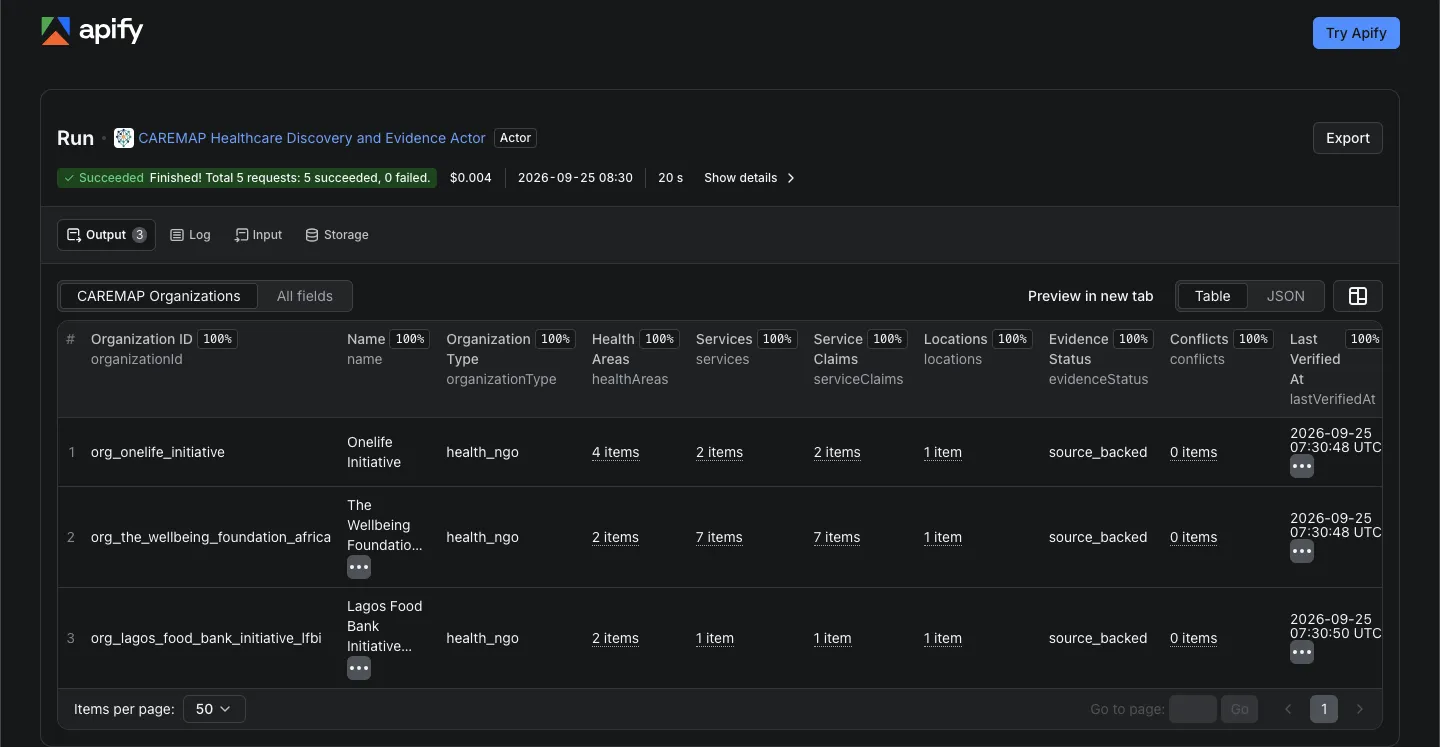
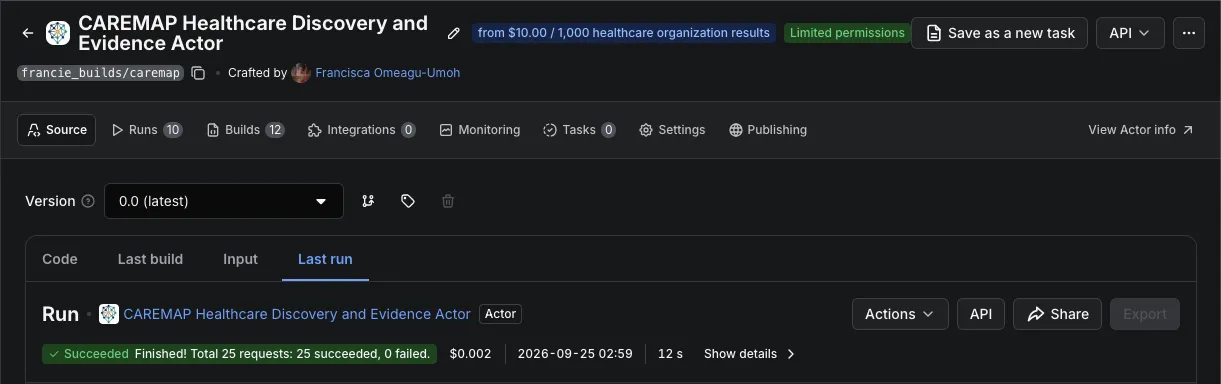
Successful run
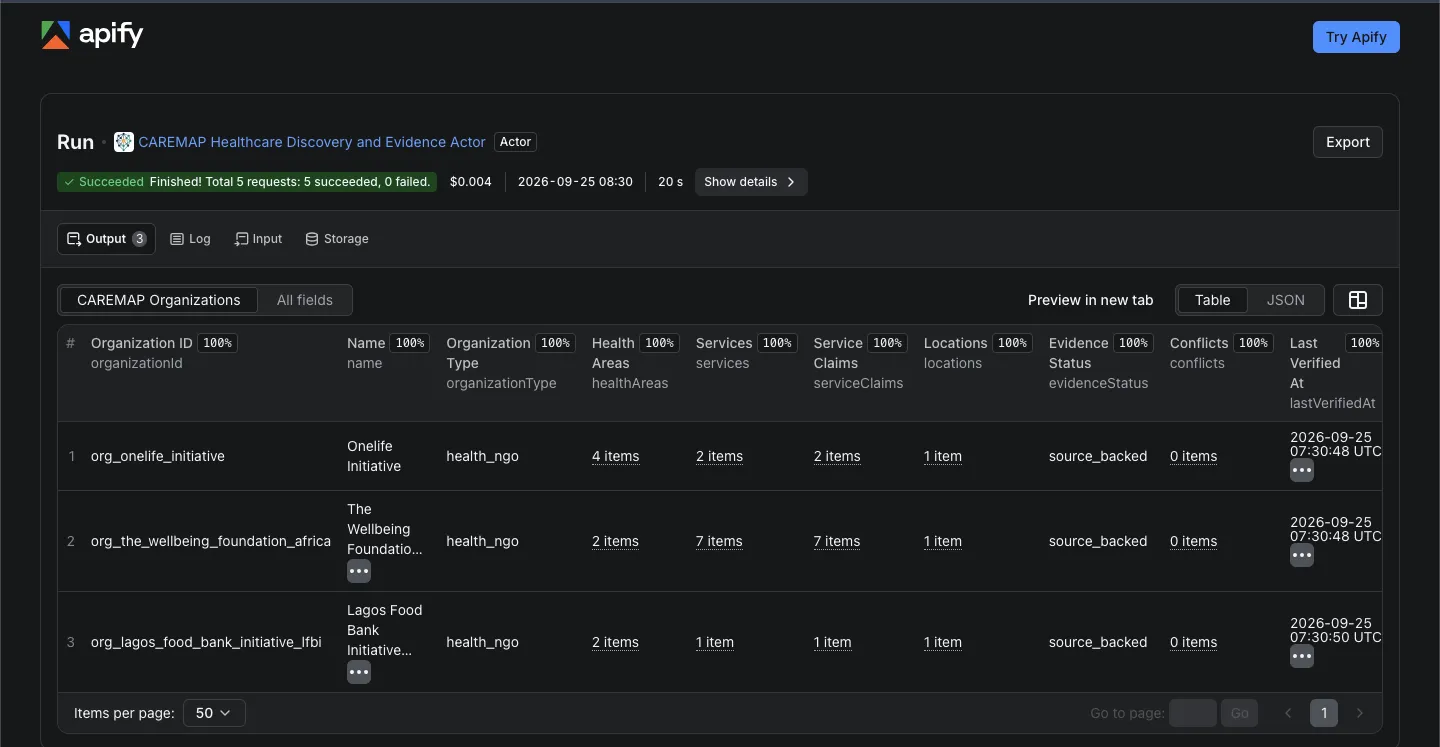
Structured output
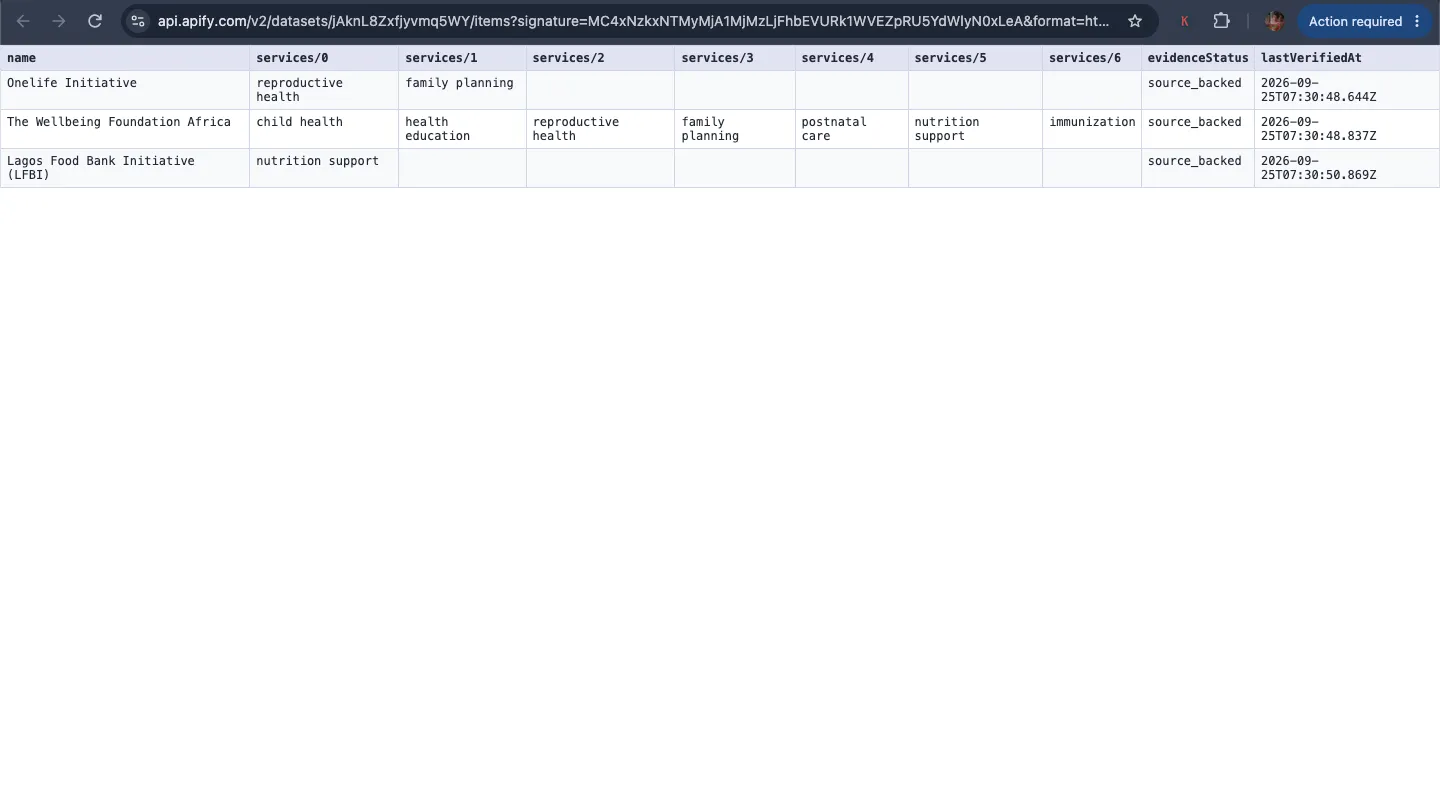
Published Actor
Actor inputs
healthArea
The health area to investigate. See "Supported health areas" above for the full list.
Examples:
location
The Nigerian state, city, or geographic area to focus on.
Example:
maxOrganizations
Maximum number of organization records to return.
includeEvidence
Whether supporting public source information should be collected.
Output
CAREMAP writes structured organization records to the Actor dataset.
Each organization can include:
- organizationId
- name
- organizationType
- description
- healthAreas
- services
- serviceClaims
- targetPopulation
- locations
- access
- evidence
- evidenceStatus
- sourceUrls
- lastVerifiedAt
If a run finds no matching organizations, the dataset (or run log, at minimum) carries the formatted no-results summary described above instead of an unexplained empty result.
Built for more than a directory
CAREMAP is designed as an evidence layer for healthcare discovery.
The current MVP focuses on publicly discoverable health organizations and services. The architecture is designed to expand to:
- Hospitals
- Clinics
- Primary healthcare centres
- Laboratories
- Imaging centres
- Pharmacies
- Government health facilities
- Health NGOs
- Additional Nigerian states
- Additional health domains
Important limitations
CAREMAP works with publicly available information.
It does not guarantee that:
- a facility is currently operating
- a service is currently available
- a service has available capacity
- a published phone number is still active
- a website accurately reflects current operations
Healthcare organizations can change their services, hours, requirements, and contact information without updating every public source.
CAREMAP therefore presents public evidence and its freshness, rather than pretending that scraped information is ground truth.
CAREMAP is a healthcare information and discovery tool. It is not a clinical decision-making system and should not be used as a substitute for professional medical advice or emergency services.
Privacy
The current Actor is designed around publicly available organizational information.
It does not require patients to submit medical records or personal health information.
Technology
CAREMAP is built with:
- Apify Actors (
danek/twitter-scraperfor x(twitter) search andscraper_one/facebook-posts-searchfor facebook posts search) - Crawlee (For NGObase search)
- TypeScript
- Node.js
- Structured dataset outputs
- Evidence-aware extraction
- Entity resolution and source merging
Apify provides the collection and execution infrastructure that allows CAREMAP to turn fragmented public healthcare information into structured, reusable data.
Roadmap
Future capabilities can include:
- More authoritative healthcare registries
- More source types
- Deeper service-level evidence
- Geographic service-gap analysis
- Freshness monitoring
- Source conflict detection
- Healthcare pathway and referral dependencies
- Scheduled evidence refreshes
- API and research-data integrations
- Coverage across additional Nigerian states
The bigger idea
Most healthcare directories answer:
"Where is healthcare?"
CAREMAP is designed to answer:
"Who provides this care, where are they, what do they publicly claim to offer, and what evidence do we have?"
CAREMAP
Don't just find care. Map the evidence behind it.


