

GitHub Candidate Scorer
Pricing
from $154.00 / 1,000 candidate scoreds
GitHub Candidate Scorer
Score GitHub developers against a job description by reading their real repos and code — with evidence, strengths, gaps and contact. · More no-code data tools → datatools-hub.vercel.app
Pricing
from $154.00 / 1,000 candidate scoreds
Rating
0.0
(0)
Developer

Fredrik Hansson
Maintained by CommunityActor stats
0
Bookmarked
2
Total users
1
Monthly active users
7 hours ago
Last modified
Categories
Share
Score developers against a job by reading their ACTUAL code — not just keywords on a profile.
Give it a job description and either a list of GitHub usernames or a search query. For each developer, it reads their real profile, repositories, languages, topics and README content, then scores how well they fit the role — with evidence (which projects and skills justify the score), strengths, gaps, an estimated seniority, and recovered contact details.
This is what a great technical screener does — read the real work — done at scale. Uses the open GitHub API only (no scraping, no legal grey area).
Quick start
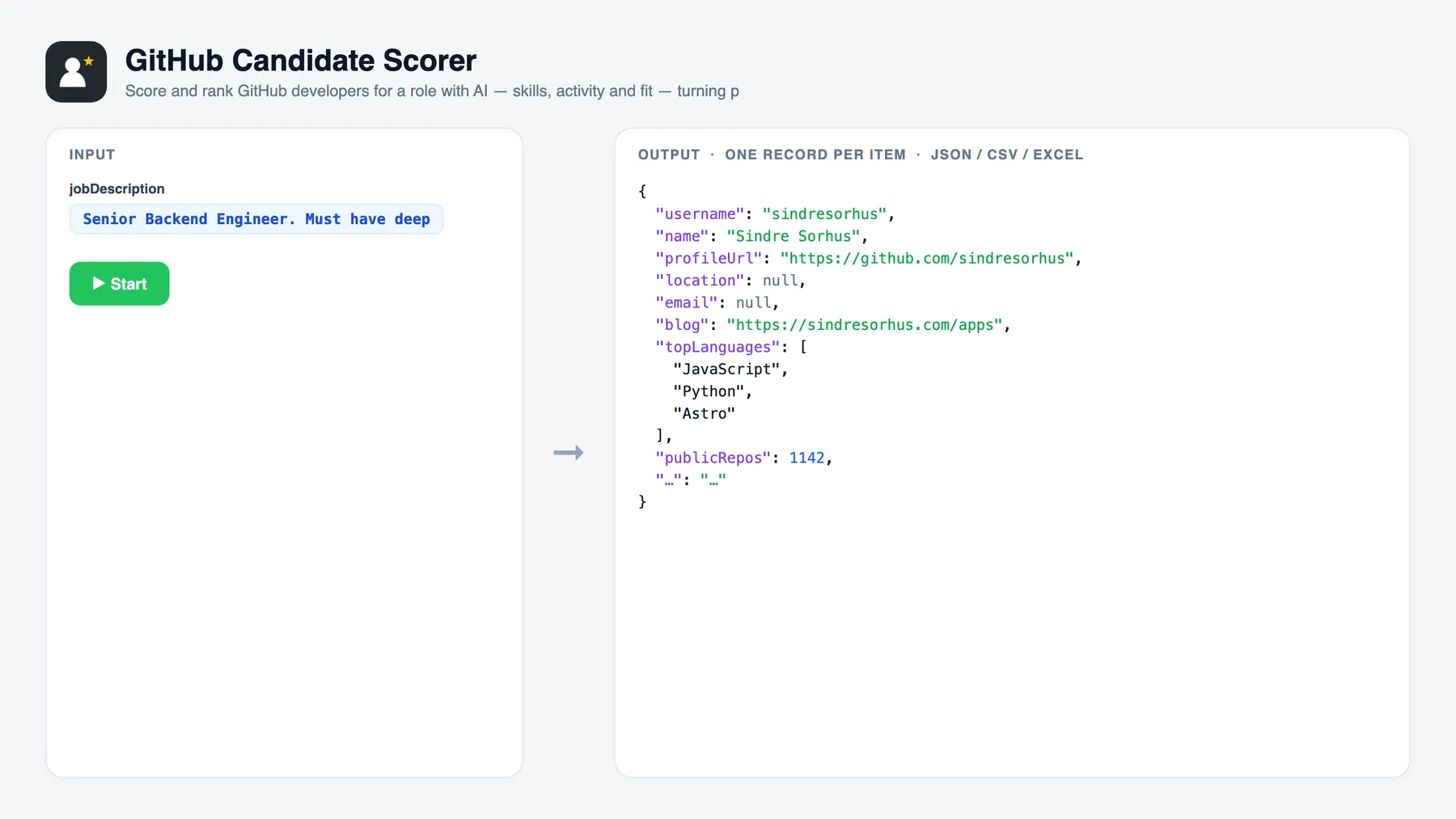
- Fill in the input — set the fields in the input tab (prefilled with a working example).
- Click Start — the Actor runs and writes one record per item to the dataset.
- Get your data — export to JSON, CSV or Excel, or pull it via the API.
Use cases
- Technical sourcing / recruiting — rank a shortlist (or a search) of developers against a specific role, with evidence.
- Hiring triage — turn a pile of GitHub profiles into a ranked, explained candidate list.
- Agent tool — via the Apify MCP server, an agent can score a developer against a role on demand.
Input
| Field | Type | Default | Description |
|---|---|---|---|
jobDescription | string | — (required) | The role to score against. |
usernames | string[] | — | Specific GitHub usernames to score. |
searchQuery | string | — | GitHub user-search query to find candidates (used if no usernames). |
maxResults | integer | 25 | Max candidates to score (one charge each). |
model | string | gpt-4o-mini | OpenAI model. |
Output
One record per candidate: matchScore, seniority, matchReason, strengths[], gaps[], evidence[], topLanguages[], name, location, email, blog, followers, publicRepos, profileUrl. Top candidates in the run SUMMARY.
Pricing
Pay-per-event: one candidate-scored event per developer scored.
Environment variables
| Variable | Required | Purpose |
|---|---|---|
OPENAI_API_KEY | Yes | Powers the scoring. |
GITHUB_TOKEN | Recommended | Free GitHub personal access token — raises the GitHub API limit from 60 to 5,000 requests/hour. Without it, only a few candidates per run. |
Notes
- Reads profile + repositories + top READMEs (real "what did they build" signal). Forks and archived repos are discounted.
- Scoring is evidence-based; provide a detailed job description for best results.
License
ISC.
Related actors
- Nordic Tender Matcher (AI) — AI agent that scores Norwegian, Finnish and Swedish public tenders against your company
- EU & Nordic Grant Finder (AI-matched) — Find open EU + Nordic public-funding calls matched to your company with AI — eligibility
- AI SEO + AEO/GEO Site Auditor — Crawl & Auto-Fix — Crawl a whole site and get an AI-prioritized technical + content + AEO/GEO audit with


