

SEC Account Briefs
Pricing
from $350.00 / 1,000 account brief (extractive or your own key)s
SEC Account Briefs
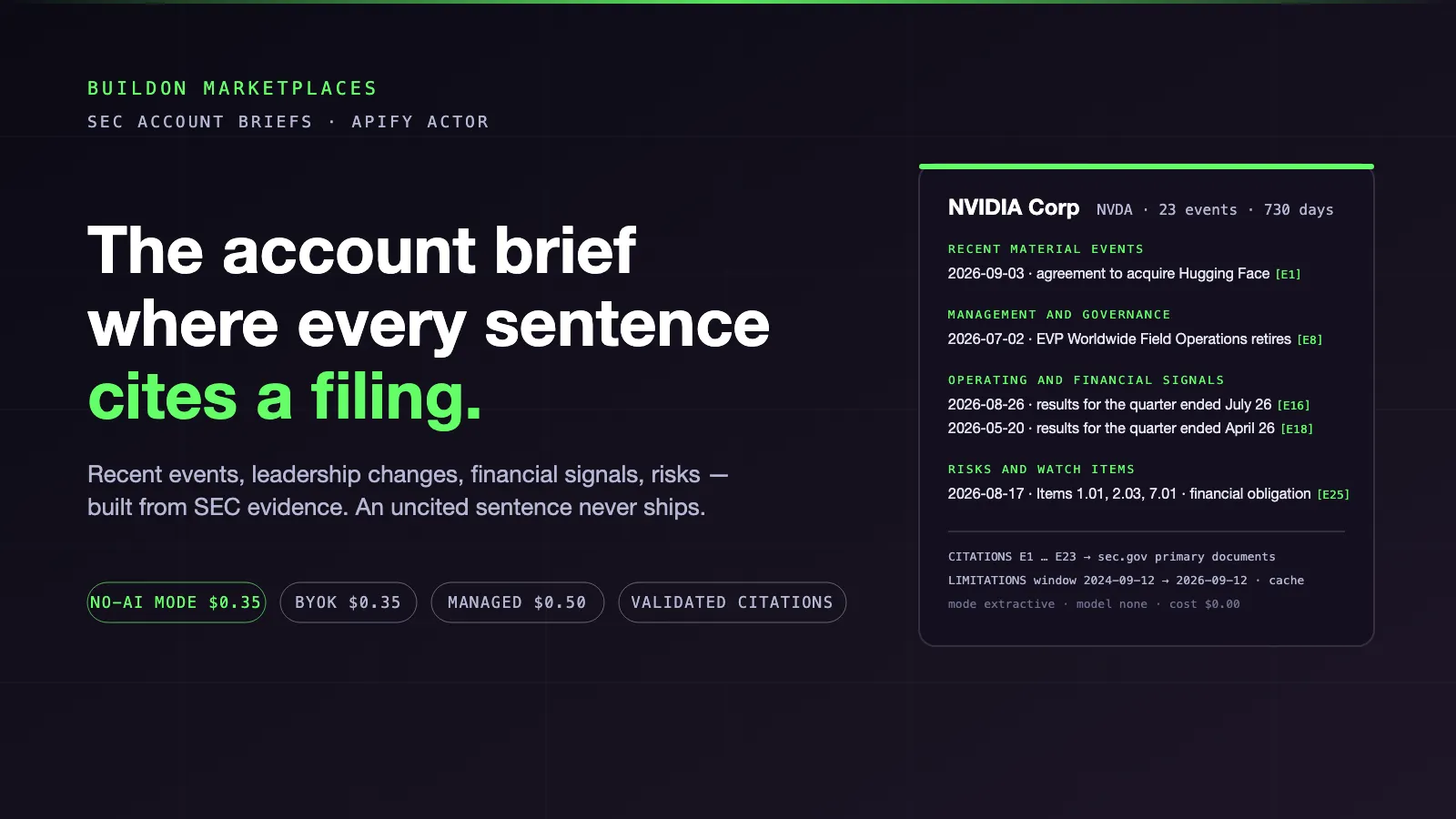
Turn a company's SEC filings into a decision-ready account brief: recent material events, leadership changes, financial signals, and risks — every sentence cited to an 8-K item with a sec.gov link. No-AI, bring-your-own-key, or managed modes.
Pricing
from $350.00 / 1,000 account brief (extractive or your own key)s
Rating
0.0
(0)
Developer

Clance Hoskin
Maintained by CommunityActor stats
0
Bookmarked
2
Total users
1
Monthly active users
a month ago
Last modified
Categories
Share
A decision-ready account brief for any US filer — every sentence cited to an SEC filing.
Give it a company. Get back a structured brief: what changed recently, who came and went at the top, what the financial signals are, what to watch — each point tied to a specific 8-K item with a link to the filing on sec.gov. Run it with no AI at all (every line is a cited fact), with your own Anthropic key, or in managed mode where a bounded model writes two to four sentences per section and a validator throws out any sentence it can't cite.
See how it works, with a real brief you can read, at buildonmarketplaces.com/solutions/sec-account-briefs.
Who it's for
- Sales teams doing pre-call research on enterprise accounts: the brief is the first page of your account plan, and every claim in it survives a "where did you read that?"
- Account-research and investment-research teams who need a repeatable, citable summary per company rather than a fresh reading of every filing.
- Anyone who has been burned by an AI summary that made something up. This one structurally cannot — see How the citation guarantee works.
What you get
One dataset item per company:
| Part | What it holds |
|---|---|
company | Name, ticker, CIK — as SEC names the registrant |
window | The evidence window (from, to, lookbackDays) |
coverage | How many filings the brief draws on, by form, with newest and oldest dates and cache freshness |
sections[] | Four synthesized sections — Recent material events, Management and governance, Operating and financial signals, Risks and watch items — each a list of sentences with citations (E1, E2, …) |
citations[] | Every cited evidence item: filing date, form, headline, filingUrl, primaryDocumentUrl |
limitations[] | The window, caps hit, sections with no evidence, any section that fell back to extractive text and why, and the model cost if a cap was exceeded |
evidenceSet[] | The exact events the brief was built from, with retrievedAt and classifierVersion — regenerate the same brief from the same evidence |
model | null in extractive mode; otherwise the mode, model id, and effort |
costs | Mode, model, tokens, estimated USD, cap, and an exceeded flag — BYOK and managed costs are never mixed |
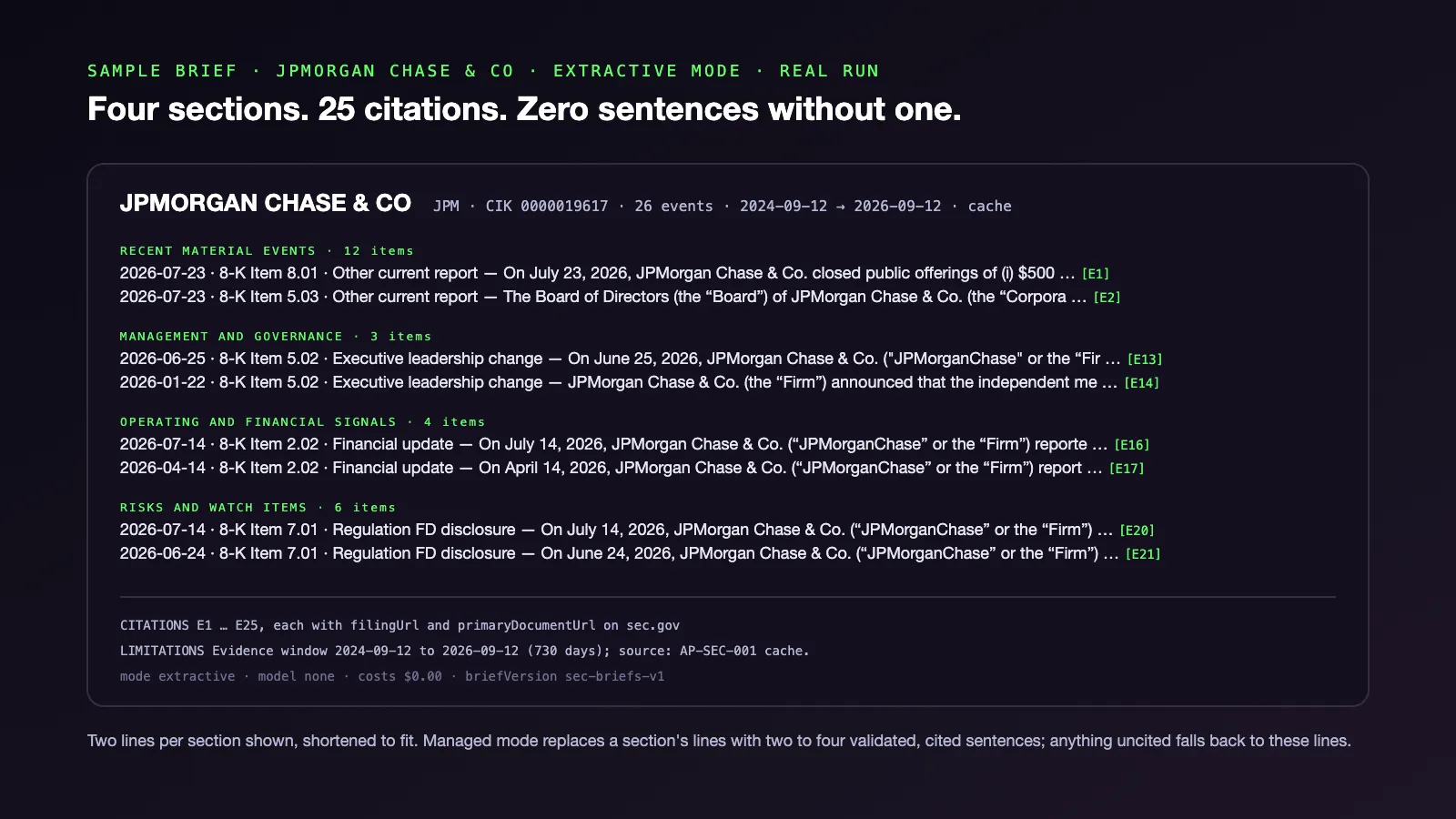
Each section says where its text came from: synthesized (model sentences that passed validation), extractive (deterministic cited lines), or empty (no evidence in the window — stated, never filled).
Sample section (extractive mode, real run)
How the citation guarantee works
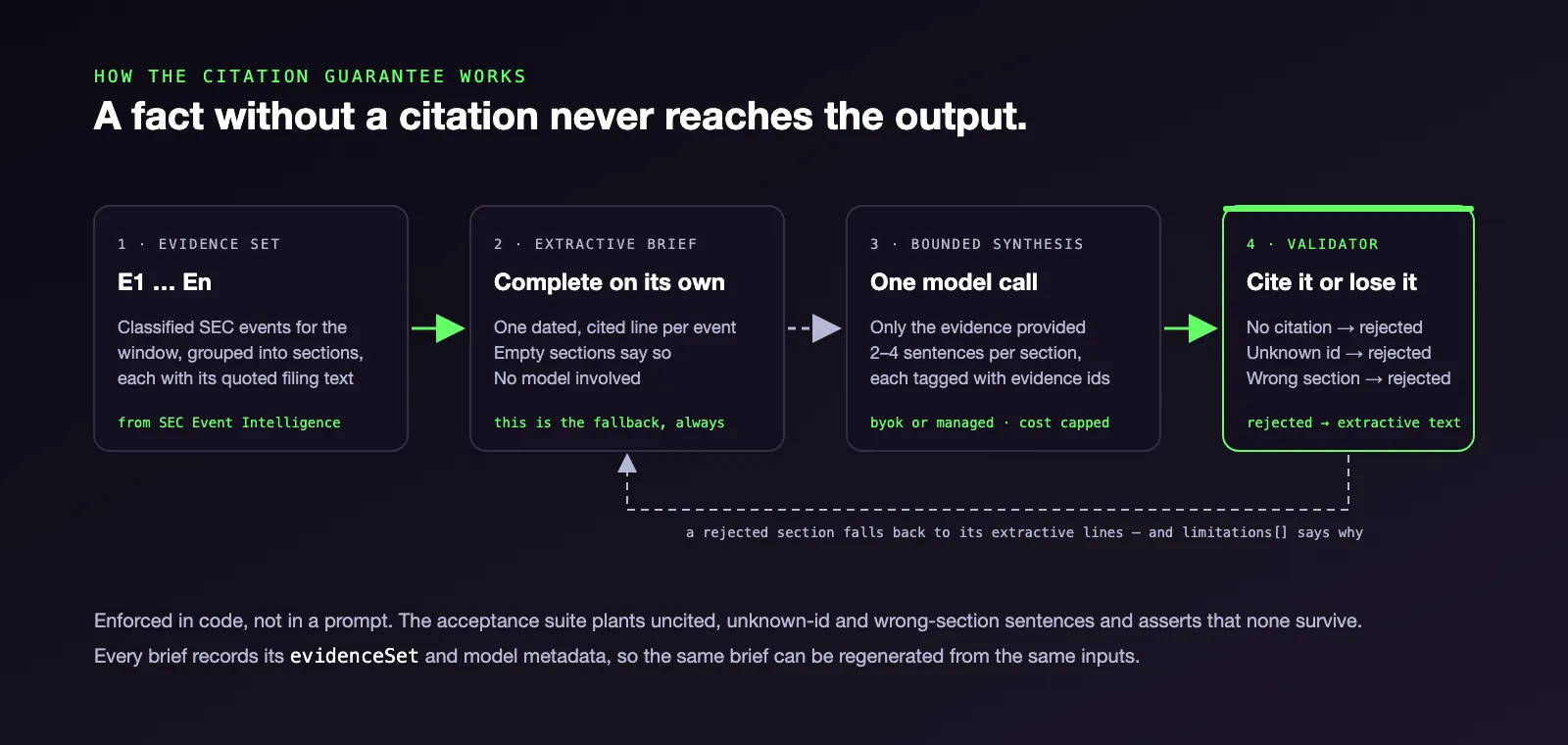
- Evidence first. The brief's skeleton is built from the company's classified SEC events (from the companion SEC Event Intelligence cache). Each event becomes a numbered evidence item —
E1,E2, … — with its quoted filing text and links. - The extractive brief is complete on its own. Every line is a dated, cited fact. In
extractivemode this is the whole brief, and no model runs. - Synthesis is bounded. In
byokormanagedmode, one structured model call writes two to four sentences per section, using only the evidence it was given, and must tag every sentence with the evidence ids it rests on. - The validator decides. A sentence with no citation, a citation to an id that doesn't exist, or a citation to evidence from a different section rejects the whole section. A rejected section falls back to its extractive text, and
limitationssays why.
The model cannot add a fact, because a fact without a citation never reaches the output. This is enforced in code, not in a prompt.
Input
| Field | Notes |
|---|---|
companies | 1–10 companies by SEC CIK. Ticker and legal name are display hints. |
asOfDate, lookbackDays | The evidence window: lookbackDays (1–1095) ending at asOfDate (default today). |
sections | Which synthesized sections to include. Coverage, citations, and limitations are always included. |
detail | brief (up to 5 events per section) or standard (up to 12). |
aiMode | extractive — no model. byok — your Anthropic API key, passed as a secret input. managed — the operator's model. |
anthropicApiKey | BYOK only. Stored as a secret; never written to the dataset or logs. |
model | BYOK only: claude-opus-5 (default), claude-sonnet-5, or claude-haiku-4-5. |
maxModelCostCents | BYOK and managed: flag a brief whose model usage runs past this many US cents (1–20). The brief is still delivered, with the limitation noted. |
Pricing
Pay per brief, charged only for a completed brief:
| Mode | Event | Price | Model |
|---|---|---|---|
| Extractive | byokBrief | US$0.35 | none |
| BYOK | byokBrief | US$0.35 | on your key; the brief reports the tokens and list-price USD it used |
| Managed | managedBrief | US$0.50 | included in the price |
Prepaid volume blocks
For teams buying ahead, prepaid blocks are consumed in 500-brief increments. These are commercial bundle prices; the Actor's Apify pay-per-event event prices remain US$0.35 for extractive/BYOK and US$0.50 for managed.
| Briefs | BYOK | Managed |
|---|---|---|
| 500 | US$175 (US$0.35/brief) | US$250 (US$0.50/brief) |
| 1,000 | US$325 (US$0.325/brief) | US$475 (US$0.475/brief) |
| 2,500 | US$750 (US$0.30/brief) | US$1,100 (US$0.44/brief) |
| 5,000 | US$1,400 (US$0.28/brief) | US$2,000 (US$0.40/brief) |
Bundle pricing is separate from the Actor's fixed event prices and does not change Apify pay-per-event billing.
A company with no events in the window still yields a (mostly empty) brief; it is charged as a completed brief because the coverage, citations, and limitations sections are real answers.
If the run reaches the spend limit you set when starting it, the dataset holds only the briefs you were charged for, and the run summary reports charging.limitReached: true with the counts.
Limits — please read
- Coverage follows the SEC Event Intelligence cache. A brief reports
freshness.lastCheckedAtandfreshness.stale; when it is stale or the company has never been checked, run SEC Event Intelligence for that company first — the brief itself never fetches from SEC. - Evidence is the 8-K item section, not the exhibits. Earnings numbers, for example, live in the press-release exhibit; the brief will tell you results were announced and link the filing, not restate the figures.
- Sections with no evidence stay empty. The brief never fills a gap with outside knowledge.
- In managed mode, sentences are the model's words — but every one is cited. Read the citations; the
evidenceSetlets you regenerate the brief from exactly the same inputs. - Model usage is reported in the brief — tokens and list-price USD, separately for BYOK and managed, never blended with the brief price.
- No advice, no predictions. Sentences describe what filings say.
Compared with alternatives
| Reading the filings | A generic AI summary | SEC Account Briefs | |
|---|---|---|---|
| Time per account | 30–60 minutes | seconds | seconds |
| Can you verify a claim? | yes, by hand | usually not | every sentence carries citations → primaryDocumentUrl |
| Can it invent a fact? | no | yes | no — uncited sentences are rejected in code |
| Repeatable | no | no | evidenceSet + model metadata on every brief |
FAQ
Which mode should I start with? extractive. It uses no model at all, every line is a fact, and it shows you exactly what the brief would be built from. Switch to managed when you want prose.
What's the difference between BYOK and managed? Same brief structure and the same validator. BYOK uses your Anthropic key and you pay Anthropic directly; managed uses ours with a hard cost cap per brief.
What happens if the model refuses or errors? The brief is still delivered, fully extractive, with the reason in limitations. The run does not fail.
Can it brief any company? Yes, once SEC Event Intelligence has fetched it; the brief tells you when it has not.
Where do the events come from? The companion Actor, SEC Event Intelligence — same cache, same classifier, same evidence.
Support
Use the Actor's Issues tab. For a wrong or unsupported sentence in managed mode, include the eventIds from evidenceSet — the brief is reproducible from them.
Changelog
- 0.1 — Private build. Extractive, BYOK, and managed modes; citation validator with extractive fallback; per-brief model-cost cap.


