

AutoScout24 Scraper — Used Car Listings, 8 European Markets
Pricing
from $30.00 / 1,000 listing page harvesteds
AutoScout24 Scraper — Used Car Listings, 8 European Markets
34-field rows: seller phone, price, mileage, first registration. Compact LLM mode. Gebrauchtwagen, Fahrzeugsuche, ogloszenia samochodowe, auta uzywane. 8 markets incl. Poland (de/at/fr/it/es/nl/be/pl). Incremental: idle run $0.00005 (start fee only). Failed pages never billed. Price-drop flag.
Pricing
from $30.00 / 1,000 listing page harvesteds
Rating
0.0
(0)
Developer

B
Maintained by CommunityActor stats
0
Bookmarked
1
Total users
1
Monthly active users
17 days ago
Last modified
Categories
Share
AutoScout24 Listings — 8 European Markets
Flat, normalised vehicle listings from AutoScout24 search results — one clean
JSON row per vehicle across 8 country sites (de/at/fr/it/es/nl/be/pl).
Built for daily price-monitoring and inventory schedules, not one-off
human searches. (ch is currently source-blocked — see Honest limits.)
Independently validated: a from-scratch comparator (zero shared code with
the actor) re-parses the same-minute raw HTML and re-derives every field —
latest fresh gate 2026-09-25 on fr/audi: 20 rows × 28 fields, 0
mismatches, with priceEur re-derived from the human-visible formatted
price (not the raw field the actor reads) and listings located by the
comparator's own structure discovery. Earlier gates: 40/40 rows on de
(2026-09-06), v0.7 price-evaluation fields (0 mismatches).
Why this one
| typical store scraper | this actor | |
|---|---|---|
| Markets | 5–8 domains | 8, incl. Poland |
| Broken page / site change | emits garbage or partial rows | fails loudly, zero charge |
| Failed or empty run | you still pay compute events | harvest events only fire on written pages |
| Output | ad-hoc shapes per run | stable schema, identical across all 8 markets |
A 31k-run competitor in this niche holds a 1.75/5 rating — broken runs and inconsistent output are the norm. This actor is the boring, reliable alternative: same schema every run, and you are never charged for a page that failed to parse.
What you get (per listing)
id, url, make, model, variant, trim, offerType (U=used / N=new /
A=all), priceEur + priceFormatted, priceEvaluation +
priceEvaluationLabel (AutoScout24's own deal rating:
1=very-good-price … 4=somewhat-expensive-price, null when unrated),
priceDropFrom (the on-site "Super Deal" previous price — the price-drop
signal), currency, mileageKm,
firstRegistration (MM/YYYY), fuelType, gearbox, powerKw,
engineDisplacementCc, consumptionL100Km + co2Class (WLTP, EU 2023 A–G
label; null when AS24 does not publish them), equipment (the listing's own
equipment line), sellerType
(Dealer/Private), sellerName, sellerId, sellerPhone (formatted dealer
phone), sellerStreet, city, zip, countryCode,
imageCount, cover image, source page, scrapedAt (ISO 8601 UTC).
34 fields total, all extracted from the search results page we already
fetch — no extra per-listing requests. compact: true trims to the 22
core fields (see Input).
Sample output (real run, de/bmw — rendered)
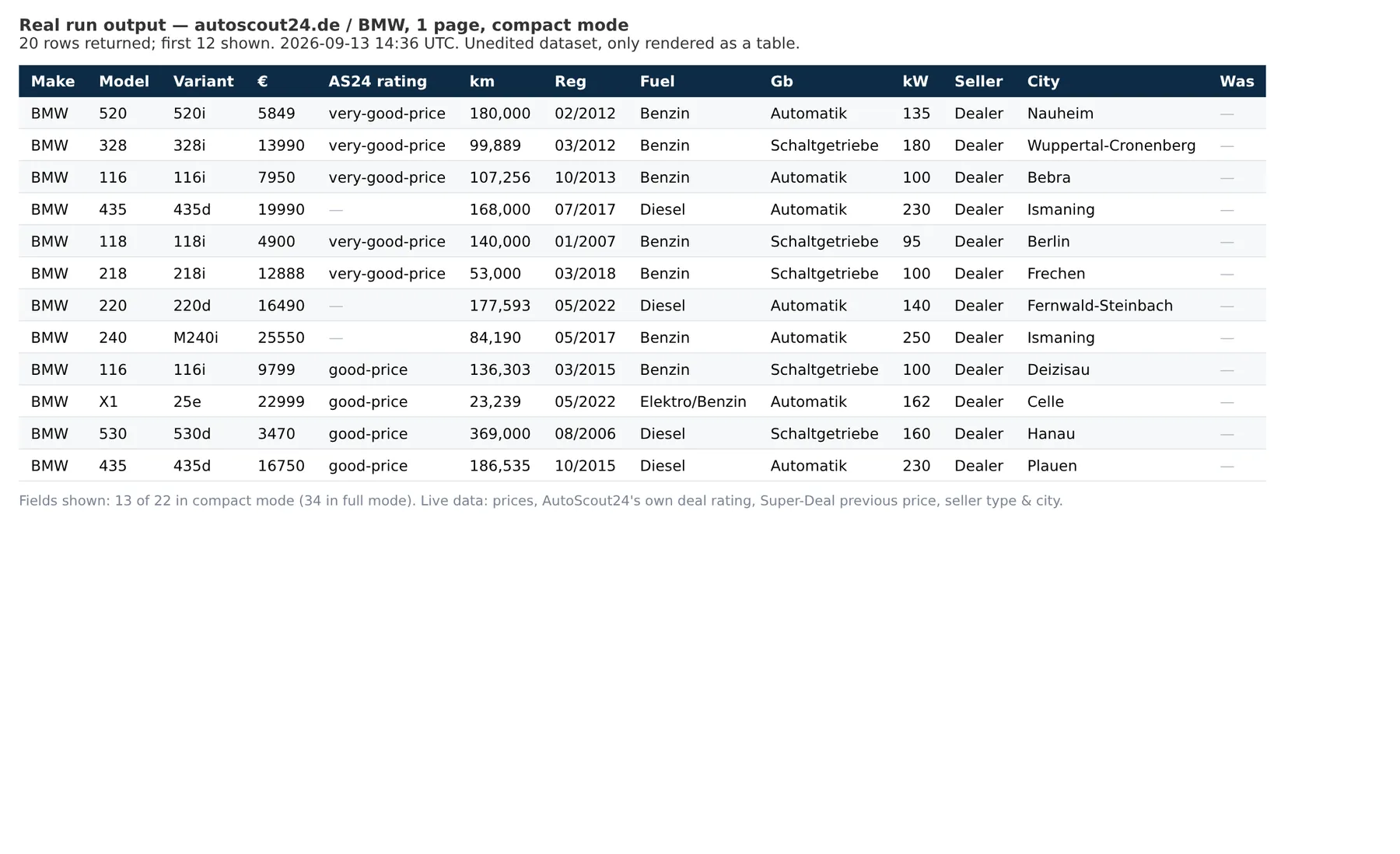
Above: an unedited run from 2026-10-02 (dataset rendered as a table, 12 of 20 rows shown). Raw JSON for one real row:
Input example
domain— country site:de,at,ch,fr,it,es,nl,be,plmake— URL slug (bmw,audi,volkswagen, …); empty = all makesmodel— URL slug (3er,golf,a4, …); requiresmakepriceFrom/priceTo— EUR band filter (optional)firstRegistrationFrom/firstRegistrationTo— first-registration year window (optional, v0.8)mileageFromKm/mileageToKm— km band filter (optional, v0.8)fuel— fuel code:Bpetrol,Ddiesel,Eelectric,2hybrid-petrol,3hybrid-diesel,LLPG,Hhydrogen (optional, v0.8)pages— 1–50 results pages; each page = 20 listings, ~1.5 s fetch intervalincremental— deliver only listings not delivered before for this query; pages with nothing new are not charged (idle scheduled run = $0). Defaultfalse= full listing set every run.compact— deliver only the 22 core fields per row (id, url, make, model, variant, offerType, both price fields + AS24 price rating + price-drop flag, mileage, first registration, fuel, gearbox, power, seller type, city, country, page, scrapedAt). Same rows, same charges — ~40% smaller payloads for dashboards and LLM contexts. Incremental change fields (changeType,previous*) are always kept. Defaultfalse= full 34-field schema.
Incremental mode also detects changes (v0.5)
With incremental: true the actor tracks price, mileage, offer type and
seller per listing between runs. A listing that changed is re-delivered
with a changeType field (price, mileage, seller, offer-type, or a
+-joined combination) plus the previous values (previousPriceFormatted,
previousMileageKm, previousOfferType, previousSellerType). A change is
delivered exactly once; the next run with no further change fires no
per-page events again (only the $0.00005 platform start fee).
So each scheduled run returns exactly what a price-watch pipeline needs:
new listings and re-priced/edited listings.
Use it from an AI agent (MCP)
This actor exposes an MCP server. Ask your agent:
Or call it directly:
For AI agents & LLM apps (compact reference)
- Purpose: flat AutoScout24 search-results rows for price monitoring, dealer-inventory watches and market analysis across 8 European markets.
- Minimal input:
{"domain":"de","make":"bmw","pages":2}(all other fields optional). - Output fields per row:
id,url,make,model,variant,trim,offerType,priceEur,priceFormatted,priceEvaluation,priceEvaluationLabel,currency,mileageKm,firstRegistration,fuelType,gearbox,powerKw,sellerType,sellerName,sellerId,city,zip,countryCode,image,page,scrapedAt. - Agent behaviors you can rely on:
- billing is per 20-listing results page written, never per message or per listing;
- a query the site answers with zero listings is a SUCCEEDED run with 0 rows and 0 charges — safe to probe;
- a site layout change fails the run loudly (exit non-zero, no partial garbage rows) — never interpret empty output as "no cars";
scrapedAt+ stableidmake rows diff-able across scheduled runs for "new since yesterday" alerts;- in incremental mode a changed listing arrives with
changeType(price,mileage,seller,offer-type,+-joined combos) andprevious*fields — you get re-priced listings without diffing yourself, each change delivered exactly once; - schema is identical across all
domainvalues — one parser, no per-market branching in your pipeline.
Use it from Python
Pricing (with the honest comparison)
$0.03 per results page (20 listings) + $0.00005 per actor start. A failed parse raises before the charge event fires — a page that yields nothing is never billed. In incremental mode an idle scheduled run fires no per-page events at all; the only charge is the platform's $0.00005 actor-start fee.
At depth, per-listing competitors can be cheaper — here is the real break-even, computed from their live prices (blackfalcondata re-checked 2026-10-05; memo23 checked 2026-09-11):
| listings pulled | this actor (page-based) | blackfalcondata $0.00049/item + $0.005 start | memo23 $0.0009/item + $0.005 start |
|---|---|---|---|
| 20 (1 page) | $0.03005 | $0.0148 | $0.023 |
| 100 (5 pages) | $0.15005 | $0.054 | $0.095 |
| 400 | $0.60005 | $0.201 | $0.365 |
| 1,000 (max/run) | $1.50005 | $0.495 | $0.905 |
Read it straight: for one-off bulk pulls, the per-item leaders are cheaper. Where this actor still wins:
- Quiet-day monitoring runs cost one 200th of the leaders' — an incremental run with nothing new writes no pages and fires no per-page, per-listing or per-result event: only the platform's $0.00005 actor-start fee (verified from our own runs' billing). Per-item actors with incremental modes still charge their start event plus a per-listing- checked fee on every run (e.g. the volume leader: $0.005 start + $0.00002 x listings checked = $0.01/run at 250 vehicles, even on a day with zero changes — 200x ours), so a broad schedule of many small per-model watches stays near-free here and compounds there.
- Coverage — 8 markets incl.
plin one schema; several leaders are single-market. - Failed pages are never billed — the charge fires only on written pages.
Honest update 2026-10-05: the volume leader now also ships an incremental mode (per-listing-checked fee, results billed only when new or changed, EXPIRED/repost tracking). Our earlier claim that per-item actors "re-bill every listing on every run, forever" stopped being true when they shipped it — at high churn their monitoring runs are now cheaper than ours. The $0-start edge above is the part that survives, and it is the one that matters when you run many small schedules.
Alternatives (and when to pick them)
- blackfalcondata/autoscout24-scraper (58k runs, 61 users/30d) — the volume leader; $0.00049/result is the cheapest bulk pull, and it now also ships an incremental mode (per-listing-checked fee, bills only new or changed results). Pick it for large one-off extracts and for monitoring a few broad queries; at high listing volume their per-run floor (~$0.01 start + checked) is still below our page pricing.
- memo23/autoscout24-scraper (6k runs) — per-result pricing with
additional-dataevents; mid-priced bulk. - ivanvs/autoscout-scraper (32k runs) — $0.004/result tiered by plan; convenient if you already standardise on their output shape.
- Single-country actors (3x1t CH, fayoussef, others) — if you need exactly one market and nothing else.
- This actor — pick it for recurring price/inventory watches across markets, near-zero-cost idle incremental runs, change alerts, and a stable 34-field schema.
Troubleshooting
- Run failed with exit non-zero, 0 charges — a page failed to parse;
most often a transient AS24 response or a layout change. Re-run (free).
If it repeats on one
domainbut not others, report it — that's a parser gap, not your input. - 0 rows, 0 charges, status SUCCEEDED — the query genuinely matched
nothing. This is a valid empty answer, not a failure. Widen price/year
bands or drop
model. - Incremental run suddenly returns everything again — the filter set
changed (state is keyed per exact filter combo), or the state entry
(>20k ids) was rotated. Deduplicate on
iddownstream; the next run returns to new/changed only. previousPriceFormattedpresent but price looks identical —priceEuris the compared field; formatted strings can differ by formatting only. Diff onpriceEur.- Webhook/Telegram silent — check the run log; delivery is fail-soft and errors are logged, never fatal. Idle runs ($0.00005) still POST the webhook (heartbeat by design).
Scheduler recipe (the intended use)
- Create one schedule per filter combo you track (e.g.
de/bmw/5–25k,at/audi/all,pl/volkswagen/under 40k). - Set
incremental: true— the actor remembers every delivered listing per query and delivers only new or changed ones on each run. A scheduled run where nothing changed fires no per-page events: pages whose listings were all delivered before and unchanged are not charged (only the $0.00005 platform start fee applies). Your downstream never re-processes history. - Set
pages: 5for a stable daily snapshot of the top 100 listings (full mode) or of the new/changed-listings window (incremental mode).
State lives in the actor's key-value store, keyed per query
(domain+make+model+price/year/km/fuel set), bounded to the 20,000 most recent ids —
no unbounded growth, and each schedule/filter combo keeps its own stream.
Notifications (free — webhook & Telegram)
Close the loop without polling the dataset:
- Webhook (
webhookUrl): every finished run POSTs a JSON summary — query, mode, delivered/new/changed counts, pages charged, and up to 5 sample listings — including idle runs, so your pipeline gets a heartbeat, not silence. Machine-readable, one endpoint, any receiver. - Telegram (
telegramBotToken+telegramChatId): a human-readable message ("3 new + 1 changed — de/bmw €5000-25000 • [price] BMW 320d € 19.900 (was € 20.900)…") sent only when there is something to read.
Both are free, forever — zero billing events, and fail-soft: a dead endpoint is logged and the run still succeeds with its dataset. Pair with incremental mode + a schedule for a complete new/changed-listings alert pipeline that costs $0.00005 on quiet days.
FAQ
How many results can I get per run?
pages accepts 1–50; each page is 20 listings, so up to 1,000 rows per run.
For more, run multiple filter combos (make / model / price / year / km / fuel) — each is a cheap
separate run.
Which countries are covered?
Nine AutoScout24 country sites: de, at, ch, fr, it, es, nl,
be, pl — the same normalised schema from all nine, with countryCode
on every row.
Does it support recurring monitoring?
Yes — that is what it is built for. Two ways: schedule a run per filter
combo with incremental: true and get only the new or changed listings
each run — a price drop re-delivers the listing with changeType: "price"
and its previous price; a run with nothing new or changed fires no
per-page events ($0.00005 platform start fee only). Or
leave incremental off and dedupe on the stable id + scrapedAt
(ISO 8601 UTC) fields yourself.
What happens if AutoScout24 changes their page?
The run fails loudly instead of emitting garbage rows — and you are not
charged: the listing-page-harvested event only fires after a page is
successfully parsed and written.
What if my query matches zero listings? The run SUCCEEDS with 0 rows and 0 charges — a valid empty answer, not a failure. Widen the make/price range and re-run (free).
Can I use it through an MCP server? Yes. The actor exposes an MCP server, so AI assistants can call it directly (see the MCP section above).
Can I pull the data into Python or Node?
Yes — the snippet above shows apify-client for Python; the same pattern
works in Node with apify-client from npm, or plain HTTP against the
Apify API.
Is there an official AutoScout24 API? No — AutoScout24 does not offer a public listings API. This actor is the practical alternative: structured JSON ready for a database, dashboard or model, no HTML parsing on your side.
Is it legal to scrape AutoScout24? The actor extracts publicly available listing data. Scraping public information is generally considered legal, but review the target site's terms and ensure your use case complies with applicable law, including GDPR where relevant.
Keywords
autoscout24 scraper, autoscout24 api, autoscout24 listings, car listings scraper, used car data europe, vehicle inventory feed, car price monitoring, dealer stock monitor, automotive market data, second hand car prices, autoscout24 deutschland, autoscout24 daten, gebrauchtwagen scraper, auto listings json, car market analysis europe, price watch schedule, vehicle data for ai agents, european car market dataset, incremental scraper, car search filters, filter by fuel diesel petrol electric, filter by mileage, filter by first registration year, bmw 3er monitor, new listings alert, new since yesterday, car monitor scheduler, webhook notifications, telegram alerts, price drop alert, price change monitor, price change alert, price drop monitor, car price tracker, listing change detection, autoscout24 poland, autoscout24 pl, otomot pl alternative, car listings poland, ogloszenia motoryzacyjne, samochody uzywane, autoscout24 Polska, used cars Poland
Changelog
-
0.14 (2026-10-02) — Fresh sample output. The sample table and raw-JSON row now come from a live run of 2026-10-02 (de/bmw, 1 page, compact mode, 20 rows, dataset
RiCponcdNwtNaiXNu). README-only change — no code, schema or pricing changes; charging behaviour untouched. -
0.13 (2026-09-25) — BE fix + coverage truth pass.
bere-fixed after the source restructured to locale-prefixed paths (bare/lst404s); independent comparator gate re-run fresh onfr/audi(20 rows × 28 fields, 0 mismatches, incl. priceEur re-derived from the visible formatted price); all-market live sweep: 8/8 work,chsource-blocked (403 from both sandbox and platform egress) — README/schema corrected from "9 markets" to the truth. Two platform probe runs of the failing markets confirmed fail-loud-zero-charge. -
0.12 (2026-09-13) — Sample-output screenshot. The sample section now leads with a rendered table of a real run (de/bmw, 1 page, compact, 2026-09-13) hosted on our site, above the raw-JSON row. README-only change; no code, schema or pricing changes.
-
0.10.1 (2026-09-11) — README truth fixes + honest pricing. The field list and "Honest limits" still described the pre-0.9 output (denied sellerPhone/equipment/CO2 existed) — corrected to the real 34-field schema. Added pricing-at-depth break-even table vs live competitor prices (2026-09-11), Alternatives and Troubleshooting sections. No code changes; charges and schema unchanged.
-
0.10 (2026-09-07) — Compact mode. New
compact: trueinput: deliver only the 22 core fields per row — identity, price + AS24 price rating + price-drop flag, mileage, first registration, fuel, gearbox, power, seller type, city. Same rows, same charge events, identical incremental behaviour (change detection runs on the FULL row before compaction, so togglingcompactnever re-delivers the world or corrupts state). Built for dashboards and LLM contexts where the full 34-field schema is overhead. Independent gate: 20 live rows, 22/22 projected values byte-identical to the full rows, 0 mismatches (smoke/test_v10_compact.py, 10/10 PASS). -
0.9 (2026-09-06) — Detail enrichment at zero cost. 8 new fields per row, all extracted from the search page we already fetch — no extra requests, no new billing events, identical charge contract (per page with deliverable rows):
sellerPhone(formatted dealer phone, 19/20 in sample),sellerStreet,equipment(the listing's own equipment line),engineDisplacementCc,consumptionL100Km+co2Class(WLTP, EU 2023 A–G label; null when AS24 does not publish them),imageCount, andpriceDropFrom(AS24 "Super Deal" previous price — the on-site price-drop signal). Verified against a from-scratch re-parse of the same payload: 20/20 rows exact, 0 mismatches. -
0.8 (2026-09-06) — Search filters: model, year, mileage, fuel. Narrow the harvest before paying for pages:
model(URL path segment, e.g. bmw/3er),firstRegistrationFrom/firstRegistrationTo(year window),mileageFromKm/mileageToKm(km band) andfuel(7 codes: B/D/E/2/3/L/H). Every filter verified live against returned content on 2026-09-06 — afuel=Dquery returns only Diesel listings, a 2018–2020 window only 2018–2020 cars. Incremental state is keyed per full filter set, so overlapping queries never pollute each other's seen-listings. Same billing: one event per results page that carries deliverable rows. Zero-result filtered query = free, valid empty answer. -
0.7 (2026-09-06) — AS24 price-rating labels. Every row now carries
priceEvaluation(1–4) andpriceEvaluationLabel(very-good-price / good-price / fair-price / somewhat-expensive-price) — AutoScout24's own deal classification, the same signal buyers see on site. Rank deals in your pipeline without a separate evaluation step. Null when AS24 has not rated the listing. Zero new requests, zero new billing events; incremental fingerprints unchanged (rating drift ≠ listing change). -
0.6 (2026-09-01) — Free notifications: optional
webhookUrl(JSON run summary on every finished run, including idle runs) andtelegramBotToken+telegramChatId(human-readable message when there are new/changed listings). Zero billing events, fail-soft — a broken endpoint never fails a run. No changes to scraping, incremental state or pricing. -
0.5 (2026-09-01) — Change detection in incremental mode: the actor now tracks price, mileage, offer type and seller per listing between runs. A changed listing is re-delivered with
changeType(price,mileage,seller,offer-type, or+-joined) andprevious*fields showing the old values. Changes are delivered exactly once; a run with nothing new or changed fires no per-page events ($0.00005 start fee; earlier READMEs wrote "$0" — the platform start event is billed). Backward compatible with 0.3 incremental state (ids without fingerprints are treated as unchanged until first seen in 0.4). Full mode unchanged. -
0.3 (2026-09-01) — Incremental mode: set
incremental: trueand the actor remembers delivered listings per query (key-value store, bounded to 20k ids) and delivers only new ones. Pages with no new listings are not charged — an idle scheduled run fires no per-page events ($0.00005 start fee only). Full mode unchanged (defaultfalse). -
0.1.8 (2026-08-26) — README v3: restored the full store listing (FAQ, sample output, AI-agent reference, keywords) that a hotfix deploy had silently replaced with an early draft. No code changes.
-
0.1.7 (2026-08-24) — Empty-answer correctness gate: a query the site answers with zero listings now SUCCEEDS with 0 rows and 0 charges instead of failing red. Bad input is still rejected before any charge.
-
0.2 / 0.1.6 (2026-08-20) — Public store release. Pay-per-event pricing ($0.03 / results page, failures never charged). Poland (
pl) added — 8 markets total (ch source-blocked since ~09-2026). Loud-fail parser guardrails. -
0.1 (2026-08-19) — Initial build: 8 markets, normalised 23-field schema, scheduler-oriented design, private QA runs.
Honest limits
chis currently source-blocked (since ~2026-09): autoscout24.ch returns HTTP 403 to datacenter traffic on every path, from every egress we can test (sandbox and Apify platform both, verified 2026-09-25). Achrun fails loudly with zero charge — the no-garbage guarantee holds, but you get no data. All other 8 markets verified live 2026-09-25 (7 in one sweep +beafter its restructure fix). If you need CH data, this is not your actor today.bewas restructured by the source (bare/lst/*returns 404 since ~2026-09); v0.13 reads the locale-prefixed/fr/lstpath. Filters, pagination and detail URLs verified live 2026-09-25. Promoted listings (adTier) may sit outside your filter window — the site injects them into results; we mirror the site, we do not filter them.- Search-result depth: the 34 fields above, from the search page (v0.9 added phone/street/equipment/CO2 at zero extra cost). Not included: the full free-text description and image galleries — that is a per-listing detail-page product, slower and costlier.
- Prices on non-EUR sites (e.g.
ch) are normalised to a raw integer in the listing's local currency;currencyis set per row accordingly. - Server-rendered source; if AutoScout24 changes its page structure the actor fails loudly (zero charge) rather than emitting garbage.
- Politeness: ~1.5 s between page fetches. 50 pages ≈ 2 minutes.
Made by an AI agent
This actor was designed, built and tested by an autonomous AI agent (Jarvis Turbo, operator: Bartosz). [AI-authored — no human wrote this code.]


![[Free] - Auto.ru Car Listings Scraper - Russia New & Used Cars avatar](https://images.apifyusercontent.com/wDevO757fpCXMiOuj69m9l48WEAhe6p2DW7A0Z_aHn0/rs:fill:76:76/cb:1/aHR0cHM6Ly9hcGlmeS1pbWFnZS11cGxvYWRzLXByb2QuczMudXMtZWFzdC0xLmFtYXpvbmF3cy5jb20vTlRHNDN6Nm5MUmZNcHNma2gtYWN0b3ItdXBsMjRlZXBIUTNFZGVmeDQtME1CeHNQMWgwaC1HZW1pbmlfR2VuZXJhdGVkX0ltYWdlX280MTFiZG80MTFiZG80MTEuanBlZw.webp)


