

Glassdoor Jobs Scraper & API: Job Search, Salaries, Companies
Pricing
from $0.17 / 1,000 jobs
Glassdoor Jobs Scraper & API: Job Search, Salaries, Companies
Scrape Glassdoor jobs by keyword, place, company, search link or job id in any country, no login: pay range and period, employer rating, size, revenue and industry, Easy Apply, full description, posted date, apply link, salary estimates. Past the 900 cap. Misses free.
Pricing
from $0.17 / 1,000 jobs
Rating
0.0
(0)
Developer

Hyperbach
Maintained by CommunityActor stats
0
Bookmarked
2
Total users
1
Monthly active users
5 days ago
Last modified
Categories
Features
Share
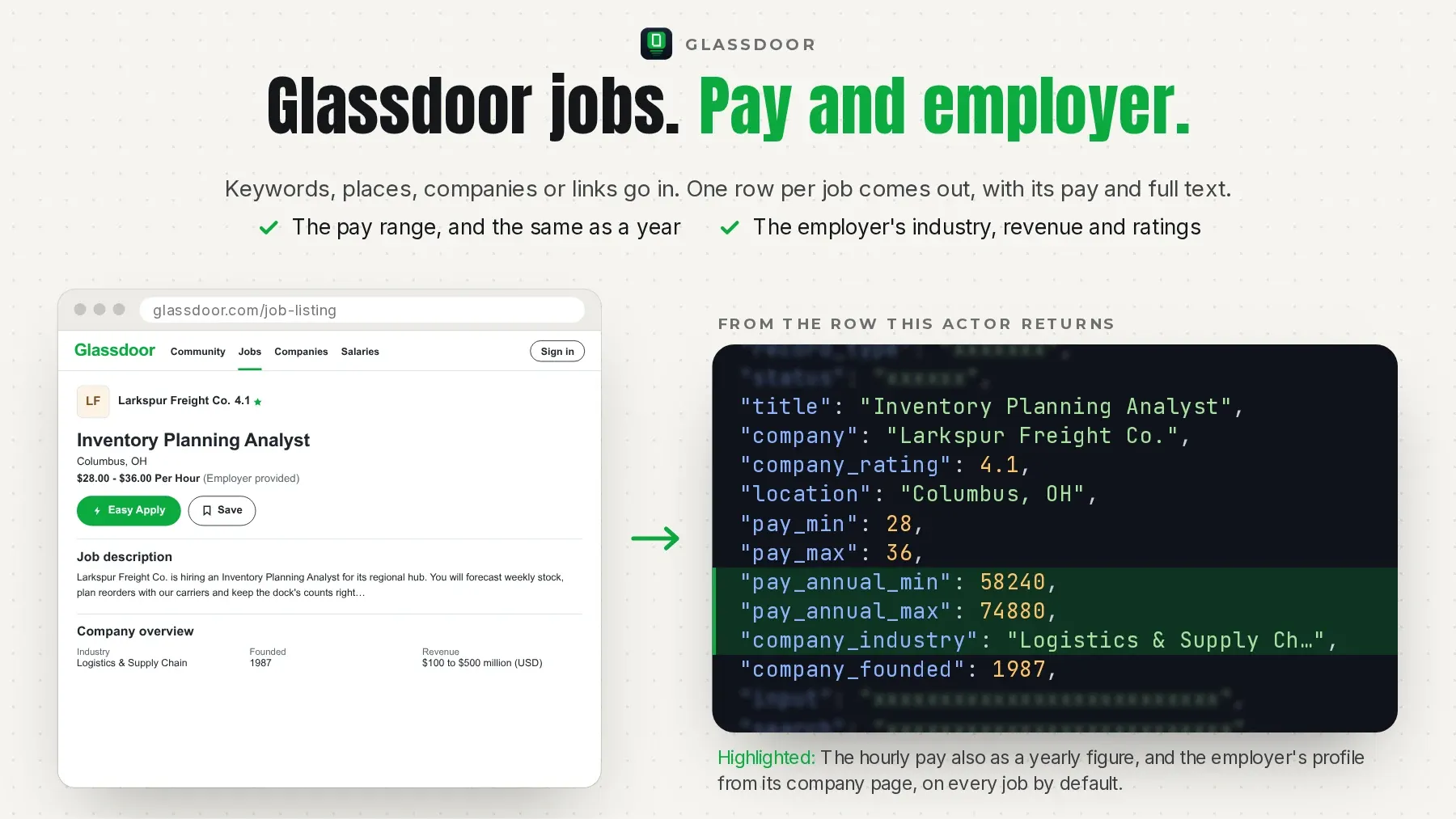
Glassdoor job listings as data, logged out, in any country. Give keywords, places, companies, Glassdoor search links or job ids, and get one row per job: title, employer and its rating, place with its coordinates, the pay range (10th, median, 90th percentile) with its period, currency and source plus the same a year, the age and the posted date, Easy Apply, both of Glassdoor's sponsored flags, and by default the job's full description, skills, education, the apply link and the employer's profile (size, revenue, industry, sector, founded, HQ, website, CEO and its 9 ratings). Glassdoor's own filters (date, Easy Apply, remote, rating, radius, company size, job type, seniority, salary, industry, function), and past a single search's ~900-job end with deepSearch. Every input ends with a free row that says what was found. No login, no cookies of yours, proxies handled for you.
From $0.34 per 1,000 rows (result) on the Free plan, $0.289 on Starter; every row and add-on is priced under Pricing below. A run start is $0.00086. The default input returns about 51 rows for about $0.01786. A search with no job, a place or company Glassdoor does not know, a job that is gone or a value that names nothing is a free row that says why: you never pay for an input that gave no job.
How it compares
- Cheaper than valig's Glassdoor Jobs Scraper, with more data: $0.25 per 1,000 jobs, against $0.34; 58 fields per job, against 11. It is 3 times faster: 50 jobs in 4.7 s, against our 51 jobs in 14 s.
- kaix's Glassdoor Jobs Scraper is faster and 5 times cheaper: 50 jobs in 8.6 s, against our 51 jobs in 14 s; $0.049 per 1,000 jobs, against our $0.25. We give more data: 58 fields per job, against 9.
- openclawai's Jobs API cannot do this job: it returned 1 of 50 jobs.
- Faster and cheaper than bebity's Glassdoor jobs scraper, with more data: 51 jobs in 14 s, against 50 jobs in 26 s; $0.25 per 1,000 jobs, against $0.30; 58 fields per job, against 39.
- 19 times cheaper than cheap_scraper's Glassdoor Jobs, with more data: $0.25 per 1,000 jobs, against $4.80; 58 fields per job, against 32.
Measured on 2026-11-20. Each line compares one job, run by both scrapers at the same time. Prices are per 1,000 jobs: Apify Actors at the Scale plan's prices.
Tested head-to-head on 2026-11-20
The job: Glassdoor's search for Software Developer in New York, 50 jobs (the input schema's example: the lane study's T1). Every Actor ran on it the same day from the same harness; every run's cost is at the Scale plan's prices: a rival's charged events at its price for that plan, this Actor's at its list price. Fields counts the filled fields of a typical row. Each rival searches Software Developer in New York on Glassdoor for 50 jobs (openclawai 20, its own per-board limit). openclawai, valig and bebity are the three most used Glassdoor job scrapers; kaix sells the cheapest row and bills the platform usage on top; cheap_scraper is the next dedicated one by users. Re-measured monthly.
| Actor | Rows | First row | Run time | Cost | Fields | Failures |
|---|---|---|---|---|---|---|
| this Actor | 51 | 12 s | 14 s | $0.013 | 58 | none |
openclawai/job-board-scraper | 1 | 115 s | 115 s | cannot | 7 | cannot: returned 1 of 50 jobs |
valig/glassdoor-jobs-scraper | 50 | 4.6 s | 4.7 s | $0.017 | 11 | none |
bebity/glassdoor-jobs-scraper | 50 | 11 s | 26 s | $0.015 | 39 | none |
kaix/glassdoor-jobs-scraper | 50 | 8.8 s | 8.6 s | $0.002 | 9 | none |
cheap_scraper/glassdoor-jobs-scraper-remove-duplicate-jobs | 50 | 10 s | 14 s | $0.24 | 32 | none |
Why this Glassdoor scraper
- The whole list a search reaches, and further. Glassdoor ends one search near 900 jobs whatever its count (852 and 843 of 2,230 on two reads; 297 of 337 for one company in London); every input row says the source's count beside the jobs read,
TRUNCATEDwhen the list ended under it, never a false COMPLETE.deepSearchreads the search again by company size: 2,509 distinct jobs of a 3,378 count in 93 s on the laptop, where a single search ends at about 850. - Every row complete by default. Glassdoor's list carries no description, so each job's own details are read in the run, side by side on 8 connections (0.36 s median a job): the full description (as text and as HTML), the posted date, the coordinates, skills, education and experience, the apply link and the employer's size, revenue, type, founding year, HQ, website, industry, sector, CEO and ratings.
- Nulls, never zeros. A job whose employer has no Glassdoor profile has no rating: the row says null where Glassdoor's answer says 0.0 (5 of 30 New York cards); a job with no pay range says null, never 0 (Glassdoor sends 0.0 for each percentile on 19 of 30 Tokyo cards).
- Both sponsored flags, as Glassdoor sets them.
sponsored(the promoted placement: 26 of 100 New York cards) andsponsored_job(Glassdoor's ad order: 78 of 100); the leaders give one or the other.excludeSponsoredleaves the promoted ones out. - The place Glassdoor resolved, named. A place word goes through Glassdoor's own lookup, filtered by your
country(Vienna in AT is Austria's capital, not Vienna, Virginia), and the input row names the place Glassdoor answered for. Glassdoor's .com site serves every country's jobs in their own currency (22 of 22 places tested). - Honest billing. One charge a delivered job, however many searches list it; no charge for a page of results, a summary row, a filtered job or a gone one.
Who it's for
- Job seekers and career coaches — every opening for a title in a city with its pay range, the company's rating and the full description, newest first, without the sponsored ones.
- Recruiters and sales teams — which companies hire for a role now, how big they are, their industry, website and rating: leads from live job ads.
- Researchers and analysts — pay ranges by role, place and company size across countries, each in its own currency and also a year, from a whole search and past its end.
Quick start
Software developer jobs in New York, 50 with their details
Remote data analyst jobs posted in the last 7 days, newest first, no sponsored jobs
A company's open jobs in London, with the salary benchmark
A Glassdoor search link and two job ids
Switching from valig/glassdoor-jobs-scraper?
Your input works as it is. Each name in the left column is read as this Actor's own field and the run log says so (read <theirs> as <ours>); a name marked not read is ignored with a note. A value in the other Actor's shape, an object list or its own date form, is read too.
| valig/glassdoor-jobs-scraper | this Actor | what to know |
|---|---|---|
keywords | queries | Read as queries: a string is one keyword, a list is several (one search each). |
location | locations | Read as one place of locations; give several in locations (one search each). |
daysOld | postedWithinDays | Read as postedWithinDays: Glassdoor's own filter at 1, 3, 7, 14 and 30 days, any other number kept exactly on each job. |
easyApply | easyApplyOnly | Read as easyApplyOnly. |
remoteWorkType | remoteOnly | Read as remoteOnly (true = remote jobs only). |
minRating | minRating | The same name: 1 to 4 stars. |
radius | radius | The same name and values (miles). |
employerSizes | companySizes | Read as companySizes: the leader's one size (1-5) works as it is. |
sortBy | sort | Read as sort: relevant_desc is relevance and date_desc is newest (the whole list read first, then ordered by age). |
limit | maxItemsPerSearch | Read as maxItemsPerSearch; 0 here reads the whole list. |
urlParam | extraFilters | Read as extraFilters: each key-value pair passes when the key is one of Glassdoor's own search filters; the others are dropped and named in the log. |
excludeJobIds | excludeJobIds | The same name: listing ids (or job links) left out. |
What differs:
- The leader's
keywordsandlocationare one string each; herequeriesandlocationstake many (one search for each pair), and the leader's strings are read as one value each. - The leader's
limit(default 100) ismaxItemsPerSearchhere, where 0 reads the whole list; set it,maxItemsor a charge limit to bound a run. employerSizes(one size 1-5) is read ascompanySizes, which also takes several sizes and the words tiny, small, medium, large, enterprise.- The output columns are snake_case (
pay_min,pay_median,pay_max,company_rating,age_days,easy_apply), and each job carries its full description and the employer's profile by default (includeDetails). - Each input gets a free summary row (
record_type=target) beside its job rows; filter onrecord_type=postingfor the jobs alone.
Output
One row per job (and one free summary row for every search, company, link or job id you give):
| field | meaning |
|---|---|
record_type | posting on a job row (charged); target on an input's free summary row. |
status | ok, or why an input gave no row: no_results, not_found, invalid_input, duplicate, filtered (a job id your exclusions leave out), failed, not_read. |
input | The value you gave that this row answers (a keyword with its place as keyword @ place). |
search | The search that delivered the job (words, place, company) or job <id>. |
id | Glassdoor's listing id of the job (the jl= of its link). |
url | The job's Glassdoor page. |
title | The job title as posted. |
company | The employer's name (Glassdoor's profile name, else the name the job shows). |
company_id | Glassdoor's employer id; null when the employer has no Glassdoor profile. |
company_url | The employer's Glassdoor page (/Overview/W-EI_IE<company_id>.htm); null when the employer has no Glassdoor profile. |
company_rating | The employer's overall Glassdoor rating (1-5); null when it has no profile or no rating, never 0. With the details read, a card that shows no rating takes the employer profile's own overall figure (a profile with few reviews can read 5.0). |
company_logo | The employer's logo image. |
location | The job's place as Glassdoor shows it (Brooklyn, NY; London, England; Remote). |
location_id | Glassdoor's id of that place. |
location_type | city, state, country or metro. |
city | The city of the job's map (details). |
state | The state or region of the job's map (details). |
country | The job's country: the details' map, else the place you searched when the job is in its country; null when neither says. |
postal_code | The postal code of the job's map, when Glassdoor has one (details). |
latitude | The job's latitude (details). |
longitude | The job's longitude (details). |
work_mode | remote or hybrid when Glassdoor says so (the details' remote work types, or the place Remote); null when it says nothing, never on-site by guess. |
pay_min | The pay range's 10th percentile, in pay_period and pay_currency; null when the job shows no pay. |
pay_median | The pay range's median. |
pay_max | The pay range's 90th percentile. |
pay_currency | The pay's currency (USD, GBP, EUR, INR …). |
pay_period | The pay's period as Glassdoor gives it: annual, monthly, weekly, daily, hourly. |
pay_source | Who gave the pay: employer_provided, or Glassdoor's estimate. |
pay_annual_min | pay_min a year (hourly × 2,080, daily × 260, weekly × 52, monthly × 12), computed by this Actor. |
pay_annual_median | pay_median a year, computed by this Actor. |
pay_annual_max | pay_max a year, computed by this Actor. |
age_days | The job's age in days, as Glassdoor counts it. |
posted_at | The posted date (YYYY-MM-DD). |
posted_at_source | source (the date in the job's details) or age (today less age_days, when the details were not read). |
easy_apply | True when you can apply on Glassdoor itself. |
sponsored | True when Glassdoor shows the job in a promoted (sponsored) slot. |
sponsored_job | True when Glassdoor marks the job itself as sponsored (an ad order). |
expired | Glassdoor's expired flag. |
job_types | The job types (Full-time, Contract, Part-time …) from the details. |
occupation | Glassdoor's occupation for the job (software developer, back end engineer …). |
occupation_id | Glassdoor's id of that occupation. |
normalized_title | Glassdoor's normalised job title. |
skills | The skills Glassdoor extracted from the job (details). |
education | The education the job names (details). |
experience | The years of experience the job names (details). |
job_attributes | Other attributes Glassdoor extracted from the job's card, when it has them. |
description_snippet | The first lines of the description, as the search shows them. |
description | The job's full description as text (details). |
description_html | The job's full description as Glassdoor's HTML (details). |
apply_url | The apply link (Glassdoor's link to the employer's application). |
company_size | The employer's size band ("1 to 50 Employees" …). |
company_revenue | The employer's revenue band, when Glassdoor knows it. |
company_type | The employer's type (Company - Private, Company - Public, Government …). |
company_founded | The year the employer was founded. |
company_headquarters | The employer's headquarters. |
company_website | The employer's website. |
company_industry | The employer's industry. |
company_sector | The employer's sector (Information Technology, Human Resources & Staffing …). |
company_ceo | The employer's CEO as Glassdoor names them. |
company_ratings | The employer's ratings: overall, CEO approval and its count, recommend to a friend, compensation and benefits, culture and values, career opportunities, senior management, work-life balance. |
visa_sponsorship | offered, not_offered or not_mentioned, from the description's words (no model); null when the description was not read. |
matched_keywords | Your resumeKeywords found in the title, snippet or description. |
unmatched_keywords | Your resumeKeywords not found. |
keyword_match_score | The share of your resumeKeywords found, 0-100. |
salary_benchmark | With includeSalaryBenchmark: Glassdoor's salary estimate for the job's role in its place (base, additional and total pay at the 10th-90th percentile, the number of salaries, the confidence, the currency, the period, the update date). |
salary_benchmark_status | served, not_served (no estimate for the role and place), refused (no connection served the page in time), no_role (the job names no role, or only Glassdoor's catch-all "other"), no_place (a job outside the US whose place the salary page cannot take), cut (the run stopped before the page was read), or not_asked (the add-on is off). |
detail_status | served (the job's details read), not_asked (includeDetails off), failed (not served: the card's fields stand) or cut (the run stopped while they were read). |
verdict | On an input row: COMPLETE, TRUNCATED (Glassdoor's list ended under its count), CAPPED or PARTIAL. |
rows_delivered | On an input row: the job rows it delivered. |
source_count | On an input row: Glassdoor's own count of jobs for the search. |
place_resolved | On an input row: the place Glassdoor answered for. |
note | Why a row has the status or the verdict it has, and what your filters left out. |
scraped_at | When this row was read (UTC). |
Example record:
Pricing
Pay for the jobs a run delivers, plus one run start. No platform usage is billed to you, and the price falls with your Apify plan.
| event | unit | Free | Starter | Scale | Business |
|---|---|---|---|---|---|
Job (result) | per 1,000 | $0.34 | $0.289 | $0.238 | $0.17 |
Salary benchmark (salary-benchmark) | per 1,000 rows that carry it | $12.70 | $12.70 | $12.70 | $12.70 |
New visitor session (visitor-session) | per session | $0.00634 | $0.00634 | $0.00634 | $0.00634 |
Run start (start) | per run | $0.00086 | $0.00086 | $0.00086 | $0.00086 |
A job is $0.34 per 1,000 on the Free plan ($0.00034 a row) and $0.289 on Starter, with the whole row by default: the full description as text and HTML, the pay range with its yearly figure, the employer's profile and ratings, the place with coordinates, skills, education and the apply link. Each run that delivers a charged job pays the run start, $0.00086 once.
Glassdoor's job search asks for a visitor session. The Actor keeps recent sessions and reuses them across runs, so most runs open none; a run that has to open a new one pays $0.00634 for it, once, with its first charged jobs (never on a run that delivers no job).
So the example (software developer in New York, 50 jobs) costs $0.01786 on the Free plan and $0.01531 on Starter; 1,000 jobs $0.34086 and $0.28986 (plus $0.00634 when the run opens a session). A search with no cap reads to the end of Glassdoor's list, which stops near 900 jobs whatever its count: "Software Developer" in New York delivered 892 jobs of a count of 3,344 on 2026-11-20, $0.30414 on the Free plan. deepSearch reads further, at the same price a job.
The salary benchmark is an add-on, off by default: $0.0127 a job row that carries Glassdoor's estimate ($12.70 per 1,000) on every plan. Glassdoor serves its salary pages only past a bot check, and each page costs this Actor a paid read whether it is served or not; on 2026-11-20 3 and 5 of the same 10 London jobs got an estimate on two runs. A row whose estimate was not served says refused and pays nothing for it. The add-on also makes the first rows wait for their salary pages (up to about 70 s).
Free: every input's summary row (Glassdoor's count, the jobs read and the verdict), a search with no job, a place or company Glassdoor does not know, a gone job, a value that names nothing, a job your filters leave out, a job another search of the run already delivered (one row, one charge), and a run that delivered no charged job (no run start and no session either). A run that stops early (a timeout, an abort, the charge limit) is charged for the jobs it delivered.
Before the first request the log names the prices at your plan and what the run can cost: "at most" under maxItems or maxItemsPerSearch and your charge limit, and the price per 1,000 jobs when a search has no cap. Enterprise plans have their own rates: the Actor's Pricing tab shows the price for your plan.
Usage patterns
- What a search reads — Each keyword of
queries(or company) in each place is one search of Glassdoor's own job search: 100 jobs a call in Glassdoor's order, to the end of its list. A place is a city, a state or region, a country or Remote, resolved by Glassdoor's own place lookup insidecountrywhen you give one; no place reads the United States. A company is its name (Glassdoor's company lookup gives its employer id), its id or its Glassdoor page link. The filters in the first group are Glassdoor's own (posted within 1, 3, 7, 14 or 30 days, Easy Apply, remote, minimum rating, radius, company size, job type, seniority, salary, industry, job function, and any other filter of its search as key=value); the second group is kept by this Actor on every job (jobs without pay, sponsored jobs, staffing agencies, companies and title words, the keyword in the title, an exact number of days). Several company sizes are read one size at a time and joined (Glassdoor answers 0 for two sizes at once). - How far a search goes — Glassdoor's list for one search ends near 900 jobs whatever its count: 852 of 2,230 for software developers in New York, 843 on a second read of the same search, 50 of 601 for developers in London on glassdoor.com. Every input's row carries the source's count (
source_count) and the verdict:COMPLETEwhen the jobs read reach the count,TRUNCATEDwhen Glassdoor's list ended under it (the end is read twice, the second time on a fresh connection),CAPPEDat your cap.deepSearchreads the search again for each company size, and a size that ends near 900 again by job type: 2,509 distinct jobs of 3,378 for software developers in New York (2026-11-20), about 1,800 of 2,230 in an earlier hour; each extra list is one more call of 100 jobs, so the cost is the rows it delivers. - Newest first — Glassdoor ignores its own date sort for this search. With
sortnewest the run reads the whole list first (100 jobs a call), orders it by each job's age, and reads the details of the jobs it delivers only.postedWithinDaysuses Glassdoor's own date filter (1, 3, 7, 14, 30) and keeps any other number of days exactly on each job's age. - What a row is —
record_type=posting: one job, charged once a run however many searches list it;detail_statussays whether its details were read (served), not asked (includeDetailsoff: the search card's fields), not served (failed: the card's fields stand) or cut by the run's time limit or an abort (cut).record_type=target: one free row per input with itsstatus,verdict,source_count,place_resolvedand anotethat says why and what your filters left out. Pay is Glassdoor's own: the 10th percentile, the median and the 90th of the range in its period (hourly,monthly,annual…), withpay_source(employer_providedor Glassdoor's estimate);pay_annual_*are the same figures a year (hourly × 2,080, monthly × 12), computed by this Actor. - The salary benchmark — With
includeSalaryBenchmarkon, each job row gets Glassdoor's salary estimate for its role (Glassdoor's own occupation of the job) in its place: base pay, additional pay and total pay at the 10th, 25th, 50th, 75th and 90th percentile, the number of salaries, the confidence, the currency, the period and the date Glassdoor updated it. One salary page per role and place is read once a run and kept a week for the next runs; a page no connection serves within 70 s leaves the row'ssalary_benchmark_statusrefusedand the row goes out without it. It is a paid add-on charged only on the rows that carry it, and it makes a run slower the first time a role and place is asked.
Input configuration
| field | type | default | what it does |
|---|---|---|---|
queries | array | [] | Job titles, skills or any words, as you type them in Glassdoor's search box. Each one is a search in each place of Locations (or across the United States when no place is given). Empty by default: the prefill is an example. |
locations | array | [] | Places as words: a city (New York, London, Berlin), a state or region (California), a country (Germany) or Remote. Glassdoor's own place lookup resolves each word; the summary row names the place it resolved. Every keyword and company is searched in every place. Empty: the United States. |
country | string | "" | Optional: a country name or its two-letter code (US, GB, DE, IN, CA, AU …). The place words resolve inside this country (Vienna in AT, not Vienna, VA). With no Locations, the whole country is searched. Glassdoor's .com site serves every country's jobs in their own currency. |
companies | array | [] | A company's open jobs: its name (Amazon), its Glassdoor employer id (6036) or its Glassdoor page link. With Keywords empty, all its jobs; with Locations, its jobs in each place. |
startUrls | array | [] | Glassdoor search links (their words, place and filters are read), job links (with jl=) or company links. A link's own place and filters win over the fields below. |
jobIds | array | [] | Glassdoor listing ids (the digits after jl= in a job link): each job's full details, one row each. |
postedWithinDays | integer | 0 | Only jobs posted at most this many days ago (1, 3, 7, 14 and 30 match Glassdoor's own filter; any other number is kept exactly by this Actor). 0 = any age. |
easyApplyOnly | boolean | false | Only jobs you can apply to on Glassdoor itself. |
remoteOnly | boolean | false | Only remote (work from home) jobs. |
minRating | number | 0 | Only employers rated at least this (1 to 4 stars; half stars such as 3.5 too). 0 = any rating. |
radius | `` / 0 / 5 / 10 / 15 / 25 / 50 / 100 | "" | Distance from the city of Locations. Empty = Glassdoor's default (25 miles). |
companySizes | array | [] | Any of: tiny (1-50 employees), small (51-200), medium (201-1000), large (1001-5000), enterprise (5000+); or 1 to 5. Empty = every size. |
jobTypes | array | [] | Any of: full-time, part-time, contract, permanent, temporary. Empty = every type. |
seniority | `` / internship / entrylevel / midseniorlevel / director / executive | "" | One level. Empty = every level. |
minSalary | integer | 0 | Glassdoor's pay filter, a year in the place's own currency. 0 = no minimum. |
maxSalary | integer | 0 | Glassdoor's pay filter, a year in the place's own currency. 0 = no maximum. |
industryIds | array | [] | Glassdoor's industry ids (10013 Information Technology, 10010 Financial Services, 10012 Healthcare …: the id in a filtered search link's industryNId). |
jobFunctionIds | array | [] | Glassdoor's job function ids (1007 Engineering, 1011 Information Technology, 1021 Sales …: the id in a filtered search link's sgocId). |
extraFilters | array | [] | Other filters of Glassdoor's search as key=value (for example cityId=1132348). Keys Glassdoor does not filter on are dropped and named in the run's log. |
includeNoSalary | boolean | true | Off: only jobs that show a pay range (this Actor keeps the filter itself: Glassdoor ignores it). |
excludeSponsored | boolean | false | Leave out the jobs Glassdoor shows in a promoted (sponsored) slot. |
excludeAgencies | boolean | false | Leave out jobs whose employer Glassdoor files under its Human Resources & Staffing sector (read from the job's details). An agency Glassdoor files under no sector or another one stays. |
excludeCompanies | array | [] | Company names (any part, case apart) or employer ids to leave out. |
excludeTitleWords | array | [] | Whole words that leave a job out when its title contains them (senior, intern …): java leaves out a Java title, not a JavaScript one. |
titleMustMatch | boolean | false | Keep only jobs whose title contains every word of the search's keyword. |
excludeJobIds | array | [] | Listing ids (or job links) you have already, left out of the run. |
sort | relevance / newest | "relevance" | Relevance: Glassdoor's order. Newest: the whole list is read first, then the newest jobs are delivered first (Glassdoor ignores its own date sort). |
includeDetails | boolean | true | The full description, the posted date, coordinates, skills, education, the apply link and the employer's profile (size, revenue, industry, founded, HQ, website, CEO, ratings). Off: the search card's fields only, faster. |
includeSalaryBenchmark | boolean | false | Add Glassdoor's salary estimate for each job's role in its place: base, additional and total pay (10th to 90th percentile), the number of salaries and the confidence. A paid add-on, charged only on rows that carry it. |
resumeKeywords | array | [] | Your skills or words: each row says which of them its title, snippet and description contain, and a match score from 0 to 100. Write alternatives as js |
deepSearch | boolean | false | Glassdoor ends a single search near 900 jobs whatever its count. On: the search is read again by company size (and by job type inside a large size), to reach more of the count (about 80 % in our tests). Slower. |
maxItemsPerSearch | integer | 0 | The most job rows from one search (one keyword or company in one place, or one link). 0 = the whole list. |
maxItems | integer | 0 | The most charged rows of the whole run; 0 = no cap beyond your charge limit. |
feedback | string | A note to the people who maintain this Actor: what you needed and did not get. For example a missing field, a wrong or empty result, or the Actor you switch from or to, and why. The run does not read it: the rows and the charges stay the same. A person reads every note. |
Errors
A run does not fail because of your input. When an input cannot be used — a date that is not a date, an id in the wrong form, two settings that contradict each other — the run ends Succeeded, charges nothing, and says what to change:
- the status message starts with
INPUT REJECTED; - the dataset holds one row,
{"error": true, "code": "…", "message": "…"}, and no results; - the key-value store record
ERRORholds the same object.
From code, check error on the first row before reading results.
A search with no job, a place or a company Glassdoor's own lookup does not know, a job that is gone or a value that is not a Glassdoor search, job or company is not an error: it gets one free row with its status and the reason, and the run goes on with the others. A run that ends Failed is a fault on our side, never your input; it charges nothing, and we are alerted.
FAQ
Which status and verdict is which?
A job row is ok. An input's row: ok with a verdict (COMPLETE: the list was read to the source's count; TRUNCATED: Glassdoor's list ended under its count, the note gives both; CAPPED: maxItems or maxItemsPerSearch stopped it; PARTIAL: stopped early, the note says why), or a free status: no_results (Glassdoor lists no job for the search), not_found (a place, company or job Glassdoor does not know or no longer has; a gone job is read on two connections first), invalid_input (a value that is not a Glassdoor search, job or company), duplicate (a job id another input of the run delivered), failed (the source refused every connection, the reason in the note) or not_read (the run stopped before it).
Which countries?
Any country Glassdoor lists jobs in: give the place (London, Berlin, Toronto, Bangalore, Sydney …) and, to settle an ambiguous name, the country (a name or its two-letter code). Glassdoor's .com site serves each country's jobs with their own currency and place; the country sites (glassdoor.co.uk …) can list more jobs for the same search (London: 160 against 50 on glassdoor.com in one test), and this Actor reads glassdoor.com.
How fresh is it?
Every list and every job's details are read during the run; nothing about a job is cached between runs (the salary benchmark's estimates, which Glassdoor updates monthly, are kept a week). age_days is Glassdoor's own age of the job; posted_at is the date Glassdoor's details give (posted_at_source source), or today less the age when the details were not read (age).
Can it get the recruiter's name, e-mail or phone?
No. Glassdoor shows no recruiter or contact on a job logged out; the employer's website, HQ and apply link are on the row.
Does it need a Glassdoor account, cookies or an API key?
No. Everything is read from Glassdoor's public, logged-out job search: no login, no cookie of yours, no token. The connections are included in the price.
Do I need Apify Proxy or my own proxy?
No. The Actor uses its own connections, at no extra cost to you.
Integration
JavaScript
Python
CLI
REST
AI agents and MCP
Apify's MCP server offers this Actor as a tool to Claude, Cursor, VS Code and any other MCP client. Connect https://mcp.apify.com?tools=hyperbach/glassdoor-jobs-scraper and ask, for example: "Find the newest software developer jobs in New York on Glassdoor with the salary range, the company rating and the full job description". The agent fills the input from the table above and reads the rows from the run's dataset. A field under the name another Actor gives it is read as this Actor's own: keywords, keyword, query, search as queries; sortBy, sortOrder, order as sort; location, place, city, where as locations; company, companyName, companyNames, employer as companies (and more). An agent or a person can add feedback to any run and say what was needed and not delivered: a missing field, a wrong or empty result, the Actor switched from or to, and why. The run returns the same rows at the same price, and a person reads every note.
n8n, Make and Zapier
The Apify node in n8n, the Apify app in Make and the Apify integration in Zapier run this Actor on a schedule or from a trigger and read its dataset. A webhook on the run's end (Integrations on the Actor page) sends the rows on to your own endpoint. Nothing to install on our side.
Support
Disagree with a charge? Write to apify@hyperbach.com with the run ID. We will ask Apify to compensate you, and the charge comes back to your Apify account as platform credit.
Did it do the job? A short review on the Store, at any rating, helps the next buyer choose.
See also
- Upwork Jobs History — every Upwork job posting since November 2024 by period, category and skill, with the client's record as it stood on the day of posting.
- LinkedIn Jobs Scraper — LinkedIn job listings for keywords and a location, with the applicants count, the salary block and the company's facts.
- Greenhouse Jobs Scraper — the hiring of major tech companies from their own Greenhouse boards, kept as roles open and close.
- Remote Jobs Scraper — every remote job from seven boards and ATSs in one deduplicated feed, kept after the postings close.
- Y Combinator Jobs Scraper — every open job of every YC company on Work at a Startup, newest first, by keyword, company or link: the description, salary and equity, the role, posting age, remote, visa, the batch and the founders.
- Arbeitsagentur Jobs Scraper — jobs of Germany's Federal Employment Agency (Jobsuche) by keyword, search link or job link: employer, place, working time, contract and the stated salary as numbers, with the description on request.
This page is generated from the Actor's schemas and a live sample — it cannot describe a field the Actor does not have.


