

Instagram Comments Scraper: Export Reel & Post Comments
Pricing
from $0.12 / 1,000 comments
Instagram Comments Scraper: Export Reel & Post Comments
Scrape Instagram comments from post and reel links or a profile's newest posts, no login: an Instagram comment scraper and comments extractor. Every comment the list serves, newest first, with text, exact time, likes, author, verified badge, comment link and GIF; a free post row with the count.
Pricing
from $0.12 / 1,000 comments
Rating
0.0
(0)
Developer

Hyperbach
Maintained by CommunityActor stats
0
Bookmarked
17
Total users
7
Monthly active users
a day ago
Last modified
Categories
Features
Share
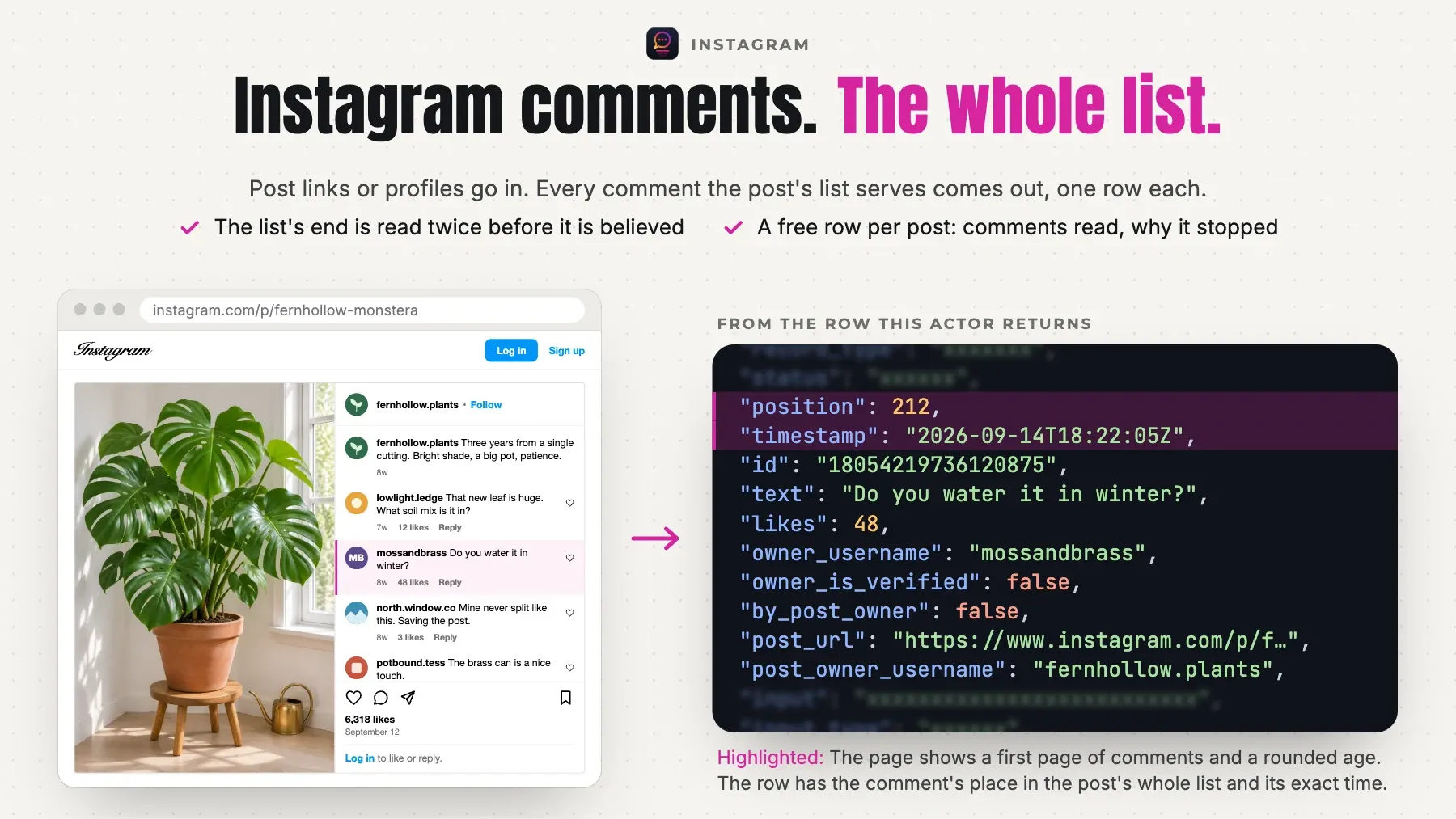
Every comment of an Instagram post or reel, as data, logged out. Give post and reel links (or a shortcode, or a profile for its newest posts) and get one row per comment, newest first, to the end of the post's list — the full text, the exact time, the likes, the author with the verified badge and the picture, the comment's own link, the GIF, the mentions and hashtags, and the post's link, type, time and owner on every row. Every post also gets a free row with its caption, likes and Instagram's own comment count, how many comments the list served ("listed 257 of count 324") and a verdict (COMPLETE: the list ended; CAPPED: your limit came first). No login, no Instagram account, no cookie, proxies handled for you.
$0.30 per 1,000 comment rows on the Free plan, $0.18 on Starter. A run start is $0.0029. The default input returns about 50 rows for about $0.0179. A value that names nothing is a free row that says why.
Why this Instagram comments scraper
- The whole list, not the first 15. Instagram shows logged-out viewers a post's comments in pages of 15; this Actor reads them to the list's own end on every plan (2,300 comments on @instagram's reel, 6,651 on its carousel, 832 on a NASA photo in our runs). The post row says how many the list served against Instagram's count and why the walk stopped; a shorter dataset is never silent.
- An end flag that is read twice. Instagram's list sometimes says it ended after one or two pages (about 7 % of fresh reads at one hour of our study). Every end under Instagram's count is read a second time before it is believed: a second read that serves more continues the walk, one that ends at the same comment confirms it. The post row counts the false ends and the re-reads.
- Counts that do not lie. Instagram serves no reply count and no replies to logged-out viewers, so
replies_countis null on every row, never a 0 it did not serve; Instagram's own comment count is on the post row, and the note says it counts replies and hidden comments. - Every comment kept. A GIF comment gets its animated GIF; a comment Instagram serves with no text and no GIF (a sticker or a removed body) is kept with
content_typeno_text, as Instagram lists it, not dropped. Each row has itspositionin the list and its own link (comment_url). - Posts any way you have them. A post or reel link in any form, a shortcode, a numeric media id, or a profile for its newest posts by publish time (pinned posts are not put first). Two forms of one post are read once, and a post that two inputs name is read once.
- One row per comment, free rows for the rest. A comment is delivered and charged once a run. A comment a filter leaves out (a date window, words, a likes floor), a missing or comments-off post: free.
maxCommentsPerPostandmaxItemsare exact. - Plain HTTP, no browser. Instagram's own logged-out answers: no login, no cookie, no account of yours, nothing to configure. On six of our runs on Apify (version 0.1.4, 2026-10-30) the first comment came 2.2 to 5.3 seconds after the start, and two ordinary posts read to the end of their lists (300 comments) took 20 seconds.
Who it's for
- Brand and social media teams — every comment on their own and their competitors' posts and reels, with the authors and likes.
- Researchers and analysts — the full comment list of a post for sentiment, topic or audience work, with exact times and the post's record on every row.
- Influencer marketers — how audiences answer a creator's posts: the commenters, their verified badges, the most liked comments, the creator's own comments (
by_post_owner). - Developers and data teams — typed rows keyed by the comment id, one free row per post with the verdict, a run summary to check a pipeline against.
Quick start
Every comment of one reel
The newest 15 comments of two posts
A profile's 5 newest posts, 100 comments each
The 20 most liked comments, the last 30 days only
Switching from apify/instagram-comment-scraper?
Your input works as it is. Each name in the left column is read as this Actor's own field and the run log says so (read <theirs> as <ours>); a name marked not read is ignored with a note. A value in the other Actor's shape, an object list or its own date form, is read too.
| apify/instagram-comment-scraper | this Actor | what to know |
|---|---|---|
directUrls | postUrls | Post and reel links, one per line, in any form. |
resultsLimit | maxCommentsPerPost | Comments per post, newest first (or most liked with sortBy). |
includeNestedComments | not read | Not read: Instagram serves no replies logged out (the FAQ); the run log says so when it is on. |
What differs:
- Replies are not served to a logged-out viewer on any route we measured, so
includeNestedCommentsis not read;replies_countis null rather than a 0. - The cap is per post (
maxCommentsPerPost, 50 by default; 0 = the whole list);resultsLimitfills it. - A profile in
profilesgives the comments of its newest posts, which the leader does not offer.
Output
One row per comment (and one free row per post and per profile).
| field | meaning |
|---|---|
record_type | comment (one comment: charged when status is ok), post (a free row per post: its record, how many comments its list served and the verdict, or why it gave no comment) or profile (a free row per profile you gave). |
status | A comment: ok. A post: ok (see verdict), not_found (missing, deleted or a private account's post: a logged-out viewer cannot tell these apart; two connections agree), comments_off (the owner turned comments off), restricted (Instagram withholds the post from logged-out viewers), duplicate (another input of the run reads the same post, or the value is a second form of a post given before), invalid_input, failed, not_read (maxItems, the charge limit or the time limit came first). A profile: ok, private, not_found, restricted, duplicate (a second form of a profile given before), invalid_input, failed, not_read. |
input | The value you gave that led to this row (the profile for a post read from a profile). |
input_type | post (from postUrls) or profile (a post read from a profile's newest posts, or the profile's own row). |
position | The comment's place in the post's list: 1 = the newest (Instagram's order). With sortBy most_liked, its place in our likes order of the comments read, 1 = the most liked. |
id | Instagram's id of the comment. One row per id in a run. |
text | The comment's text in full; "" for a GIF-only comment and for a comment Instagram serves with no text and no media (a sticker, a photo comment or a removed body: see content_type). |
content_type | text, gif (a GIF only), text_gif (text and a GIF) or no_text (no text and no GIF in Instagram's logged-out answer: a sticker, a photo comment or a removed body; 79 of 12,324 comments in our study). |
timestamp | When the comment was posted (UTC, ISO 8601), Instagram's exact time. |
likes | The comment's like count. |
replies_count | Always null: Instagram serves no reply count and no replies to logged-out viewers (null on 12,324 of 12,324 comments in our study). Never a 0 Instagram did not serve. |
owner_username | The commenter's username. |
owner_id | The commenter's Instagram id (pk). |
owner_is_verified | The commenter's verified badge. |
owner_profile_pic_url | The commenter's profile picture (a signed Instagram URL: it stops working about 4 days after the run). |
owner_profile_url | The commenter's profile link. |
by_post_owner | The commenter is the post's owner or one of its coauthors (matched by id). |
comment_url | The comment's own link (instagram.com/p/<code>/c/<id>/): a logged-in viewer sees the comment, a logged-out one Instagram's login page. |
gif_url | A GIF comment's animated GIF (a signed URL that stops working about 1.4 days after the run); null otherwise. |
mentions | The accounts the comment mentions, without @. |
hashtags | The hashtags of the comment, without #. |
is_covered | Instagram's own flag for a comment it covers (hides behind a tap) for logged-out viewers; false on every comment of our study. |
has_translation | Instagram's own translation flag; null when Instagram serves none (every comment of our study). |
post_url | The post's link (instagram.com/p/<code>/). |
post_shortcode | The post's shortcode: group the comments of one post by it. |
post_id | The post's media id. |
post_type | reel, photo, carousel or video. |
post_timestamp | When the post was published (UTC, ISO 8601). |
post_owner_username | The post owner's username. |
post_owner_id | The post owner's Instagram id (pk). |
post_owner_full_name | The post row: the post owner's full name. |
post_owner_is_verified | The post row: the post owner's verified badge. |
post_caption | The post row: the post's caption in full. |
post_hashtags | The post row: the hashtags of the caption, without #. |
post_mentions | The post row: the accounts the caption mentions, without @. |
post_likes | The post row: the post's like count; null when the owner hides it. |
post_comments_count | The post row: Instagram's own comment count. It counts replies and comments Instagram hides from logged-out viewers, so it is above the comments the list serves (43 of 50, 257 of 324 on our runs). |
post_comments_disabled | The post row: the owner turned comments off. |
post_coauthors | The post row: the usernames of the post's coauthors (a collaboration post). |
comments_listed | The post row: the distinct comments the walk read from the post's list. |
comments_delivered | The post row: the comment rows of this post in the dataset. |
comments_matched | The post row, with a filter: the comments that passed of those read. |
order | The post row: newest (Instagram's order) or most_liked (our likes order of the comments read). |
verdict | The post row: COMPLETE (the list's own end, read twice when it came under Instagram's count; or the date window ended the walk), CAPPED (maxCommentsPerPost or maxCommentsToRead came first), RUN_CAP (maxItems or your charge limit came first), PARTIAL (the time limit, a refusal or an end that could not be confirmed: see stop_reason). |
stop_reason | The post row: end_of_list, your_cap, read_budget, run_cap, date_window, time_limit, blocked, cursor_error, end_not_confirmed or failed. |
false_ends | The post row: times the list's end flag came early and a second read served the rest. |
reasks | The post row: second reads of an end under Instagram's count (each confirms the end or finds more). |
profile_username | The profile row: the username. |
profile_full_name | The profile row: the full name. |
profile_is_verified | The profile row: the verified badge. |
profile_is_private | The profile row: a private profile (its posts and comments are not shown logged out). |
posts_listed | The profile row: the newest posts taken (each has its own post row). |
note | A free row: "listed k of count n" and why the walk stopped, the filters' counts, or why the row gave no comment. |
scraped_at | When the row was read (UTC). |
Example record:
Pricing
Pay for the comments a run delivers, plus one run start; no platform usage is billed to you. The comment price falls with your Apify plan.
| event | unit | Free | Starter | Scale | Business |
|---|---|---|---|---|---|
Comment (comment) | per 1,000 | $0.30 | $0.18 | $0.17 | $0.12 |
Run start (start) | per run | $0.0029 | $0.0029 | $0.0029 | $0.0029 |
A comment is $0.30 per 1,000 on the Free plan ($0.0003 a comment) and $0.18 on Starter, with every field of its row. Each run that delivers a comment also pays the run start, $0.0029 once; a run that delivers none pays nothing at all. So the 15 newest comments of two posts cost $0.0119 on the Free plan and $0.0083 on Starter; one ordinary post to the end of its list (257 comments) $0.08 and $0.04916; 1,000 comments $0.3029 and $0.1829; @instagram's reel to its end (2,300 comments) $0.6929 and $0.4169; the posts of one run share one start. Free: every post and profile row (the record, the counts, the verdict), a missing, private, comments-off or withheld post, a post named twice (one read, one charge), a value that names nothing, a comment a filter leaves out (newerThan, olderThan, textContains, minLikes, onlyVerifiedCommenters, excludePostOwnerComments), and a post left unread at maxItems or the time limit. A run that stops early (a timeout, an abort) is charged for the comments it delivered. maxItems counts the charged comments. Before the first request the log names the price of a comment at your plan, the run start and, when maxCommentsPerPost or maxItems caps the run, the most it can cost. With no cap (maxCommentsPerPost 0, the API's default) each post is read to the end of its list, and the cost follows the post: the list holds fewer comments than Instagram's count (43 of 50, 257 of 324, 2,300 of 3,293 and 6,651 of 9,950 on our runs), and the post row names both. Set maxItems or a charge limit to bound a run. Enterprise plans have their own rates — the Actor's Pricing tab shows the price for your plan.
Usage patterns
- What to give —
postUrls: post and reel links in any form (/p/,/reel/,/reels/,/tv/, with or without?igsh=), shortcodes or numeric media ids.profiles: usernames (natgeo,@natgeo) or profile links; each gives its newestmaxPostsPerProfileposts (10 by default, up to 100) by publish time. A value in the other list is served there (a post link inprofilesis a post). Every post gets its own free row. - How many comments — By default every comment the post's list serves, to its end, newest first.
maxCommentsPerPostcaps each post (exact; a comment a filter leaves out does not count);maxItemscaps the whole run. The post row says how many the list served (comments_listed) against Instagram's count (post_comments_count), and why the walk stopped (verdict,stop_reason). - Filters and order —
newerThanandolderThan(a date, a date and time, or7 days) keep the comments posted in a window: the list is newest first, sonewerThanalso ends the walk early.textContains(any of the words or phrases, case-insensitive; a comma is part of a phrase),minLikes,onlyVerifiedCommentersandexcludePostOwnerCommentskeep a comment only when it matches; a comment left out is free.sortBymost_liked re-sorts the comments read by their likes and delivers the topmaxCommentsPerPost: this is our order of what was read (the whole list, or up tomaxCommentsToRead), since Instagram serves no ranked order logged out. - What a logged-out viewer is not shown — Replies and their count, the commenter's full name and private flag, the likers of a comment, and a "top comments" order are not served to logged-out viewers on any route we measured (up to a real browser), so this Actor does not offer them. The list holds the top-level comments Instagram shows: fewer than its count, which includes replies and comments it hides.
Input configuration
| field | type | default | what it does |
|---|---|---|---|
postUrls | array | [] | Posts and reels, one per line: any post or reel link (https://www.instagram.com/p/<code>/, /reel/<code>/, /reels/<code>/, /tv/<code>/, instagram.com/<user>/p/<code>/, with or without ?igsh= or ?img_index=), a bare shortcode (DcOuBsxJww9) or a numeric media id. Each post gives its comments, newest first, and one free post row with Instagram's comment count and how many comments the list served. Two forms of one post are read once. A value that names no post is a free row that says why. |
profiles | array | [] | Instagram profiles, one per line: a username (natgeo, @natgeo) or a profile link. Each gives the comments of its newest maxPostsPerProfile posts by publish time (pinned posts are not put first), and one free profile row. A private profile, a missing username or a profile Instagram withholds from logged-out viewers is a free row that says so. |
maxPostsPerProfile | integer | 10 | How many of each profile's newest posts to read the comments of (by publish time; a pinned older post does not take a place). |
maxCommentsPerPost | integer | 0 | The most comments delivered per post, newest first (or the most liked first with sortBy). 0 = every comment the post's list serves, to its end. A comment left out by a filter does not count. The post row says CAPPED when this came first. |
sortBy | newest / most_liked | "newest" | newest: Instagram's own order, newest first (the default). most_liked: the comments read (the whole list, or up to maxCommentsToRead), re-sorted by their likes by this Actor, and the top maxCommentsPerPost delivered. Instagram serves no ranked or "top" order to logged-out viewers, so this is our sort of what was read, and the post row says so. |
maxCommentsToRead | integer | 0 | A bound on how many comments are read per post when a filter or most_liked reads more than it delivers (a post can hold thousands). 0 = read to the list's end. The post row says CAPPED with read_budget when this came first. |
newerThan | string | "" | Only comments posted on or after this time: a date (2026-09-01), a date and time (2026-09-01T12:00:00Z), or a span back from now in lower case (7 days, 12 hours, 2 weeks, 3 months). The list is newest first, so the walk stops at the first older comment. |
olderThan | string | "" | Only comments posted on or before this time (a date includes its whole day), in the same forms as newerThan. The newer comments are read and left out, free. |
textContains | array | [] | Keep a comment only when its text contains one of these words or phrases (case-insensitive), one per line; a comma is part of a phrase. The walk reads on; a comment left out is free, and the post row says how many matched of how many read. |
minLikes | integer | 0 | Keep a comment only with at least this many likes. Free when it leaves a comment out. 0 = every comment. |
onlyVerifiedCommenters | boolean | false | Keep a comment only when its author has Instagram's verified badge (as Instagram serves it on the comment). Free when it leaves a comment out. |
excludePostOwnerComments | boolean | false | Leave out the comments of the post's owner (and its coauthors), told by the owner's id from the post. Free when it leaves a comment out. |
maxItems | integer | 0 | The most charged rows (comments) of the whole run, over every post and profile; 0 = no cap beyond maxCommentsPerPost and your charge limit. Posts are read side by side, so a cap under what they hold is shared as their comments arrive; each post's row says RUN_CAP or not_read. |
feedback | string | A note to the people who maintain this Actor: what you needed and did not get. For example a missing field, a wrong or empty result, or the Actor you switch from or to, and why. The run does not read it: the rows and the charges stay the same. A person reads every note. |
Errors
A run does not fail because of your input. When an input cannot be used — a date that is not a date, an id in the wrong form, two settings that contradict each other — the run ends Succeeded, charges nothing, and says what to change:
- the status message starts with
INPUT REJECTED; - the dataset holds one row,
{"error": true, "code": "…", "message": "…"}, and no results; - the key-value store record
ERRORholds the same object.
From code, check error on the first row before reading results.
A missing, deleted or comments-off post, a private or missing profile, or a value that names nothing is not an error: it gets one free row with its status and Instagram's own reason, and the run goes on with the others. A run that ends Failed is a fault on our side, never your input; it charges nothing, and we are alerted.
FAQ
Why do I get fewer comments than the post's comment count?
Instagram's count includes the replies and the comments it hides from logged-out viewers; the list it serves holds the top-level comments it shows (43 of 50, 257 of 324, 2,300 of 3,293 on our runs). The walk reads the list to Instagram's own end flag, reads an early end a second time, and the post row says listed k of count n with the verdict. No logged-out route serves the rest.
Does it get replies?
No: Instagram serves no replies and no reply count to logged-out viewers (every reply route answers a login wall or an error), so replies_count is null on every row rather than a 0 that would claim there are none. The scrapers that sell replies read them with a logged-in session.
Does it need my Instagram login or cookies?
No. It reads only what Instagram shows to anyone without an account, over plain HTTP, with its own connections. You never give a password, a cookie or a session, so no account of yours can be blocked.
How fast is it?
A page of 15 comments takes about half a second; a post's pages are read in turn and several posts side by side. An end that comes under Instagram's count is read a second time (a new read of the post, or its last page again after about 10 seconds), so a whole list takes a few seconds more than its pages. On six of our runs on Apify (version 0.1.4, 2026-10-30): the first comment 2.2 to 5.3 seconds after the run's start; two ordinary posts to the end of their lists, 300 comments with both ends read twice, in 20 seconds.
What happens with a deleted post, a private profile or comments turned off?
Each gets one free row with its status: not_found (missing, deleted or a private account's post: a logged-out viewer cannot tell these apart, so a second connection checks it first), comments_off, restricted (withheld from logged-out viewers), and for a profile private, not_found or restricted. Nothing is charged for them, and the run goes on.
Is the same comment ever delivered twice?
No. A comment is claimed by its id when it is read and delivered once a run; a post named by two inputs (a link and a profile's post) is read once and the second input gets a free duplicate row. A second read of a list's end only adds the comments it had not served.
What is most_liked?
Our sort of the comments read, by their likes, then the newest first; the top maxCommentsPerPost are delivered with position 1 = the most liked. Instagram serves no ranked or "top" comments order to logged-out viewers, so the whole list is read (or maxCommentsToRead of it) and the post row says how many were ranked.
I move from another Instagram comment scraper: which column is which?
The usual keys map one to one: id → id, text → text, timestamp → timestamp, likesCount → likes, repliesCount → replies_count (null logged out), ownerUsername → owner_username, ownerProfilePicUrl → owner_profile_pic_url, owner.id / owner.is_verified → owner_id / owner_is_verified, postUrl → post_url, commentUrl → comment_url, a GIF's media → gif_url, a position → position.
Do I need Apify Proxy or my own proxy?
No. The Actor uses its own connections, at no extra cost to you.
Integration
From code, set maxCommentsPerPost (or maxItems): through the API it defaults to 0, every comment of the post's list (the form's 50 is a prefill).
JavaScript
Python
CLI
REST
AI agents and MCP
Apify's MCP server offers this Actor as a tool to Claude, Cursor, VS Code and any other MCP client. Connect https://mcp.apify.com?tools=hyperbach/instagram-comments-scraper and ask, for example: "Get the first 50 comments of this Instagram reel with each commenter's username, likes and time". The agent fills the input from the table above and reads the rows from the run's dataset. A field under the name another Actor gives it is read as this Actor's own: directUrls, postURLs, postLinks, posts as postUrls; usernames, username, profileUrls, handles as profiles; resultsLimit, maxComments, commentsPerPost, maxResults as maxCommentsPerPost; maxPosts, resultsPerPage as maxPostsPerProfile (and more). An agent or a person can add feedback to any run and say what was needed and not delivered: a missing field, a wrong or empty result, the Actor switched from or to, and why. The run returns the same rows at the same price, and a person reads every note.
n8n, Make and Zapier
The Apify node in n8n, the Apify app in Make and the Apify integration in Zapier run this Actor on a schedule or from a trigger and read its dataset. A webhook on the run's end (Integrations on the Actor page) sends the rows on to your own endpoint. Nothing to install on our side.
Support
Disagree with a charge? Write to apify@hyperbach.com with the run ID. We will ask Apify to compensate you, and the charge comes back to your Apify account as platform credit.
Did it do the job? A short review on the Store, at any rating, helps the next buyer choose.
See also
- Meta Ad Library Scraper — every ad a page runs on Facebook, Instagram, Messenger, WhatsApp and Threads, with the landing URL, media, run dates and EU reach.
- Threads Scraper — Threads profiles with the exact follower count, their posts and replies with view counts, and keyword and tag search, without a login.
- Instagram Reels Transcript Scraper — the spoken words of Instagram reels, by reel link or creator, with the exact posting time.
- Instagram Posts Scraper — the posts and reels of Instagram profiles, with the whole caption, the exact publish time, likes, comments and plays.
- Instagram Hashtag Scraper — Instagram's own ranked list of top reels for a hashtag or a search keyword.
- Facebook Pages Scraper — Facebook pages by URL, id, name or search words: the exact follower count, categories, address, phone, e-mail and websites, and the page transparency facts.
This page is generated from the Actor's schemas and a live sample — it cannot describe a field the Actor does not have.


