
Rainwater Harvesting Calculator: Tank Size, Roof Yield
Pricing
Pay per event
Rainwater Harvesting Calculator: Tank Size, Roof Yield
Rainwater harvesting from plain text for any place: how much water a roof collects each month from NASA rainfall data, the tank size for your household or garden use, and the share of the use it covers.
Pricing
Pay per event
Rating
0.0
(0)
Developer

Jumble Mog
Maintained by CommunityActor stats
0
Bookmarked
2
Total users
1
Monthly active users
9 hours ago
Last modified
Categories
Features
Share
How much rainwater a roof collects each month, and the tank that covers your water use, for any place, from one line of text. Describe the roof and the use (rainwater tank for a 2,000 sq ft roof in Austin, Texas, 4 people, toilets and laundry or 2 rain barrels on a 600 sq ft roof in Seattle watering a 300 sq ft vegetable garden) and you get back:
- The water collected: gallons or litres a year and by month, from NASA's monthly rainfall for the place, the roof area and its material.
- The water use: toilets, laundry or the whole house for the people in the home, a daily amount, or a garden's watering from its evapotranspiration (lawn, vegetables, shrubs, trees, drought-tolerant plants; drip or sprinkler).
- The tank size: the smallest standard tank that covers nearly as much of the use as any tank could, with the share covered, the water supplied, the overflow and the days it runs short. Give your tank (
5,000 gallon tank,2 rain barrels) to check it instead. - Every tank size compared: the share of the use covered by each standard size from a 55-gallon barrel up.
- One storm:
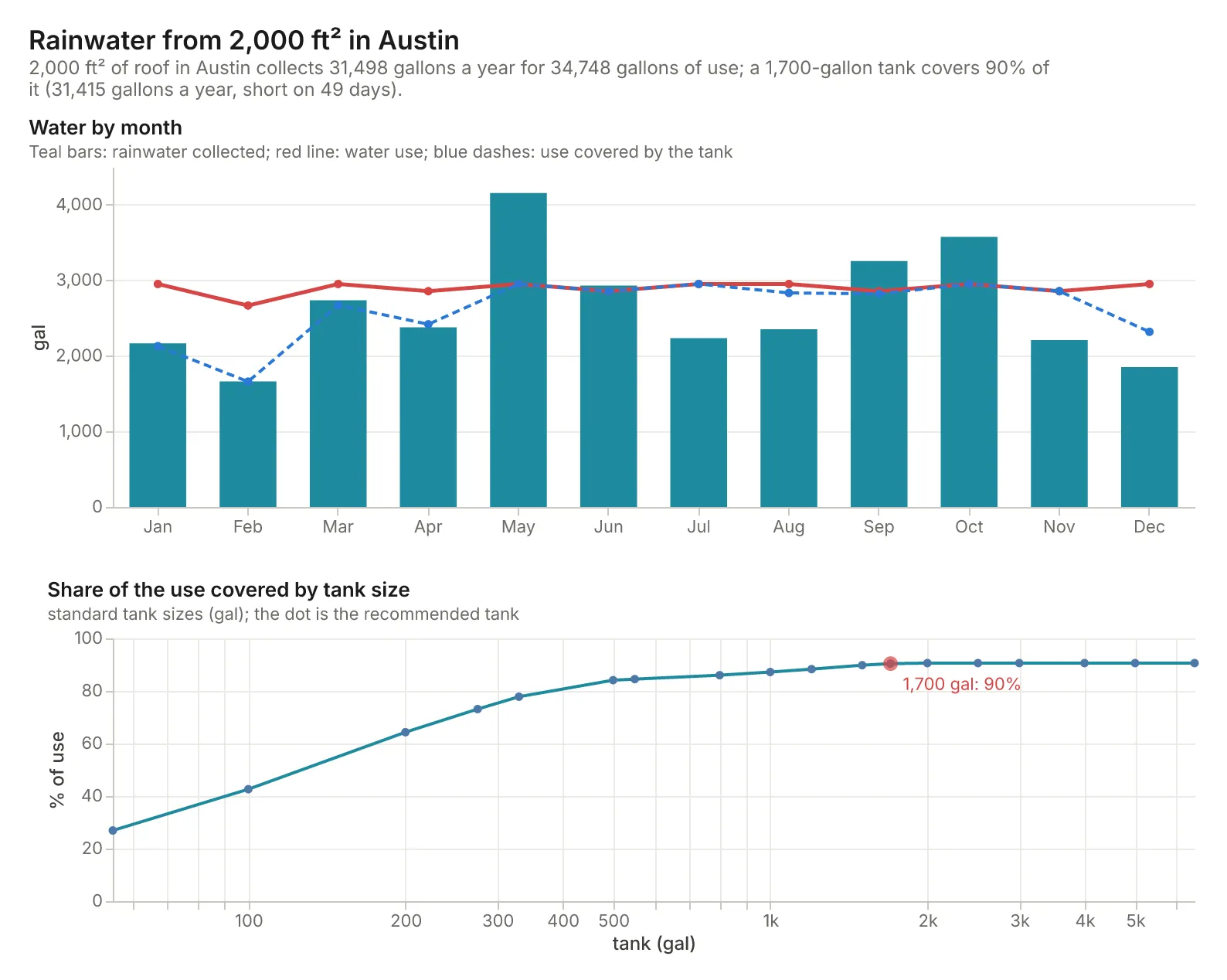
1 inch of rain on a 2,000 sq ft roofgives the water it collects. - A chart: water collected and used by month, and the share covered by tank size.
It's made for:
- Homeowners and homesteaders sizing a rain tank or cistern, or checking what their rain barrels really cover.
- Gardeners and small farms working out how much garden a roof can water.
- Landscapers, plumbers and tank sellers quoting systems, and green-building and sustainability teams.
- Architects, students and AI agents that need water-balance numbers for a real place.
How to use it
- Write Rainwater systems, one per entry. The form has examples.
- Optionally set the Units (US: gallons, ft², inches; or metric: litres, m², mm). Units written in a request win.
- Click Start. Each system is a row in the results, with its summary, chart and report.
What you can write
| You write | It means |
|---|---|
in Austin, Texas, Bristol, UK, 30.27, -97.74 | Where (a town of 5,000+ people or coordinates); the rainfall comes from NASA POWER |
32 inches a year, 650 mm annual rainfall | Your own yearly rainfall (spread over the months in the place's pattern) |
2,000 sq ft roof, 120 m² roof, 40 x 30 ft | The roof (catchment) area |
metal roof, tile roof, shingle roof, gravel roof, green roof, runoff 0.8 | How much of the rain reaches the gutters |
4 people, toilets and laundry, family of 5, whole house, toilet flushing | Household use |
100 gallons a day, 300 litres per day, 2,000 gallons a month | A water use amount |
500 sq ft vegetable garden, lawn of 200 m², drip, sprinkler | Garden watering |
5,000 gallon tank, 10,000 litre cistern, 2 rain barrels | A tank to check |
1 inch of rain, 25 mm of rain | One storm's water |
The same as an object: {"place": "Bristol, UK", "roofArea": 100, "units": "metric", "people": 4, "use": "toilet"} or {"lat": 30.27, "lon": -97.74, "roofArea": 1500, "roofType": "metal", "tank": 2500, "gardenArea": 400, "garden": "vegetable", "irrigation": "drip"}.
Examples
rainwater tank for a 2,000 sq ft roof in Austin, Texas, 4 people, toilets and laundry→ 31,498 gallons a year collected for 34,748 gallons of use; a 1,700-gallon tank covers 90% (the most any tank can is 91%).2 rain barrels on a 600 sq ft roof in Seattle watering a 300 sq ft vegetable garden→ the barrels cover 39% of the summer watering; a 4,000-gallon tank would cover 100%, because Seattle's summers are dry.1,500 sq ft roof in Tucson, Arizona, 5,000 gallon tank, 500 sq ft garden, drip→ the roof collects 9,122 gallons a year, 48% of the 18,899 the garden needs; a 1,700-gallon tank does nearly as well.{"place": "Bristol, UK", "roofArea": 100, "units": "metric", "people": 4, "use": "toilet"}→ 61,983 litres a year for 43,800 litres of toilet flushing; a 2,500-litre tank covers it all.how much rain from a 120 m² metal roof in Bristol, UK→ about 83,130 litres a year from 810 mm of rain.how much water from 1 inch of rain on a 2000 sq ft roof→ about 954 gallons.
How-to examples
Each example is a complete input; the results are from runs of the Actor (also listed under Examples).
How to size a rainwater tank for a house
Result: 31,498 gallons a year collected for 34,748 gallons of use; a 1,700-gallon tank covers 90%, where the most any tank can is 91%.
How to see if rain barrels can water a garden
Result: the barrels cover 39% of the summer watering; a 4,000-gallon tank would cover 100%, because Seattle's summers are dry.
How to calculate how much rain a roof collects
Result: about 83,130 litres a year from 810 mm of rain in Bristol, and about 954 gallons from 1 inch on 2,000 sq ft.
How to let an AI agent plan rainwater harvesting
Add this Actor to the Apify MCP server with https://mcp.apify.com/?tools=jumblemog/rainwater-harvesting-calculator. The agent passes the roof, place and water use in one line and answers with the yearly collection, the use covered and the tank size.
FAQ
Where does the rainfall come from? NASA POWER's monthly climatology for the place (bias-corrected precipitation from 2001), or your own yearly total.
How is the tank sized? By a daily water balance over a typical year with realistic storms: the smallest standard tank within 2 points of the best share any tank gives, and no smaller than the BS 8515 rule of thumb.
Does the roof material matter? Yes, through the runoff coefficient: metal 0.95, concrete 0.9, shingle and membrane 0.85, tile 0.8, gravel 0.6 and green roofs 0.3.
Can I drink the water? Roof water for drinking needs filtering and disinfection, and in many places a permit. Size up for drinking water, since droughts aren't in a typical year.
Input
| Field | What it is |
|---|---|
requests | The systems, as lines of text or objects (up to 200 per run) |
units | us (gallons, ft², inches) or metric (litres, m², mm): the output, and the units of object numbers |
charts | Draw a chart for each system (default on) |
Output
One dataset item per system, also saved together in the run's OUTPUT record:
Every item also has place, warnings, notes (the method and every assumed value), a Markdown report and links to the chart and report. A request that can't be computed has "status": "failed" and the reason in error, and isn't billed.
How it works
- Rainfall: NASA POWER's monthly climatology for the point (bias-corrected precipitation, 2001 on), or your own yearly total spread over the months in the place's pattern.
- Collected water = rain × roof area × runoff coefficient (metal 0.95, concrete 0.9, shingle and membrane 0.85, tile 0.8, gravel 0.6, green 0.3) × 90% for the gutter filter and first flush. 1 mm on 1 m² is 1 litre; 1 inch on 1 ft² is 0.623 gallons.
- Use: per person a day for toilets (14.2 gal US / 30 L), laundry (9.6 gal / 20 L) or all indoor use (58.6 gal / 140 L), from the Water Research Foundation's 2016 US study and typical European figures; garden watering = plant factor × Hargreaves reference evapotranspiration − 75% of the rain, in months averaging 10 °C or more, ÷ watering efficiency (drip 90%, sprinkler 70%).
- Daily water balance: each month's rain falls on evenly spaced wet days (more for wetter months) with storm sizes from an exponential distribution; every day the rain fills the tank, the overflow spills, and the use is drawn (yield after spillage). It runs from an empty tank until the year repeats.
- Tank size: the smallest standard tank within 2 points of the best share any tank gives, and no smaller than the UK BS 8515 rule of thumb (5% of the smaller of yearly collection and use, about 18 days) for dry spells.
Pricing
You pay one low price per system, at the price shown on this page. The chart and report are included. Requests that can't be computed are never charged. If you set a maximum cost per run, the Actor stops before a request that wouldn't fit.
Speed
A system takes about half a second (the NASA data for a place is fetched once per run). A run through the API answers in about 10-15 seconds, including the cloud container starting.
Tips and limits
- Typical years: droughts and dry spells longer than average aren't in a typical year; size up for drinking water or livestock.
- Satellite rainfall can differ from a local rain gauge by 10% or more; give your yearly rainfall to use your own.
- Drinking water from a roof needs filtering and disinfection, and in many places a permit; check local rules on rainwater use.
- Limits: 200 systems per run; places need NASA POWER to answer, or give the yearly rainfall.
For AI agents and developers
This Actor works with the Apify MCP server, so AI agents can call it as a tool. Pass requests as plain text and read summary, water, tank, monthly and warnings. A direct API call that waits for the answer:
run-sync instead returns the run's OUTPUT: the status, the counts and every result as JSON.
In Python, with the apify-client package:
Credits
- Rainfall and temperature: NASA POWER (NASA Langley Research Center POWER Project, funded through the NASA Earth Science Directorate Applied Science Program; public).
- Places: GeoNames via geonamescache (CC BY 4.0, MIT).
- Math: NumPy (BSD-3-Clause). Charts: Vega-Lite and vl-convert (BSD-3-Clause), with the Inter font (SIL Open Font License).
- Methods: yield-after-spillage water balance (Jenkins et al.; Fewkes); BS 8515 intermediate sizing; Hargreaves-Samani evapotranspiration with FAO-56 extraterrestrial radiation; Water Research Foundation Residential End Uses of Water (2016).