

Solar Panel Calculator: System Size, Production, Battery Bank
Pricing
Pay per event
Solar Panel Calculator: System Size, Production, Battery Bank
Solar PV systems from plain text for any place: the system size for your power use or bill, kWh by month from NASA sunlight data, panels, roof area and payback; off-grid battery bank, panels, controller and inverter.
Pricing
Pay per event
Rating
0.0
(0)
Developer

Jumble Mog
Maintained by CommunityActor stats
0
Bookmarked
2
Total users
1
Monthly active users
7 days ago
Last modified
Categories
Security
Limited permissionsShare
How big a solar system you need, what it makes each month and when it pays back, or the battery bank and panels for an off-grid cabin or RV, from one line of text. Describe the place and the use (how big a solar system for 900 kWh a month in Denver, 6 kW system in Austin, Texas facing south, 6/12 roof, $2.80/W, 14 cents/kWh or off-grid cabin in Flagstaff: fridge 60 W 24 h, lights 40 W 5 h, laptop 60 W 4 h) and you get back:
- The system size: kW, the number of panels, the panel and roof area, and the inverter size, for your yearly or monthly use, your electricity bill or a share of it (
80% offset). - Production by month: kWh each month from 25 years of NASA satellite sunlight and temperature for the place, with the sunlight on the panels at your tilt and facing, the cell temperature and the yearly kWh per kW.
- The best tilt for the place and how much yours gives of it.
- Money: yearly savings at your rate, cost per watt, incentives, payback years and 25-year savings.
- Off-grid systems: the daily load (from a list of appliances or a total), the battery bank in kWh and Ah at 12, 24 or 48 V (lithium or lead-acid, with days of autonomy), the panels for the darkest month you use it, the MPPT charge controller and the inverter.
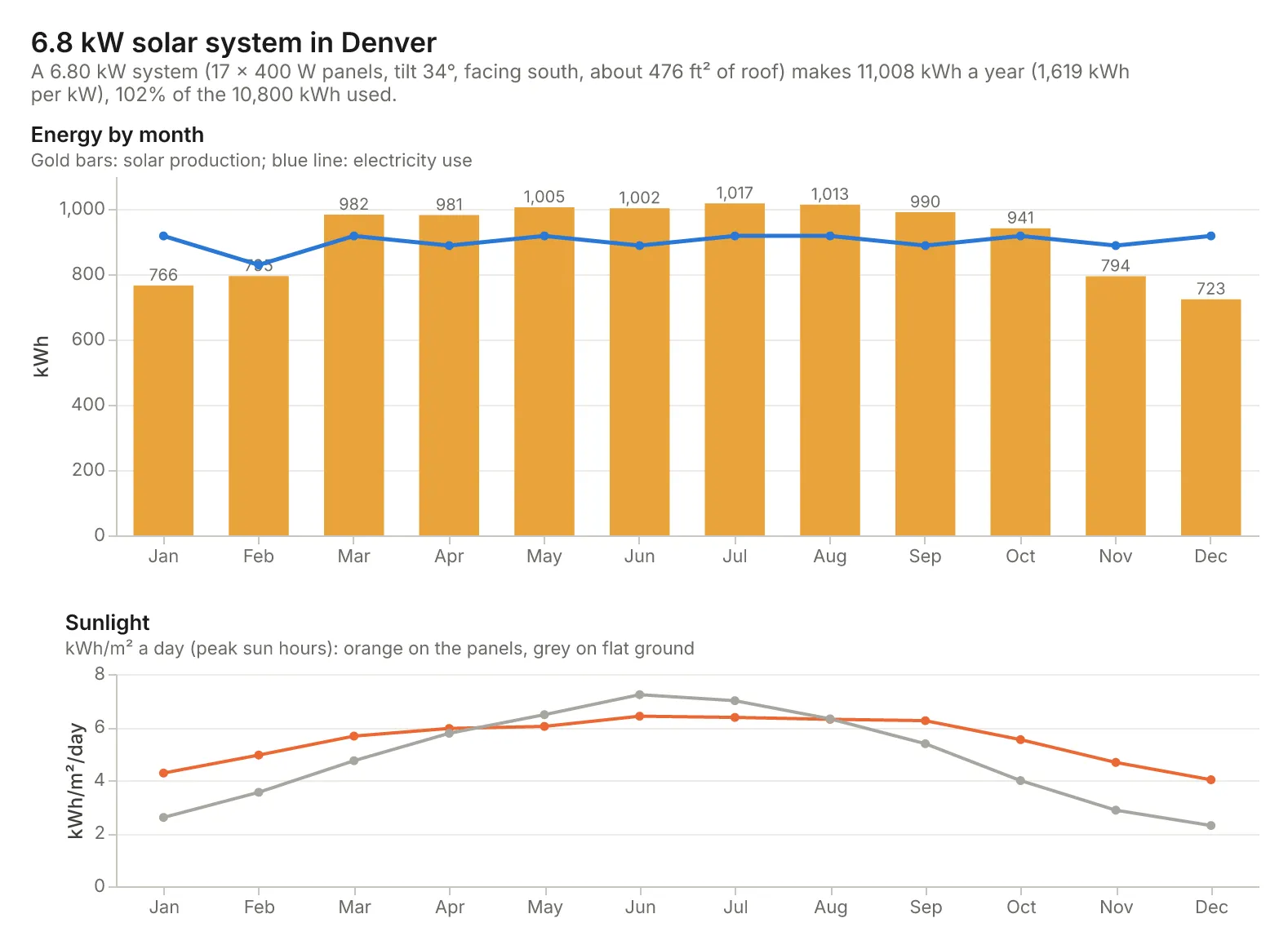
- A chart: energy by month against your use or load, and the sunlight on the panels against flat ground.
It's made for:
- Homeowners checking a solar quote: is the size right, what will it make, when does it pay back.
- Solar installers and sales teams sizing systems from a customer's bill in seconds.
- Off-grid builders: cabins, tiny houses, sheds, RVs, vans and boats.
- Real-estate, energy and climate apps, and AI agents that need correct solar numbers for a real place instead of a rule of thumb.
How to use it
- Write Solar systems, one per entry. The form has examples.
- Optionally set the Units for areas (ft² by default, or m²).
- Click Start. Each system is a row in the results, with its summary, chart and report.
What you can write
| You write | It means |
|---|---|
in Denver, Austin, Texas, Sydney, Australia, 39.74, -104.99 | Where (a town of 5,000+ people or coordinates); the sunlight comes from NASA POWER |
900 kWh a month, 10,800 kWh a year, $150 a month bill at 15 cents/kWh | The electricity use the system should cover |
6 kW, 20 x 400W panels, 16 panels | A system size to rate instead of sizing one |
30°, 6/12 roof, flat roof, facing southwest, azimuth 200 | Tilt and facing (the best tilt facing the equator if not given) |
roof 400 sq ft, 80% offset, 430 W panels, 12% losses | Roof room, share of use to cover, panel size (400 W), losses (14%) |
$2.80/W, $18,000 installed, 30% tax credit, 14 cents/kWh | Cost, incentives and rate for savings and payback |
off-grid, cabin, RV, 2 kWh a day, fridge 60 W 24 h, 2 fans 50 W 6 h | An off-grid system and its daily load |
3 days autonomy, lead acid, 24V, summer only, peak load 1500 W, DC loads | Battery days, chemistry, voltage, season, inverter size, no inverter |
5 sun hours | Peak sun hours on the panels instead of NASA's data |
The same as an object: {"lat": 51.5, "lon": -0.13, "panels": 12, "panelWatts": 430, "tilt": 35}, {"place": "Tucson, Arizona", "monthlyKwh": [1100, 950, 900, 950, 1200, 1600, 1800, 1750, 1500, 1100, 900, 1050], "costPerWatt": 2.6, "rate": 0.13} or {"type": "offgrid", "place": "Duluth, Minnesota", "loads": [{"name": "fridge", "watts": 80, "hours": 24}, {"name": "lights", "watts": 50, "hours": 6}], "battery": "lithium", "autonomyDays": 3}.
Examples
how big a solar system for 900 kWh a month in Denver→ 6.80 kW (17 × 400 W panels, tilt 34° south, about 476 ft² of roof), 11,008 kWh a year, 1,619 kWh per kW.6 kW system in Austin, Texas facing south, 6/12 roof, $2.80/W, 14 cents/kWh→ 8,689 kWh a year (1,448 kWh per kW), $1,216 a year saved, payback 12.0 years.solar for a $150 a month electric bill in Phoenix at 13 cents per kWh, $18,000 installed→ 8.00 kW (20 panels), 14,244 kWh a year, 103% of the use, payback 9.0 years.off-grid cabin in Flagstaff: fridge 60 W 24 h, lights 40 W 5 h, laptop 60 W 4 h, 2 days autonomy→ 1,880 Wh a day: 2 × 400 W panels, a 4.5 kWh LiFePO4 bank (189 Ah at 24 V), a 50 A MPPT controller, a 300 W inverter.RV using 2 kWh a day, 12V lithium, summer only, in Bozeman, Montana→ 2 × 400 W panels sized for April, 4.8 kWh (403 Ah at 12 V), a 100 A controller.12 x 430W panels in London, tilt 35°→ 5.16 kW, 5,120 kWh a year (992 kWh per kW).
How-to examples
Each example is a complete input; the results are from runs of the Actor (also listed under Examples).
How to calculate what size solar system you need
Result: 6.80 kW (17 × 400 W panels, tilt 34° south, about 476 ft² of roof), 11,008 kWh a year, 1,619 kWh per kW, with production for every month.
How to work out solar panel payback
Result: 8,689 kWh a year (1,448 kWh per kW), $1,216 a year saved, and a payback of 12.0 years. A monthly bill works too: "solar for a $150 a month electric bill in Phoenix at 13 cents per kWh, $18,000 installed" gives 8.00 kW (20 panels), 103% of the use and a 9.0-year payback.
How to size an off-grid solar system and battery bank
Result: 1,880 Wh a day, met by 2 × 400 W panels, a 4.5 kWh LiFePO4 bank (189 Ah at 24 V), a 50 A MPPT controller and a 300 W inverter. RVs, vans and boats work the same way.
How to let an AI agent give real solar numbers
Add this Actor to the Apify MCP server with https://mcp.apify.com/?tools=jumblemog/solar-panel-calculator. The agent passes the user's question as written and answers with numbers for the real place, from NASA sunlight data, instead of a rule of thumb.
FAQ
Where does the sunlight data come from? From 25 years of NASA POWER satellite sunlight and temperature data for the place.
Does it take my roof angle and direction into account? Yes. Give a tilt or a roof pitch (6/12) and a facing, and it also says what the best tilt for the place would give.
Can it work from my electricity bill? Yes: a monthly bill and your rate, yearly or monthly kWh, or a share such as 80% offset.
Does it work outside the US? Yes, anywhere NASA has data, which is the whole world. Set units to metric for areas in m².
Is this a quote? No. It's an estimate to check a quote against: real output depends on shading, equipment and local rules.
Input
| Field | What it is |
|---|---|
requests | The systems, as lines of text or objects (up to 200 per run) |
units | For areas: us (ft²) or metric (m²) |
charts | Draw a chart for each system (default on) |
Output
One dataset item per system, also saved together in the run's OUTPUT record:
Off-grid items have offgrid (dailyLoad, designMonth, arrayWatts, panels, batteryKwh, batteryAh, batteryVoltage, batteryBank, autonomyDays, chargeController, inverterWatts) and loads instead of system; items with a rate or cost have money. Every item also has units, warnings, notes (the method and every assumed value), a Markdown report and links to the chart and report. A request that can't be computed has "status": "failed" and the reason in error, and isn't billed.
How it works
- Sunlight and temperature: NASA POWER's monthly climatology for the point (satellite and reanalysis data from 2001 on): global and diffuse sunlight on flat ground and the air temperature.
- Sunlight on the panels: the Liu-Jordan isotropic-sky model: beam sunlight scaled by the ratio of the panel's to the ground's beam over each month's average day (integrated every 5 minutes with the NOAA sun position), plus sky diffuse and 20% ground reflection. Any tilt and facing.
- Energy: kWh per kW = sunlight on the panels × (1 − 0.37%/°C above 25 °C at the month's cell temperature) × (1 − 14% losses) × 96% inverter, as NREL's PVWatts does. For Denver it comes within about 3% of PVWatts.
- Grid-tied sizing: the yearly use × offset ÷ kWh per kW, rounded up to whole panels. Payback adds yearly savings with 0.5%/yr panel degradation and 3%/yr electricity price rise until they meet the net cost.
- Off-grid sizing: battery kWh = daily load ÷ inverter efficiency × autonomy days ÷ usable depth (90% lithium, 50% lead-acid); array = the energy into the battery (after its round-trip losses) ÷ kWh per kW per day in the darkest month used, at the tilt that's best for that month; charge controller = array watts ÷ battery volts × 1.25; inverter = all listed loads at once + 25%.
Pricing
You pay one low price per system, at the price shown on this page. The chart and report are included. Requests that can't be computed are never charged. If you set a maximum cost per run, the Actor stops before a request that wouldn't fit.
Speed
A system takes about a second (the NASA data for a place is fetched once per run). A run through the API answers in about 10-15 seconds, including the cloud container starting.
Tips and limits
- Shade isn't included: trees, chimneys and neighbouring buildings can cut production a lot; use the
lossesto allow for it. - Average years: a single year can be 5-10% sunnier or cloudier than the climatology.
- Money: no maintenance, inverter replacement or net-metering rules; savings count only the energy you use. Check what your utility pays for surplus.
- Off-grid: the array is sized to cover the darkest month without a generator; with a generator for the darkest weeks it can be much smaller. Motors draw a surge several times their rating, so check the inverter's surge rating.
- Limits: 200 systems per run; places need NASA POWER to answer, or give
sun hours.
For AI agents and developers
This Actor works with the Apify MCP server, so AI agents can call it as a tool. Pass requests as plain text and read summary, system or offgrid, monthly, money and warnings. A direct API call that waits for the answer:
run-sync instead returns the run's OUTPUT: the status, the counts and every result as JSON.
In Python, with the apify-client package:
Credits
- Sunlight and temperature: NASA POWER (NASA Langley Research Center POWER Project, funded through the NASA Earth Science Directorate Applied Science Program; public).
- Places: GeoNames via geonamescache (CC BY 4.0, MIT).
- Math: NumPy (BSD-3-Clause). Charts: Vega-Lite and vl-convert (BSD-3-Clause), with the Inter font (SIL Open Font License).
- Methods: Liu and Jordan; Duffie and Beckman, Solar Engineering of Thermal Processes; NREL PVWatts loss assumptions.


