

Steel Beam & Column Calculator (AISC 360-16)
Pricing
Pay per event
Steel Beam & Column Calculator (AISC 360-16)
AISC 360-16 steel member design from plain text: check W, HSS, pipe and channel beams, columns and beam-columns (flexure with lateral-torsional buckling, shear, compression, tension, combined, deflection) or select the lightest shape that works.
Pricing
Pay per event
Rating
0.0
(0)
Developer

Jumble Mog
Maintained by CommunityActor stats
0
Bookmarked
2
Total users
1
Monthly active users
10 hours ago
Last modified
Categories
Features
Share
Check a steel beam, column or beam-column by AISC 360-16, or find the lightest shape that works, from one line of text. Ask W12x26 beam, span 20 ft, Lb 20 ft, Mu 60 kip-ft, W10x33 column, KL = 14 ft, Pu = 250 kips or lightest W beam for w = 2 klf, span 24 ft, fully braced, L/360 and you get back:
- Every check with its ratio: major and minor-axis flexure, shear, compression or tension, combined axial and bending (H1-1) and deflection, each with the demand, the available strength and the limit state that governs.
- Available strengths by LRFD (φ) or ASD (/Ω): φMn with lateral-torsional buckling at your unbraced length and Cb, φVn, φPn with flexural, torsional and flexural-torsional buckling and slender elements, φTn with yielding and rupture.
- The details to check by hand: Mp, Lp, Lr, flange and web class, KL/r, Fe, Fcr, effective area, deflection.
- Selection: the lightest W, HP, M, S, channel, square or rectangular HSS, round HSS or pipe that passes every check, and the lightest of each depth.
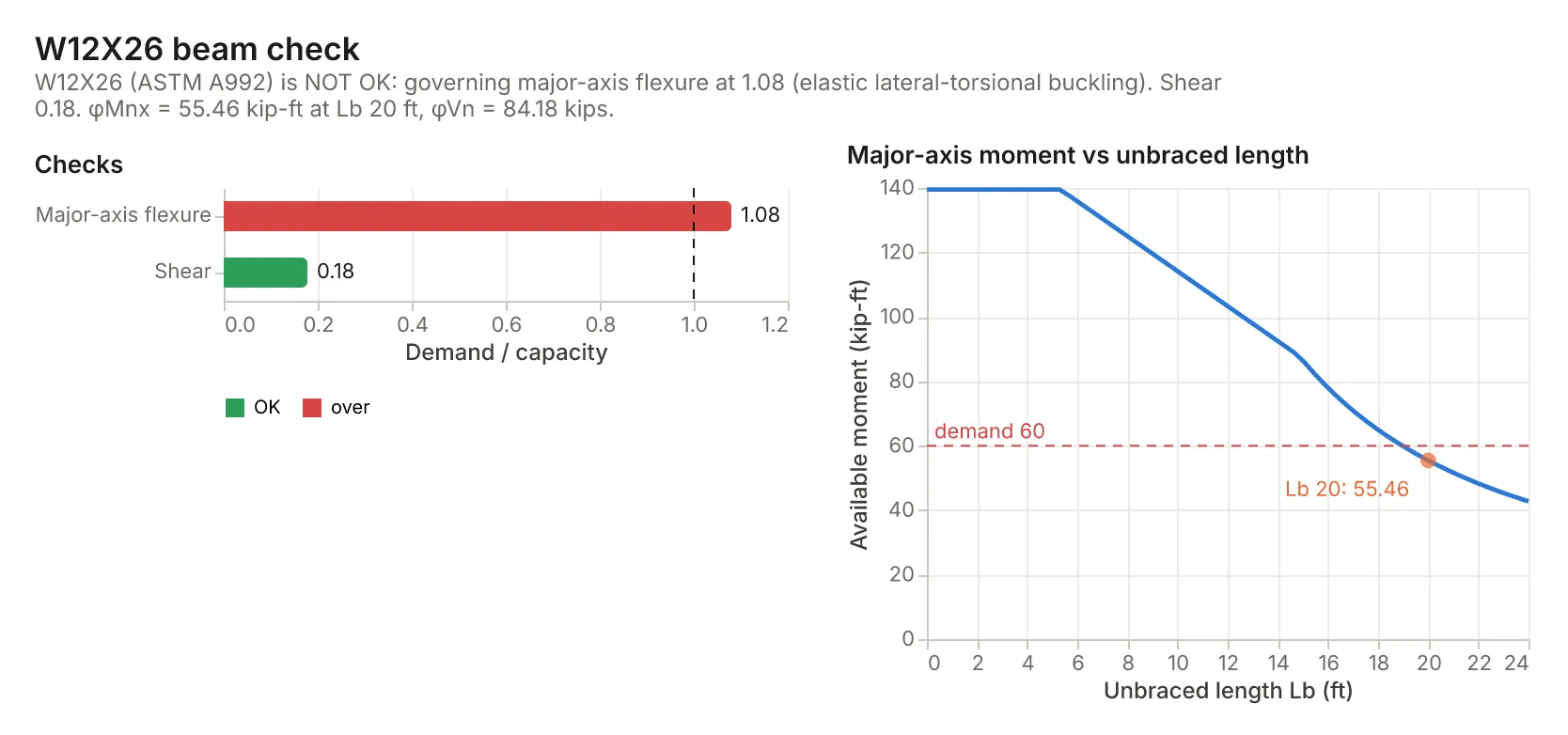
- A chart (each ratio, and the moment capacity against unbraced length) and a Markdown report.
Shapes and their properties come from the AISC Shapes Database v15: 351 W, M, S and HP shapes, 72 channels, 391 rectangular and square HSS and 179 round HSS and pipes. Metric names such as W310x38.7 work too.
It's made for:
- Structural engineers checking a member quickly or comparing shapes before modelling.
- Contractors, fabricators, architects and students sizing a beam, header, post or lintel.
- AI agents and calculation tools that need steel capacities they can cite.
How to use it
- Write Members, one per entry. The form has examples.
- Optionally set the Units: US (kips, kip-ft, ft, ksi) by default; kN, kN·m, m or MPa in a request switch it to metric.
- Click Start. Each request is a row in the results, with its summary, chart and report.
What you can write
| You write | It means |
|---|---|
W12x26, HSS6x6x1/4, HSS6.625x0.280, Pipe4STD, C10x15.3, HP12x53, W310x38.7 | The shape to check |
Mu 60 kip-ft, Muy 10 kip-ft, Vu 15 kips | Moments and shear (Ma, Va for ASD) |
Pu 250 kips, tension 60 kips | Axial compression or tension |
w = 1.2 klf, span 25 ft (or cantilever) | A uniform load: M and V from the span |
Lb 10 ft, fully braced, braced at midspan, Cb 1.14 | Lateral bracing for flexure |
KL = 14 ft, KLx 28 ft, KLy 14 ft, K = 2.1 | Effective lengths for compression |
L/360 | A deflection limit (under the given w) |
A36, A572 Gr 50, A500 Gr B, Fy 50 ksi | Material (A992 for W, A500 Gr. C for HSS, A53 for pipe by default) |
An 3.9 in2, U 0.85 | Net area and shear lag for tensile rupture |
ASD | Allowable stress design (LRFD by default) |
lightest W beam ..., lightest W12 column ..., select a square HSS ..., max depth 16 in | Selection |
The same as an object: {"shape": "C10x15.3", "T": "60 kips", "an": "3.9 in2", "u": 0.85, "method": "asd"} or {"type": "select", "family": "w", "M": "150 kip-ft", "lb": 0}.
Examples
W12x26 beam, span 20 ft, Lb 20 ft, Mu 60 kip-ft, Vu 15 kips→ NOT OK: flexure 1.08 (elastic lateral-torsional buckling, φMn = 55.5 kip-ft at Lb = 20 ft; Lp = 5.33 ft, Lr = 14.9 ft as in the AISC Manual), shear 0.18.W10x33 column, KL = 14 ft, Pu = 250 kips→ OK at 0.99: φPn = 252.5 kips (AISC Manual Table 4-1a: 253 kips).HSS6x6x1/4, L = 12 ft, Pu 100 kips, Mux 20 kip-ft→ OK at 0.98 by H1-1a (φMn = 42.0 kip-ft, φPn = 178.8 kips).lightest W beam for Mu = 150 kip-ft, fully braced→ W16x26 (φMp = 165.8 kip-ft).select the lightest square HSS column, Pu 200 kips, KL 16 ft→ HSS8x8x1/4 at 0.82, then HSS6x6x3/8, HSS7x7x5/16 ...C10x15.3, tension 60 kips, An 3.9 in2, U 0.85, ASD→ OK at 0.62, governed by tensile rupture (96.1 kips).
How-to examples
Each example is a complete input; the results are from runs of the Actor (also listed under Examples).
How to check a steel beam for lateral-torsional buckling (AISC 360)
Result: NOT OK, with flexure at 1.08 (elastic lateral-torsional buckling, φMn = 55.5 kip-ft at Lb = 20 ft; Lp = 5.33 ft and Lr = 14.9 ft, as in the AISC Manual) and shear at 0.18.
How to find the lightest W beam or HSS column
Result: W16x26 (φMp = 165.8 kip-ft); and HSS8x8x1/4 at 0.82, followed by HSS6x6x3/8, HSS7x7x5/16 and other choices.
How to check a steel column's axial capacity
Result: OK at 0.99, with φPn = 252.5 kips (AISC Manual Table 4-1a gives 253 kips). Beam-columns are checked by H1-1: HSS6x6x1/4, L = 12 ft, Pu 100 kips, Mux 20 kip-ft is OK at 0.98.
How to let an AI agent check steel members
Add this Actor to the Apify MCP server with https://mcp.apify.com/?tools=jumblemog/steel-member-calculator. The agent passes the member as one line and answers with the ratios and the governing limit state from AISC 360-16, with the intermediate values for a hand check.
FAQ
Which shapes does it know? The AISC Shapes Database v15: 351 W, M, S and HP shapes, 72 channels, 391 rectangular and square HSS and 179 round HSS and pipes. Metric names work too.
LRFD or ASD? LRFD by default. Add ASD to the line for allowable stress design.
Which checks does it do? Flexure with lateral-torsional buckling at your unbraced length and Cb, shear, compression with flexural, torsional and flexural-torsional buckling and slender elements, tension, and combined forces.
Is it a stamped calculation? No. It's a design aid; a licensed engineer must check the design.
Input
| Field | What it is |
|---|---|
requests | Members, as lines of text or objects (up to 200 per run) |
units | us or metric for values without a unit |
charts | Draw a chart for each request (default on) |
Output
One dataset item per request, also saved together in the run's OUTPUT record:
Selections add alternatives (the lightest passing shape of each depth with its weight and ratio), candidates and passing. Every item also has ltbCurve (moment against unbraced length), warnings, notes (the method and every assumption), a Markdown report and links to the chart and report. A request that can't be computed has "status": "failed" and the reason in error, and isn't billed.
How it works
- Flexure (chapter F): F2 yielding and lateral-torsional buckling with Lp, Lr and Cb for I-shapes and channels, F3 flange local buckling, F6 minor axis, F7 rectangular HSS (flange and web local buckling, lateral-torsional buckling) and F8 round HSS.
- Shear (chapter G): G2.1 with φ = 1.0 for rolled I-shapes with stocky webs, G4 rectangular HSS, G5 round HSS.
- Compression (chapter E): E3 flexural buckling, E4 torsional buckling of I-shapes and flexural-torsional buckling of channels, E7 effective widths for slender flanges, webs and walls.
- Tension (chapter D): yielding on the gross area and rupture on Ae = U An. Combined forces by H1-1a and H1-1b.
- Selection runs every shape of the family through the same checks and keeps the lightest that passes.
Pricing
You pay one low price per request, at the price shown on this page. The chart and report are included. Requests that can't be computed are never charged. If you set a maximum cost per run, the Actor stops before a request that wouldn't fit.
Speed
A check takes milliseconds and a selection well under a second. A run through the API answers in about 10 seconds, including the cloud container starting.
Tips and limits
- This is a design aid, not a stamped calculation. Loads, bracing, effective lengths and connections are your input; a licensed engineer must check the design.
- Not covered: angles and tees, built-up and plate girders, torsion, web crippling and local yielding at bearings, second-order (P-δ) amplification (give amplified moments), composite beams, seismic provisions and fire.
- Deflection is computed under the line load you give, so use service loads (often the live load) for the L/360 check.
- Cb defaults to 1.0 (1.14 for a uniformly loaded simple span braced only at the supports); give your own for other moment diagrams.
- Limits: 200 requests per run.
For AI agents and developers
This Actor works with the Apify MCP server, so AI agents can call it as a tool. Pass requests as plain text and read summary, checks, capacities and warnings. A direct API call that waits for the answer:
run-sync instead returns the run's OUTPUT: the status, the counts and every result as JSON.
In Python, with the apify-client package:
Credits
- Method: ANSI/AISC 360-16, Specification for Structural Steel Buildings. This Actor is not affiliated with AISC.
- Shapes: the AISC Shapes Database v15, as packaged in efficalc (MIT, copyright 2024 Andrew Young; license in
src/LICENSE-efficalc.txt). - Charts: Vega-Lite and vl-convert (BSD-3-Clause), with the Inter font (SIL Open Font License).


