

Google Flights Scraper: flight prices by route and date
Pricing
$0.50 / 1,000 flight row delivereds
Google Flights Scraper: flight prices by route and date
Flight options and prices Google Flights shows for a route and date: airline, times, duration, stops, layovers. One-way or round trip, optional return flights. Plain HTTP, no login. Not affiliated with Google or any airline.
Pricing
$0.50 / 1,000 flight row delivereds
Rating
0.0
(0)
Developer

Mohammed Samaan
Maintained by CommunityActor stats
0
Bookmarked
2
Total users
1
Monthly active users
4 hours ago
Last modified
Categories
Features
Share
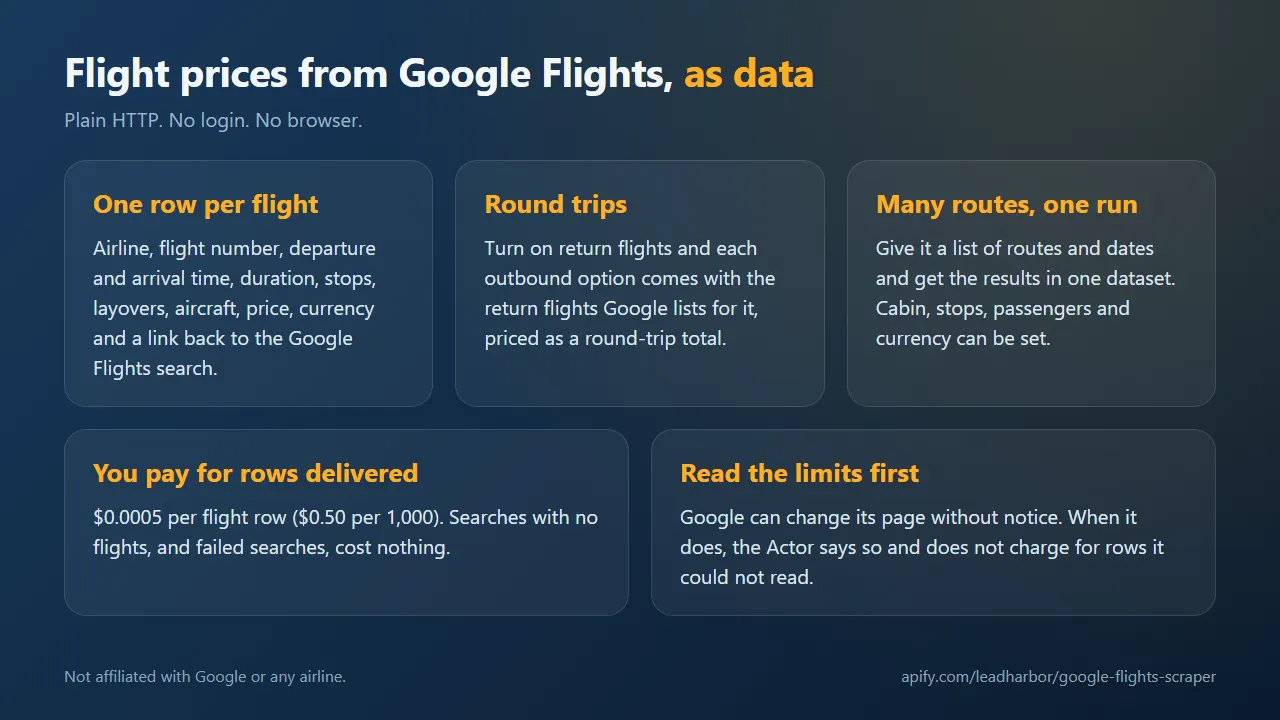
Google Flights scraper and flight price scraper. Give it routes and dates, get back one row per flight option that Google Flights shows: price, airline, flight numbers, departure and arrival times, duration, stops and layovers. One-way or round trip, with optional return flights. It reads Google's public flight results page with plain HTTP, logged out. No browser, no login, no cookies, no proxy. Use it from the Apify Console, the Apify API, schedules or integrations as a Google Flights API for price tracking, fare comparison and travel data. It is not an official Google API and is not affiliated with or endorsed by Google or any airline.
What you get
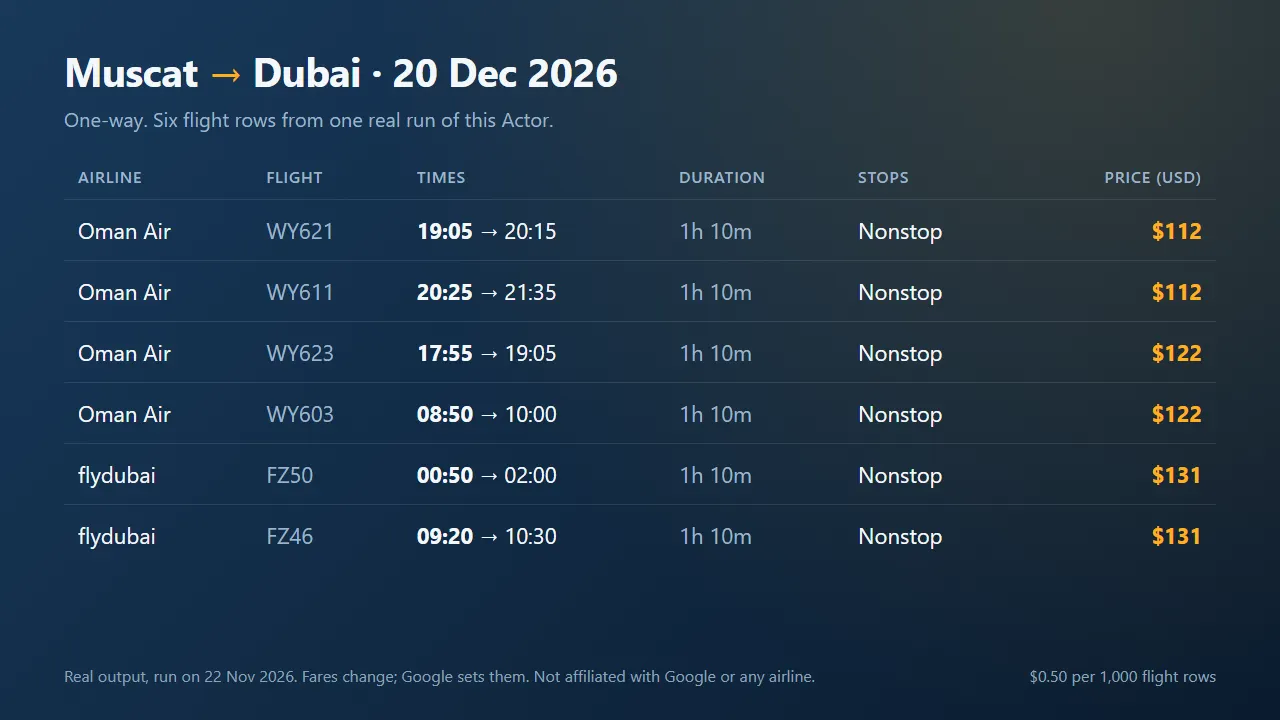
For every flight option: the route and date you searched, the flight's own origin, destination, dates and times, duration in minutes, number of stops, layover airports and minutes, airline names, flight numbers, aircraft where Google shows it, the price and its currency, and a link to the same search on Google Flights. In our test on 22 Nov 2026, the 9 routes Google answered with flights returned between 16 and 178 options per search.
| Field | Meaning |
|---|---|
rowType | flight, or a free status row: no_flights, search_failed |
searchFrom, searchTo, searchDepartureDate, searchReturnDate, tripType | The search that produced the row. tripType is one-way or round-trip |
legType | outbound, or return for a return flight (only with Include return flights) |
origin, destination, departureDate, departureTime, arrivalDate, arrivalTime | The flight itself. Times are local airport times, HH:MM |
durationMin, stops | Total duration in minutes and number of stops |
price, currency, priceAvailable, priceBasis | Price as Google shows it (see "What the price means"). price is null and priceAvailable false when Google shows no price |
airlines, flightNumbers, legs, layovers | Airline names, flight numbers in order, one entry per flight with airports, times, duration and aircraft, and the layovers between them |
isTopFlight | true if Google listed the option in the group it shows first |
returnFlightsStatus | With Include return flights, on outbound rows: delivered, none (Google lists no return options), failed (including unreadable: Google lists 3 or more return options and none could be read), or skipped |
outboundRowId, outboundFlightNumbers, outboundDepartureDate | On return rows: the outbound row (its rowId) and flight they were looked up for |
billable | true for a charged row. false on an outbound row whose return options could not be read: it is delivered and not charged |
cabin, passengers, searchUrl, scrapedAt, rowId, searchIndex | What was asked, the Google Flights link for the search, when the row was read, a stable id, and the position of the search in your list |
Example
Input:
One output row (shortened; read on 22 Nov 2026 for a flight on 2026-12-19, so the dates differ from the input above):
Input
| Field | Meaning |
|---|---|
searches | The searches, up to 50. Each: from and to (3-letter IATA airport or city codes such as MCT, DXB, LHR, NYC), optional departureDate and optional returnDate, written YYYY-MM-DD |
departureDate left out | The search uses the day 28 days after the day the run starts. The prefill does this on purpose so it never goes stale |
returnDate | Left out: one-way. Given: round trip |
adults, children | 1 to 9 adults, 0 to 8 children, at most 9 together. Infants are not supported |
cabin | economy, premium_economy, business, first |
stops | any, nonstop, max1, max2 (Google's stops filter) |
currency | One of 38 currency codes, default USD |
maxResults | Flight rows delivered per search, 1 to 500, default 50. For a one-way search this is also the most you pay for that search. With Include return flights it caps the outbound rows, and every outbound can add up to returnOptionsPerOutbound return rows, so the most a search can cost is maxResults x (1 + returnOptionsPerOutbound) rows |
sortBy | price (default, cheapest first), duration, or google (Google's order) |
includeUnpriced | Default off, see below |
includeReturnFlights, returnOptionsPerOutbound | Round trips only, see below |
requestGapSeconds | Pause between two requests to Google, 0.8 to 10 seconds, default 2 (see "Limits and honest caveats") |
Dates must be real calendar days from today up to 320 days ahead. "Today" is the current day in UTC, so a user far west of UTC may see their own local today refused as in the past. 320 days is a cautious limit set by the actor, not a number Google publishes (our checks on 22 Nov 2026 found Google still answering for the busy route London to New York at 330 days, while Muscat to Dubai had no flights listed even at 320 days); airlines open their schedules at different times, so a date inside the window can still have no flights. A search with a bad entry (a code that is not three letters, a past date, a return before the departure) becomes a free search_failed row with the reason, and the other searches still run. If no search is usable the run stops with an input error that names the field.
What the price means
Google's prices are totals for all travellers in the search, not per person (on 22 Nov 2026 the cheapest MCT to DXB option was 112 USD for one adult and 223 USD for two, so about twice).
- One-way search:
priceis the one-way fare. - Round-trip search, default: you get the outbound options.
priceis the round-trip total with the cheapest return Google lists for that outbound (priceBasissays so). In the 10 outbound options we checked against their return lists (one Apify run on 22 Nov 2026), the outbound price equalled the cheapest return option's total. - Round trip with Include return flights: for each delivered outbound the actor makes one more request with that outbound chosen, and delivers up to
returnOptionsPerOutboundreturn flights. Theirpriceis the round-trip total with that outbound (legTypeisreturn,outboundFlightNumbersnames the outbound). Each outbound and each return row is one charged flight row, and the run needs one more request per outbound, so keepmaxResultssmall for round trips.
Prices are what Google Flights showed when the row was read. They are not an offer and not a promise that you can book at that price, and they can differ from what an airline or travel agency charges at booking time.
Options without a price
Google lists some options without a price (21 of 91 on one DXB to BOM search we saved). By default these are left out: they are not delivered and not charged, and the run summary counts them in droppedUnpriced. Turn on includeUnpriced to get them with priceAvailable: false and price: null; they come after the priced rows when sorting by price and are charged like any other row. Options Google lists without complete times or flight numbers cannot be turned into a row and are left out too (droppedIncomplete in the summary).
Searches with no flights, and searches that fail
- No flights is a valid answer. If Google lists no flights for the route and date (for example no service that day) or does not know a code, the search gets one free
no_flightsrow with the reason. It is not an error and not charged. Before the actor accepts an answer as "no flights" it looks through the whole data block for flight-like entries; if it finds some in a place it does not read, the search is reported asunreadable. If Google changed its format in a way that hides the flights completely, that would still look like "no flights", so a run in which every search says "no flights" for routes that normally have flights deserves a look. - Retries. Google's flight backend often answers a normal-looking page that contains an error instead of flights. We measured this on Apify on 22 Nov 2026: 18 of 43 requests in three first test runs, then in three runs of the same round-trip search with return flights, 28 of 49 requests at a 0.8 second gap, 15 of 37 at 2 seconds and 11 of 25 at 3 seconds. So expect roughly 4 in 10 requests to be answered with an error first. The actor retries such a request, and also 429, 5xx and other failed HTTP answers (but not a consent, CAPTCHA or 403 answer) and network errors, up to 4 more times with growing waits (about 1.5, 4, 9 and 15 seconds). In our four later test runs, 11 of 12 first searches succeeded within the retries; 1 of 12 failed after all 5 attempts (see the next point). The errors cluster: one route needed 5, 3, 5 (failed) and 3 attempts in those four runs.
- A search that stays failed (in one of our three gap test runs, one of three searches failed after all 5 attempts) gets one free
search_failedrow witherrorKind, a plain-languageerrorandattempts. A search that fails is reported as failed, not as "no flights". If every search of a run fails, the run itself ends as failed. - Refusals and a stop rule. If Google answers with a cookie consent page, a CAPTCHA or a 403, the actor does not retry, sends no cookies and does not try to solve anything. A 429 is retried like other failures. When three searches (or return lookups) in a row still fail after all their retries, whatever the cause, the run stops asking: the remaining searches get free
search_failedrows witherrorKindskipped_blocked, and no further request is sent. A success resets the count. No retry starts after the 40 minute run time budget; a request that is already waiting for its gap or running can finish later, in the worst case about one request gap plus 45 seconds (we measured 50 seconds).
Pricing
Pay per event: $0.0005 per delivered flight row ($0.50 per 1,000), one event per row. No fee per run and none per search. Free rows (no_flights, search_failed), options left out for having no price, outbound rows whose return options could not be read (billable: false) and rows an earlier attempt of the same run already delivered are not charged. Rows are saved to the dataset first and charged afterwards, so a failed save is never charged. Set a maximum charge on the run and the actor delivers and charges only as many rows as the limit allows, never one more: it counts the rows left in your budget before every batch. Searches not read after that are marked skipped_charge_limit. If a run is restarted by the platform, rows already in the dataset are neither delivered nor charged again, and maxResults counts them, so a restart never delivers more than maxResults rows for a search (and returnOptionsPerOutbound return rows for an outbound). The Apify platform usage of the run is not billed on top.
Limits and honest caveats
- Google can change its page at any time. The actor reads fixed positions in an undocumented data block of the page. It has three safety checks, and only these three. (0) Dropped options: if Google lists 3 or more options and every one of them is dropped (no price, or incomplete data), in the first request of a search or in a return lookup, the search (or that outbound's return lookup) is reported as a free
search_failedrow witherrorKindunreadable, not as "no flights", and it counts toward the stop rule below. This also happens when a real answer has 3 or more options and none shows a price; turn onincludeUnpricedto get those without a price. The price part of this check does not apply whenincludeUnpricedis on (options with incomplete times or flight numbers are still caught): if Google then moved the price field, the rows are delivered withprice: nulland charged like any other row, so watchpriceAvailablein your data. (1) Shape: if the page or the flight lists do not have the expected shape, the search is reported asunreadableorno_data_block. (2) Durations: for every option, the minutes of its flights plus the minutes of its layovers must add up to the total duration Google gives. If that fails for more than 1 in 10 of the options of an answer, or if the minutes are missing for every option of a group (at least 3 options), the search is reported asunreadable. Answers with fewer than 3 options are not judged by this check. Nothing checks that prices, times or airline names are in the right place, and a few options with wrong durations (up to 1 in 10) are delivered and only counted indurationMismatchesof the run summary. A Google change that keeps durations consistent and the shape intact would go unnoticed, so spot-check your data. The actor then needs an update; there is no uptime promise. - Prices and availability change between runs and within a day.
- Outbound options for round trips, return options only on request (see above). Multi-city trips, flexible dates, price calendars and booking links are not covered.
- Each row is a snapshot of the moment it was read. No booking, no seat or fare-rule data, no baggage prices.
- Where the request comes from matters. Google shows different lists depending on the address of the request. The results are what Google shows to Apify's servers (US addresses in our tests), not to your browser at home: for MCT to DXB we got 15 options from a home address in Oman and 65 to 69 from Apify, and prices can differ too. The currency and two-adult checks in the evidence files were made from a home address, not from Apify.
- Infants are not supported. Children are searched as child passengers; we did not verify the child fares Google returns.
- Currency. Google priced in the requested currency for each of the 38 codes on the list when we checked on 22 Nov 2026 (38 of 38). If Google ever answers in another currency, each row says which, and the summary counts those rows (a code that is not on the list is refused).
- Run time and the request gap. Requests are spaced 2 seconds apart by default;
requestGapSecondssets it from 0.8 to 10. We measured Google's error answers on Apify on 22 Nov 2026 with round-trip searches that also look up return flights: at a 0.8 second gap 28 of 49 requests (57%), at 2 seconds 44 of 100 (44%, two runs), at 3 seconds 11 of 25 (44%, and one of three searches failed after all retries). A longer pause seems to help a little, 3 seconds no more than 2; these are small samples, so the pause does not remove the errors, it only makes them somewhat rarer. From one home address outside Apify, 45 requests at 2 seconds got no error answer, so the rate depends on where the request comes from. Return-flight lookups are about 1 request per outbound option, so a round trip with return flights takes many more requests than a one-way search: 119 rows (3 round-trip searches, 10 outbounds each, 3 returns each) took 4 minutes. A run stops reading new searches after 40 minutes and marks the restskipped_time_budget; in return-flight mode the outbound options not yet looked up are left out (free).
Data handling
The actor sends requests only to www.google.com, built from the airport codes, dates and options in your input. It takes no URL as input, so you cannot make it fetch another address. It sends no cookies, signs in nowhere, uses no proxy and no browser. It collects only the flight options Google shows publicly; it asks for and stores no personal data. Input and output stay in your Apify account. It is your responsibility to use the data in line with Google's terms and the law that applies to you.
Not affiliated
This actor is an independent tool. It is not affiliated with, endorsed by or sponsored by Google or any airline. Google Flights is a Google product; airline and airport names belong to their owners.


