

SEC 8-K Material Event & Change Monitor
Pricing
from $1.90 / 1,000 8-k filings
SEC 8-K Material Event & Change Monitor
Find official SEC 8-K and 8-K/A material events by ticker, CIK, or whole market, classify SEC items, link amendments, and track verified accession changes.
Pricing
from $1.90 / 1,000 8-k filings
Rating
0.0
(0)
Developer

Luka
Maintained by CommunityActor stats
0
Bookmarked
2
Total users
1
Monthly active users
11 days ago
Last modified
Categories
Share
Find official SEC Form 8-K and 8-K/A filings, understand which SEC items were reported, and rerun the same scope to receive only new or source-metadata-updated accessions.
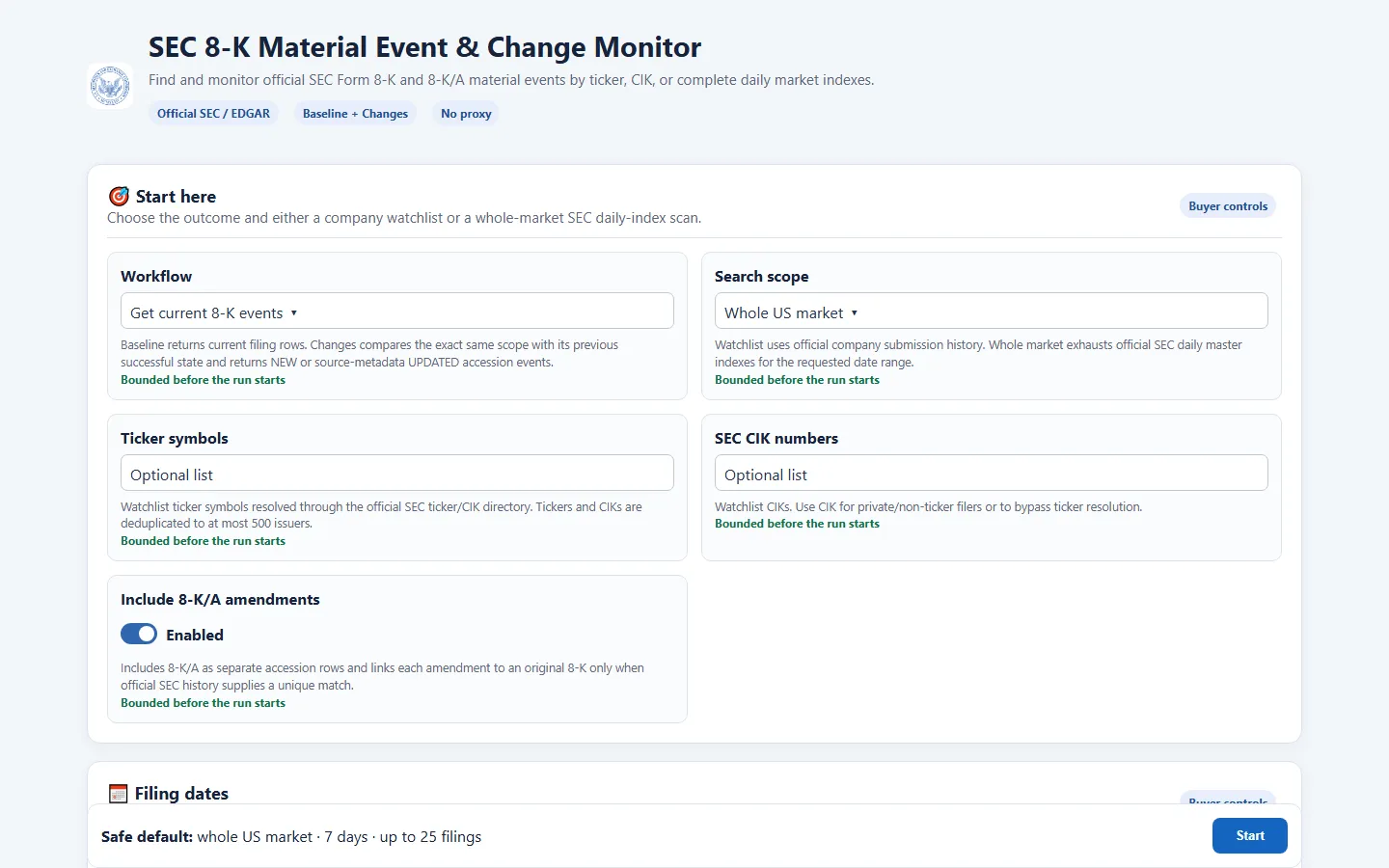
Start in 60 seconds
- Keep Get current 8-K events and Whole US market selected.
- Start the safe 7-day run; it returns up to 25 of the newest qualifying official filings.
- Open Material-event overview — mixed rows to review SEC item codes, event categories, accession numbers, and filing links.
- Switch to Ticker / CIK watchlist only when you want named companies instead of the complete daily market feed.
Choose the workflow
| Workflow | Use it for | Delivered rows |
|---|---|---|
| Get current 8-K events | A current watchlist or whole-market export | One filing row per official accession-and-registrant pair |
| Track new and updated events | Repeat monitoring for the same exact scope | NEW or source-metadata UPDATED change rows; optional UNCHANGED audit rows are free |
The first run in Changes mode emits the accessions currently inside the requested scope as NEW. Repeat runs of the same scope compare against the last safely delivered state. Run the same scope sequentially. SEC filing history is treated as append-only: a filing leaving a rolling date window is never reported as ended.
What you get
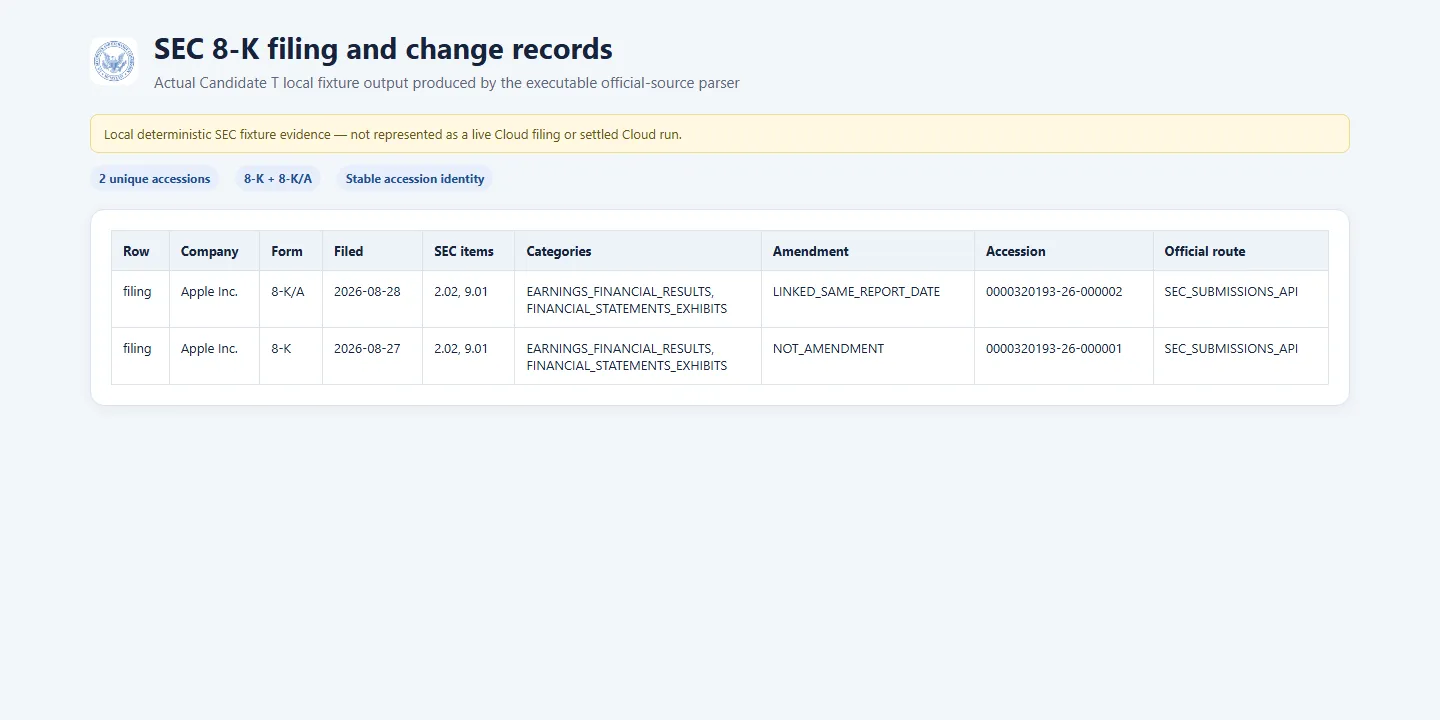
The example below is a synthetic fixture. It uses a synthetic accession and issuer and does not represent a live filing.
Every result keeps the canonical SEC accession and is uniquely keyed by accession plus registrant CIK. When one official filing is co-filed for multiple registrants, every issuer remains visible and each row lists the complete co-filed registrant set found in the requested scope. Item categories are deterministic labels derived from official Form 8-K item codes; the Actor does not score importance, sentiment, or likely stock-price impact.
Ticker, CIK, and whole-market search
Watch a company list
Mix up to 500 ticker symbols and CIK numbers. Tickers are resolved through the official SEC ticker/CIK directory and duplicate issuers are fetched once.
Scan the whole market
Whole-market mode reads the SEC daily master indexes for every requested filing date, then checks the official filing detail for every candidate 8-K/8-K/A. A date range can cover up to 31 calendar days per run. When dates are omitted, the rolling whole-market window ends on the last completed calendar day because SEC daily indexes are finalized nightly; weekend dates are recorded as confirmed non-filing days without requesting nonexistent index files.
Optional filing-body keywords are matched against the official primary filing document and return a short source snippet. They add one SEC archive request per candidate filing; they do not convert the filing to Markdown or provide an AI summary.
SEC item classification
The Actor expands every official item code into its current SEC title, section, and a deterministic automation category. Common examples include:
| SEC item | Official event | Category |
|---|---|---|
1.01 | Material definitive agreement | BUSINESS_AGREEMENT |
1.05 | Material cybersecurity incident | CYBERSECURITY_INCIDENT |
2.01 | Acquisition or disposition of assets | M_AND_A_ASSET_TRANSACTION |
2.02 | Results of operations and financial condition | EARNINGS_FINANCIAL_RESULTS |
4.02 | Non-reliance on prior financial statements | FINANCIAL_RESTATEMENT_NON_RELIANCE |
5.02 | Director or officer changes | LEADERSHIP_BOARD_CHANGE |
8.01 | Other events | OTHER_MATERIAL_EVENT |
If SEC metadata publishes no item codes, the row says OFFICIAL_NO_ITEM_CODES. No code is guessed from prose.
8-K/A amendment links
An amendment is always a separate accession. amendsAccessionNumber is filled only when one of these official-evidence rules yields a unique original 8-K:
- the same CIK and same official period-of-report date; or
- an explicit original 8-K filing date in the amendment document followed by one unique official-history match.
Multiple candidates produce AMBIGUOUS; no supported candidate produces UNRESOLVED. The Actor never picks the nearest filing merely because it looks plausible.
Input guide
| Input | Limit | Effect |
|---|---|---|
tickers + ciks | 500 issuers combined | Watchlist targets; ignored in whole-market mode |
startDate / endDate | 31 whole-market days; 10 watchlist years | Fixed inclusive filing window |
lookbackDays | 1–31 | Rolling window when explicit dates are empty |
itemCodes | 40 | Filters by official SEC item codes after classification |
keywords | 10 | Searches the official primary document; adds source work |
maxFilingsPerCompany | 1–1,000 | Watchlist-only per-issuer cap |
maxFilings | 1–20,000 | Global delivered filing/change ceiling |
maxTrackedItems | 1–20,000 | Changes state ceiling; must be at least maxFilings |
maxBuyerChargeUsd | $0.001–$100 | Stops before source work if the worst-case Actor charge for the selected limits is higher |
Every result-set-affecting limit and filter participates in the Changes state scope. Changing one starts an independent comparison history.
Pricing
Each usable completion follows one of two mutually exclusive formulas:
- one or more paid rows: result-bearing run start + delivered filing or change rows;
- no paid row: one verified-empty-scope event only.
| Buyer tier | Result-bearing run | Baseline filing | Verified empty scope | New or updated event |
|---|---|---|---|---|
| All buyer tiers | $0.00095 | $0.00190 | $0.00180 | $0.00190 |
Unchanged rows, coverage, summaries, warnings, duplicates, failed source work, and suppressed rows are free.
Dataset view
The Dataset keeps the stable accession, filing type, SEC items, event categories, amendment evidence, source route, and official filing link visible in one row.
Coverage you can trust
Every run stores a free coverage receipt:
COMPLETE— every requested official source branch was exhausted;EMPTY_CONFIRMED— every required branch was reached and proved no matching 8-K/8-K/A;FILTERED— traversal completed but buyer filters bounded the returned set;CAPPED— a declared filing/request/byte/runtime cap stopped traversal;PARTIAL— useful rows exist but one or more requested branches failed;BLOCKEDorFAILED— the expected official source shape was not reached and is never presented as empty.
A missing current-day daily index, failed filing detail, or blocked SEC response is visible in the receipt. Whole-market completeness is claimed only inside the exact requested dates and limits.
Price examples
Complete run charge:
result-bearing run start + delivered filing/change rows, or $0.00180 when the official scope is confirmed usable but has no paid row.
| Event | Price | Charged when |
|---|---|---|
| SEC run with results | $0.00095 per run | At least one paid filing/change row is ready for delivery |
| Baseline filing | $0.00190 each | One unique 8-K/8-K/A filing row is delivered |
| Verified empty SEC scope | $0.00180 per completion | Usable official evidence confirms no paid filing/change row; the result-bearing start is not charged |
| New or updated event | $0.00190 each | One NEW or source-metadata UPDATED change is delivered |
Examples on every buyer tier:
- Baseline with 10 filings:
$0.00095 + (10 x $0.00190) = $0.01995. - Changes with no new or updated filing:
$0.00180. - Changes with 5 new or updated filings:
$0.00095 + (5 x $0.00190) = $0.01045.
Automation and API
Save one tested Changes input as an Apify Task, then schedule that Task. Keep one same-scope run sequential; use a different Monitoring scope name for an independent state history. Dataset export supports JSON, CSV, Excel, and API access. Webhooks can forward successful runs to a database, spreadsheet, queue, Slack, or another downstream system.
Official-source and fair-access policy
The Actor uses only official www.sec.gov and data.sec.gov endpoints, identifies itself with a descriptive User-Agent, shares one paced client across the run, and stays below two requests per second. It fails closed immediately on an SEC access block or rate limit and fails closed on source-contract drift. Source extraction runs in Apify Cloud; automated validation uses clearly labeled fixtures.
FAQ
Does this determine whether an event is important for an investment decision?
No. It reports official SEC item classifications and source links. It does not provide investment, legal, accounting, or compliance advice.
Does it download full filings or XBRL financial statements?
No. It returns event metadata, official item classifications, direct links, and optional keyword snippets. Full-document conversion and XBRL financial analysis are separate workflows.
Can an amendment be linked incorrectly?
The Actor refuses heuristic nearest-filing links. Ambiguous and unresolved relationships remain explicit so a buyer can review the official filings.
Why can a run be CAPPED?
The buyer selected a filing, request, byte, runtime, or state limit before every matching official row was reached. Increase the relevant supported limit or narrow the date/filter scope, then rerun.
Support
For a reproducible issue, share the Apify run ID, sanitized input, expected accession/date, and the coverage status. Never send account tokens or private credentials.


