

arXiv Research Monitor - New Papers & Revision Changes
Under maintenancePricing
from $0.60 / 1,000 saved observations
arXiv Research Monitor - New Papers & Revision Changes
Under maintenanceFind arXiv papers by search query or category and track revisions under stable paper IDs. Export abstracts, authors, categories and changed fields. No full-text downloads.
Pricing
from $0.60 / 1,000 saved observations
Rating
0.0
(0)
Developer

Brandt May
Maintained by CommunityActor stats
0
Bookmarked
2
Total users
1
Monthly active users
5 hours ago
Last modified
Features
Share
arXiv Research Monitor - New Papers & Revision Changes
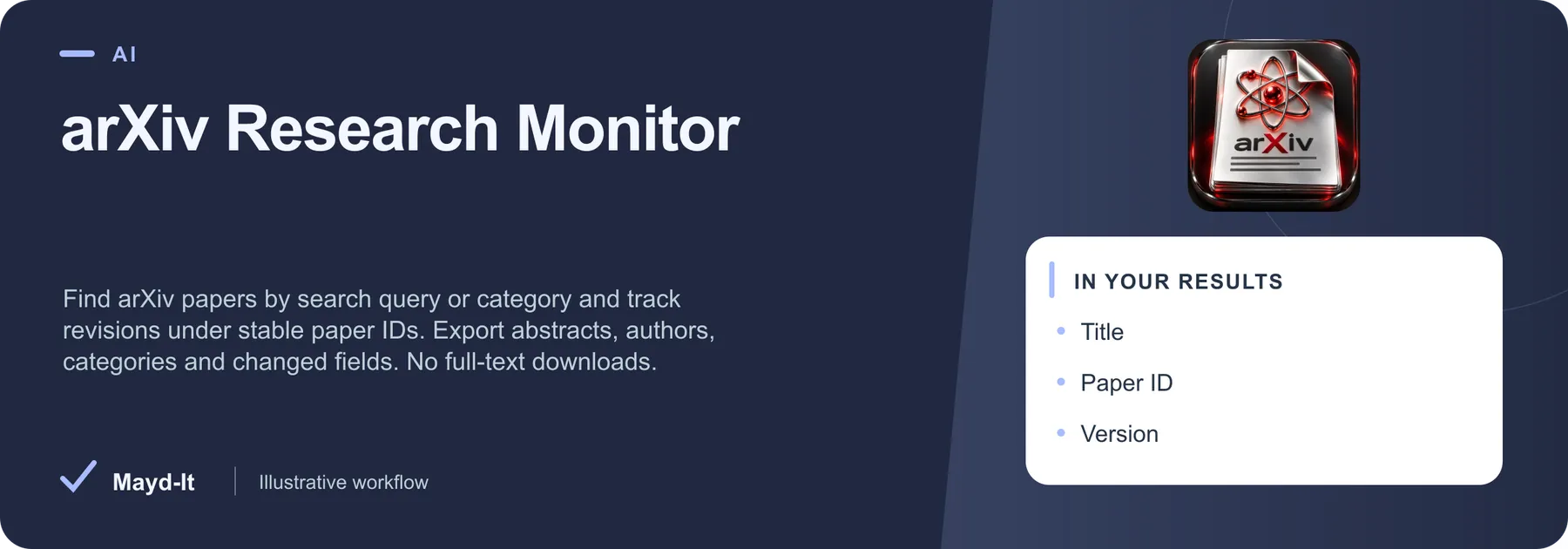
Find arXiv papers by search query or category and track revisions under stable paper IDs. Export abstracts, authors, categories and changed fields. No full-text downloads.
Open in Apify Console · First run · Output · Pairings · Price
First run and source setup
- Review the source targets and filters before starting. Apify account authorization is required to run the Actor.
- Open the JSON input editor and start with the bounded configuration below. Review dates and targets for your intended use.
- Review the current Pricing tab and set a maximum run charge and timeout in Run options. A result limit does not set a spending limit or promise that many rows.
- After completion, inspect the dataset and the run's diagnostics/Storage records described in the full guide. A successful process alone does not establish complete source coverage.
Historical evidence for this exact input was recorded 2026-10-18 UTC on build ID WK6bUqvVTV2Re1O4C. It is not a fresh source-availability test.
Source timeouts and retries
arXiv requests use the same official API endpoint and exact search query for at most two attempts. A temporary network timeout or HTTP 502, 503 or 504 can receive one retry if the existing run budget leaves enough time for another request and saving output. Requests remain sequential with at least 3.1 seconds of pacing; valid longer server Retry-After delays are respected. HTTP 429, permission errors and invalid response data are not retried. SUMMARY.sourceControls records attempts and their outcomes. Repeated failure remains a failed or incomplete run; no replacement or cached records are presented as fresh results. Avoid overlapping Actor runs or other arXiv API jobs: arXiv applies its request limit across the machines under your control.
Output worth checking
The published default dataset view includes these fields. Missing values and source-specific coverage are explained in the full guide.
- title ·
title - paper Id ·
paperId - version ·
version - authors ·
authors - categories ·
categories - published At ·
publishedAt
Keep original source links and observation dates when interpreting records. JSON preserves nested values; CSV is useful for flat columns.
Use this with other Mayd It Actors
These are separate tools for a reviewed workflow. Each run uses its own input, authorization and pricing; this guide does not configure automatic execution.
Europe PMC Literature Monitor - Papers & Citation Changes
Look for related publication evidence with explicit identifiers and publication dates rather than treating a registration or catalog record as study results.
Parallel research context: Choose the corresponding source target in this second Actor’s own input form; no automatic field transfer is configured. Keep both original source URLs and observation dates in your review sheet; reconcile identities manually.
Keep the distinction: Publication records, preprints and datasets are distinct objects. Match persistent identifiers and versions when available; topical similarity is not evidence that two records describe the same work.
DataCite DOI Monitor - Research Datasets & Metadata Changes
Find dataset DOIs through DataCite and track version, rights and metadata changes. Export stable DOI identities and source links for dataset discovery and provenance reviews. Keep this DataCite DOI Monitor evidence alongside the original source in a reviewed research discovery workflow.
Parallel research context: Choose the corresponding source target in this second Actor’s own input form; no automatic field transfer is configured. Keep both original source URLs and observation dates in your review sheet; reconcile identities manually.
Keep the distinction: Publication records, preprints and datasets are distinct objects. Match persistent identifiers and versions when available; topical similarity is not evidence that two records describe the same work.
Price and run limits
At the captured FREE-tier rate (2026-11-16 UTC), $0.001 per saved observation. Actor Start is $0.00005 per event; the number of startup events depends on memory. Plan rates and future changes may differ; check the current Pricing tab before starting.
A capped or interrupted run can save useful rows without covering its intended scope. Review the source-specific completeness and comparison rules below before treating missing rows as removals.
Documentation and support
Product guide, source limits and saved output · API and MCP setup · Input schema
Open this Actor's Issues tab with a run URL, the relevant input field and the result you expected. Remove API keys and private information before sharing.
Complete source guide
arXiv Research Monitor - New Papers & Revision Changes

Keep a stable paper identity across version updates and export the exact changed fields.
arXiv Research Monitor with saved field comparisons, source URLs and CSV/JSON exports. Simple inputs, bounded results and readable reports. No source API key.
Start in under a minute
- Paste arxiv searches into the first input field, or use the included sample.
- Keep the five-result limit for your first run and choose Start.
- Open Observations, Scope and diagnostics, or the Readable run report in Output. Export CSV or JSON from the dataset.
No source account, API key, paid proxy or extra subscription is required for these public endpoints. Source availability and rate limits still apply.
Who this helps
AI R&D teams tracking technical advances and paper revisions.
A real output sample
Captured in a successful bounded Apify run; arrays and long text are shortened for readability. Values are snapshots, not live guarantees.
What you receive
One row per unique confirmed observation. Every row includes a stable recordId, title, source URL and observation time.
| Field | Meaning |
|---|---|
paperId | Source-reported paper id; missing optional values remain null. |
version | Source-reported version; missing optional values remain null. |
authors | Source-reported authors; missing optional values remain null. |
categories | Source-reported categories; missing optional values remain null. |
publishedAt | Source-reported published at; missing optional values remain null. |
updatedAt | Source-reported updated at; missing optional values remain null. |
abstract | Source-reported abstract; missing optional values remain null. |
comparisonStatus | not_requested, new, changed or unchanged |
changedFields | Fields different from your last saved observation |
previous | Previous saved source values when comparison is enabled |
Saved comparisons
Enable Compare with saved observations, choose a snapshot name, and reuse the same input scope. The first run establishes history; it cannot report changes before that point. Enable Save only new or changed observations for later runs if you want a change-only export. An unchanged run can correctly save zero rows.
Only confirmed saved rows advance history. A bounded or failed run never establishes that a missing record was deleted. History is stored in a named key-value store in the running user's account. Use one writer per snapshot: do not overlap runs against the same snapshot. Change the snapshot name when starting a new independent workflow.
Scope and limitations
Official Atom API, newest submissions first, one page per query. Supports arXiv search syntax. Preprints are not necessarily peer reviewed. No PDF download or full-text extraction.
At most ten input values and five hundred saved rows per run. Results requested per query controls a single source page (1–50, default five); there is no pagination. Each input uses one public source query with at most two bounded attempts for temporary failures. Requests are sequential and paced by at least 3.1 seconds. Responses are capped at 8 MiB and share the run deadline. No authentication bypass or code execution is performed. HTTP 429 stops further requests. Source failures appear in SUMMARY and the HTML report, never as paid data rows.
Pricing
The configured base price is $0.001 per saved observation, plus $0.00005 per start at the default memory. Five observations cost $0.00505 at that base rate. Applicable plan discounts and the Store pricing panel govern actual charges. Set a maximum charge in Run options. Diagnostics, reports and unchanged skipped rows are not dataset result events.
A practical workflow
AI R&D teams tracking technical advances and paper revisions. Keep a stable paper identity across version updates and export the exact changed fields. Start with the included five-result sample, review source links, then save your own scope as an Actor task. Use a named snapshot for repeat runs and keep source metadata with downstream exports.
Make it recurring
Save an Actor task with your inputs, then attach an Apify Schedule. For change detection, keep the same snapshot and avoid overlapping runs. Add an integration to deliver results to your own spreadsheet or workflow. No external delivery is enabled automatically.
Frequently asked questions
Why did a repeat run return zero rows? With change-only mode enabled, unchanged records are skipped. Check SUMMARY to distinguish this from empty matches, limits, or an upstream error.
Does a missing record mean it was deleted? No. Searches cover a bounded source window; a record can move outside it. Missing records never become deletion claims.
Can I export or integrate the data? Yes. Use Apify dataset exports for CSV/JSON, or the Actor API and your own integrations. No external message or delivery is enabled by default.
Examples
- arXiv searches: all:transformer — A bounded all:transformer observation sample. Review source evidence and export rows or compare them in a later run.
- arXiv searches: cat:cs.RO — A bounded cat:cs.RO observation sample. Review source evidence and export rows or compare them in a later run.
- arXiv searches: all:reasoning — A bounded all:reasoning observation sample. Review source evidence and export rows or compare them in a later run.
Source and support
Official source documentation. This independent Mayd IT tool is not affiliated with the source platform. Open an Actor issue with the run ID and expected result, or contact bmay@mayd-it.com. Never include credentials.


