

Earnings Guidance Change Monitor - SEC Ranges
Pricing
from $3.00 / 1,000 guidance observations
Earnings Guidance Change Monitor - SEC Ranges
Extract explicit EPS, revenue and margin guidance ranges from SEC earnings exhibits. Compare matching fiscal periods with evidence, prior ranges and review flags. No API key.
Pricing
from $3.00 / 1,000 guidance observations
Rating
0.0
(0)
Developer
Brandt May
Maintained by CommunityActor stats
0
Bookmarked
2
Total users
1
Monthly active users
4 hours ago
Last modified
Categories
Share
See what changed in company guidance
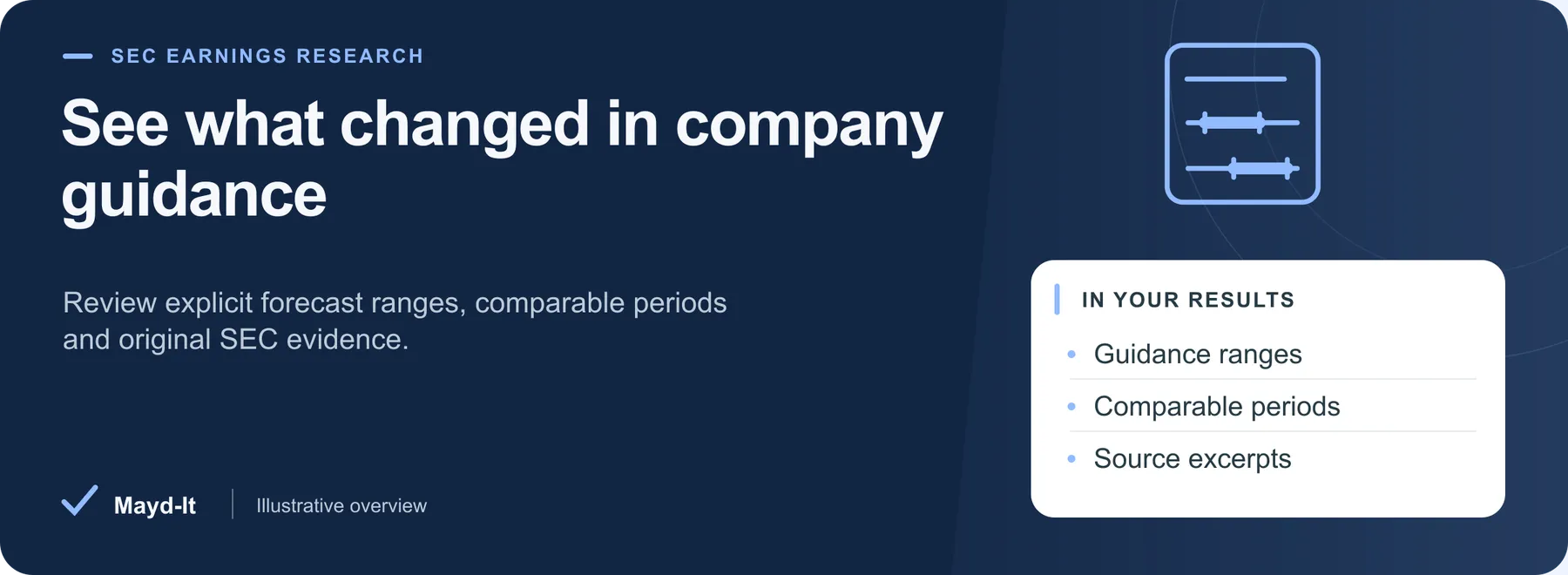
Turn explicit EPS, revenue and margin guidance from SEC earnings exhibits into a research table. Keep each range attached to its fiscal period, accounting basis and original evidence, then compare matching observations over time.
Use it to review earnings releases, maintain a company watchlist or feed a research workflow. No API key or proxy is required.
Open Actor · Read the results · Saved monitoring · Coverage and reference
Try one earnings exhibit
Start with this fixed Walmart FY2027 Q2 exhibit to see how a single document becomes inspectable guidance rows.
- Open the Actor and select the JSON input editor.
- Paste the input below and click Start.
- Open the output table, review the fiscal period and range, then follow SEC source to the filing.
Prefer a current sample? Click Start with the default input to inspect Walmart’s recent filings (CIK 104169). The fixed document above is a historical example; the default follows the SEC’s current recent-filings response.
Read the results
| Your research question | Fields to inspect |
|---|---|
| Which company and period does this cover? | companyName, tickers, targetPeriod |
| What range did the company state? | metric, low, high, unit |
| Are these figures comparable? | accountingBasis, currencyBasis |
| Did guidance change between sources? | guidanceChange and the prior/current evidence |
| Can I use the extracted number directly? | extractionConfidence, review reasons and quote |
| Where did it come from, and when? | sourceUrl, filingDate, acceptedAt, observedAt |
Compare the same period and basis. A new quarter is not a guidance increase over the previous quarter. guidanceChange compares source guidance; savedGuidanceChange compares a matching observation against your saved history. These fields do not measure stock-price impact.
A statement that cannot be safely parsed keeps its evidence, null numeric bounds and needs_review status. A valid current range can also have a review reason when its prior value is not comparable.
Check coverage before using the export
Export the dataset as JSON or CSV from the run’s output panel. Each observation includes the original SEC URL, accession, filing date, acceptance timestamp when available, and observation time.
In the Output tab, open Run report for a readable coverage report or Coverage and history summary (SUMMARY) for machine-readable source coverage, unsupported cases, failures, saved rows and limits. Reports create no paid dataset rows. A successful run can have partial coverage; SUMMARY marks it explicitly.
Usage and pricing
$5 per 1,000 saved observations on the FREE plan ($0.005 per observation), plus the applicable Actor Start charge. The Pricing tab is authoritative for your plan and current charges.
One confirmed saved observation is one result. Failure messages and run reports are never charged as result rows. Set Apify’s spending limit and maxResults before scheduling. The Actor checks the remaining dataset-item charge allowance before writing.
Build a saved guidance watchlist
Follow recent company filings
Collect current explicit guidance ranges from Walmart’s recent SEC earnings exhibits.
Replace the sample CIK with your companies’ exact SEC identifiers. Current SEC ticker arrays are included for convenience; they are not historical ticker mappings.
Save a baseline, then follow changes
Save the current observations; later runs identify changed or unchanged source guidance.
- Run this input once to establish a baseline. First observations are marked new.
- Save it as an Apify task and reuse the same watchlist, filing limit, date filter and history names.
- On later runs, inspect the comparison fields. Enable Save only new or changed observations (
onlyChanges) when you want an incremental output. - Schedule the saved task at a cadence suited to your research. An unchanged repeat can correctly produce zero rows.
Use a dedicated history name/store per workflow and allow only one run at a time for that scope.
Coverage and reference
Supported guidance
The Actor looks inside explicitly headed Guidance/Outlook sections of selected HTML EX-99.1 exhibits furnished with recent 8-K filings and amendments under Items 2.02, 7.01 or 8.01. Only the first HTML EX-99.1 is inspected. It supports two-ended numeric ranges for EPS, revenue, revenue growth, gross margin, operating margin and EBITDA margin. A range’s fiscal year or quarter, accounting basis, currency basis and units stay attached to it. Revenue-growth percentages are distinct from currency revenue. Naked EPS ranges and unsupported currency labels are left for review. Dollar symbols without an explicit USD label are marked dollar_unspecified.
How source comparisons work
The same fiscal period, metric, accounting basis, currency basis and unit form one observation identity. When a table includes prior and current guidance columns, their labels and values are retained; an explicit “Unchanged” cell carries forward that row’s prior value. Otherwise the latest source may be compared with an older matching-period observation in the inspected filings. Unspecified accounting bases do not receive cross-document numeric comparisons. A new quarter is never treated as a guidance increase over the old quarter. guidanceChange describes source-to-source range changes; savedGuidanceChange describes a matching observation from your saved history. Neither measures stock-price impact.
Extraction limits
A quoted guidance statement that cannot be safely parsed has null numeric bounds, extractionConfidence: needs_review and explicit reasons. This version does not parse PDFs, charts, implied ranges, analyst consensus, withdrawal/reaffirmation announcements without a supported numeric statement, or every issuer layout. Missing supported guidance is reported as an empty source observation, not proof the company gave no guidance.
Inputs and saved-history boundaries
ciks: up to 10 exact SEC company identifiers. The source checks company identity before parsing filings.documentUrls: up to 10 specific official SEC HTML documents, validated against their accession index. Direct documents suppress the sample fallback. Combine them with explicit CIKs when intentional.maxFilingsPerCompany: 1–10 matching filings from the SEC’s current recent-submissions response; default 3. Old archive pages are not scanned.filedFrom: optional inclusive filing-date filter. Historical direct documents with unavailable filing dates do not pass a date filter.comparePrevious: save and compare observations in your named key-value store. The first run is a new baseline.onlyChanges: implies comparison and suppresses unchanged observations. A repeat can correctly save zero rows.snapshotName/stateStoreName: isolate workflows. Scope includes the exact watchlist, document URLs, date filter and filing bound. Use one writer per scope; overlapping runs are unsupported.
Source chronology is checked using SEC acceptance timestamps when available, otherwise strictly ordered filing dates. A stale or temporally ambiguous replacement of saved guidance is skipped and counted in SUMMARY; it cannot overwrite newer guidance. Only confirmed saved dataset rows advance history. A source failure cannot erase previous observations. No disappearance or deletion is inferred from bounded or missing filings.
Source access and run limits
SEC requests are sequential with at least 1.1 seconds between request starts; every request has a deadline and an 8 MiB response cap. There are no paid providers, proxies, generative-model calls or credential requirements. SEC refusals and timeouts remain visible in SUMMARY. Coordinate parallel runs to respect the SEC’s aggregate fair-access policy.
Source and interpretation
Data comes from official SEC submissions APIs and the EDGAR archive. See SEC developer resources for fair access. Filing acceptance time, disclosure/event date and observation time are different; this Actor does not promise real-time exchange data or a trading signal.
Questions about an extraction? Include the run ID, source URL and relevant excerpt when reporting it through the Actor’s Issues tab.
Explore Maydit data tools · Quality dashboard · Workflow recipes


