

GitHub Marketplace Apps – Adoption, Plans & Permissions
Pricing
from $1.20 / 1,000 saved observations
GitHub Marketplace Apps – Adoption, Plans & Permissions
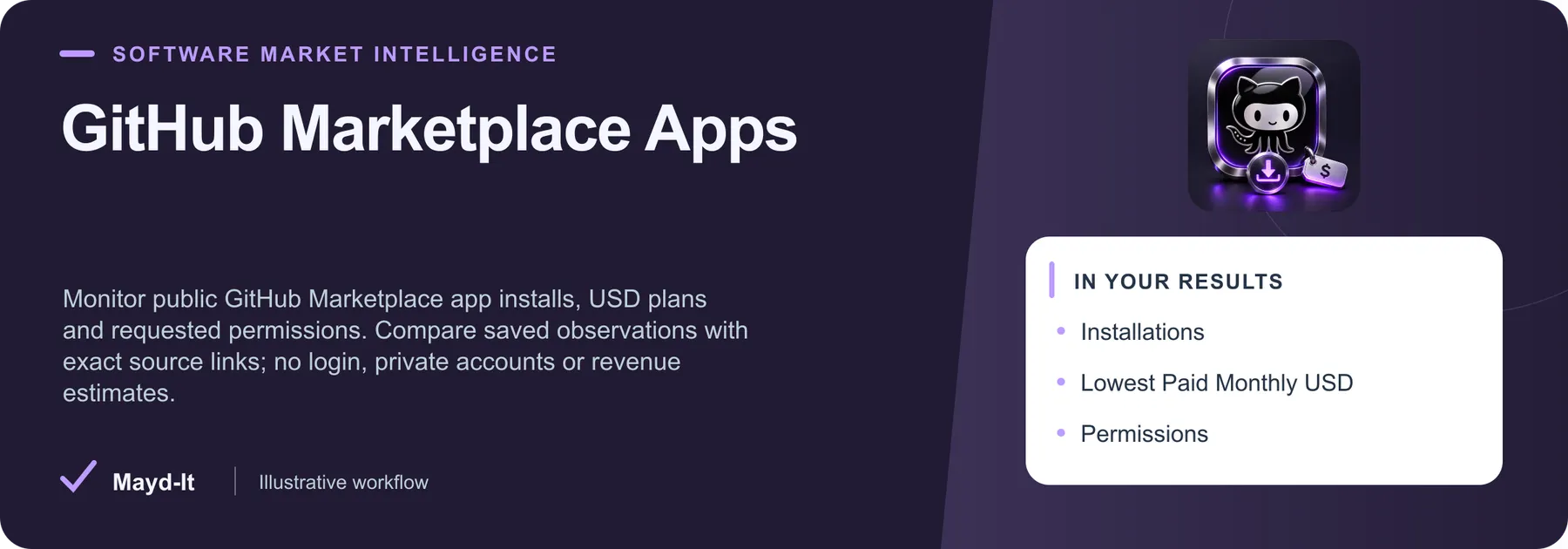
Monitor public GitHub Marketplace app installs, USD plans and requested permissions. Compare saved observations with exact source links; no login, private accounts or revenue estimates.
Pricing
from $1.20 / 1,000 saved observations
Rating
0.0
(0)
Developer
Brandt May
Maintained by CommunityActor stats
0
Bookmarked
2
Total users
1
Monthly active users
6 days ago
Last modified
Categories
Features
Share
GitHub Marketplace Apps – Adoption, Plans & Permissions
Which competing GitHub apps changed adoption, billing plans or requested access? Keep actual public adoption evidence separate from paid-seat assumptions, and identify plan or permission changes without manually revisiting every app.
Start with a small useful result
Built for devtool vendors, procurement analysts and agencies following a shortlist of public GitHub apps. No API key or login is required. Press Start for at most three real public observations, or use one of the exact input recipes below. Each saved row includes recordId, title, url, sourceUrl and observedAt.
What you get
Each row includes a stable listing ID, title, publisher verification, exact public installation count, normalized public plans, and permission groups. Plans preserve cents as well as USD amounts, free/per-unit/flat-rate distinctions and annual versus monthly terms. installationChange is a signed difference between your saved observations; a decreased counter is explicitly marked. A plan’s directBilling flag remains visible. No competitor customer lists, support emails, CSRF values, account state or private repository details are exported.
Three practical recipes
Compare AI review and code coverage apps
Observe CodeRabbit and Codecov installs, plans and permissions without deriving revenue.
Inspect a security app through its public URL
Read Snyk’s published Marketplace app metadata and exact billing units.
Start a recurring code-review pricing watch
Establish a complete saved CodeRabbit baseline, then compare subsequent observations.
Scheduled monitoring and reliable comparisons
Set comparePrevious: true and a stable snapshotName. The first complete run saves a baseline and marks rows new; later runs identify changed or unchanged observations with changedFields and previous. onlyChanges: true suppresses unchanged output and can legitimately produce zero rows. Scope fields are part of the history key; a different watchlist/filter creates a separate scope. We never infer an item was deleted from missing search results.
A failed source, incomplete window, output truncation, deadline or spending cap prevents the baseline from advancing. Previously saved history remains intact. The last accepted billable row is retained even if it reaches your spending cap; rejected rows are never represented as saved. Concurrent history changes are detected instead of overwritten.
Coverage and limits
- Installations are public aggregate counters, not paid users, active users or revenue.
- GitHub plan prices are USD; annual prices cover the whole year. Missing plan prices remain null.
lowestPaidMonthlyUsdis the smallest published plan amount, not total spend: inspect each plan’s billing model and unit before comparing per-seat and flat-rate offers. - Permissions are the published request groups, not a security audit or permissions actually granted by any customer.
- Anonymous app detail pages only; robots are honored and HTTP 401/403/429 stop further requests.
- Up to 20 exact targets and 100 saved results per run; requests are paced by at least one second per source host. The time budget is capped at 120 seconds.
- HTTP 401, 403 or 429 stops remaining source requests. No proxies, login cookies or challenge bypass. Source errors are recorded in
SUMMARY, never emitted as paid fake data rows. - A valid filter with no matches can succeed with zero rows. An all-source failure fails honestly.
Output and pricing
Download JSON or CSV from the dataset, read SUMMARY for completeness/source errors, and open the self-contained RUN_REPORT for a readable check. Store history is private to the account running the Actor.
The base rate is $0.002 per confirmed saved observation, plus $0.00005 per Actor start, with standard plan-tier discounts. One observation may contain several nested plans or node types; it remains one result. Source failures and unchanged rows suppressed by onlyChanges do not incur a result charge. Apify platform usage may apply according to your plan.
Source and interpretation
Exact public GitHub Marketplace app pages only. Does not search private organizations, list customer identities, audit repositories/Actions or estimate paid seats or revenue.
Primary source documentation. This is an independent tool, not an official product of the source provider. Ask questions or report a source change through this Actor’s Issues tab.
Companion workflows
Each Actor runs separately with its own inputs, authorization and pricing. These instructions do not configure automatic execution.
GitHub Repository Change Monitor - Stars, Forks & Activity
Add release and repository context to a public Marketplace app shortlist.
- Verify which public repository, if any, belongs to the app publisher, then supply that repository in the companion tool.
- Keep app installs and Marketplace pricing separate from repository stars, releases and code activity.
An app can have no public source repository. Similar names do not establish ownership; installs and stars do not measure paying users.
Software Lifecycle Watchlist Monitor
Review support lifecycles for the verified software dependencies behind an app deployment.
- Identify the actual supported runtime or dependency from the app vendor's documentation.
- Configure those products separately in the lifecycle monitor and retain the documented version identifiers.
A Marketplace permission or category does not reveal a software dependency. This workflow requires manual verification and does not assess an app's security.


