

FDA Recalls Scraper - Drug, Device & Food
Pricing
from $2.40 / 1,000 results
FDA Recalls Scraper - Drug, Device & Food
Scrape & monitor FDA drug, medical device, and food recalls from the openFDA enforcement API in one run. Filter by type, class, state, and date. Export CSV/JSON.
Pricing
from $2.40 / 1,000 results
Rating
0.0
(0)
Developer
Brandt May
Maintained by CommunityActor stats
0
Bookmarked
2
Total users
1
Monthly active users
4 hours ago
Last modified
Categories
Share
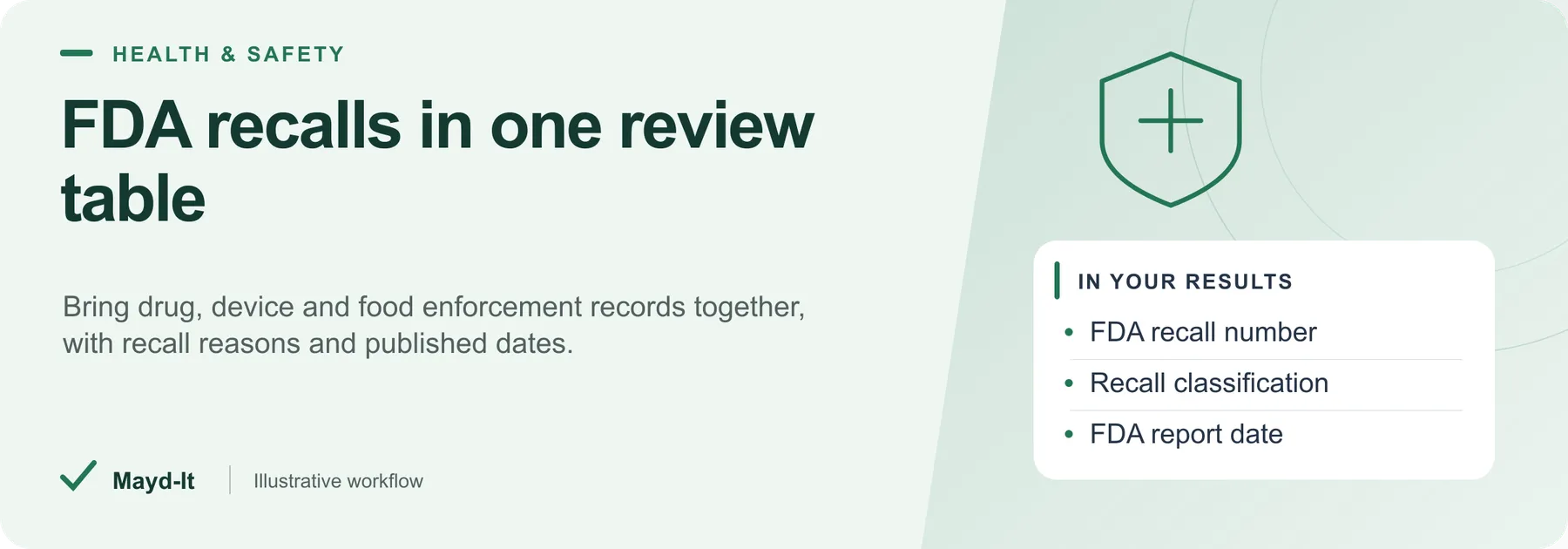
FDA recalls in one review table
For product-safety and supplier-review teams, collect FDA recall notices across drugs, devices and food in one consistent export.
Coverage: FDA enforcement records with assigned recall numbers; CPSC consumer products and NHTSA vehicles are separate sources. FDA can publish Not Yet Classified entries with a blank or N/A recall number. Those entries are counted in SUMMARY.unassignedRecallNumbersSkipped, with product-type and reason breakdowns in unassignedRecallNumbersSkippedByType and unassignedRecallNumbersSkippedByReason, but are not emitted or billed. Event IDs are not substituted for recall numbers.
Open this Actor in Console · First run · Results · Cost · Full guide
Try this Actor
- Select the product categories you need, use a keyword example below if helpful, and lower the maximum recall count before a broader pull.
- Open the run's dataset to review or export records. Check
SUMMARYfor time or spending stops before treating the output as complete.
Read the results correctly: The report date and recall initiation date mean different things. FDA publication can lag the underlying recall; the firm-state filter is not a distribution-area filter.
Result preview
The dataset view highlights these columns:
- Product category ·
productType - FDA recall number ·
recallNumber - Recall classification ·
classification - FDA recall status ·
status - Product description ·
productDescription - Recall reason ·
reasonForRecall
Use the original source links and the field definitions below when interpreting the results. CSV works well for flat columns; JSON preserves nested values.
Usage and pricing
Base result rate on the FREE tier: $4 per 1,000 results. The Pricing tab shows your plan's result rate and any Actor Start charge. Set a small result limit for the first run; the requested limit is not a guarantee of that many results.
Full guide
Monitor and export US FDA recalls for drugs, medical devices, and food in a single run - straight from the official openFDA enforcement API.
What it does
This FDA recalls scraper pulls US FDA recall enforcement data for drugs, medical devices, and food by querying the public openFDA enforcement API (no API key required) and returning one clean, normalized record per recall. It unifies all three FDA product categories in one place, so you no longer have to run a separate FDA drug recall API query, an FDA medical device recall search, and an FDA food recall API call to assemble a complete picture. Each record captures the recall's severity (Class I/II/III), status, product and reason for recall, the recalling firm and its location, distribution pattern, brand and generic names, key dates, and the FDA recall number. Filter by product type, keyword, classification, status, firm state, and date range, then schedule it for continuous FDA recall monitoring and alerting.
Who it's for
- Pharma, medical-device, and food-safety compliance / regulatory affairs teams tracking recalls in their category
- Quality assurance teams monitoring their own products and lot/batch codes
- Supply-chain and supplier-risk managers surveilling vendors and contract manufacturers
- Insurers and underwriters assessing product-liability and recall exposure
- Legal / class-action researchers building recall and incident timelines
- Journalists and data teams covering public-health and consumer-safety stories
- Developers who want structured openFDA enforcement data without writing and maintaining API plumbing
What you get / Output
One row per recall, with the following fields:
| Field | Description |
|---|---|
productType | FDA category: drug, device, or food |
recallNumber | FDA-assigned recall identifier |
classification | Severity: Class I (most serious), Class II, or Class III |
status | Recall status (e.g. Ongoing, Completed, Terminated) |
productDescription | Description of the recalled product |
reasonForRecall | Why the product was recalled |
recallingFirm | Company that issued the recall |
city | City of the recalling firm |
state | US state of the recalling firm |
country | Country of the recalling firm |
distributionPattern | Where the recalled product was distributed |
brandNames | Brand name(s), when available |
genericNames | Generic name(s), when available |
reportDate | Date the recall was reported/published by FDA |
recallInitiationDate | Date the firm initiated the recall |
terminationDate | Date the recall was terminated, when applicable |
Export the dataset to CSV, Excel, JSON, or XML from the run's Storage tab, or pull it programmatically via the Apify API.
Input / How to query
All filters are optional - run with defaults to pull recent recalls across all three categories, or narrow the query:
- Product types - any combination of
drug,device, andfood(defaults to all three) - Keyword - match against product description, reason for recall, or recalling firm (e.g.
listeria,salmonella, a drug name, or a company name) - Classification -
Class I,Class II, orClass III - Status - e.g. Ongoing, Completed, Terminated
- Recalling firm state - two-letter US state code (e.g.
CA,NJ) - Reported since / Reported until - date window (
YYYY-MM-DD) on the FDA report date - Max results - upper bound on recalls returned per run
- Max run seconds - wall-clock budget for the run (default 240). When it is reached the Actor stops cleanly and finishes successfully with the recalls it already has, and records
stoppedEarlyOnTimeLimit: truein the run'sSUMMARY. Raise it, together with the run timeout, for a deliberately large pull
Example use cases
- Track a supplier or manufacturer: set a keyword to a firm name and schedule weekly runs to catch every new recall tied to that company.
- Class I early warning: filter to
Class Iacross all product types to surface only the most serious, potential-harm recalls for immediate triage. - Food-safety pathogen watch: filter product type to
foodwith keywordlisteriaorsalmonellaand a rolling date window. - Device-recall register: pull all
devicerecalls for a given state and date range to feed a compliance dashboard. - Recall dataset for analysis: export a full historical slice to CSV for BI, risk scoring, or research.
Recurring use / scheduling
Add the actor to an Apify Schedule (for example, every Monday) with a Reported since date set to roughly the last week to poll for new FDA recalls on an ongoing basis. Because the actor returns a stable recallNumber per recall, you can dedupe incrementally on that field to keep only genuinely new records and wire the fresh rows into email, Slack, or webhook recall alerts. Note that FDA publishes enforcement data on a roughly weekly cycle, so the newest recalls can lag one to two weeks.
FAQ
How do I get FDA recall data via API?
This actor queries the official openFDA enforcement API for you and returns normalized, ready-to-use records - no openFDA API key or query-building required. Run it in the Apify Console or trigger it via the Apify API, then read results from the dataset.
How can I monitor FDA drug, device, and food recalls in one place?
That is exactly what this actor is built for. One run covers drugs, medical devices, and food together, so you get a unified recall feed instead of stitching together three separate single-category tools.
How do I export FDA recall data to CSV or Excel?
After a run, open the dataset in the run's Storage tab and export to CSV, Excel, JSON, or XML with one click, or fetch it programmatically through the Apify dataset API.
How do I search FDA recalls by company or recalling firm?
Set the keyword filter to the company name - it matches against the recalling firm (and product description and reason), and each result includes the recallingFirm, city, and state fields.
How often is openFDA recall (enforcement) data updated?
The FDA publishes enforcement (recall) data on a roughly weekly cycle, so the freshest recalls can appear one to two weeks after initiation. Scheduling a weekly run keeps your dataset current.
How do I filter FDA recalls by classification (Class I, II, III)?
Use the classification filter to restrict results to Class I, Class II, or Class III. Class I is the most serious (risk of death or serious harm); Class III is least serious.
How can I set up automated alerts for new FDA recalls?
Schedule the actor with a rolling Reported since date, dedupe on recallNumber, and connect the new rows to an integration (email, Slack, or webhook) so each run pushes only newly published recalls.
What is the openFDA enforcement endpoint and how do I use it?
The openFDA enforcement endpoints expose the FDA's public drug, device, and food recall records. This actor calls those endpoints on your behalf and normalizes the fields into a consistent schema, so you do not have to learn the endpoint syntax yourself.
How do I track recalls for a specific manufacturer or supplier?
Set the keyword to the manufacturer or supplier name and add it to a recurring schedule. Every run returns any new recalls mentioning that firm, giving you continuous supplier surveillance.
Can I get FDA recalls filtered by state or date range?
Yes. Use the recalling firm state filter (two-letter code) and the Reported since / Reported until date window to scope results by geography and time.
Data source & notes
- Source: the official US FDA openFDA enforcement (recall) API for drugs, devices, and food. This is public, government-published data and does not require an API key.
- Coverage: US FDA-regulated recalls only. This actor does not cover other agencies (such as CPSC or NHTSA) or non-US regulators - it stays focused on FDA drug, device, and food recalls.
- Freshness: FDA publishes enforcement data on a roughly weekly cadence, so newly initiated recalls may take one to two weeks to appear.
- Fields: availability of optional fields (such as brand/generic names or termination date) depends on what the FDA published for a given recall.
Related actors
Part of a set of US public-records tools that work well together:
- FDA Adverse Events Scraper - FAERS and MAUDE reports - the safety signals behind many recalls
- CPSC Product Recalls Scraper - consumer product recalls outside FDA jurisdiction
- NHTSA Recalls Scraper - vehicle recalls and owner complaints
Running all three recall sources together (FDA, CPSC and NHTSA) gives near-complete US recall coverage across regulated products.
See the full collection at apify.com/maydit.
Free guide: A working guide to the openFDA enforcement API - the undocumented traps in this data source, measured against the live API.
Found this useful?
If this actor saved you time, a short review on the Apify Store genuinely helps. Reviews are how the next person decides whether a tool is worth trying.
Something broken, missing a field, or a source you want covered? Open an issue on the Issues tab and it will get looked at - that is the fastest route to getting it changed.
Run spending limits
The run stops at its spending limit. SUMMARY.datasetItemsSaved reports the number of rows actually saved, and SUMMARY.stoppedOnChargeLimit identifies this stop. A final batch may be saved only in part; increase the spending limit to collect more results.
Help with your run
Open the Issues tab on this Actor with the run URL, the input field that caused trouble and what you expected to receive. Remove API keys and private information before posting.
Understand your run
Open Run report in the run’s Output tab for saved-record counts, reported source issues and limits, and suggested next steps. Use CSV export to take the saved results into a spreadsheet. The existing JSON results and detailed machine-readable summary remain available.
The report reflects this run’s recorded coverage. A successful run or a saved result does not establish that every possible source record was collected.


