

V-Dem Democracy Indices — Country-Year v16
Pricing
from $10.00 / 1,000 scraped items
V-Dem Democracy Indices — Country-Year v16
V-Dem v16 democracy indices for every country, 1789-2025: the 5 democracy indices, corruption, rule of law, civil liberties and 56 more, with confidence bounds and regime type. No sign-up form. JSON or CSV out.
Pricing
from $10.00 / 1,000 scraped items
Rating
0.0
(0)
Developer

Muhamed Didovic
Maintained by CommunityActor stats
0
Bookmarked
2
Total users
1
Monthly active users
3 hours ago
Last modified
Categories
Share

V-Dem Democracy Indices: Country-Year Data, 1789-2025
Get the Varieties of Democracy (V-Dem v16) indices for every country and year from 1789 to 2025 as clean rows: the five democracy indices (electoral, liberal, participatory, deliberative, egalitarian), corruption, rule of law, civil liberties, media freedom, women's empowerment and more. 64 indices in all, each with V-Dem's confidence bounds, plus the Regimes of the World classification.
No sign-up form, no email, no CSV wrangling. Pick countries, years and variables and get one row per country-year.
Why use this actor
- Ready to analyse. One row per country-year, indices keyed by their V-Dem names (
v2x_polyarchy,v2x_libdem,v2x_corr...), values rounded to V-Dem's three decimals. - Regime type included. Each row says whether the country was a closed autocracy, electoral autocracy, electoral democracy or liberal democracy that year.
- Confidence bounds on request. Turn on
includeConfidenceBoundsto get<variable>_lowand<variable>_high(V-Dem's 68% interval). - Fast and light. Only the columns you ask for are downloaded. A typical run finishes in seconds.
- Country names or ISO codes.
"Sweden","USA"and"hun"all work.
Where the data comes from
V-Dem v16 (released March 2026) as republished by Our World in Data (dataset version 2026-03-17). OWID publishes the main V-Dem indices as open data; the official v-dem.net download asks for personal details before it hands out a file, which an automated tool should not fill in on your behalf. The trade-off: this actor covers the 64 indices OWID republishes, not every one of V-Dem's ~500 raw indicators.
Please cite both sources when you publish results: Coppedge et al., V-Dem Country-Year Dataset v16, Varieties of Democracy (V-Dem) Project, and Our World in Data.
How it works
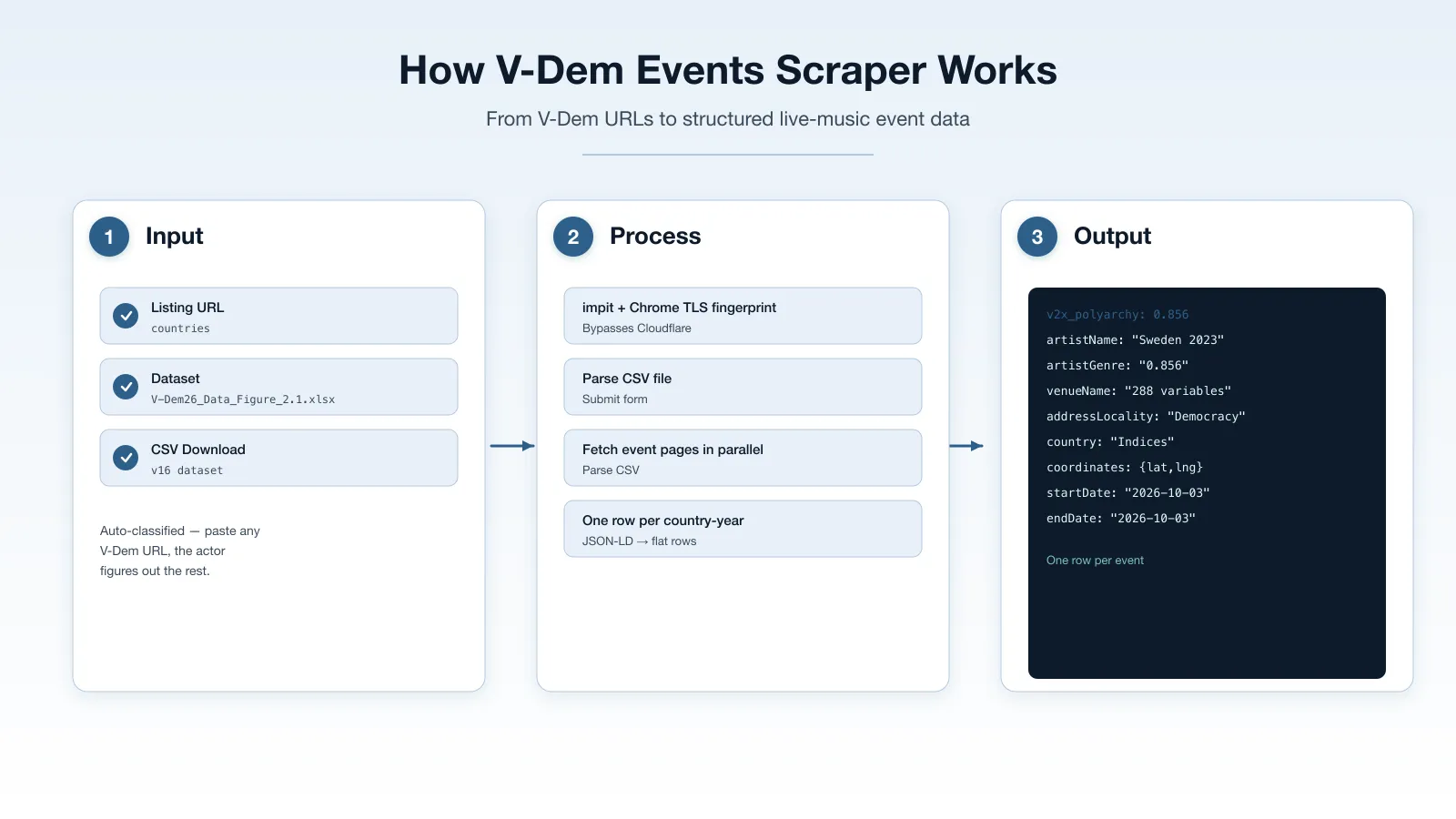
- You provide country names/ISO codes, years, and the V-Dem variables you want.
Input
| Field | Type | Default | What it does |
|---|---|---|---|
countries | array | all | Country names or ISO 3-letter codes. |
years | array | all | Specific years, e.g. ["2025", "2024"]. |
yearFrom / yearTo | integer | - | A year range instead of a list. |
variables | array | 10 key indices | V-Dem variable names, index names, or "all". |
includeConfidenceBounds | boolean | false | Adds _low / _high columns. |
includeRegimeType | boolean | true | Adds regime (0-3) and regimeLabel. |
includeRegions | boolean | false | Adds world and continent averages when no countries are named. |
maxItems | integer | 10000 | Row cap. Rows come newest year first. |
Example:
When variables is empty you get: v2x_polyarchy, v2x_libdem, v2x_partipdem, v2x_delibdem, v2x_egaldem, v2x_civlib, v2x_corr, v2x_rule, v2x_freexp_altinf, v2x_jucon.
Output
Most indices run from 0 (low) to 1 (high). Corruption indices are reversed: higher means more corrupt. A few V-Dem measurement-model scores (e.g. v2mebias, v2cacamps) are on a roughly -5 to 5 scale.
Available variables
| Variable | Index |
|---|---|
v2x_civlib | Civil liberties index |
v2xcs_ccsi | Core civil society index |
v2x_cspart | Civil society participation index |
v2x_execorr | Executive corruption index |
v2jucorrdc | Judicial corruption score |
v2lgcrrpt | Legislative corruption score |
v2x_pubcorr | Public sector corruption index |
v2x_corr | Political corruption index |
v2dlcountr | Respect for counterarguments |
v2xdl_delib | Deliberative political institutions index |
v2x_delibdem | Deliberative democracy index |
v2svdomaut | Domestic policymaking free from foreign influence |
v2x_egal | Egalitarian political institutions index |
v2x_egaldem | Egalitarian democracy index |
v2x_polyarchy | Electoral democracy index |
v2xel_frefair | Clean elections index |
v2dlconslt | Elite consultation |
v2xeg_eqaccess | Equal access to power index |
v2xeg_eqdr | Equal resource distribution index |
v2xeg_eqprotec | Equal rights protection index |
v2x_frassoc_thick | Freedom of association thick index |
v2x_freexp_altinf | Freedom of expression and alternative sources of information index |
v2xcl_rol | Equality before the law and individual liberty index |
v2svinlaut | Foreign policymaking free from foreign influence |
v2x_jucon | Judicial constraints on the executive index |
v2dlcommon | Common good justifications |
v2dlreason | Justified political positions |
v2xlg_legcon | Legislative constraints on the executive index |
v2x_liberal | Liberal component index |
v2x_libdem | Liberal democracy index |
v2xel_locelec | Elected local governments |
v2x_partip | Participatory political institutions |
v2x_partipdem | Participatory democracy index |
v2xnp_pres | Presidentialism index |
v2x_clphy | Physical violence index |
v2x_clpol | Political civil liberties index |
v2x_clpriv | Private civil liberties index |
v2clrspct | Rigorous and impartial public administration |
v2xel_regelec | Elected regional governments |
v2x_rule | Rule of law index |
v2dlengage | Engaged society |
v2clsocgrp | Equality of civil liberties across social groups |
v2pepwrsoc | Equality of political power across social groups |
v2svstterr | Territory under state control |
v2caautmob | Mass mobilization for autocracy |
v2cacamps | Political polarization score |
v2cademmob | Mass mobilization for democracy |
v2cagenmob | Mass mobilization |
v2caviol | Political violence by non-state actors |
v2elvotbuy | Election vote buying |
v2mebias | Media bias |
v2mecenefm | Government censorship of the media |
v2mecorrpt | Media corruption score |
v2meharjrn | Journalist harassment |
v2meslfcen | Self-censorship of the media |
v2smgovdom | Government dissemination of false information domestic |
v2xca_academ | Academic freedom index |
v2xcl_prpty | Property rights |
v2xnp_client | Clientelism index |
v2x_gencl | Women's civil rights index |
v2x_gencs | Women's civil society participation index |
v2x_gender | Women's political empowerment index |
v2lgfemleg | Lower chamber female legislators |
v2x_genpp | Women's political participation index |
Use cases
- Political risk and country screening for investment, supply chains or insurance.
- Academic and policy research: panel data for regressions, trend charts, before/after comparisons.
- Journalism: how a country's democracy scores moved after an election or a crackdown.
- Dashboards and AI agents that need a structured democracy measure per country.
FAQ
How current is it? V-Dem v16 covers up to 2025. V-Dem releases once a year (usually March); OWID follows within weeks, and the actor will move to the new release.
Can I get V-Dem variables that are not in the list? Not from this actor. Those are only in the official download from v-dem.net.
Are values identical to V-Dem's own files? Yes, OWID republishes V-Dem's estimates. Values here are rounded to three decimals.
For AI agents and LLM apps
Call the actor with countries, yearFrom/yearTo and variables and read the dataset: every row is flat JSON with stable keys (V-Dem variable names), so it drops straight into a table, a dataframe or a prompt.
Disclaimer
V-Dem data is published by the V-Dem Institute (University of Gothenburg) and republished by Our World in Data under CC BY. This actor is not affiliated with either. Cite the original sources when you use the data.


