

arXiv Paper Monitor
Pricing
from $500.00 / 1,000 daily monitoring of one watches
arXiv Paper Monitor
Watch arXiv categories, keywords and authors on a schedule. Each run remembers exactly which papers it has already seen and delivers only the NEW ones, with optional webhook alerts (Discord, Slack, generic) and a digest mode. Built on the documented arXiv export API.
Pricing
from $500.00 / 1,000 daily monitoring of one watches
Rating
0.0
(0)
Developer

Muhammad Zuhaib Zahid
Maintained by CommunityActor stats
0
Bookmarked
2
Total users
1
Monthly active users
a month ago
Last modified
Categories
Share
Watch arXiv categories, keywords and authors on a schedule. Each run remembers exactly which papers it has already seen and delivers only the NEW ones, so you can poll as often as you like without seeing the same paper twice.
Built entirely on the documented arXiv export API (export.arxiv.org). No scraping, no unofficial endpoints, and the documented courtesy rate limit is enforced by the actor.
What it does
- Category watches follow a subject:
cs.AI,stat.ML,math.CO, or any OR-list of categories. Case matters (stat.ML). - Keyword watches match papers where ALL keywords appear, in the whole record
(
all), the title (ti) or the abstract (abs). Multi-word phrases are supported. - Author watches follow one or more authors by name phrase.
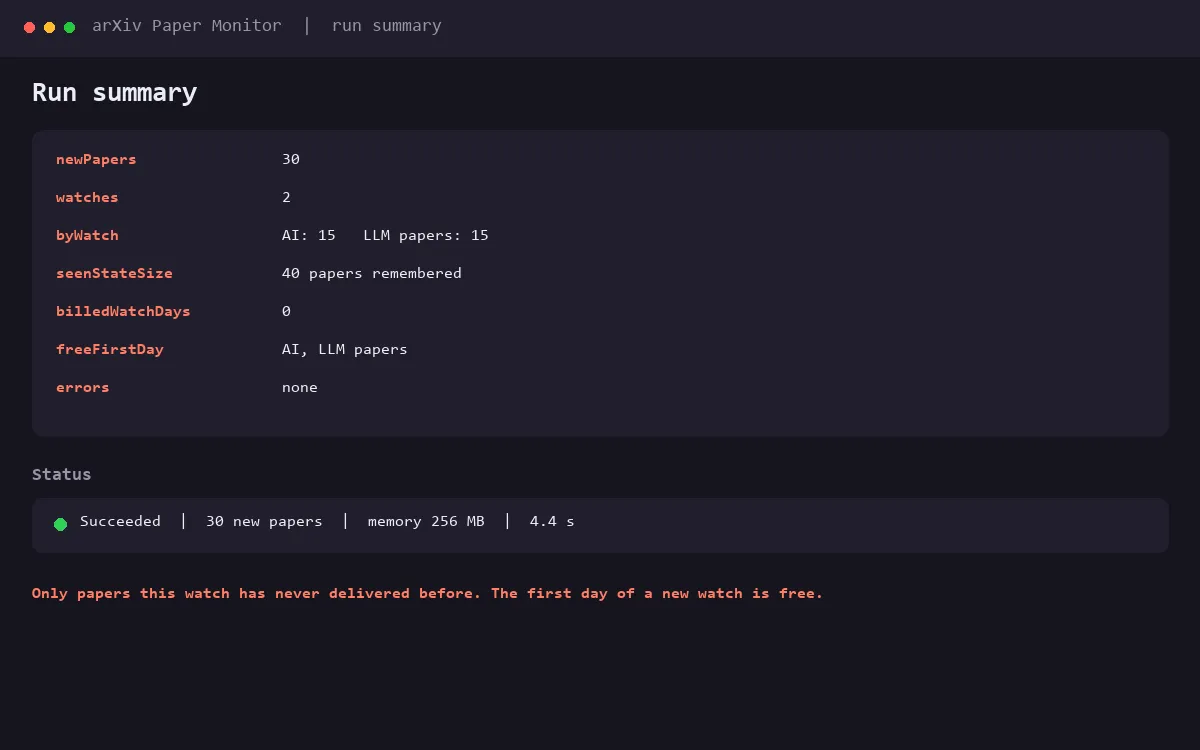
- Cross-run memory: seen papers are stored between runs; a scheduled run emits only genuinely new papers. The FIRST run of each watch seeds the baseline quietly, so you never get a flood of the current front page, and its whole first day is free.
- Webhook alerts: each batch (or each paper) posted to Discord, Slack or your own receiver as ready-to-use payloads. Shape is auto-detected from the webhook URL.
- Digest mode: one summary item per run instead of one item per paper, if you would rather read one post than many.
- Spend guard: maxEventsPerRun caps billable watch-days per run; the dataset still receives everything found, and the run summary tells you when the cap engaged.
How to use
- Add watches (the input schema has a working prefill, so the default run needs nothing).
- Set a schedule (e.g. every 4 hours). arXiv publishes new papers about once a day.
- Optionally add a webhook for alerts, or enable digest mode for one summary per run.
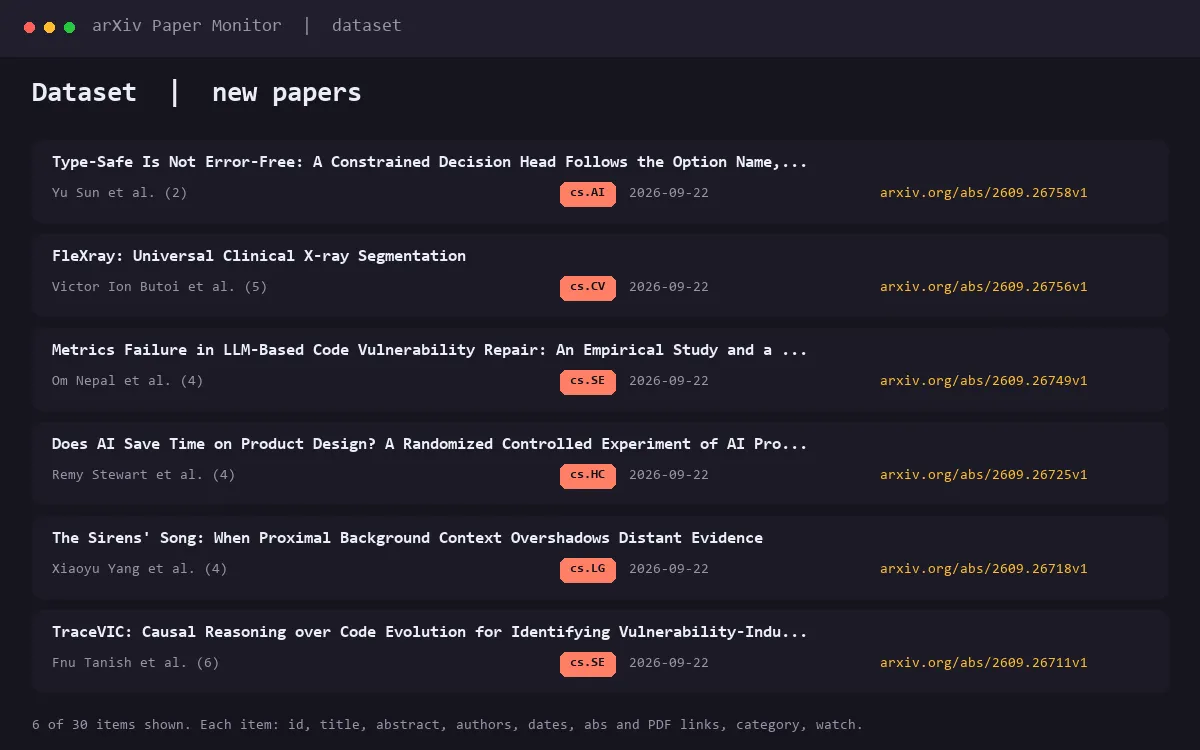
- Read results from the dataset: one item per new paper (title, authors, abstract, abs + pdf URLs, primary category, matched watch), plus a run summary.
Pricing
One event, one price: watch-monitored-day, $0.50, charged once per watch per UTC day.
- The first day of every new watch is free. Add a watch, see exactly what it finds, and decide before anything is charged.
- The number of papers never changes the price. A quiet day and a day with forty new papers cost the same, because you are paying for the watch being kept, not per result.
- Run it as often as you like. Four runs a day cost the same as one: the day is charged once, on the first run that monitors the watch successfully.
- A watch that fails is never charged. If arXiv is unreachable for a watch, that watch costs nothing for that day and is billed when it next succeeds.
So three watches on any schedule cost $1.50 a day, about $45 a month. Compute is included in the price; the only other charge is the platform's standard Actor start event ($0.00005 per run).
Notes
- arXiv's courtesy limit is one request every 3 seconds; the actor spaces its calls and backs off on 429/5xx. Keep the number of watches reasonable.
- Metadata only: title, authors, abstract, links. No PDF downloads.
- Memory between runs lives in a named key-value store in your own account
(
arxiv-monitor-stateby default, set by thestateStoreNameinput). Deleting that store, or pointing the input at a new name, re-seeds every watch on the next run.


