Australia ASIC Company Search — Corporate Registry avatar

Australia ASIC Company Search — Corporate Registry

Pricing

from $80.00 / 1,000 company records

Go to Apify Store
Australia ASIC Company Search — Corporate Registry

Australia ASIC Company Search — Corporate Registry

Search ASIC + ABR Australian corporate registries. ACN, ABN, status (registered / deregistered / external admin), Pty Ltd / Ltd / Inc type, registered address, jurisdiction, GST flag, officers (best-effort). KYC, AML, M&A — InfoTrack / Equifax / CreditorWatch alternative.

Pricing

from $80.00 / 1,000 company records

Rating

0.0

(0)

Developer
NexGenData

NexGenData

Maintained by Community

Actor stats

0

Bookmarked

2

Total users

1

Monthly active users

4 days ago

Last modified

Categories

Share

The cleanest Australian-corporate-registry signal on the market. Search the entire ASIC (Australian Securities & Investments Commission) corporate register and the ABR (Australian Business Register) — together covering every one of the ~3 million companies, business names, sole traders, trusts, partnerships, super funds and incorporated associations that operate in Australia. Look up any entity by company name, by 9-digit ACN, or by 11-digit ABN. Filter by status (registered / deregistered / external administration). Every record carries the legal name, the ACN, the ABN, the current ASIC status, the registration date, the company type (Pty Ltd / Ltd / Inc / Co-op / Trust), the registered jurisdiction (state), the principal address as published, the entity type expanded into a human-readable label, the GST-registration flag and effective date from ABR, the last review date, any registered business / trading names, and — optionally — the visible officer signal (directors, secretaries) from the free ASIC Connect public search.

Drop-in alternative to ASIC Connect paid extracts, InfoTrack, Equifax / Veda, illion, CreditorWatch and SearchPoint AU — without the per-extract paywall or the AU$3K-a-year platform subscription. Pay $0.08 per company record returned. A weekly KYC audit of 100 Australian counterparties costs $8. A one-off due-diligence sweep of an entire industry cluster (say, every Pty Ltd registered in NSW with "construction" in the name, capped at 500 hits) costs $40 — a single ASIC Company Extract from the official ASIC Connect store costs AU$19 alone.


Why this actor beats the alternatives

FeatureThis actor (ASIC + ABR)ASIC Connect paid extractInfoTrackEquifax / illionCreditorWatchSearchPoint AU
CoverageAll ~3M Australian companies, business names, sole traders, trusts, super fundsASIC-registered companiesASIC + ABR + ABSCurated overlayCredit-scored AU companiesASIC + courts
Refresh latencyReal-time (ABR live + ASIC daily)Real-timeDailyWeeklyDailyDaily
Pricing$0.08 / company record (pay-as-you-go)AU$9–AU$40 per extractAU$50+ per searchAU$3K–AU$25K / yrAU$199+ / moAU$25–AU$100 per search
ACN + ABN cross-referencedYes (every record)YesYesYesYesPartial
GST registration flagYes (from ABR)NoYes (ABR feed)PremiumYesNo
Entity type expandedYes (PRV → Pty Ltd, PUB → Ltd, SMF → SMSF, etc.)Codes onlyYesYesYesCodes only
Officers (free public)Best-effort (see notes)Paid extractYes (paid)YesLimitedYes
Filter by statusRegistered / deregistered / external adminPer-extract feeYesYesYesYes
Filter by jurisdiction (state)Returned per recordYesYesYesYesYes
API / scriptableApify REST + SDKNoneEnterpriseEnterpriseRESTNone
Setup time< 1 minuteAccount approval1-2 weeks2-6 weeks1 weekAccount approval
SourceABR (ATO) + ASIC public searchASIC directASIC + ABR + ABSCuratedASIC + bureausASIC + courts

What you get — fields per company

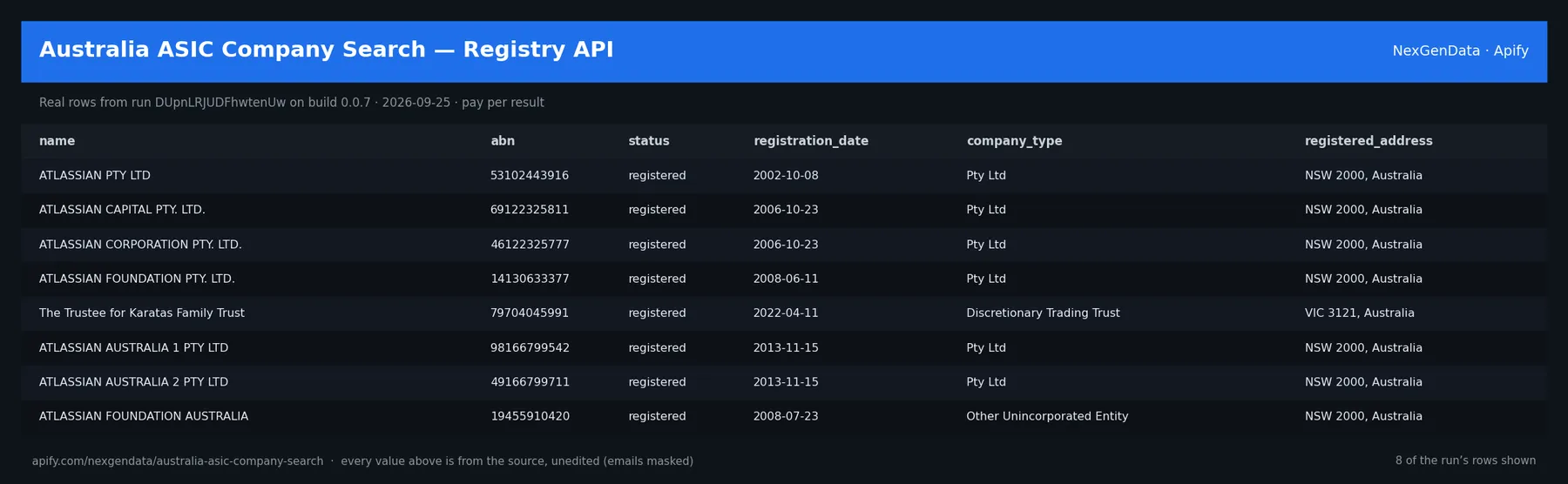
Every dataset row is a single Australian legal entity with these fields:

  • Identifiers: name (the canonical entity name as registered), acn (9-digit Australian Company Number, ASIC's primary ID for incorporated companies), abn (11-digit Australian Business Number, the ATO / ABR ID that every active business holds).
  • Status & timing: status (normalised to registered, deregistered, or external administration), registration_date (the ABR effective-from date for the current ABN), last_review_date (when ASIC / ABR last touched the record — useful for staleness detection in a KYC refresh cycle).
  • Legal structure: company_type — Pty Ltd, Ltd, Inc, Sole Trader, Partnership, Co-operative, Incorporated Association — inferred from the entity-type code and the name suffix. entity_type — the full ABR label, e.g. Australian Private Company, Australian Public Company, ATO Regulated Self-Managed Superannuation Fund, Discretionary Trading Trust, Sole Trader.
  • Geography: registered_address (state + postcode + country, as ABR publishes — ABR does not expose street-level addresses for individuals for privacy reasons, but state-level coverage is sufficient for jurisdiction / venue analysis), jurisdiction (2-letter Australian state code: NSW, VIC, QLD, WA, SA, TAS, ACT, NT — or AU if not specified).
  • Tax: gst_registered (boolean — true if the entity has an active GST registration with the ATO), gst_effective_from (ISO date the GST registration took effect — useful for distinguishing newly-GST-registered SMEs from established traders).
  • Names: business_names (array of registered business names / trading names the entity operates under, beyond the canonical legal name — for example, a Pty Ltd holding company may operate three brands all under one ACN).
  • People (optional): officers (array of directors / secretaries scraped from ASIC Connect's free public search when includeOfficers=true and a visible signal exists), officers_source — explicit label telling you the provenance: asic_connect_public_search (free public signal), asic_extract_required (ASIC does NOT expose officers in the free search for this entity — buy a paid Company Extract from connectonline.asic.gov.au for the full list), not_requested, no_acn_available.
  • Audit trail: data_source (ABR + ASIC), _source_url (a direct deep-link to either the ABR public view page or ASIC Connect Registry Search for human verification).

Australian corporate registry mechanics — a plain-English primer

If you are running KYC on Australian counterparties, doing M&A diligence on an AU target, investigating fraud, or chasing leads as a journalist, the Australian register has its own quirks. Here is the orientation you need.

ACN vs ABN — the two canonical IDs

  • ACN (Australian Company Number) is the 9-digit ID that ASIC issues at incorporation under the Corporations Act 2001. Every Australian company — every Pty Ltd, every Ltd, every Co-operative — has exactly one ACN. The ACN never changes for the life of the company. Format: 123 456 789 (spaces are cosmetic; the canonical value is 9 digits).
  • ABN (Australian Business Number) is the 11-digit ID that the ATO (Australian Taxation Office) issues via the ABR for any entity that interacts with the tax system — every Pty Ltd, every Ltd, every Sole Trader, every Partnership, every Trust, every Self-Managed Super Fund. For incorporated companies, the ABN is built as XX (check digits) + ACN (9 digits), which is why ABN and ACN look related. Format: 12 345 678 901.

In practice: every incorporated Australian company has both an ACN and an ABN, but a sole trader has only an ABN (no ACN — they're not a separate legal entity). When AU KYC providers ask for the "company number", they almost always mean the ACN. When the ATO or Centrelink asks for the "business number", they mean the ABN. This actor returns both for every incorporated entity and only the ABN for sole traders / trusts / unincorporated entities.

Company type abbreviations — Pty Ltd, Ltd, Inc, Co-op

  • Pty Ltd (Proprietary Limited) — the most common AU company form, equivalent to a UK / Irish private limited company or a US LLC / Inc. Members 1–50, no public fundraising, simplified reporting. ~90% of all incorporated AU companies are Pty Ltd. Internally ASIC codes them PRV / Australian Private Company.
  • Ltd (Limited) — a public company that can offer shares to the public, ASX-listed or unlisted. Annual financial reports required. ASIC code: PUB / Australian Public Company. Big names: Commonwealth Bank Ltd, BHP Ltd, Telstra Ltd, Atlassian (NASDAQ-listed, but the AU parent is Atlassian Pty Ltd until 2022 restructure).
  • Inc / Incorporated — typically an incorporated association under state Associations Incorporation Acts (NSW, VIC, etc.). These are non-profit-ish entities and are NOT registered with ASIC — they are registered with the state Office of Fair Trading equivalents. ABR carries them with code ASS.
  • Co-op — co-operative under the Co-operatives National Law. ASIC code COP. Member-owned organisations: credit unions, agricultural co-ops.
  • Pty Co — historical shorthand for Pty Ltd, occasionally seen in older registrations.
  • NL (No Liability) — a historical mining-company form unique to Australia. Mostly extinct.

Status values — what "external administration" means

  • Registered — the company is alive and required to lodge ASIC annual reviews + pay the annual review fee.
  • Deregistered — the company has been struck off the register, either voluntarily (a winding-up application by the directors) or compulsorily by ASIC (typically for non-payment of the annual review fee or non-lodgement of accounts). A deregistered company cannot sue, be sued, hold property, or sign contracts. For KYC purposes a deregistered counterparty is a hard fail.
  • External administration — the umbrella term for a company under any of: voluntary administration (Part 5.3A), liquidation (creditors voluntary, members voluntary, or court-ordered), receivership, deed of company arrangement (DOCA), or scheme of arrangement. ASIC publishes notices to the EXAD register. A counterparty in external administration is, at minimum, a yellow flag for trade-credit exposure.

Jurisdiction — Australian states matter for venue

Australia is a federation. While ASIC is a federal regulator and companies are registered federally, the registered office state determines the venue for most commercial disputes, the applicable stamp-duty regime for property transactions, and the state Office of State Revenue for payroll-tax. The seven Australian states / territories: NSW (New South Wales), VIC (Victoria), QLD (Queensland), WA (Western Australia), SA (South Australia), TAS (Tasmania), ACT (Australian Capital Territory), NT (Northern Territory). This actor surfaces the registered-office state in the jurisdiction field for every record.

ASIC enforcement context — what to know

ASIC is the federal corporate regulator. Its enforcement priorities for the 2024–2026 period (per the ASIC Corporate Plan) emphasise:

  • Predatory practices in private credit and superannuation.
  • Insider trading and market manipulation on the ASX.
  • Greenwashing in financial-product disclosures.
  • Director liability for insolvent trading (Section 588G of the Corporations Act).

For practical KYC work: ASIC publishes the banned and disqualified register (persons banned from being a company director or auditor) and the enforceable undertakings register. Cross-referencing director names from this actor against those two ASIC registers is the standard AML / KYC enhanced-due-diligence step for any Pty Ltd counterparty. ASIC also publishes the professional registers (financial advisers, liquidators, registered auditors) — a director who is also a registered liquidator carries a different risk profile than one with no professional registration.

GST — what the flag tells you

GST in Australia is a 10% value-added tax administered by the ATO. Registration is mandatory for any entity with GST turnover ≥ AU$75K / year (AU$150K for non-profits, ride-share drivers always required to register from dollar one). The gst_registered flag from ABR is therefore a useful proxy for active commercial trading: an entity with no GST registration and the IND (Sole Trader) entity type is most likely either (a) below the threshold (i.e. a side-hustle / micro-business) or (b) dormant. For trade-credit underwriting on Australian counterparties, the absence of GST registration on a counterparty claiming substantial revenue is a flag worth investigating.


Use cases

  • KYC / AML onboarding for Australian counterparties. Pull every prospective AU customer / supplier by ABN, screen status, cross-reference directors against the ASIC banned register. Re-run weekly for active customers (Section 6 AML/CTF Rules — ongoing customer due diligence).
  • M&A target screening across an Australian industry cluster. Search by company-name keyword, filter by registered, dump the dataset to CSV, hand to bankers for pre-due-diligence outreach.
  • Insolvency-risk monitoring. Re-search a portfolio of trade-credit counterparties weekly, alert when any flip from registered to external administration or deregistered.
  • Fraud investigation. Look up an ABN claimed on an invoice — verify name match, GST registration, registration date (newly-incorporated counterparties on high-value invoices are a classic invoice-fraud signature), entity type (a Sole Trader claiming Pty Ltd liability protection is mis-represented).
  • Journalist / investigative use. Reverse-lookup an ABN on a contract or tender award; surface the registered-office state, entity type, and any associated business names — much faster than ASIC Connect's web search and bypasses the per-extract paywall for routine checks.
  • Sales / lead-gen. Filter all AU Pty Ltds with GST registration in a target state (proxy for "active SME"), enrich with downstream contact-discovery actors.

Quick start

Look up an ABN

{
"abn": "53 102 595 786",
"includeOfficers": true
}

Returns one record for the ABN holder, including ACN cross-reference, status, GST flag, entity type, and a best-effort officer list.

Search by company name with status filter

{
"companyName": "Atlassian",
"status": "registered",
"maxResults": 25,
"includeOfficers": true
}

Returns up to 25 Australian entities matching "Atlassian" — including the parent Atlassian Pty Ltd, subsidiaries, and any registered business names.

ACN-only lookup

{
"acn": "102 595 786",
"includeOfficers": false
}

ACN lookup is fastest when officers are not required — pure ABR fields only.


Officers — what to expect (and what to do for full lists)

ASIC charges ~AU$19 for a paid Company Extract that exhaustively lists every current and historical officer of a Pty Ltd / Ltd. This actor does NOT replicate that paid extract — it surfaces only the publicly visible officer signal from the free ASIC Connect Registry Search. For most companies that means zero officers are returned with officers_source = "asic_extract_required". The actor explicitly tells you when a paid extract is needed, so you can either (a) accept the limitation for low-stakes use cases, or (b) follow the _source_url deep-link to ASIC Connect and buy the extract for high-stakes use cases.

For workflows that REQUIRE full officer history at scale, pair this actor with UK Companies House Officers for the UK equivalent, or UK PSC Beneficial Ownership for the UK People-with-Significant-Control register — those registers ARE free at point of access and this actor mirrors that pattern. The Australian register's commercial gating is what it is.


Pricing — premium institutional tier

  • $0.00005 per actor start (effectively free).
  • $0.08 per company record returned (matches the institutional KYC tier of France Pappers Companies, and reflects the legal-grade source data — ASIC + ABR are the official registers, not scraped overlays).

A weekly KYC audit of 100 Australian counterparties costs $8 / week ($416 / year). A one-off M&A diligence sweep of 500 companies costs $40. A single AU$19 ASIC paid extract is 4× the cost of a single record from this actor — and you cannot script ASIC extracts.


This actor is part of NexGenData's global corporate-registry suite. If you operate across jurisdictions, the same record shape and pricing tier applies in every region:

  • UK Companies House Officers — UK Companies House officers list (directors, secretaries, partial DOB, nationality, country of residence, appointment + resignation dates).
  • UK PSC Beneficial Ownership — UK People with Significant Control register — the 25%+ beneficial owners behind every UK company.
  • France Pappers Companies — French RCS / INSEE / SIRENE via the Pappers public API. SIREN, SIRET, NAF code, directors, capital.
  • Singapore ACRA Companies — Singapore's Accounting and Corporate Regulatory Authority register. UEN, entity type, principal activities, directors.
  • Hong Kong Companies Registry — Hong Kong CR Cyber Search — every HK incorporated entity, English + Chinese name, status, directors.

Cross-jurisdiction KYC sweeps are now a single chained workflow. Pull the entity by AU ABN here, then chain into UK Companies House for the UK parent, into France Pappers for the French subsidiary, and into Singapore ACRA for the APAC HQ. Same record shape, same pricing tier, one Apify account.


FAQ

Does this need an ASIC API key? No. ABR exposes free public JSON endpoints for name search, ABN lookup and ACN lookup. ASIC Connect's free Registry Search is unauthenticated. No key, no signup, no rate-limit headache for normal usage. For bulk extracts you would buy directly from ASIC.

Can I search by director name? Not directly via the free registers — ASIC's free search keys on entity name / ACN / ABN, not on natural-person names. The paid ASIC Connect "Person Search" requires a paid subscription. Workaround: search by company-name keyword, set includeOfficers=true, post-filter the officer arrays in your downstream pipeline.

Are deregistered companies included? Yes — set status to deregistered or any. ABR retains historical records for years after deregistration, which is essential for forensic / litigation work.

What about Australian trusts? Trusts that have an ABN (most trading trusts do) are returned with entity_type = "Discretionary Trading Trust" (or similar). Bare trusts that do not interact with the tax system have no ABN and are not in the ABR.

How fresh is the data? ABR is real-time — when an entity updates its GST status or principal address with the ATO, the change propagates to the public JSON endpoint within minutes. ASIC propagates daily.

What if a company is registered in Australia but has overseas parents? This actor returns the AU entity record only. For the offshore parent, chain into the relevant registry actor for that jurisdiction (UK Companies House, France Pappers, Singapore ACRA, Hong Kong CR, etc.).


About NexGenData

NexGenData operates a global fleet of legal-grade corporate-registry, beneficial-ownership and KYC actors on the Apify platform. We mirror the institutional-data tier of Bureau van Dijk Orbis, Refinitiv World-Check, LexisNexis Bridger and Equifax Veda — at pay-as-you-go pricing, with no platform subscription, no minimum spend, and no procurement cycle. Spin up an Apify account, fund it with a credit card, and you are running enterprise-grade KYC workflows in under five minutes.

Built and operated by NexGenData. Apify referral link: apify.com/?fpr=2ayu9b.