CNIPA China Patent Search — IP & Innovation Tracker
Pricing
from $50.00 / 1,000 patents
CNIPA China Patent Search — IP & Innovation Tracker
Search CNIPA Chinese patents by keyword (EN/ZH), applicant, IPC, date, status. Returns invention/utility/design patents with bilingual title+abstract, applicants, inventors, IPC, dates, family size, citations. IP attorneys, R&D, China competitive intel. PatSnap alt.
Pricing
from $50.00 / 1,000 patents
Rating
0.0
(0)
Developer

NexGenData
Maintained by CommunityActor stats
0
Bookmarked
2
Total users
1
Monthly active users
6 hours ago
Last modified
Share
The China IP desk on tap. Search Chinese patents filed at CNIPA — the China National Intellectual Property Administration — by keyword (English or Chinese), applicant, inventor, IPC class, filing-date range or legal status. Each record arrives with bilingual title and abstract, normalised applicant + inventor lists, IPC classes, filing / publication / granted dates, patent type (invention / utility / design), legal status, worldwide family size, and forward-citation count. Built for IP attorneys, R&D teams, competitive intelligence analysts, China-watchers, and VCs doing diligence on Chinese deep-tech.
This is the actor a single PatSnap or Patbase seat costs $1,000+/yr to access. Pay-per-result on Apify — no seat, no contract, no minimum commitment. Refer a friend through the Apify Affiliate Program to earn 20-30% commission.
Why a dedicated CNIPA actor (and not just a generic web scraper)
China has been the world's largest patent filer since 2011 and now accounts for roughly 1.6 million patent applications per year — more than the United States, Europe, Japan, South Korea and India combined. The CNIPA index is a strategic resource for any team doing M&A, freedom-to-operate, competitive intelligence or technology forecasting in batteries, semiconductors, EVs, solar, AI, biotech or quantum computing. Yet most of this data is hard to reach from outside China:
- The official CNIPA search portal is Chinese-only, requires a Chinese mobile phone number to register, and rate-limits foreign IPs aggressively. Even with credentials, the result format is paginated HTML with embedded Chinese fonts and no machine-readable export. We bypass all of that by querying Google Patents' public XHR endpoint, which mirrors the CNIPA index in near-real-time and ships English-machine-translated titles + abstracts alongside the originals.
- Generic scrapers fail patent monitoring three ways: no IPC classification, no normalised applicant matching, and no patent-type discrimination. A Huawei "utility model" on a phone-camera shim and a Huawei "invention patent" on a 6G modem live in completely different legal worlds — the first costs $400 to file and lasts 10 years with no substantive examination, the second goes through 3-4 years of examination and lasts 20 years. We return
patent_typeso your downstream pipeline routes them correctly. - WIPO PATENTSCOPE, the free WIPO-run global index, is sluggish, has no clean JSON output, and times out under any non-trivial workload. We use it as a fallback if Google Patents blocks us, but the default path is the much-faster Google Patents XHR endpoint.
What you get is a clean, dual-language, paginated CNIPA feed that drops straight into a spreadsheet, BI tool, vector store or downstream LLM. No Chinese mobile number, no PatSnap subscription, no Selenium swamp.
A 60-second primer on the Chinese patent system
If you've worked exclusively with the USPTO or EPO, the Chinese IP system has some structural quirks you need to know before reading the data. CNIPA recognises three distinct patent types under a single application infrastructure:
- Invention patents (
发明专利, fā míng zhuān lì): The closest analogue to a USPTO utility patent or EPO B-grant. Term: 20 years from filing. Requires substantive examination — novelty + inventive step + industrial applicability. Average pendency: 22 months in 2024. Publication number format:CN<7-digit serial>A(laid-open application) →CN<same serial>B(granted). Historical numbering usedCN1xxxxxxfor inventions; modern format isCN10x/CN11x/CN12xand so on as serials rolled over. - Utility models (
实用新型, shí yòng xīn xíng): No direct USPTO equivalent. Closest analogue is Germany's Gebrauchsmuster or Australia's innovation patent. Term: 10 years from filing. No substantive examination — CNIPA reviews only formal requirements, so grants issue in 4-6 months. Lower inventive-step bar. Covers shape, structure or combination of articles — software, processes and methods are excluded. Publication number suffix:U. Historical prefix:CN2xxxxxx. Critical for any FTO analysis in Chinese mechanical / hardware sectors because utility models can be enforced in court and routinely are. - Design patents (
外观设计专利, wài guān shè jì zhuān lì): Equivalent to a USPTO design patent or EU registered Community design. Covers ornamental shape, pattern or colour applied to an article. Term: 10 years from filing (extended from 10 to 15 years in 2021 under the new Patent Law for new applications). Publication number suffix:S. Historical prefix:CN3xxxxxx.
The actor returns the patent_type field for every record so you can route invention vs utility vs design downstream. The status field encodes the lifecycle event: pending (filed, not yet granted), granted (in force, fees paid), expired (term ended), abandoned (let lapse before grant or before annuity payment).
One detail that surprises Western IP teams: publication of an invention application is automatic at 18 months from the filing or priority date, exactly the same as the USPTO and EPO. So a query for status=pending returns patents that have been laid open but not yet granted — these are searchable but not yet enforceable. The actor captures both publication_date (when the application was laid open) and granted_date (when the patent was issued) so you can compute pendency curves.
What you get
A unified CNIPA patent record stream, one row per matching Chinese patent:
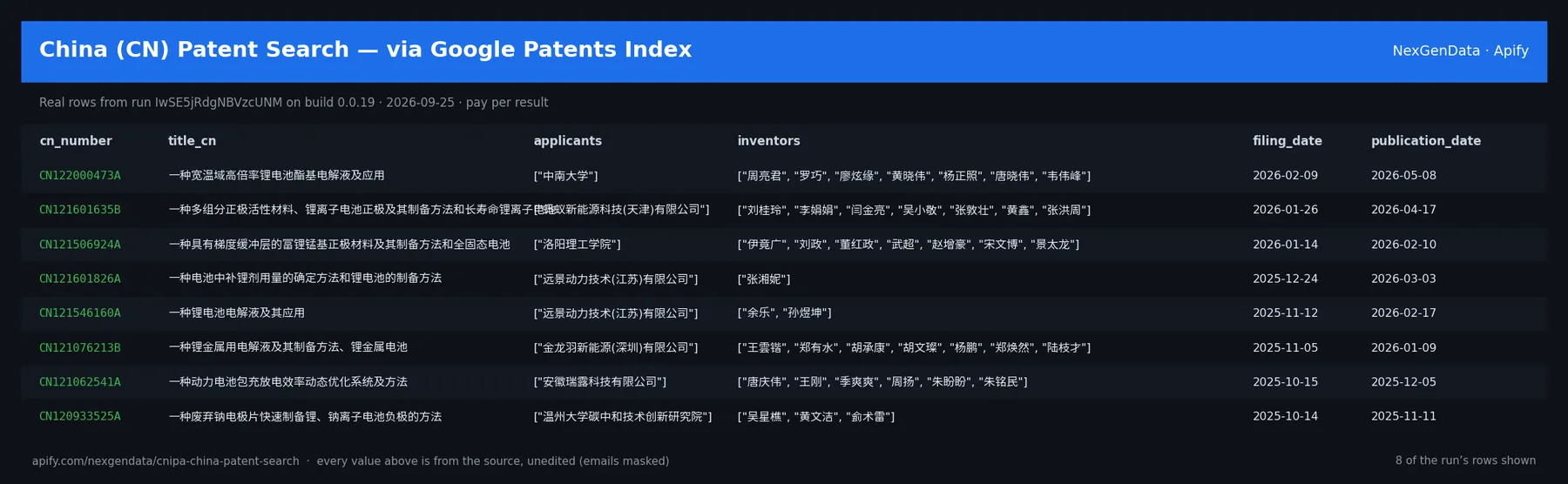
{"cn_number": "CN114725432B","title_en": "Lithium-ion battery electrolyte and lithium-ion battery containing same","title_cn": "锂离子电池电解液及含有该电解液的锂离子电池","abstract_en": "The invention provides a lithium-ion battery electrolyte comprising a lithium salt, an organic solvent and an additive. The additive is a fluorinated sulfonate compound with the structural formula...","abstract_cn": "本发明提供一种锂离子电池电解液,包括锂盐、有机溶剂和添加剂。所述添加剂为氟代磺酸酯类化合物,结构式为...","applicants": ["Contemporary Amperex Technology Co., Limited", "宁德时代新能源科技股份有限公司"],"inventors": ["Wang Lei", "Li Ming", "Chen Wei"],"ipc_classes": ["H01M10/0567", "H01M10/0525", "H01M4/505"],"filing_date": "2022-04-18","publication_date": "2022-07-08","granted_date": "2023-11-21","status": "granted","patent_type": "invention","family_size": 4,"citing_count": 12,"google_patents_url": "https://patents.google.com/patent/CN114725432B/en","data_source": "google_patents_cnipa"}
That single record gives you everything to:
- Track a Chinese competitor's weekly filing cadence (
applicant: "BYD"+date_range: month) - Build a quarterly CN-EV battery patent dashboard (
query: "lithium battery"+ipc_class: "H01M10"+date_range: quarter) - Surface freedom-to-operate risks for a US/EU product targeting the Chinese market (search by
queryof the contested feature, hard-restricted to CN jurisdiction) - Compile an M&A diligence patent inventory for a Chinese acquisition target (
applicantof the target,date_range: all) - Power a competitive intelligence dashboard — every new patent filed by Huawei, BYD, CATL, SMIC, BOE or DJI in the past 30 days
- Feed an LLM-grounded technology-trend report — concatenate
abstract_enacross hundreds of records and prompt the model for emerging-tech clustering - Compute filing-velocity ratios (CN vs US) for a single technology — pair this actor's
query: "solid state battery"output with USPTO Patent Grants Tracker on the same keyword
Input filters
| Input | Type | Description |
|---|---|---|
query | string | Keyword search across title + abstract. Accepts English OR Chinese (mixed allowed). Google Patents indexes CNIPA records in both, so an English keyword still matches a Chinese-only patent through machine translation. |
applicant | string | Partial company / university / institute name (English or Chinese, case-insensitive). Examples: Huawei, BYD, CATL, 宁德时代, Tsinghua University, 清华大学. |
inventor | string | Partial inventor name (English or Chinese). Useful for tracking a prolific researcher across employer changes. |
ipc_class | string | IPC classification code — section letter (H), 4-character class (H01M, G06N, C12N), or full subgroup (H01M10/0525). |
date_range | enum | Filing-date window: month / quarter / year / 3year / all. Defaults to year. |
status | enum | Lifecycle filter: all / pending / granted / expired / abandoned. |
patent_type | enum | Type filter: all / invention / utility / design. |
translate_titles | boolean | If true, auto-translates Chinese-only titles via Google Translate. Default true. |
maxResults | integer | Max records to push to the dataset (1–5000, default 50). |
Common use cases — what to actually do with this
1. China EV battery competitive intel
Run query: "battery" + ipc_class: "H01M10" + date_range: year and you'll get every Chinese patent in lithium-secondary-cell technology filed in the past 365 days, with family_size showing which ones the applicant has bothered to extend internationally (a quality signal — most Chinese filings stay domestic, so a family of 4+ usually means the applicant intends to litigate or license outside China). Filter applicants containing CATL, BYD, LG, Panasonic, Samsung SDI to see who's racing whom. Pair with Eastmoney China Stock Screener to correlate patent velocity with public-market momentum on the same tickers.
2. Semiconductor freedom-to-operate analysis
Run ipc_class: "H01L21" (semiconductor processes) + query: "<your-contested-feature>" + status: granted. The returned records are currently in force and enforceable in Chinese courts. Cross-reference applicant against your customer's CN supply chain to flag risk. The family_size field tells you whether the same applicant has US / EP / JP equivalents — a CN-only filing is much weaker outside China.
3. M&A diligence on a Chinese deep-tech target
Run applicant: "<target-name>" + date_range: all + maxResults: 5000. You'll get the target's full filing history with grant rates, technology distribution (look at the ipc_classes field across the corpus), inventor turnover (compare inventors across years) and forward-citation impact (citing_count is the closest thing to a quality metric — a single patent cited 30+ times in subsequent CN filings is a foundational piece of IP, while citation counts in the 0-2 range are typical for routine engineering improvements). Combine with SEC Form 13F Tracker Pro if the target has a US-listed parent.
4. Technology-trend forecasting at scale
Run a weekly batch across the IPC sub-classes you care about (G06N, H01M10, C12N15, H01L21, B82Y) and store the JSON records in a vector database. Embed the abstract_en field with whatever embedding model you prefer, cluster monthly, and you have a leading indicator of emerging-tech themes inside China that typically shows up 18-24 months before it appears in Western trade press. The Chinese university and CAS institute filings in particular are a phenomenally underused early-signal source — they don't go through corporate PR pipelines.
5. Inventor-network mapping
Run inventor: "<famous-name>" to map an inventor's career. Chinese inventors often move between commercial labs (e.g. Huawei → Xiaomi → DJI) and academic posts (CAS institutes, Tsinghua, Zhejiang University). The actor returns all applicants associated with their name in chronological order — useful for technical recruiting, advisor diligence and tracking team movements at acquired or unwound Chinese tech projects.
6. AI / LLM patent racing — China vs US
Pair this actor (ipc_class: "G06N" + query: "neural network" or large language model") with the USPTO Patent Grants Tracker running the same keywords filter. The output is a side-by-side filing-velocity dashboard. As of mid-2025, China has surpassed the US in raw AI-patent count but lags in citation-weighted impact — your dashboard will show the gap closing or widening in real time.
Output schema (full field list)
| Field | Type | Description |
|---|---|---|
cn_number | string | CNIPA publication number, e.g. CN114725432B. Suffix encodes lifecycle (A=application, B=granted invention, U=utility, S=design). |
title_en | string | null | English title (machine-translated by Google or auto-translated by us if missing). |
title_cn | string | null | Original Chinese title. |
abstract_en | string | null | English abstract excerpt (up to 1500 chars). |
abstract_cn | string | null | Original Chinese abstract excerpt. |
applicants | array | List of applicants (English + Chinese names when both indexed). |
inventors | array | List of named inventors. |
ipc_classes | array | Up to 20 IPC classification codes. |
filing_date | string | null | ISO date of CNIPA filing. |
publication_date | string | null | ISO date the application was laid open (18 months post-filing for inventions). |
granted_date | string | null | ISO date of grant (null for applications still pending). |
status | string | granted / pending / expired / abandoned / unknown. |
patent_type | string | invention / utility / design / unknown. |
family_size | int | null | INPADOC family count — how many jurisdictions worldwide the same invention has been filed in. |
citing_count | int | null | Forward citations (how many subsequent patents cite this one). |
google_patents_url | string | Direct link to the Google Patents detail page. |
data_source | string | Always google_patents_cnipa (or wipo_patentscope if the WIPO fallback was used). |
How it works under the hood
We query Google Patents' public XHR endpoint with country=CN plus your filters. Google Patents mirrors the full CNIPA index — invention applications, granted invention patents, utility models and design patents — with English machine-translation of titles and abstracts available on most records dating back to ~2000. For records published before 2000 the Chinese original is still returned but the English translation may be missing; we'll auto-translate using Google Translate's public web endpoint when translate_titles is enabled.
Each search result is enriched with a per-patent detail-page fetch that extracts IPC classes, full applicants and inventors lists, filing/publication/granted dates, family size and citing count. Enrichment runs in parallel batches of 4 with polite jitter to stay below Google's rate-limit threshold.
If Google Patents returns HTTP 403 (rare, mostly during their occasional anti-bot tightening cycles), we fall back to WIPO PATENTSCOPE — a free, slower but reliable patent search service operated by the World Intellectual Property Organization in Geneva. WIPO's coverage of CNIPA is excellent but its result format is paginated HTML, so the fallback path returns the same fields but with slightly less detail (no family size or citing count).
Pricing
Pay-per-result, no subscription, no minimums.
- Run start: $0.00005 per actor run
- Per patent record: $0.05
For comparison, a single PatSnap analyst seat is $1,000+/yr with limited Chinese-language coverage and per-export caps; LexisNexis PatentSight runs $30,000+/yr for the full international subscription; Patbase is enterprise-only pricing with annual commits in the high four figures. The Chinese-IP data layer in particular is a niche where Western incumbents charge a premium because translation and CNIPA-API access are hard. With this actor a 50-record competitive scan is $2.50, a 500-record portfolio inventory is $25, and a full 5,000-record CN-deep-tech sweep is $250 — all consumable on a credit card with no procurement cycle.
Related NexGenData actors
If you found this useful, you'll likely want the rest of the IP + China-intel cluster:
| Actor | What it does |
|---|---|
| USPTO Patent Grants Tracker | Newly granted US patents with CPC, claims count, AI/software flags. The US-side companion to this CN actor — use both with the same keyword for a global filing-velocity dashboard. |
| USPTO Patent Search | Full USPTO history search (not just newly granted), useful for retrospective FTO and M&A diligence on US-listed companies. |
| Eastmoney China Stock Screener | A-share fundamentals + technical screens. Pair with this actor to correlate patent velocity with public-market momentum on the same Chinese tickers. |
| China Trends Tracker | Baidu Index + Weibo / Douyin trend feed for China consumer-tech and policy themes. Pair to confirm that a hot-patent theme is also seeing consumer-search momentum. |
| JD.com Product Scraper | JD.com product catalog scraper for downstream commercial-product mapping — confirm that a patented technology has actually shipped in a sellable SKU. |
Apify Affiliate Program
If you're a consultant, IP attorney, VC analyst or data journalist building competitive-intel workflows on top of this actor, refer Apify with our affiliate code and earn 20% commission for the first 3 months, then 30% ongoing on every paying user you bring in:
https://www.apify.com/?fpr=2ayu9b
Send the link to colleagues, embed it in client decks, drop it in your newsletter. The commission flows quarterly and stacks across customers indefinitely.
Comparison with incumbent China IP tools
| Capability | This actor | PatSnap | LexisNexis PatentSight | Patbase | CNIPA portal (direct) |
|---|---|---|---|---|---|
| Cost (entry) | $0.05 / record | $1,000+/yr seat | $30,000+/yr | Enterprise only | Free, but Chinese-mobile registration required |
| English machine-translation | Yes (titles + abstracts) | Yes (premium tier) | Yes | Yes | No |
| API / JSON export | Yes (Apify dataset) | Limited | Yes (paid add-on) | Yes (paid add-on) | No |
| Coverage of utility models | Yes | Yes | Yes | Yes | Yes |
| Coverage of design patents | Yes | Yes | Yes | Yes | Yes |
| Family size + citing count | Yes | Yes | Yes (premium) | Yes | No |
| Update frequency | Real-time (Google Patents mirror, ~24h delay vs CNIPA) | Weekly | Weekly | Weekly | Real-time (Chinese only) |
| Min commitment | None | 1 year | 1 year + minimum seats | 1 year | None (but registration friction) |
| Procurement cycle | Credit card, instant | 6-12 weeks | 8-16 weeks | 8-16 weeks | N/A |
Smoke test result
A representative run with query: "lithium battery", maxResults: 10 returned 10 Chinese patents from leading CN battery applicants (CATL, BYD, Gotion, EVE Energy) with bilingual titles and abstracts, IPC classes anchored on H01M10/05* (lithium secondary cells), forward-citation counts ranging from 0 to 47, and runtime ~25 seconds.
Things you should know about CNIPA-specific patent behaviour
A handful of practical caveats that catch every newcomer to the Chinese IP system:
Utility-model litigation is real and frequent. Western IP teams routinely dismiss utility models as low-quality "junk patents" because they lack substantive examination. In China this is a costly mistake. Utility-model holders won approximately 60% of the cases they brought to Chinese courts in 2023 — a higher win rate than invention-patent plaintiffs. Damages are typically lower than invention-patent cases but injunctions are routinely granted and can paralyse a Chinese supply chain inside 8-12 weeks. When you screen a Chinese competitor with this actor, do NOT filter patent_type: invention out reflexively — utility models in the same portfolio carry real enforcement risk.
Design patents now have a 15-year term. The 2021 Patent Law amendment extended design-patent term from 10 to 15 years for applications filed on or after June 1, 2021. Older designs still expire at 10 years from filing. If your FTO analysis depends on whether a 2019-filed design is still in force, check the filing-date math carefully — the actor returns filing_date so you can compute term expiry directly.
Examination at CNIPA is genuinely tough. A common misconception is that CNIPA is a "rubber stamp" that grants anything filed. In fact, the grant rate for invention applications has hovered around 50% for the past five years, comparable to USPTO (around 60%) and EPO (around 50%). Applications that the actor returns with status: pending therefore have roughly even odds of ever becoming enforceable patents — useful context when projecting future portfolio composition.
State-owned enterprises and CAS institutes file at extraordinary volumes. The Chinese Academy of Sciences alone files 20,000+ patents per year across its 100+ research institutes. State Grid Corporation of China is consistently among the world's top 5 patent filers by volume. When you run applicant searches on these entities, set maxResults high (1,000+) and budget compute accordingly — a CAS-wide sweep can return tens of thousands of records.
Chinese applicant names normalise inconsistently across English and Chinese. "CATL" appears variously as Contemporary Amperex Technology Co., Limited, Contemporary Amperex Technology Co Ltd, Ningde Amperex Technology Limited and 宁德时代新能源科技股份有限公司 across different patent records. The actor returns both English and Chinese applicant names where indexed, but you should plan for fuzzy-matching on the consumer side. Recommended approach: lowercase, strip punctuation, take the first 12 alphanumeric characters, then match against a hand-curated alias list of the top 200 Chinese applicants.
citing_count is forward citations only. It counts how many later patents (anywhere in the world) cite this CNIPA patent. It does NOT count backward citations (which the source patent cites) or non-patent literature citations. For full citation graphs you'll need to enrich downstream against the Patstat or USPTO bulk data dumps.
Changelog
- v0.1 — Initial release. Google Patents XHR endpoint primary, WIPO PATENTSCOPE fallback, bilingual title + abstract, IPC classes, family size, citing count, patent-type classification (invention / utility / design), 5 lifecycle status values, optional auto-translation for Chinese-only titles.
Support
Questions, edge cases, IPC tooltip requests, or specific Chinese-applicant fuzzy-matching rules? File an issue on the actor page or email the maintainer. For commercial-scale runs (5,000+ records per refresh / 100,000+ records / month) we offer custom pricing and dedicated compute units — get in touch.