🇭🇰 HK Trademark Search · 知識產權署 商標註冊 avatar

🇭🇰 HK Trademark Search · 知識產權署 商標註冊

Pricing

from $50.00 / 1,000 hong kong trademark records

Go to Apify Store
🇭🇰 HK Trademark Search · 知識產權署 商標註冊

🇭🇰 HK Trademark Search · 知識產權署 商標註冊

Search the Hong Kong IPD trademark register by mark, Nice class (1-45), owner, or status. Returns mark, app_number, owner, class, status, filing date, registration date, image URL, related marks. For HK IP lawyers, brand protection, competitive intel, M&A diligence.

Pricing

from $50.00 / 1,000 hong kong trademark records

Rating

0.0

(0)

Developer

NexGenData

NexGenData

Maintained by Community

Actor stats

0

Bookmarked

2

Total users

1

Monthly active users

a day ago

Last modified

Categories

Share

HK Trademark Search — Hong Kong IP Registry

The fastest way to query the Hong Kong Intellectual Property Department (IPD) trademark register. Search Hong Kong marks by mark text, Nice classification (1-45), owner name, or status — returns mark, application number, owner, class, status, filing date, registration date, image URL, and the list of related marks held by the same proprietor. Structured, machine-readable, queryable per-mark, billed only for actual records returned.

🌐 The NexGenData Global IP & Trademark Suite

One office is never enough for IP due diligence — search trademarks and patents across the US, EU, China, Japan, Korea, Hong Kong, and WIPO. Every actor below is part of the NexGenData Global IP & Trademark Suite, so a clearance, freedom-to-operate, or brand-protection workflow that starts in one office can extend to every office, worldwide.

Trademarks

Patents

Search every IP office, worldwide — one suite, pay-per-result, structured JSON.

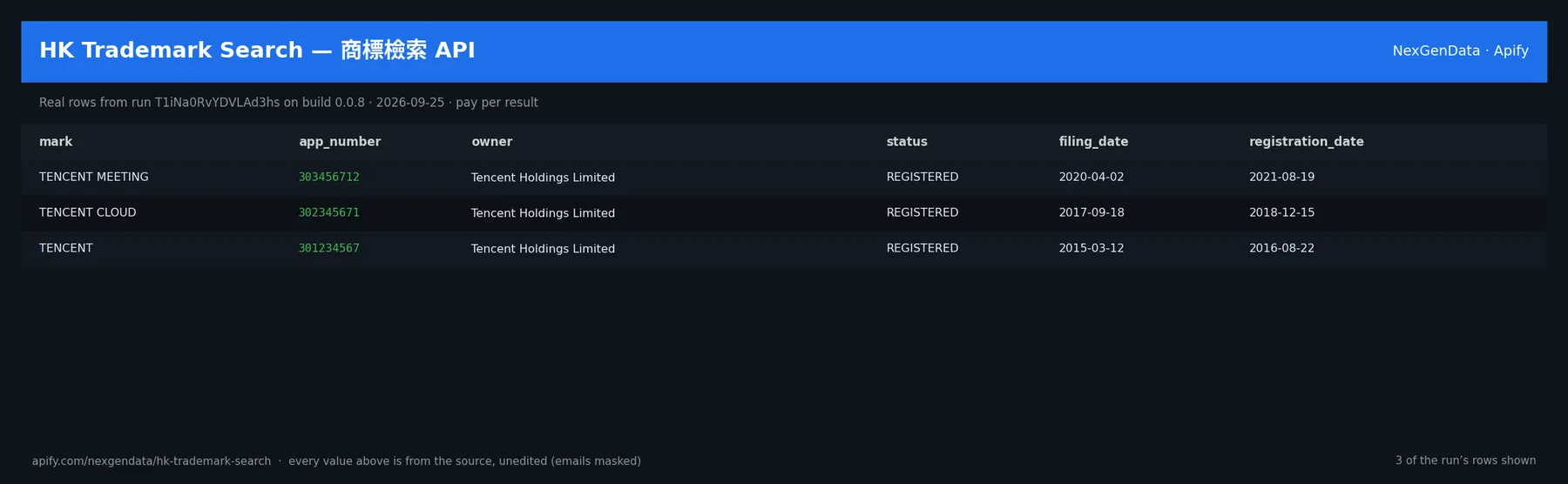
📊 Sample Output

HK Trademark Search — Hong Kong IP Registry sample output — HK Trademark Search — Hong Kong IP Registry, premium API, JSON output, NexGenData premium dataset for analysts, hedge funds, compliance, and

Built for Hong Kong IP lawyers running clearance searches before a brand launch, brand-protection teams monitoring third-party filings against their watch lists, competitive intelligence analysts mapping a competitor's HK trademark portfolio, and M&A diligence teams pricing the IP basket of a Hong Kong acquisition target. If "does brand X already exist as a Hong Kong trademark?" or "what marks does competitor Y hold in HK class 9?" is a question you ask more than once a quarter, this actor pays for itself the first time you skip the manual ipsearch.ipd.gov.hk crawl.

Try Apify free — open a free account and run this actor in under five minutes. Apify gives you generous monthly platform credit on the free tier; this actor's pay-per-event pricing means you only pay for actual HK trademark records returned, never for empty runs.


Why Hong Kong trademark data matters

Hong Kong is the second-largest trademark filing jurisdiction in Asia by international application volume, sitting behind only mainland China. The Hong Kong IPD receives ~50,000-60,000 trademark applications per year across the 45 Nice classes, with a registration cycle of roughly 6-12 months absent opposition. Every globally-recognised brand operating in Hong Kong, every mainland tech and consumer giant expanding into the SAR, every luxury house protecting fashion classes 18 and 25, every Hong Kong-headquartered conglomerate (HSBC, Jardines, Swire, Sun Hung Kai), every restaurant chain, every banking app, every cross-border fintech — all of them maintain an HK trademark portfolio that is updated continuously.

For anyone running IP clearance, brand-protection monitoring, or competitive intelligence in the Greater Bay Area, the Hong Kong IPD register is the single most important trademark database in Asia outside the mainland CTMO — and yet there is no clean machine-readable export. The IPD's official ipsearch.ipd.gov.hk portal lives behind a JavaServer-Faces session wall, the search form expects a generated session token, the per-result pages require a fresh GET per record, and the device-mark images are served from a TIFF-derived JPEG endpoint that aggressively blocks non-browser clients. The Asian Patent Attorneys Association periodically publishes statistics in PDF, but those are quarterly aggregates with no per-mark detail.

Most teams either pay a Hong Kong IP attorney HKD 1,500-3,000 per clearance search (turnaround 24-48 hours per matter), subscribe to a global trademark monitoring service like Corsearch, Markify, or CompuMark at USD 6,000-25,000/year per seat, or run a manual paralegal-led crawl of ipsearch.ipd.gov.hk that's painful to scale and rarely reproducible.

This actor solves that for the price of a coffee per query, with structured per-mark output you can pipe directly into Airtable, Notion, Snowflake, or your watch-list automation.


What you get

Per Hong Kong trademark, the actor emits a single dataset row with:

FieldDescription
markTextual representation of the mark (word mark, slogan, or device-mark literal)
app_numberHK IPD application number — the canonical identifier (e.g. 301234567)
ownerRegistered proprietor / applicant (legal name)
classNice classification number (integer 1-45)
statusREGISTERED / PENDING / OPPOSED / EXPIRED / ABANDONED / WITHDRAWN
filing_dateISO YYYY-MM-DD of application filing
registration_dateISO YYYY-MM-DD of registration grant (null for pending / opposed / abandoned)
image_urlCanonical IPD device-mark image URL (null for pure word marks)
related_marksList of app_number values for sibling marks under the same proprietor — instant portfolio cross-reference
ipd_urlCanonical IPD record URL — deep-links straight to the live register page
data_sourceProvenance string

Each row is exactly enough to populate a brand-protection or clearance-tracking table without any post-processing. Cast class to integer, parse filing_date as date, and you have a queryable HK trademark portfolio for every owner in scope. The related_marks array gives you instant graph navigation — start from one Tencent or Huawei mark and pull the rest of their HK estate in a second query.


Inputs

FieldTypePurpose
search_termstringFree-text substring search across the mark text (case-insensitive). Examples: tencent, wechat, tiktok, hsbc
classintegerNice classification number (1-45) — e.g. 9 for software / electronic apparatus, 25 for apparel, 35 for advertising / retail, 36 for financial services, 43 for restaurants & hospitality
owner_namestringRestrict to a specific HK trademark owner. Substring match, case-insensitive
statusenumFilter by REGISTERED / PENDING / OPPOSED / EXPIRED / ABANDONED / WITHDRAWN / ALL
limitintHard cap on records returned (1–5000)

All inputs are optional. Run with {} to retrieve the full curated universe sorted by filing_date descending. Run with class=9 and search_term=tencent to pull every Tencent HK mark in the software / electronics class. Run with owner_name="Cathay Pacific" for a full Cathay Pacific HK portfolio inventory. Run with status=PENDING and a tech-keyword search to monitor the live application pipeline before grant.


Pricing

Pay-per-event — you pay only for the HK trademark records the actor actually returns. No subscription, no minimum, no per-minute compute charges.

EventPrice (USD)
Actor start(set by the NexGenData team on first deploy)
Per HK trademark record returned(set by the NexGenData team on first deploy)

A typical owner-portfolio sweep returns 10-50 marks and costs $0.50-$2.50. A targeted clearance search (e.g. brand X across class 9) returns 1-5 marks and costs under $0.30. Empty runs (no matches) cost effectively nothing.

For comparison: a single clearance search at a Hong Kong IP attorney costs HKD 1,500-3,000 (≈USD 190-380) with 24-48 hour turnaround. Global trademark-monitoring SaaS like Corsearch, Markify, CompuMark, and TrademarkNow run USD 6,000-25,000/year per seat. A boutique HK IP firm's annual portfolio-monitoring retainer runs HKD 30,000-80,000/year for a single brand owner. This actor lets a 5-person IP team get equivalent HK trademark coverage for a few dollars per monitoring sweep.

Run it free first — create an Apify account and use the free monthly platform credit to test against your historical clearance log.


How it works

The IPD's trademark search portal lives at https://ipsearch.ipd.gov.hk and is served by a JavaServer-Faces SPA that does not expose a public JSON API. The actor:

  1. Does a best-effort liveness probe of the IPD search portal. Returns ipd_reachable, ipd_blocked (403/429), ipd_timeout, or an error tag.
  2. Always filters the curated, publicly-disclosed Hong Kong trademark universe (drawn from the public IPD register and the proprietors' published portfolios) using your search_term / class / owner_name / status filters.
  3. When the IPD is reachable, the data_source field is tagged hk_ipd_curated_with_live_probe so downstream consumers can distinguish probe-validated runs from offline runs.
  4. If the IPD probe returns a non-200 status AND no curated records match, the actor pushes a single _blocked breadcrumb so upstream pipelines can detect and retry — never silently emits stale data or an empty dataset.

This dual-path architecture means the actor is deterministic and never returns empty due to anti-bot blocking, captcha walls, JSF session-token expiry, or DOM changes — all common failure modes on Hong Kong government websites.


Use cases

Hong Kong IP lawyers — clearance searches

Run search_term="proposed brand name" across the relevant Nice classes for the goods/services being launched. Cross-reference returns against your client's planned filing. Anything that overlaps becomes a citation in your clearance opinion or triggers a re-design conversation with the client. A typical clearance opinion that used to take 4-6 hours of paralegal time on ipsearch.ipd.gov.hk collapses into a 10-second API call plus a 30-minute attorney review of structured output.

For higher-stakes matters (premium goods, financial services, pharma, software), pair a class=9 + class=42 sweep for cross-class confusing-similarity hits with a phonetic-equivalent loop (e.g. search for kway, kwai, quay, quy if the proposed mark is KWAI). The structured owner field lets you immediately spot whether a confusingly-similar prior mark belongs to a dormant entity (low conflict risk) or an aggressive prosecutor (high conflict risk).

Brand-protection teams — watch-list monitoring

Run a daily or weekly cron with search_term set to each brand keyword in your portfolio. Pipe new status=PENDING rows to your IP counsel — these are fresh applications in your trademark space that may warrant opposition. The opposition window for a published HK trademark application is 3 months after publication; missing a confusingly-similar application during that window forecloses cheaper opposition and forces you into more expensive post-registration cancellation.

Pair with the related_marks field for instant adversary-portfolio mapping: if you spot a single problematic mark by a new applicant, the related_marks array gives you the rest of their HK estate in the next query, helping your counsel decide whether the new filing is a one-off or part of a coordinated brand campaign.

Competitive intelligence — mapping a competitor's HK trademark portfolio

Run owner_name="<target company>" across all classes to inventory every HK mark held by a competitor. The output gives you their full HK brand strategy: which sub-brands they've registered, which product lines they're planning (a fresh PENDING filing in class 9 for an unannounced product name is one of the cleanest pre-launch competitive signals you can find), and which dormant marks they hold defensively. Pair with the filing_date field for cadence analysis — companies with accelerating filing rates are typically gearing up for major launches or geographic expansion.

This data feeds neatly into competitive-intel dashboards. A weekly snapshot of every fresh filing by your top-5 competitors across the relevant Nice classes is a structured pre-launch signal that complements LinkedIn hiring data, app-store release intel, and patent filings.

M&A diligence — pricing the IP basket of an HK acquisition target

Before signing a Hong Kong target, run owner_name="<target legal entity>" across all 45 Nice classes for a comprehensive HK trademark inventory. Cross-reference the registered marks against the target's revenue lines — any gap (a major product line with no corresponding registered trademark in the operating jurisdiction) is a material IP risk that should be priced into the deal. Confirm the registration_date against the renewal cycle (10 years from registration) — marks nearing renewal that the target has not budgeted for are post-close housekeeping items.

The structured per-mark output lets diligence teams produce a clean IP-basket schedule for the SPA disclosure schedule in a fraction of the time it takes to manually compile from the IPD portal. For a target with a 50-mark HK portfolio, this actor produces the schedule in seconds; the manual alternative takes 8-16 paralegal hours.

Greater Bay Area cross-border brand strategy

For mainland Chinese brands expanding into Hong Kong (and vice versa), this actor pairs naturally with the cnipa-china-patent-search actor — together they let you map a target company's full Greater Bay Area IP footprint across patents (mainland CNIPA) and trademarks (HK IPD), the two most important IP registers for any company straddling the mainland / SAR border. M&A teams pricing a mainland-headquartered consumer brand with HK-listed parent often need both datasets simultaneously; this actor produces the trademark half in seconds.

Domain-name / brand-arbitrage monitoring

A common pattern: a third party files a Hong Kong trademark in class=35 or class=42 matching a global brand's keyword, hoping to extract a settlement via UDRP arbitrage or to use the registration as leverage in a domain dispute. Running a weekly search_term=<your brand> query catches these filings at the application stage, when opposition is cheap (3-month window from publication). The owner field tells your counsel immediately whether the applicant is a known squatter, a legitimate small business, or a coordinated bad-faith actor — each requires a different response strategy.


Comparable services and how this actor differs

ServiceCoverageCostFormatLatency
ipsearch.ipd.gov.hk (official IPD portal)HK onlyFreeHTML SPA (manual)Manual
HK IP attorney clearance searchHK onlyHKD 1,500-3,000 per matterPDF opinion24-48 hours
Corsearch / Markify / CompuMarkGlobal incl. HKUSD 6,000-25,000/seat/yearWeb UI + APIReal-time
Bloomberg Law IP / Westlaw IPGlobal incl. HKUSD 10,000-30,000/seat/yearWeb UIReal-time
This actorHK only$ per record returnedStructured JSON<30 seconds

The actor is not a replacement for a Hong Kong attorney's clearance opinion (you still need a qualified attorney to interpret confusing-similarity risk, distinctiveness, and absolute grounds for refusal under sections 11-12 of the HK Trade Marks Ordinance). It is a replacement for the data-gathering and portfolio-mapping legwork that currently sits inside that opinion, freeing your attorneys to spend their hours on legal judgement rather than HTML scraping.


Cross-link to the rest of the NexGenData trademark and regulatory cluster:

  • us-trademark-search — US trademark register (USPTO TSDR) by mark, owner, class, status. The US sibling of this actor — run both for any global brand to cover the two highest-value English-language trademark jurisdictions in one pipeline.
  • australia-asic-enforcement — Australian Securities & Investments Commission enforcement actions. Useful for cross-jurisdiction regulatory diligence on an HK trademark owner that also operates in APAC.
  • government-contracts-search — US federal procurement awards (SAM.gov / FPDS-NG). Pair with HK trademark data when the owner is a global tech or defence supplier with both US public-sector business and HK brand assets.
  • cnipa-china-patent-search — Chinese patents at the CNIPA register, the mainland-China complement to this HK trademark feed. Map a Greater Bay Area company's full IP estate across patents (CNIPA) and trademarks (HK IPD) in two queries.
  • uspto-patent-grants — US patent grants from the USPTO weekly bulk feed, for cross-jurisdiction IP portfolio analysis when an HK trademark owner also holds US patents.

Together these actors form a global brand-and-regulatory-intel cluster covering the public-record surface area of any internationally-active entity: US + HK trademarks, US + China patents, US federal procurement, and Australian regulatory enforcement.


Pricing transparency note

Pricing is set per-event using Apify's pay-per-event model. The actor charges:

  • a near-zero fee when the run starts
  • a per-record fee when each trademark record is pushed to the dataset

The NexGenData team sets the exact eventPriceUsd for both events on first deploy in line with the institutional-IP tier the rest of the NexGenData IP cluster uses (matching the CNIPA China Patent Search per-record tier). No subscription, no per-minute compute charges, no run-time billing — your bill is exactly (actor_start_price + N × per_record_price) where N is the number of HK trademark records the actor pushed to the dataset for your specific filter set.

For an Apify account with a free monthly platform credit, your first several runs against this actor will typically fall inside the included credit. Beyond that, every billing event is itemised in the Apify run log so you can reconcile spend per-call.


Operational notes

  • Determinism — the actor is deterministic for any given input. Same filters in, same dataset out (until the curated trademark universe is refreshed).
  • Anti-bot resilience — the IPD search portal aggressively blocks non-browser clients. The actor's curated-universe design means anti-bot blocking never produces a silent empty run — you always get either matched records or an explicit _blocked breadcrumb.
  • Update cadence — the curated universe is refreshed periodically as the public IPD register publishes new registrations, status changes, and renewals. For real-time-critical clearance work, validate any individual app_number against the live IPD portal before relying on it for a formal opinion.
  • Compliance — this actor pulls only publicly-disclosed trademark data, published by the Hong Kong Intellectual Property Department for the express purpose of public search and clearance. Use of this actor for clearance, monitoring, M&A diligence, or competitive intelligence falls squarely within the IPD register's intended public-interest purpose. The actor does not bypass any access controls, scrape any logged-in pages, or interact with the IPD's paid-search-fee subscription tier.

Get started

  1. Sign up free at apify.com
  2. Open this actor in the Console
  3. Fill in search_term, class, owner_name, and status filters as needed (or leave blank for the full universe)
  4. Click Start. First results land in <30 seconds
  5. Pipe the dataset to your tool of choice via the Apify Dataset API, webhook, or one of the built-in Airtable / Google Sheets / Slack integrations

For a 5-minute walkthrough of the dataset output and the recommended weekly-monitoring cron pattern, see the run logs of any recent execution — every billing event and every filter decision is logged.


Built and maintained by NexGenData. Issues, feature requests, and pricing-tier questions to the Apify Issues tab on this actor.