

IP Geolocation Lookup — DB-IP Data with VPN & Proxy Check
Pricing
$50.00 / 1,000 ip geolocation lookups
IP Geolocation Lookup — DB-IP Data with VPN & Proxy Check
IP geolocation lookup on DB-IP data for 1–1,000 addresses per run: country, region, city, coordinates, timezone, optional ASN and organization, and an optional VPN/proxy check that flags known anonymizer ranges. Unified JSON schema, one row per IP.
Pricing
$50.00 / 1,000 ip geolocation lookups
Rating
0.0
(0)
Developer

NexGenData
Maintained by CommunityActor stats
0
Bookmarked
3
Total users
1
Monthly active users
4 days ago
Last modified
Categories
Share
IP geolocation lookup on DB-IP data for 1–1,000 addresses per run: country, region, city, coordinates, timezone, optional ASN and organization, and an optional VPN/proxy check that flags known anonymizer ranges. Unified JSON schema, one row per IP.
Drop-in replacement lane: an IPinfo / MaxMind GeoLite2 substitute with a compatible output shape.
📊 Sample Output
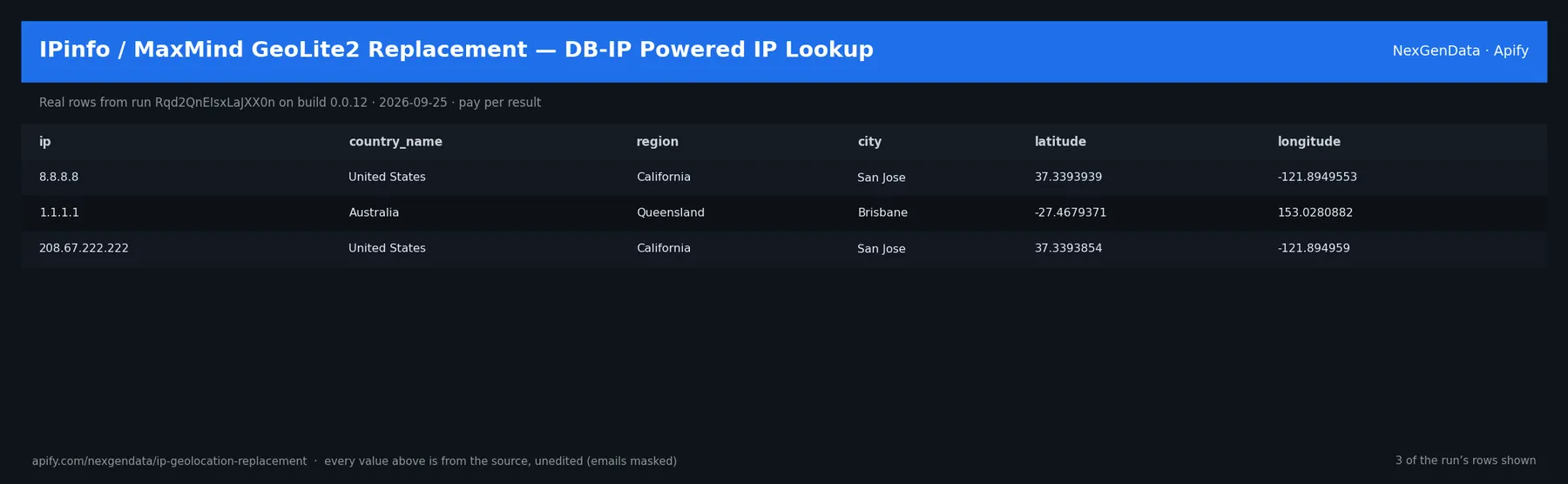
ip | country_name | region | city | latitude | longitude |
|---|---|---|---|---|---|
| 8.8.8.8 | United States | California | San Jose | 37.3393939 | -121.8949553 |
| 1.1.1.1 | Australia | Queensland | Brisbane | -27.4679371 | 153.0280882 |
| 208.67.222.222 | United States | California | San Jose | 37.3393854 | -121.894959 |
Real rows from run Rqd2QnEIsxLaJXX0n on build 0.0.12 (2026-09-25), unedited apart from masked emails/phones and shortened long text; fields the source does not publish are empty.
⚙️ Sample inputs
This is the Store example input — the same input Apify's automated check runs — so it is proven to return rows on the current build. Paste it into the input form, or send it through the API, CLI or a schedule:
🔧 Input reference
| Field | Type | Default | What it does |
|---|---|---|---|
ips (required) | array | ["8.8.8.8", "1.1.1.1", "208.67.222.222"] | List of IPv4 or IPv6 addresses to geolocate (1-1000). Example: ["8.8.8.8", "1.1.1.1", "2606:4700:4700::1111"]. Each entry returns one unified record and incurs one PPE charge. |
include_asn | boolean | true | Attach the asn and asn_org fields (AS number + organization/ISP name) to each record. Uses the DB-IP ASN Lite dataset when available, with an ipwho.is fallback. Defaults to tr… |
include_vpn_check | boolean | false | Populate is_proxy and is_vpn by cross-referencing the free ipwho.is API for each IP. Adds ~200ms per IP and is rate-limited by ipwho.is (roughly 10k req/mo per IP prefix). Def… |
batch_size | integer | 50 | Number of IPs resolved concurrently (1-100). Larger = faster but more likely to trip upstream rate limits. Defaults to 50. |
user_agent | string | "" | Optional User-Agent string for upstream calls (DB-IP CDN + ipwho.is). Leave blank to use the default. |
🧾 JSON sample record
One real record from run Rqd2QnEIsxLaJXX0n (emails/phones masked, long text shortened):
💰 Pricing
| Event | Price (USD) | When it is charged |
|---|---|---|
IP Geolocation Lookup (ip-lookup) | $0.05 | One IP resolved to full geolocation + ASN record |
Pay-per-event: you pay only for what the run delivers. A run that delivers nothing bills no result events (only the actor-start event, when the actor defines one). Example: a run that delivers 100 results costs 100 × $0.05 = $5.00 plus the start fee.
🔗 Related Actors
More from the NexGenData Leads, contacts & enrichment family:
- Bulk Email Validator — Verify & Clean Lists API
- Google Maps Reviews Scraper — Local Review Monitoring API
- IP Geolocation — Bulk IP to Location & ISP
- AI Lead Gen Agent — Automated B2B Prospecting API
- Lead List Enricher — Emails, Phones & Tech from a Domain API
- Leads to Notion CRM — Verified Lead Delivery API
30 more in this family on the NexGenData Store page.
📊 What you get
Clean JSON, one record per resolved IP:
ip— the normalized addresscountry_code— ISO-3166 alpha-2country_name— countryregion— state / regioncity— citylatitude/longitudetimezone— IANA zone id (e.g.America/Los_Angeles)asn— AS numberasn_org— AS / ISP organizationis_proxy/is_vpn— populated only when Include VPN / Proxy Heuristics is ondata_source— which backend served the record (ipwho.is,dbip,dbip+ipwho.is)lookup_time_ms
Sources (honest): bulk runs (200+ IPs, 4 GB+ memory) load the CC-BY-4.0 DB-IP Lite city + ASN snapshots and resolve locally; smaller runs resolve per IP against the free ipwho.is API, which is faster and returns the same fields. Addresses that no source can resolve are not returned and not charged; if every lookup fails the run fails loudly rather than returning empty.
Pricing: $0.05 per IP resolved (Pay-Per-Event) — about 20 IPs per $1. Only delivered rows are charged.
🤖 Use with AI agents
Point Claude, the OpenAI Agents SDK, an n8n flow or any MCP-aware client at it.
Sample agent prompt:
Agentic payments (x402): Supports agentic payment via x402 — call this actor with USDC, no API key required.
🔗 Related tools — IP geolocation
A NexGenData utility actor.


