✉️ SEC Comment Letter & Correspondence Monitor avatar

✉️ SEC Comment Letter & Correspondence Monitor

Pricing

from $5.00 / 1,000 products

Go to Apify Store
✉️ SEC Comment Letter & Correspondence Monitor

✉️ SEC Comment Letter & Correspondence Monitor

SEC staff comment letters (UPLOAD) and responses (CORRESP)

Pricing

from $5.00 / 1,000 products

Rating

0.0

(0)

Developer

NexGenData

NexGenData

Maintained by Community

Actor stats

0

Bookmarked

4

Total users

1

Monthly active users

a day ago

Last modified

Categories

Share

Track SEC staff comment letters (form type UPLOAD) and registrant responses (CORRESP) the moment they hit EDGAR's full-text search index — the early-warning channel where the SEC's Division of Corporation Finance privately challenges a company's filings on revenue recognition, non-GAAP metrics, segment reporting, going-concern, crypto disclosure, and dozens of other accounting and disclosure issues. These letters routinely surface accounting risk months before it shows up in a restatement, an 8-K, or a stock move. This actor pulls them as structured JSON — company, ticker, form type, filed date, and a direct document link — filtered by date window and optional keyword.

One actor. One token. The accounting-risk early-warning feed that forensic-accounting and short-research desks build by hand from EDGAR — delivered as pay-per-record JSON.

Why use this

  • Earliest public signal of accounting scrutiny. A UPLOAD letter is the SEC staff formally questioning a filing. By the time the market reacts to a restatement, this channel flagged the issue quarters earlier.
  • Keyword targeting across the letter index. Pass a query phrase (e.g. revenue recognition, going concern, non-GAAP) and AND it with the form filter to isolate the specific accounting topic you cover.
  • Direct document links. Every record carries a documentUrl to the letter itself, so your analysts (or your NLP pipeline) go straight from alert to source text.
  • Date-window or lookback control. Use daysBack for a rolling monitor or explicit startDate/endDate for a historical sweep of a coverage universe.
  • Official source, ETL-ready. Reads SEC EDGAR full-text search. Stable flat JSON loads straight into Snowflake, BigQuery, Postgres, or a Slack alerting workflow.

What you get

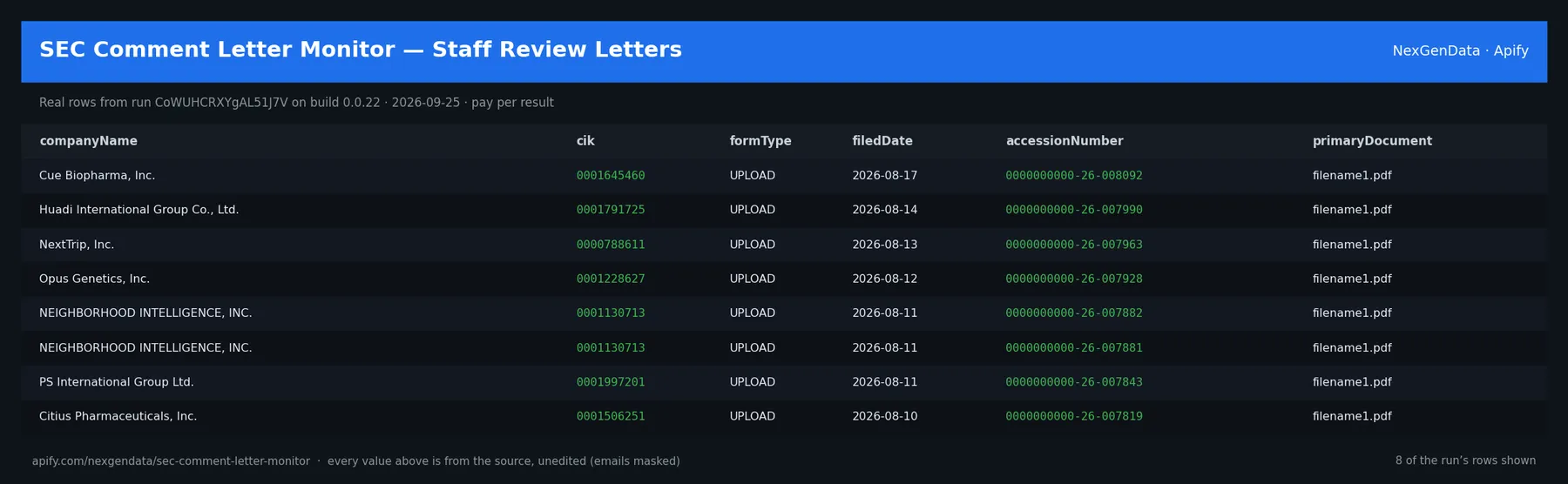
Each record represents one comment-letter or correspondence filing matching your filters. Core fields:

  • companyName — the registrant the letter concerns
  • ticker — the company's stock ticker (when resolvable)
  • formType — the SEC form type (UPLOAD = SEC staff comment letter)
  • filedDate — the date the letter was filed on EDGAR
  • documentUrl — direct link to the comment-letter document

A typical monitoring workflow keys off companyName + filedDate for dedupe and routes the documentUrl to a reader or NLP step.

Use cases

  • Forensic-accounting / short research — Run a daily monitor with query="revenue recognition" or query="going concern" and route every new UPLOAD to your analyst queue. SEC staff comments are a leading indicator of restatement risk that short desks weaponize before the broader market notices.
  • Audit-committee & controller risk monitoring — Track comment letters across your industry peer set to see which accounting topics the SEC staff is pressing this cycle (e.g. crypto-asset disclosure, supplier-finance arrangements, segment changes) and get ahead of the same questions on your own filings.
  • Securities litigation sourcing — Plaintiff and defense firms screen for UPLOAD letters on a coverage universe to identify disclosure disputes that may foreshadow securities-fraud claims.
  • Event-driven / credit research — A comment letter challenging going-concern language or non-GAAP add-backs is a tradeable signal for event-driven equity and distressed-credit desks.
  • Compliance benchmarking — Corporate IR and reporting teams study the SEC's live comment themes to calibrate their own MD&A and non-GAAP disclosures before filing.
  • Academic / policy research — Aggregate comment-letter volume and topics over time for studies on SEC enforcement priorities and disclosure-quality trends.

How the comment-letter process works (and why the timing is the edge)

When a company files a 10-K, 10-Q, S-1, or registration statement, the SEC's Division of Corporation Finance may review it and send a private comment letter challenging specific disclosures — how revenue is recognized, how a non-GAAP metric is reconciled, whether a going-concern qualification is warranted, how a segment is defined, or how a novel area (crypto-assets, SPAC accounting, supplier-finance programs) is presented. The company responds in writing; the staff may issue follow-ups. The entire exchange is made public on EDGAR after the review concludes — and that publication is the moment this actor catches.

The reason this feed is valuable is sequencing. A disclosure problem typically travels: comment letter → company response → possible amendment/restatement → 8-K → market reaction. By the time the last step prints, the UPLOAD letter was searchable quarters earlier. Monitoring UPLOAD filings on a keyword and a coverage universe puts you at the front of that chain rather than the back of it.

Common monitoring recipes

  • Going-concern early warning: {"forms": "UPLOAD", "query": "going concern", "daysBack": 7} on a daily schedule — surfaces companies the SEC staff is pressing on viability.
  • Revenue-recognition scrutiny: {"forms": "UPLOAD", "query": "revenue recognition", "daysBack": 30} — the single most common high-impact comment theme.
  • Non-GAAP pushback: {"forms": "UPLOAD", "query": "non-GAAP", "daysBack": 30} — tracks the SEC's recurring focus on adjusted-metric prominence and add-backs.
  • Historical sweep of a window: {"forms": "UPLOAD", "startDate": "2026-01-01", "endDate": "2026-06-30", "maxResults": 500} — build a back-test set of letters for a coverage universe.

Sample output

{
"companyName": "EXAMPLE TECHNOLOGIES INC",
"ticker": "EXTC",
"formType": "UPLOAD",
"filedDate": "2026-06-18",
"documentUrl": "https://www.sec.gov/Archives/edgar/data/0001234567/000000000026000123/filename.htm"
}

Input parameters

ParameterWhat it does
formsSEC comment-letter form type. UPLOAD = SEC staff comment letters. Note: CORRESP currently errors on the SEC full-text search backend.
queryOptional exact-phrase keyword to AND with the form filter (e.g. revenue recognition, non-GAAP, going concern).
daysBackLook back this many days from today (ignored if explicit dates are set).
startDateOverride start of the window (YYYY-MM-DD).
endDateOverride end of the window (YYYY-MM-DD).
maxResultsMaximum number of filings to return.
userAgentContactSEC requires a User-Agent with contact info; supply your contact string here.

How to use

Python (apify-client)

from apify_client import ApifyClient
client = ApifyClient("YOUR_TOKEN")
run = client.actor("nexgendata/sec-comment-letter-monitor").call(run_input={
"forms": "UPLOAD",
"query": "revenue recognition",
"daysBack": 30,
"maxResults": 200,
"userAgentContact": "Your Name your@email.com",
})
for item in client.dataset(run["defaultDatasetId"]).iterate_items():
print(item["filedDate"], item["companyName"], item["ticker"], item["documentUrl"])

cURL

curl -X POST "https://api.apify.com/v2/acts/nexgendata~sec-comment-letter-monitor/run-sync-get-dataset-items?token=YOUR_TOKEN" \
-H "Content-Type: application/json" \
-d '{
"forms": "UPLOAD",
"query": "going concern",
"startDate": "2026-01-01",
"endDate": "2026-06-30",
"maxResults": 500,
"userAgentContact": "Your Name your@email.com"
}'

No-code (Zapier / Make)

Use the Apify "Run actor and get dataset items" action with actor ID nexgendata/sec-comment-letter-monitor, schedule it daily, and fire a Slack message or CRM task whenever a new UPLOAD matching your keyword appears — mapping companyName, filedDate, and documentUrl into the alert.

Pricing

This actor runs on Apify's pay-per-event (PPE) model — $0.10 per result (one charge per comment-letter record returned), plus a sub-cent actor-start event. No subscription, no seat licence, no minimum.

Worked example:

  • A daily monitor returning 15 new letters → $1.50
  • A monthly keyword sweep returning 200 letters → $20.00
  • A historical coverage-universe pull returning 500 letters → $50.00

Because billing is per result, a quiet day with no matching letters costs effectively nothing.

How this compares to Bloomberg Terminal

Bloomberg's terminal surfaces SEC correspondence inside a ~$24,000-per-seat-per-year workspace, and dedicated comment-letter analytics products (Audit Analytics, Intelligize, Ideagen Disclosure) run on enterprise contracts that price most individual researchers and small funds out entirely. Those platforms add taxonomies, full-text analytics, and curated alerting you may still want at scale. But if your workflow is a keyword-targeted monitor on a coverage universe — "tell me every new SEC comment letter mentioning going concern" — you do not need a Bloomberg seat to get the company, date, and document link. You need this actor, queryable from your own code at a fraction of the cost, with the document URL ready for your own NLP.

FAQ

Q: What exactly is an UPLOAD filing? A: UPLOAD is the EDGAR form type for a comment letter sent by the SEC's Division of Corporation Finance staff to a registrant, questioning aspects of a filing. CORRESP is the registrant's written response. Both are made public on EDGAR after the review concludes.

Q: Why does CORRESP sometimes error? A: The SEC full-text search backend currently returns errors for CORRESP form queries in some cases. The UPLOAD (staff letters) path is the reliable one and is where the accounting-risk signal originates. Track UPLOAD and follow links to the related CORRESP on the company's EDGAR page when needed.

Q: How fresh are the results? A: Comment letters become searchable when the SEC publishes them on EDGAR (typically after the review process closes). Each run queries the live index; schedule daily for an early-warning monitor.

Q: Do I need the userAgentContact? A: Yes. The SEC requires every automated request to identify itself with a contact (name + email). Supply yours so the SEC can reach the request's operator per its fair-access policy.

Q: Can I get the letter's full text? A: This actor returns the documentUrl to each letter. Follow the link (or pipe it into a downstream fetch/NLP step) to retrieve and analyze the full letter text.

Schema stability & versioning

This actor follows NexGenData's additive-only schema contract. New fields may be added over time (appearing as new JSON keys, defaulting to null for older runs), but existing fields are never renamed or removed without a major-version bump and advance notice. Field semantics — date formats, value-sets — are never silently changed. Build production pipelines on this output with confidence.

  • This actor reformats public SEC EDGAR data. It is not affiliated with, endorsed by, or sponsored by the SEC.
  • Comment letters and correspondence are official public filings. Nothing here is legal or investment advice.
  • For any regulated decision — securities research, litigation, compliance — verify against the primary EDGAR filing and consult qualified counsel.
  • Requests identify themselves to the SEC per its fair-access User-Agent policy. You are responsible for compliant downstream use.

Part of NexGenData's SEC / Disclosure intelligence cluster — pair this actor with:

Browse the full 200+ actor catalog at https://apify.com/nexgendata?fpr=2ayu9b.