🔒 SEC Going-Private Transaction Tracker avatar

🔒 SEC Going-Private Transaction Tracker

Pricing

from $50.00 / 1,000 results

Go to Apify Store
🔒 SEC Going-Private Transaction Tracker

🔒 SEC Going-Private Transaction Tracker

SEC going-private (SC 13E3) and merger proxy (DEFM14A/PREM14A) filings

Pricing

from $50.00 / 1,000 results

Rating

0.0

(0)

Developer

NexGenData

NexGenData

Maintained by Community

Actor stats

0

Bookmarked

5

Total users

0

Monthly active users

a day ago

Last modified

Categories

Share

🔒 SEC Going-Private Transaction Tracker — 13E3, DEFM14A & PREM14A Filings

Pay-per-result SEC going-private intelligence — $0.10 per filing. No Bloomberg terminal, no Refinitiv deals desk, no per-seat licence. The entire SC 13E3 / merger-proxy deal flow, delivered as flat JSON from the official EDGAR full-text search.

When a public company gets taken private — a private-equity buyout, a controlling-shareholder squeeze-out, a management-led LBO — the legal trail runs through a specific cluster of SEC forms: the Schedule 13E-3 going-private statement, and the definitive and preliminary merger proxies (DEFM14A and PREM14A) that solicit the shareholder vote. These filings are where the deal terms, the fairness opinion, the buyer identity, and the merger consideration are first disclosed publicly. For M&A arbitrageurs, deal lawyers, PE deal teams, and event-driven funds, catching them the day they hit EDGAR is the difference between front-running the news and reading it in the paper.

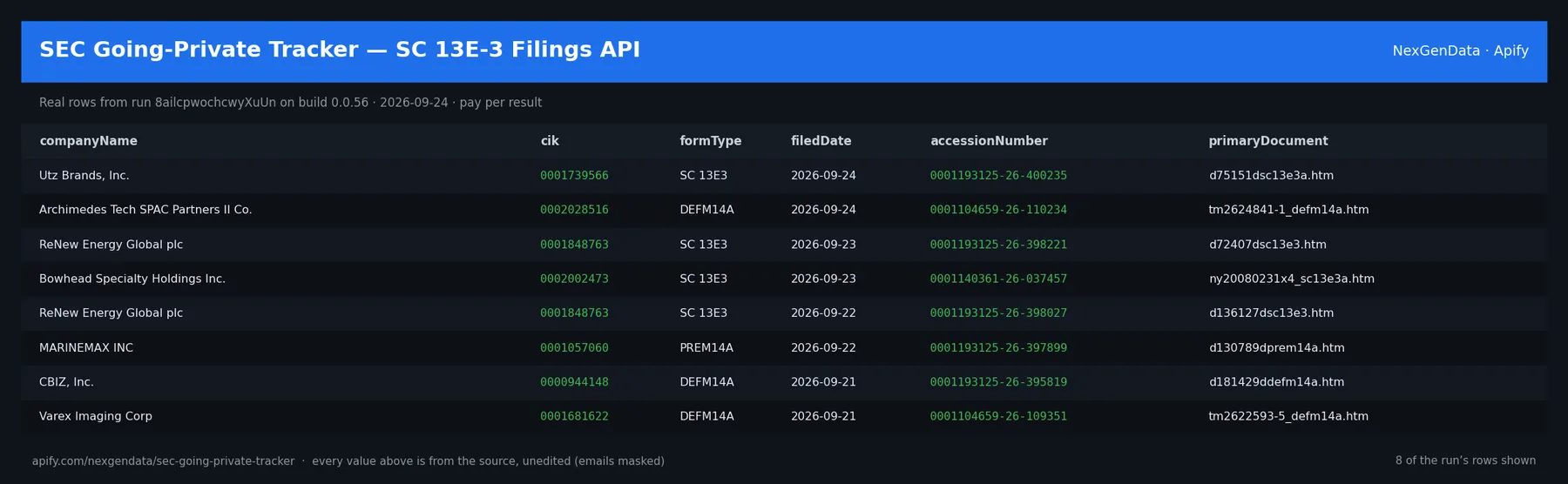
This actor monitors EDGAR's full-text search for exactly those form types and returns a clean record per filing: the filer's company name, ticker, the precise form type, the filed date, and a direct link to the source document on SEC.gov. Filter by form type, add an optional keyword to AND against the form filter, look back a configurable number of days, or pin an exact date window — then pull every going-private and merger-proxy filing that matched.

Why use this

Bloomberg and Refinitiv both surface going-private deals, but they cost $24K+ per seat per year and lock the data behind a terminal you cannot pipe into your own models. EDGAR itself is free, but the full-text search is a manual, paginated web UI that does not export, does not dedupe, does not normalize form types, and does not hand you a ticker or a clean document URL. Building and maintaining your own EDGAR scraper means handling pagination, the SEC's User-Agent fair-access policy, rate limits, and the quirks of full-text vs filing-index search.

This actor is the middle path: the official EDGAR data, normalized into structured JSON, filtered to exactly the going-private and merger-proxy forms you care about, for cents per filing. You set a form list, an optional keyword, and a date window; you get back deduplicated, ETL-ready rows. Because billing is pay-per-result, a tightly-scoped daily monitor that surfaces 3 new filings costs you for 3 records — not for a terminal subscription you pay whether or not a deal printed.

What you get

Every record represents one SEC filing and carries exactly these fields:

  • companyName — the filer's company name as recorded on EDGAR
  • ticker — the issuer's stock ticker (when resolvable from the filing)
  • formType — the precise SEC form (e.g. SC 13E3, DEFM14A, PREM14A)
  • filedDate — the date the filing hit EDGAR
  • documentUrl — a direct link to the source filing document on SEC.gov

Records are flat JSON, ready for Snowflake, BigQuery, Postgres, a pandas DataFrame, or your deal-flow CRM without remapping.

Use cases

  • Merger-arbitrage deal sourcing — Run a daily monitor on SC 13E3, DEFM14A, PREM14A with a short daysBack window and route every new filing to your arb desk. A fresh 13E-3 is the canonical signal that a going-private deal has been formalized — get the ticker and the document URL before the market fully prices it.
  • PE deal-team competitive intelligence — Track which sponsors are taking which companies private. Pull the merger proxies, extract the buyer and consideration from the linked document, and map the competitive landscape of going-private activity in your target sectors.
  • Deal-lawyer precedent research — Filter to DEFM14A / PREM14A and use the query keyword to AND in a deal feature (a structure, a clause, a party name) to build a precedent set of comparable merger proxies for drafting and negotiation.
  • Event-driven fund monitoring — Add SC 13E3 filings to your event calendar the day they file. The filedDate field anchors your event window; the documentUrl gives your analysts the primary source.
  • Squeeze-out / minority-shareholder watch — Controlling-shareholder going-private transactions trigger 13E-3 disclosure and fairness-opinion requirements. Monitor for them to flag minority-shareholder situations and appraisal-rights opportunities.
  • Corporate-development pipeline tracking — Corp-dev teams can watch peers and targets for going-private signals, feeding the companyName + ticker + filedDate rows straight into their M&A pipeline tracker.
  • Academic / market-structure research — Build a longitudinal dataset of going-private activity by setting an explicit startDate / endDate window and pulling the full population of 13E-3 and merger-proxy filings across the period.

Sample output

{
"companyName": "EXAMPLE HOLDINGS CORP",
"ticker": "EXHC",
"formType": "SC 13E3",
"filedDate": "2026-06-18",
"documentUrl": "https://www.sec.gov/Archives/edgar/data/0001234567/000123456726000045/sc13e3.htm"
}

A merger-proxy filing for the same kind of deal:

{
"companyName": "EXAMPLE HOLDINGS CORP",
"ticker": "EXHC",
"formType": "DEFM14A",
"filedDate": "2026-06-20",
"documentUrl": "https://www.sec.gov/Archives/edgar/data/0001234567/000123456726000051/defm14a.htm"
}

Input parameters

ParameterTypeDescription
formsstringComma-separated list of SEC going-private / merger-proxy form types to monitor (e.g. SC 13E3, DEFM14A, PREM14A).
querystringOptional exact-phrase keyword to AND against the form filter — narrows results to filings whose text contains the phrase.
daysBackintegerLook back this many days from today (ignored if startDate / endDate are set).
startDatestringOverride the window start (YYYY-MM-DD).
endDatestringOverride the window end (YYYY-MM-DD).
maxResultsintegerMaximum number of filings to return. Bounds result size and cost.
userAgentContactstringA contact string (name + email) sent as the SEC-required User-Agent. SEC fair-access policy requires every request to identify a contact.

How to use

Python (apify-client)

from apify_client import ApifyClient
client = ApifyClient("YOUR_TOKEN")
run = client.actor("nexgendata/sec-going-private-tracker").call(run_input={
"forms": "SC 13E3, DEFM14A, PREM14A",
"daysBack": 7,
"maxResults": 100,
"userAgentContact": "Your Name your-email@example.com",
})
for item in client.dataset(run["defaultDatasetId"]).iterate_items():
print(item["filedDate"], item["formType"], item["companyName"], item["documentUrl"])

cURL

curl -X POST "https://api.apify.com/v2/acts/nexgendata~sec-going-private-tracker/run-sync-get-dataset-items?token=YOUR_TOKEN" \
-H "Content-Type: application/json" \
-d '{
"forms": "SC 13E3, DEFM14A, PREM14A",
"daysBack": 7,
"maxResults": 100,
"userAgentContact": "Your Name your-email@example.com"
}'

Schedule it daily on Apify's built-in scheduler for a standing going-private monitor, and wire a webhook into Slack / n8n / your deal CRM so a fresh 13E-3 hits your desk the moment it files.

Pricing

This actor runs on Apify's pay-per-event model — you pay only for results:

  • $0.10 per filing record — the primary event, charged once per filing pushed to the dataset
  • No subscription, no seat licence, no minimum commitment

Cost worked example

  • A daily monitor that surfaces 4 new going-private filings → 4 × $0.10 = $0.40 per day
  • A 90-day historical backfill returning 60 filings → 60 × $0.10 = $6.00
  • A quiet day with no new filings → $0.00

You set daysBack / date window and maxResults, so you control cost before the run. Browse 200+ buyer-intent actors at https://apify.com/nexgendata?fpr=2ayu9b

How this compares to Bloomberg

PlatformGoing-private coverageAnnual costProgrammatic export
Bloomberg Terminal (M&A / deal monitor)Curated global deals + analytics~$24,000 / seat / yearSeat-locked (BLPAPI)
Refinitiv / LSEG DealsCurated global M&A databaseCustom enterprise contractAPI, enterprise-priced
EDGAR full-text search (DIY)Complete US filingsFreeNone — manual paginated web UI, no ticker, no normalization
Going-Private Tracker (this actor)US 13E-3 + merger proxies from EDGAR$0.10 per filing, no subscriptionApify REST API + webhooks; flat JSON with ticker + document URL

Bloomberg gives you a curated, analyst-enriched deal database and a full terminal — and you pay terminal money for it whether or not a deal printed this week. This actor gives you the official primary-source filings, normalized and ticker-tagged, for cents each. If your workflow is "alert me to new US going-private filings and hand me the source document," you do not need a $24K seat — you need this feed.

FAQ

Q: How fresh is the data?

A: Each run queries EDGAR live, so it reflects filings indexed up to run time. EDGAR's full-text index typically surfaces new filings within a short window of acceptance. For deal-sourcing use, schedule a daily (or intraday) run.

Q: What is a Schedule 13E-3?

A: It is the SEC going-private statement filed under Rule 13e-3 when an affiliate (such as a controlling shareholder or management) takes a public company private. It requires fairness disclosures and is the canonical signal that a going-private transaction has been formalized.

Q: What is the difference between DEFM14A and PREM14A?

A: PREM14A is the preliminary merger proxy filed for SEC review; DEFM14A is the definitive merger proxy sent to shareholders to solicit the vote. Tracking both catches a deal at the preliminary stage and again when terms are finalized.

Q: Why do I need to supply a User-Agent contact?

A: The SEC's fair-access policy requires every automated request to identify a contact (name + email) so they can reach the operator. Pass yours in userAgentContact; the actor sends it on every request.

Q: Can I get the deal terms (price, buyer) directly?

A: The actor returns the filing metadata and a direct documentUrl to the source. Deal terms — consideration, buyer identity, fairness opinion — live inside the filing document; follow the URL and parse the document (or run it through an LLM) downstream.

Q: Can I filter to a single sector or company?

A: Use the query keyword to AND an exact phrase against the form filter (a company name or deal term). For a full sector sweep, pull the form types over a date window and filter the companyName / ticker rows downstream.

Schema stability & versioning

This actor follows NexGenData's additive-only schema contract:

  • New fields may be added at any time — they appear as new keys defaulting to null for older runs.
  • Existing fields (companyName, ticker, formType, filedDate, documentUrl) are never renamed or removed without a major-version bump and an advance changelog notice.
  • Field semantics (date formats, form-type strings) are never silently changed.

Build your deal-flow ETL on this schema with confidence. Report anything unexpected via the actor's Apify Issues tab.

  • The actor reads public, unauthenticated SEC EDGAR data — the same filings any browser can open on SEC.gov.
  • Every request identifies a contact via the SEC-required User-Agent, in line with SEC fair-access policy.
  • All requests route through Apify's compliant infrastructure with polite pacing.
  • This actor is a data tool, not investment, legal, or M&A advice. Filings are primary-source documents; verify deal specifics in the underlying document before acting.
  • You are responsible for downstream-use compliance with applicable data-protection and securities laws.

Part of NexGenData's SEC / Disclosure suite — pair this actor with:

Explore the full catalog of 200+ buyer-intent actors at https://apify.com/nexgendata?fpr=2ayu9b.