🇱🇰 Sri Lanka CSE — Colombo Stock Exchange Data avatar

🇱🇰 Sri Lanka CSE — Colombo Stock Exchange Data

Pricing

from $30.00 / 1,000 datasets

Go to Apify Store
🇱🇰 Sri Lanka CSE — Colombo Stock Exchange Data

🇱🇰 Sri Lanka CSE — Colombo Stock Exchange Data

Colombo Stock Exchange (Sri Lanka) market data: today's share prices, top gainers/losers, and company announcements. For frontier/emerging-market investors and index providers.

Pricing

from $30.00 / 1,000 datasets

Rating

0.0

(0)

Developer
NexGenData

NexGenData

Maintained by Community

Actor stats

0

Bookmarked

3

Total users

1

Monthly active users

21 hours ago

Last modified

Categories

Share

Pull live Colombo Stock Exchange market data — today's share prices, top gainers and losers, and company announcements — as pay-per-result JSON, $0.10 per record. No Bloomberg seat, no FactSet contract, no frontier-market data wall.

The Colombo Stock Exchange (CSE) is Sri Lanka's primary equity market, and frontier-market investors, index providers, and country-fund managers who want exposure to it run straight into a data problem: the major global terminals charge tens of thousands of dollars a year and still treat a single frontier exchange as a long-tail afterthought, while the free CSE web pages are a manual, one-screen-at-a-time experience that can't be polled or piped into a model. This actor turns the CSE's public market pages into a clean, structured, machine-readable feed. Point it at today's share prices, the day's top gainers and losers, or the company-announcement stream, and it returns each row as JSON ready to drop into your warehouse, your index-construction pipeline, or your research notebook.

Why use this

Frontier-market equity data is the most expensive coverage-per-dollar you can buy. Bloomberg and FactSet will sell you Colombo Stock Exchange data — bundled inside a ~$12,000–$24,000 / seat / year terminal whose value is overwhelmingly in markets you may not care about, behind a per-seat login you cannot pipe into your own model. The CSE itself publishes today's prices and movers on public web pages, but those pages are built for a human clicking through them, not for a daily ETL job.

This actor closes that gap. A single mode parameter selects which public CSE dataset you want — today's prices, the gainers/losers board, or company announcements — and the actor returns it as structured rows you can schedule, diff, and join. For a frontier allocator who needs Sri Lanka coverage and nothing else, paying per record beats renting a global terminal by orders of magnitude.

What you get

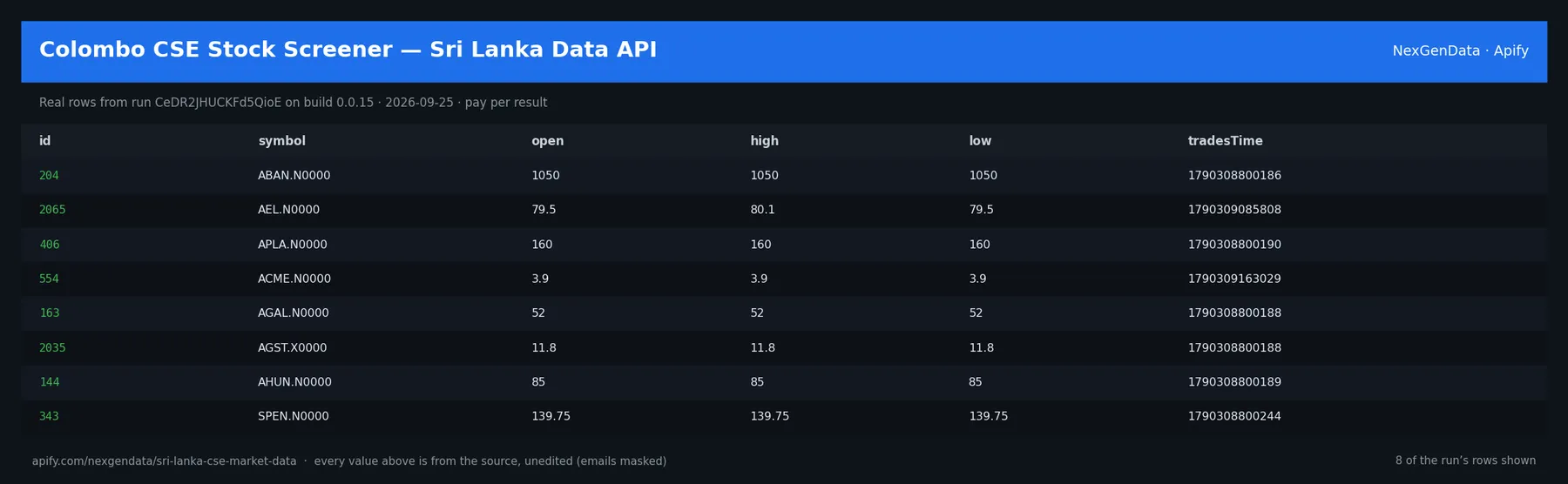
When pulling share-price data, each record is structured JSON carrying the per-symbol quote fields below, populated wherever the CSE source provides them:

  • symbol — the CSE ticker symbol for the listed security
  • lastTradedPrice — the most recent traded price for the session
  • open — the session opening price
  • high — the session intraday high
  • low — the session intraday low

The schema is stable across runs, so you can append straight to Snowflake, BigQuery, Postgres, or a research database without re-mapping each refresh.

Use cases

  • Frontier-market portfolio monitoring — Pull today's CSE prices on a daily schedule and append to a time-series table keyed on symbol + date to maintain your own Sri Lanka price history without a terminal subscription.
  • Index construction and tracking — Index and ETF providers covering frontier markets need a clean daily price feed to compute and rebalance a Sri Lanka sleeve; the per-symbol lastTradedPrice is the input.
  • Daily movers screening — Use the gainers/losers mode to surface the day's biggest CSE moves for momentum, mean-reversion, or news-driven research.
  • Corporate-event monitoring — Use the announcements mode to track CSE-listed company disclosures (dividends, results, board changes) for event-driven and governance research.
  • Intraday range and volatility studies — The open, high, and low fields let you compute true range and realized-volatility proxies per symbol without a tick feed.
  • Country-fund and EM research — Country-fund managers and emerging/frontier-market desks fold Sri Lanka prices into cross-market relative-value and allocation models.
  • Backtesting and academic research — Build a clean daily CSE dataset over time for factor and event studies on a market that's poorly served by mainstream vendors.

Sample output

{
"symbol": "JKH.N0000",
"lastTradedPrice": 198.50,
"open": 196.00,
"high": 199.75,
"low": 195.25
}

Input parameters

ParameterLabelDescription
modeModeWhich CSE dataset to fetch — today's share prices, top gainers/losers, or company announcements.
maxResultsMax resultsMaximum number of records to return.

How to use

Python (apify-client)

from apify_client import ApifyClient
client = ApifyClient("YOUR_TOKEN")
run = client.actor("nexgendata/sri-lanka-cse-market-data").call(run_input={
"mode": "prices",
"maxResults": 500,
})
for item in client.dataset(run["defaultDatasetId"]).iterate_items():
print(item["symbol"], item["lastTradedPrice"], item["high"], item["low"])

cURL

curl -X POST "https://api.apify.com/v2/acts/nexgendata~sri-lanka-cse-market-data/run-sync-get-dataset-items?token=YOUR_TOKEN" \
-H "Content-Type: application/json" \
-d '{
"mode": "prices",
"maxResults": 500
}'

Schedule it at the CSE session close via Apify's built-in scheduler and append each pull, keyed on symbol + date, to build your own price history. Wire a webhook to push the gainers/losers or announcements feed into Slack or n8n for a daily market brief.

Pricing

This actor runs on Apify's pay-per-event (PPE) model — you pay only for results, not run-time:

  • $0.10 per record pushed to your dataset
  • A negligible per-actor-start charge

No subscriptions, no seat licences, no per-CPU-second billing.

Worked cost example

A daily end-of-session pull of the full CSE price board — roughly 300 actively-quoted symbols:

  • 300 records × $0.10 = $30.00
  • plus one negligible actor-start charge

So roughly $30 per full daily price pull, or about $0.10 per symbol all-in. If you only track the day's top 25 movers, that run costs about $2.50. Either way it's a rounding error against a ~$12,000–$24,000 / year terminal seat whose Sri Lanka coverage is a sliver of what you'd be paying for.

Why pay-per-event beats time-based pricing

  • Predictable — cost equals record count, known before the run.
  • Failure-safe — if the CSE page changes and a run returns 0 rows, you pay 0.
  • Easy to attribute — 1 record = 1 unit of cost, so per-strategy or per-fund accounting is trivial.

How this compares to Bloomberg / FactSet

CapabilityBloomberg / FactSetSri Lanka CSE Market Data (this actor)
Sri Lanka CSE coverageYes, bundled in a global terminalYes, dedicated CSE feed
BreadthGlobal markets (most of which you may not need)Colombo Stock Exchange, focused
Annual cost~$12,000–$24,000 / seat / yearPay-per-record, no subscription
Programmatic accessSeat-locked API (BLPAPI / FactSet API)Apify REST API + webhooks, no seat lock
Pipe into your own model / warehouseRestricted by termsNative JSON / JSONL / CSV export

If you need global multi-asset coverage, intraday tick data, and a full analytics workspace, a terminal is the right tool. But if your need is specifically Sri Lanka CSE prices and movers feeding a frontier allocation, an index sleeve, or a research pipeline, paying per record is the right cost model and a 95%+ saving versus a terminal seat you'd be renting mostly for other markets.

FAQ

Q: How current is the data?

A: Each run reads the live CSE public pages, so prices reflect the current or most recently completed session. Schedule a run at session close to capture the official end-of-day board.

Q: What does the mode parameter control?

A: It selects which CSE dataset the run returns — today's share prices (per-symbol quotes), the top gainers/losers board, or the company-announcement stream.

Q: Is this real-time tick data?

A: No — it reads the CSE's published session prices (last traded, open, high, low), not a streaming tick feed. It's built for daily and intraday-snapshot workflows, not for high-frequency trading.

Q: How do I build a price history?

A: Run on a daily schedule and append each pull keyed on symbol + date into your warehouse; the CSE pages give you the current session, and your accumulation gives you the history.

Q: What output formats are supported?

A: JSON, JSONL, CSV, and Excel via Apify's dataset export, plus webhook delivery.

Schema stability & versioning

This actor follows NexGenData's additive-only schema contract:

  • New fields may be added at any time — they appear as new JSON keys and default to null for older runs.
  • Existing fields are never renamed or removed without a major-version bump and an advance changelog notice.
  • Field semantics (price units, the meaning of open/high/low) are never silently changed — if a change is needed, we add a new field and keep the old one for at least 90 days.

You can build production frontier-market pipelines on this actor without an unannounced change breaking your ETL.

  • The actor reads public, unauthenticated Colombo Stock Exchange market pages — the same pages any browser can open, with no login.
  • Requests are paced politely and routed through Apify's compliant proxy infrastructure.
  • NexGenData is not affiliated with, endorsed by, or sponsored by the Colombo Stock Exchange. "CSE" refers to the Colombo Stock Exchange.
  • Prices and announcements are the CSE's published values; for any trade, settlement, or index-calculation decision, verify against the primary CSE source.
  • You are responsible for ensuring downstream use complies with the CSE's terms and applicable Sri Lankan and local market-data regulations.

Part of NexGenData's International / Markets intelligence suite — pair this actor with:

Browse the full catalog of 200+ buyer-intent actors at https://apify.com/nexgendata?fpr=2ayu9b.