📈 Stock Buyback Announcement Tracker
Pricing
from $20.00 / 1,000 results
📈 Stock Buyback Announcement Tracker
Track recent share-repurchase (buyback) announcements from SEC EDGAR filings, with authorized dollar amounts extracted. For equity investors, event-driven funds, and IR teams.
Pricing
from $20.00 / 1,000 results
Rating
0.0
(0)
Developer
NexGenData
Maintained by CommunityActor stats
0
Bookmarked
7
Total users
0
Monthly active users
a day ago
Last modified
Categories
Share
📈 Stock Buyback Announcement Tracker — SEC Repurchase API
Track every share-repurchase (buyback) announcement the moment it hits SEC EDGAR — with the authorized dollar amount extracted from the filing text. Pay-per-result JSON, $0.10 per announcement. No Bloomberg seat, no FactSet contract, no event-feed subscription.
Buybacks are one of the cleanest event-driven signals on the tape: a board that authorizes a $2B repurchase is telling the market it thinks its own stock is cheap, and the announcement itself moves the price. This actor reads the official SEC EDGAR full-text search index for new buyback language across 8-K, 10-Q and any other form type you point it at, then optionally opens each filing and pulls out the authorized dollar amounts ("up to $500 million", "an additional $1.0 billion", "10 million shares") so the dollar magnitude — the actual signal — lands in your dataset instead of buried in a PDF. Every record carries company name, ticker, filing date, form type, the extracted amounts array, and a direct EDGAR document URL so you can verify against the primary source in one click.
Why use this
Buyback intelligence is gated behind expensive terminals and event-feed vendors. Bloomberg's event-driven analytics, FactSet's corporate-actions feed, and dedicated buyback-tracking newsletters all charge four- to five-figure annual sums and lock the data behind a per-seat login you cannot pipe into your own model. The raw filings, meanwhile, are public, free, and published on EDGAR the same minute the company files — but finding the repurchase language across thousands of daily 8-Ks and 10-Qs, then parsing the authorized amount out of legalese, is exactly the tedious work that kills a do-it-yourself approach.
This actor closes that gap. It queries EDGAR full-text search the way an analyst would, runs each of your buyback search phrases as an exact-phrase query, de-duplicates across forms, and hands you a clean structured feed. The extractAmounts option turns each hit into a quantified event by fetching the filing and regex-extracting the dollar figures, so you can rank announcements by size, filter out trivial top-ups, and route the big authorizations straight to your trading or IR workflow.
What you get
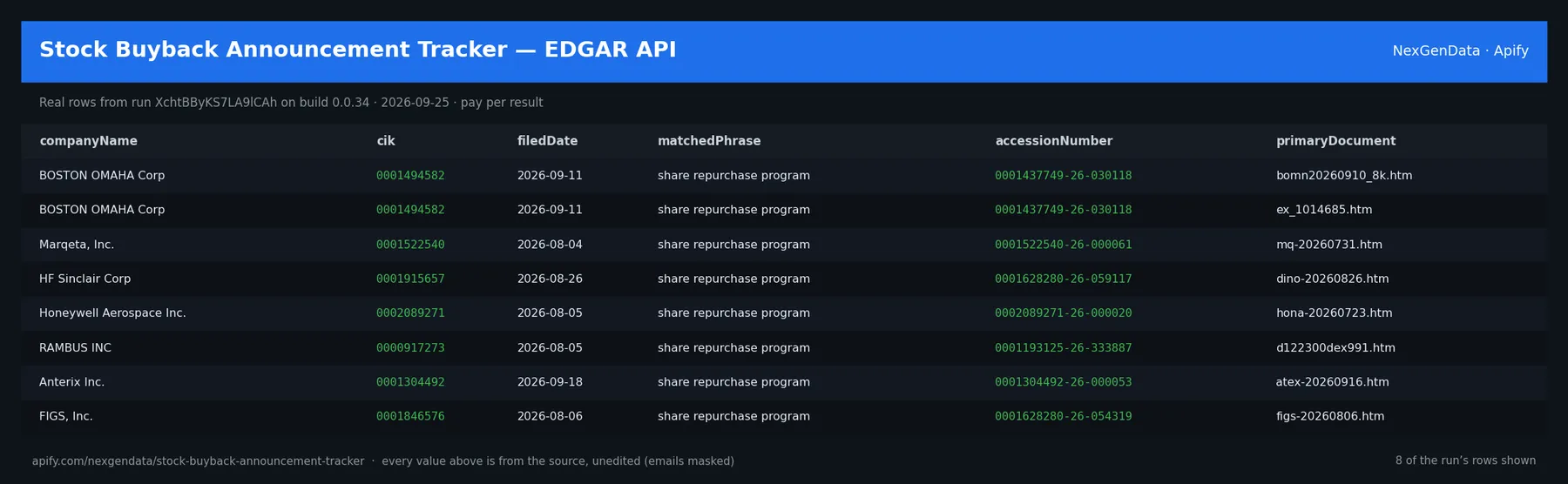
Every record returned by this actor is structured JSON with the fields below, populated wherever the underlying EDGAR filing provides them:
companyName— the filer's name as registered with the SECticker— exchange ticker symbol when EDGAR maps the filer to one (null for filers without a mapped symbol)filedDate— the date the filing was accepted by EDGAR (YYYY-MM-DD)formType— the SEC form the announcement appeared in (8-K, 10-Q, etc.)announcedAmounts— array of authorized buyback dollar amounts extracted from the filing body (only populated whenextractAmountsis enabled)documentUrl— direct link to the primary filing document on sec.gov for one-click verification
The schema is stable across runs, so you can load straight into Snowflake, BigQuery, Postgres, or your CRM without re-mapping each refresh.
Use cases
- Event-driven equity trading — Run the actor every morning with
extractAmountson, sort the day's announcements by the largest figure inannouncedAmounts, and route any authorization above your size threshold (say $500M) to your event-trader. Large buybacks relative to market cap have a documented post-announcement drift you can model against. - Buyback-yield screening — Append each run to a warehouse table keyed on
companyName+filedDate, then joinannouncedAmountsagainst market cap to compute an authorized-buyback-yield factor for a systematic value/quality sleeve. - Investor-relations competitive intelligence — IR teams track when peer companies announce repurchases and at what magnitude, to time and size their own program and to brief the board with current comparables.
- Activist and special-situations research — A fresh buyback authorization is often a defensive response to activist pressure or a signal of excess cash; pair it with insider and 13D feeds to build a fuller picture of capital-allocation intent.
- Credit and covenant monitoring — Lenders and credit analysts watch for large repurchase authorizations that draw down cash and can pressure leverage ratios or trip covenants.
- Quant signal backtesting — Pull a multi-year history by setting
startDate/endDate, then backtest the announcement-drift and buyback-yield signals on a clean, de-duplicated event set. - News and newsletter automation — Feed the daily feed into an LLM summarizer to auto-draft a "today's buyback announcements" digest with company, ticker, and authorized amount.
Sample output
{"companyName": "APPLE INC","ticker": "AAPL","filedDate": "2026-05-01","formType": "8-K","announcedAmounts": ["$110.0 billion", "$25.0 billion"],"documentUrl": "https://www.sec.gov/Archives/edgar/data/320193/000032019326000045/aapl-20260501.htm"}
Input parameters
| Parameter | Label | Description |
|---|---|---|
searchPhrases | Search phrases | Buyback-related phrases to search in SEC filings; each is run as a separate exact-phrase query (e.g. "share repurchase program", "authorized to repurchase"). |
forms | Filing form types | Comma-separated SEC form types to search (e.g. 8-K or 8-K,10-Q). |
daysBack | Days back | Look back this many days from today (ignored if startDate/endDate are set). |
startDate | Start date (YYYY-MM-DD) | Override the start of the date range. |
endDate | End date (YYYY-MM-DD) | Override the end of the date range. |
extractAmounts | Extract authorized amounts | Fetch each filing and extract the announced buyback dollar amounts — slower, but adds the key signal. |
maxResults | Max results | Maximum number of announcement filings to return. |
userAgentContact | SEC User-Agent contact | SEC requires a User-Agent with contact info. Optional override (e.g. YourCompany you@email.com). |
How to use
Python (apify-client)
from apify_client import ApifyClientclient = ApifyClient("YOUR_TOKEN")run = client.actor("nexgendata/stock-buyback-announcement-tracker").call(run_input={"searchPhrases": ["share repurchase program", "authorized to repurchase"],"forms": "8-K,10-Q","daysBack": 7,"extractAmounts": True,"maxResults": 200,})for item in client.dataset(run["defaultDatasetId"]).iterate_items():print(item["companyName"], item["ticker"], item["formType"], item["announcedAmounts"])
cURL
curl -X POST "https://api.apify.com/v2/acts/nexgendata~stock-buyback-announcement-tracker/run-sync-get-dataset-items?token=YOUR_TOKEN" \-H "Content-Type: application/json" \-d '{"searchPhrases": ["share repurchase program", "authorized to repurchase"],"forms": "8-K,10-Q","daysBack": 7,"extractAmounts": true,"maxResults": 200}'
Schedule it daily via Apify's built-in scheduler and dedupe on companyName + filedDate + formType into your warehouse to maintain a rolling buyback-event table. Webhooks let you fire a Slack or n8n alert the moment a new large authorization lands.
Pricing
This actor runs on Apify's pay-per-event (PPE) model — you pay only for results, not run-time:
- $0.10 per announcement record pushed to your dataset
- A negligible per-actor-start charge
No subscriptions, no seat licences, no per-CPU-second billing. If EDGAR returns no new buyback filings in your window, you pay essentially nothing.
Worked cost example
A daily scheduled run over the trailing 7 days, with extractAmounts on, that surfaces 40 buyback announcements:
- 40 records × $0.10 = $4.00
- plus one negligible actor-start charge
So roughly $4 per 40-announcement daily run, all-in — versus four- and five-figure annual contracts for an equivalent event feed inside Bloomberg or FactSet. A full multi-year backfill of, say, 5,000 historical announcements is a one-time ~$500 — still a rounding error against a single terminal seat.
Why pay-per-event beats time-based pricing
- Predictable — you know your cost from the record count, not from how long a scrape happened to run.
- Failure-safe — if EDGAR changes its HTML and a run returns 0 rows, you pay 0.
- Easy to attribute — 1 announcement = 1 unit of cost, so per-strategy or per-desk cost accounting is trivial.
How this compares to Bloomberg Terminal
| Capability | Bloomberg Terminal | Stock Buyback Announcement Tracker (this actor) |
|---|---|---|
| Buyback / corporate-actions coverage | Global, deeply curated | US SEC EDGAR filers (8-K, 10-Q, any form you query) |
| Authorized-amount extraction | Yes, analyst-curated | Yes, regex-extracted from filing text via extractAmounts |
| Annual cost | ~$24,000 / seat / year | Pay-per-record, no subscription |
| Programmatic access | BLPAPI, seat-locked | Apify REST API + webhooks, no seat lock |
| Pipe into your own model / warehouse | Restricted by terms | Native JSON / JSONL / CSV export |
If you need a fully curated global corporate-actions database with analyst overrides and decades of normalized history, a terminal still wins. But if your workflow is a daily event scan of US buyback announcements feeding a trading model, a research screen, or an IR brief, paying per announcement record is the right cost model and a 95%+ saving versus a terminal seat.
FAQ
Q: How current is the data?
A: As current as EDGAR. The SEC accepts and publishes filings throughout the trading day; each run queries EDGAR full-text search live, so a run picks up announcements within minutes of acceptance.
Q: How accurate are the extracted amounts?
A: announcedAmounts is a regex extraction of dollar figures from the filing body. It is high-precision on standard "up to $X billion / X million shares" language but is a convenience field, not a substitute for reading the filing. Always confirm the authoritative figure against the documentUrl before trading on it.
Q: Why is ticker sometimes null?
A: EDGAR maps many but not all filers to an exchange ticker. Smaller issuers, foreign private issuers, and recently-listed names may file without a mapped symbol; the companyName and documentUrl always resolve the entity.
Q: Can I search forms other than 8-K?
A: Yes. Pass any comma-separated form list to forms — buyback language frequently appears in 10-Q and 10-K filings as well as the headline 8-K.
Q: Can I pull historical announcements?
A: Yes. Set startDate and endDate (which override daysBack) to backfill any window EDGAR full-text search covers.
Q: What output formats are supported?
A: JSON, JSONL, CSV, and Excel via Apify's dataset export, plus webhook delivery.
Schema stability & versioning
This actor follows NexGenData's additive-only schema contract:
- New fields may be added at any time — they appear as new JSON keys and default to
nullfor older runs. - Existing fields are never renamed or removed without a major-version bump and an advance changelog notice.
- Field semantics (date formats, the meaning of
announcedAmounts) are never silently changed — if a change is needed, we add a new field and keep the old one for at least 90 days.
You can build production pipelines on this actor without a Tuesday change breaking a Friday ETL job.
Compliance & legal
- The actor reads public, unauthenticated SEC EDGAR pages — the same full-text search index and filing documents any browser can open.
- It identifies itself to the SEC with a compliant User-Agent (set yours via
userAgentContact) per the SEC fair-access policy, and paces requests politely. - NexGenData is not affiliated with, endorsed by, or sponsored by the U.S. Securities and Exchange Commission. "EDGAR" is a service of the SEC.
- The extracted
announcedAmountsare a convenience parse; the filing atdocumentUrlis the authoritative primary source and should be verified before any investment or compliance decision. - You are responsible for ensuring your downstream use complies with applicable securities laws and the SEC's terms of access.
Related NexGenData actors
Part of NexGenData's SEC / Disclosure intelligence suite — pair this actor with:
- SEC Form 4 Insider Monitor — CEO/CFO buys and sells, the insider counterpart to buyback signals
- SEC 8-K Event Monitor — all material 8-K events, the form most buybacks are announced in
- SEC Tender Offer & M&A Tracker — takeover bids and tender offers
- SEC Executive Compensation & Proxy Tracker — DEF 14A pay and capital-allocation context
- SEC Form 3 New Insider & 10% Owner Tracker — new insiders and beneficial owners
- SEC Activist Proxy Solicitation Tracker — activist campaigns that often trigger defensive buybacks
Browse the full catalog of 200+ buyer-intent actors at https://apify.com/nexgendata?fpr=2ayu9b.