🤝 SEC Tender Offer & M&A Tracker — Takeover Bids avatar

🤝 SEC Tender Offer & M&A Tracker — Takeover Bids

Pricing

from $20.00 / 1,000 domain lookups

Go to Apify Store
🤝 SEC Tender Offer & M&A Tracker — Takeover Bids

🤝 SEC Tender Offer & M&A Tracker — Takeover Bids

Track SEC tender-offer and takeover filings (SC TO-T, SC TO-I, SC 14D9) with company, filing, and date. For merger-arbitrage traders, M&A lawyers, and IR teams monitoring live takeover bids.

Pricing

from $20.00 / 1,000 domain lookups

Rating

0.0

(0)

Developer

NexGenData

NexGenData

Maintained by Community

Actor stats

0

Bookmarked

7

Total users

0

Monthly active users

a day ago

Last modified

Categories

Share

Track every SEC tender-offer and takeover filing the moment it hits EDGAR — SC TO-T, SC TO-I, SC 14D9 and the rest of the tender-offer form set. Pay-per-result JSON, $0.10 per filing. No Bloomberg Terminal seat, no deal-database subscription.

A tender offer is a live takeover attempt playing out in public, one SEC filing at a time. When a bidder files an SC TO-T it is formally offering to buy a target's shares; when the target's board files an SC 14D9 it is telling shareholders to accept or reject. For merger-arbitrage traders, these filings are the event itself — the spread between the offer price and the market price is the trade. For M&A lawyers and IR teams, they are the early-warning system for who is in play and who is defending. This actor reads the official SEC EDGAR full-text and form index for the tender-offer form set, optionally narrows by keyword, and hands you each filing as a clean structured row with company, ticker, form type, filing date, and a direct EDGAR document URL.

Why use this

Live takeover intelligence is gated behind expensive terminals and deal databases. Bloomberg's M&A function, Refinitiv's deal feed, and dedicated merger-arbitrage data vendors all charge four- to five-figure annual sums and lock the data behind a per-seat login you cannot pipe into your own model. The underlying filings, meanwhile, are public on EDGAR the same minute they're accepted — but the tender-offer forms are scattered across SC TO-T, SC TO-I, SC TO-C, SC 14D9 and related variants, mixed in with thousands of unrelated daily filings, and identifying the live bids by hand does not scale.

This actor solves that. It queries EDGAR for the tender-offer form set, lets you AND an optional exact-phrase keyword onto the form filter to zero in on a specific deal or sector, de-duplicates, and returns a clean feed keyed to the primary EDGAR document. Run it daily and you have a live takeover-monitoring system feeding your arbitrage book, your deal-flow CRM, or your IR defense desk — for cents per filing instead of a terminal seat.

What you get

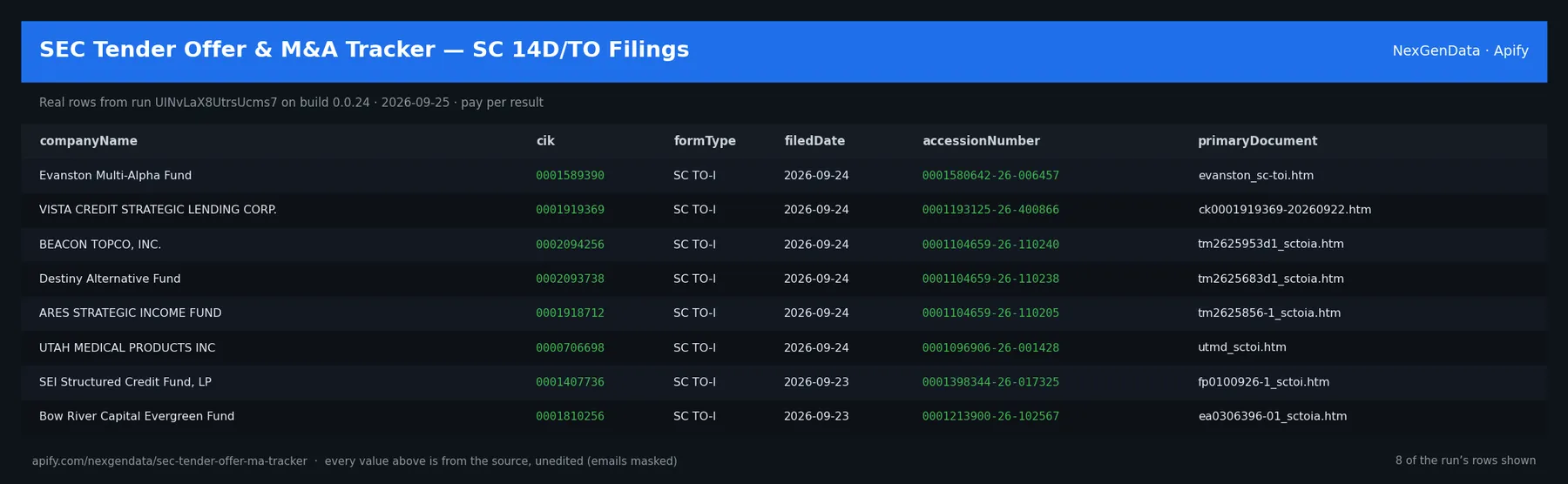
Every record is structured JSON with the fields below, populated wherever the underlying EDGAR filing provides them:

  • companyName — the filer's name as registered with the SEC (the bidder on a TO filing, the target on a 14D9)
  • ticker — exchange ticker symbol when EDGAR maps the filer to one (null for filers without a mapped symbol)
  • formType — the specific tender-offer form (SC TO-T, SC TO-I, SC TO-C, SC 14D9, etc.)
  • filedDate — the date the filing was accepted by EDGAR (YYYY-MM-DD)
  • documentUrl — direct link to the primary filing document on sec.gov for one-click verification

The schema is stable across runs, so you can load straight into Snowflake, BigQuery, Postgres, or your CRM without re-mapping each refresh.

Use cases

  • Merger-arbitrage deal sourcing — Run daily, append new SC TO-T / SC 14D9 filings to your deal table keyed on companyName + filedDate, and route fresh tender offers to your arb desk to compute the offer-vs-market spread before the rest of the tape catches up.
  • M&A legal practice monitoring — Law firms track every tender-offer filing to spot new mandates, conflict-check against existing clients, and benchmark deal structures and timelines from the primary documents at documentUrl.
  • Target-side IR and defense — IR teams and defense advisors watch the form set for unsolicited SC TO-T filings against peers and clients, so the board's response (the SC 14D9) can be prepared before the offer becomes public knowledge.
  • Event-driven and special-situations funds — De-dupe across forms to build a clean event set of live takeover situations, then size positions and hedge against deal-break risk.
  • Corporate-development competitive intelligence — Strategics monitor who is bidding for whom in their sector to anticipate consolidation and identify acquisition targets before they're contested.
  • Risk-arb backtesting and research — Set startDate/endDate to pull a historical window of tender offers for spread-capture and deal-completion-rate studies.
  • Financial-media and newsletter automation — Feed the daily feed into an LLM summarizer to auto-draft a "today's takeover bids" digest with company, form, and filing link.

Sample output

{
"companyName": "ACME ACQUISITION CORP",
"ticker": "ACME",
"formType": "SC TO-T",
"filedDate": "2026-06-22",
"documentUrl": "https://www.sec.gov/Archives/edgar/data/0001234567/000119312526123456/dsctot.htm"
}

Input parameters

ParameterLabelDescription
formsForm typesComma-separated SEC tender-offer forms to search (defaults to the tender-offer form set, e.g. SC TO-T, SC TO-I, SC 14D9).
queryKeyword (optional)Optional exact-phrase keyword to AND with the form filter, to narrow to a specific deal or sector.
daysBackDays backLook back this many days from today (ignored if startDate/endDate are set).
startDateStart dateOverride the start of the date range (YYYY-MM-DD).
endDateEnd dateOverride the end of the date range (YYYY-MM-DD).
maxResultsMax resultsMaximum number of filings to return.
userAgentContactSEC User-Agent contactSEC requires a User-Agent with contact info (e.g. Company you@email.com).

How to use

Python (apify-client)

from apify_client import ApifyClient
client = ApifyClient("YOUR_TOKEN")
run = client.actor("nexgendata/sec-tender-offer-ma-tracker").call(run_input={
"forms": "SC TO-T,SC TO-I,SC 14D9",
"daysBack": 14,
"maxResults": 200,
})
for item in client.dataset(run["defaultDatasetId"]).iterate_items():
print(item["companyName"], item["ticker"], item["formType"], item["filedDate"])

cURL

curl -X POST "https://api.apify.com/v2/acts/nexgendata~sec-tender-offer-ma-tracker/run-sync-get-dataset-items?token=YOUR_TOKEN" \
-H "Content-Type: application/json" \
-d '{
"forms": "SC TO-T,SC TO-I,SC 14D9",
"daysBack": 14,
"maxResults": 200
}'

Schedule it daily via Apify's built-in scheduler and dedupe on companyName + formType + filedDate into your deal database. Wire a webhook to fire a Slack or n8n alert the moment a new SC TO-T or SC 14D9 lands.

Pricing

This actor runs on Apify's pay-per-event (PPE) model — you pay only for results, not run-time:

  • $0.10 per filing record pushed to your dataset
  • A negligible per-actor-start charge

No subscriptions, no seat licences, no per-CPU-second billing. Tender-offer filings are relatively rare, so most daily runs cost very little.

Worked cost example

A daily scheduled run over the trailing 14 days that surfaces 15 tender-offer filings:

  • 15 records × $0.10 = $1.50
  • plus one negligible actor-start charge

So roughly $1.50 per daily run in an active deal environment, all-in. A full historical backfill of, say, 2,000 tender-offer filings over several years is a one-time ~$200 — versus four- and five-figure annual contracts for an equivalent M&A feed inside a terminal.

Why pay-per-event beats time-based pricing

  • Predictable — cost equals filing count, known before the run.
  • Failure-safe — if EDGAR changes its HTML and a run returns 0 rows, you pay 0.
  • Easy to attribute — 1 filing = 1 unit of cost, so per-strategy or per-desk accounting is trivial.

How this compares to Bloomberg Terminal

CapabilityBloomberg Terminal (M&A / MA function)SEC Tender Offer & M&A Tracker (this actor)
Tender-offer / takeover coverageGlobal, curated deal databaseUS SEC EDGAR tender-offer form set (SC TO-T/-I/-C, SC 14D9)
Deal terms & analyticsYes, analyst-normalizedFiling metadata + direct link to primary documents
Annual cost~$24,000 / seat / yearPay-per-record, no subscription
Programmatic accessBLPAPI, seat-lockedApify REST API + webhooks, no seat lock
Pipe into your own model / CRMRestricted by termsNative JSON / JSONL / CSV export

If you need a fully normalized global deal database with curated terms, premiums, and advisor league tables, a terminal still wins. But if your workflow is a daily scan of live US tender offers feeding an arbitrage book, a legal-mandate watch, or an IR defense desk, paying per filing record is the right cost model and a 95%+ saving versus a terminal seat — with the primary SC 14D9 / SC TO-T document one click away for the actual deal terms.

FAQ

Q: How current is the data?

A: As current as EDGAR. Filings are accepted and published throughout the trading day; each run queries EDGAR live and picks up new tender-offer filings within minutes of acceptance.

Q: Which forms are covered?

A: The tender-offer form set — SC TO-T (third-party offer), SC TO-I (issuer offer), SC TO-C (communications), SC 14D9 (target solicitation/recommendation) and related variants. You can override the exact list via the forms parameter.

Q: Can I track one specific deal?

A: Yes — pass a company name or deal keyword to query; it's ANDed onto the form filter so you get only the matching tender-offer filings.

Q: Where do I find the offer price and terms?

A: Those live in the body of the SC TO-T / SC 14D9, not in the filing index. The documentUrl links straight to the primary document where price, conditions, and timeline are disclosed.

Q: Why is ticker sometimes null?

A: EDGAR maps many but not all filers to a ticker; shell-bidder entities and some foreign issuers file without a mapped symbol. companyName and documentUrl always resolve the entity.

Q: What output formats are supported?

A: JSON, JSONL, CSV, and Excel via Apify's dataset export, plus webhook delivery.

Schema stability & versioning

This actor follows NexGenData's additive-only schema contract:

  • New fields may be added at any time — they appear as new JSON keys and default to null for older runs.
  • Existing fields are never renamed or removed without a major-version bump and an advance changelog notice.
  • Field semantics (date formats, form-type values) are never silently changed — if a change is needed, we add a new field and keep the old one for at least 90 days.

You can build production deal-monitoring pipelines on this actor without an unannounced change breaking your ETL.

  • The actor reads public, unauthenticated SEC EDGAR pages — the same full-text search and filing documents any browser can open, with no login.
  • It identifies itself to the SEC with a compliant User-Agent (set yours via userAgentContact) per the SEC fair-access policy, and paces requests politely.
  • NexGenData is not affiliated with, endorsed by, or sponsored by the U.S. Securities and Exchange Commission. "EDGAR" is a service of the SEC.
  • The filing at documentUrl is the authoritative primary source for all deal terms and should be verified before any investment, legal, or compliance decision.
  • You are responsible for ensuring downstream use complies with applicable securities laws and the SEC's terms of access.

Part of NexGenData's SEC / Disclosure intelligence suite — pair this actor with:

Browse the full catalog of 200+ buyer-intent actors at https://apify.com/nexgendata?fpr=2ayu9b.