UK Find a Tender — Government Procurement Tracker avatar

UK Find a Tender — Government Procurement Tracker

Pricing

from $100.00 / 1,000 tenders

Go to Apify Store
UK Find a Tender — Government Procurement Tracker

UK Find a Tender — Government Procurement Tracker

UK gov tender opportunities + contract awards via the official Find a Tender OCDS API (Cabinet Office open data). Returns tender_id, title, buyer, value_gbp, status, deadline, awarded supplier, CPV codes. B2G sales intel — alt to Tussell / BiP.

Pricing

from $100.00 / 1,000 tenders

Rating

0.0

(0)

Developer
Stephan Corbeil

Stephan Corbeil

Maintained by Community

Actor stats

0

Bookmarked

2

Total users

1

Monthly active users

13 hours ago

Last modified

Categories

Share

UK Find a Tender — Government Procurement Intel

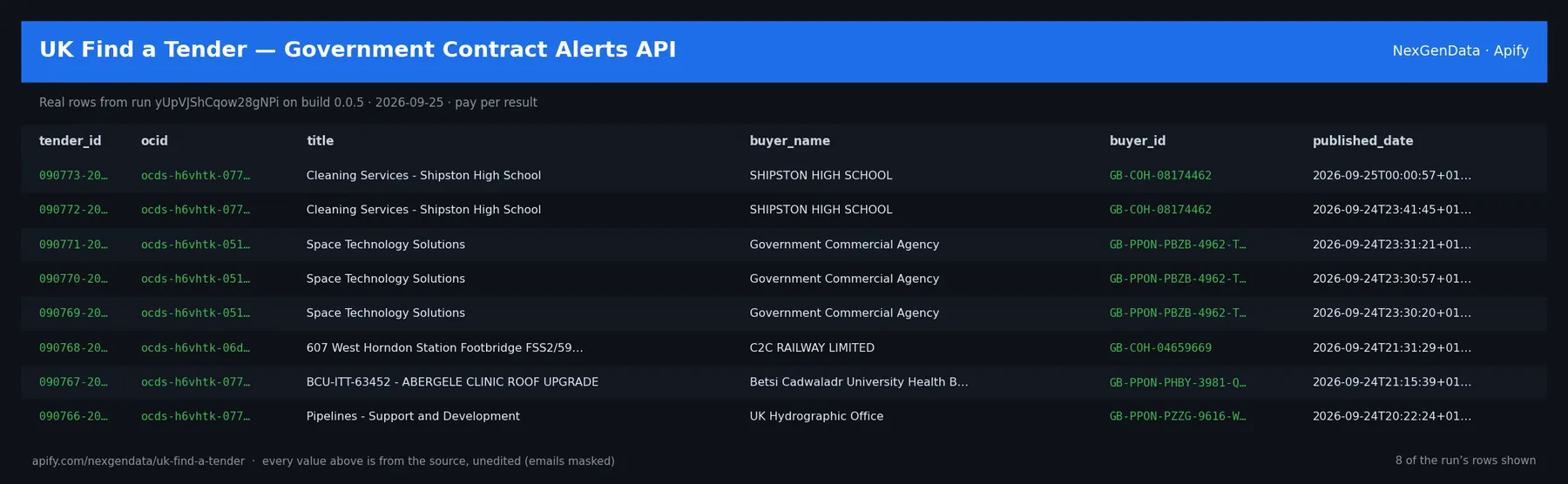
Pull UK government tender opportunities and contract award notices from the official Find a Tender Service (FTS) OCDS API run by the Cabinet Office. Returns every UK regulated procurement notice covered by the Public Contracts Regulations 2015, the Utilities Contracts Regulations 2016, the Concession Contracts Regulations 2016, the Defence and Security Public Contracts Regulations 2011, and the new Procurement Act 2023 transparency regime — every Contract Notice, Contract Award Notice, Prior Information Notice (PIN), Pipeline Notice, Modification Notice, and Termination Notice, in machine-readable OCDS 1.1 format with the UK extension. Per-tender output includes tender_id, ocid, title, buyer_name, buyer_id, value_gbp, tender_status, published_date, deadline_date, award_date, awarded_supplier, cpv_codes[], description, procurement_category, procurement_method, notice_type, above_threshold, and the canonical Find a Tender notice URL.

The UK Cabinet Office publishes the most open, machine-readable government procurement register in the G7. Since 1 January 2021, Find a Tender Service has replaced OJEU / TED for UK regulated notices post-Brexit. Every UK contracting authority — central government, executive agencies, NHS Trusts, local authorities, fire and rescue services, police and crime commissioners, devolved-administration bodies in Scotland / Wales / Northern Ireland, NHS Foundation Trusts, the BBC, the universities sector, defence and security buyers, and utilities buyers in water, energy, transport, and postal services — is statutorily required to publish every above-threshold procurement notice on Find a Tender. The service is published under the Open Government Licence v3.0: no auth, no per-record fee, no NDA, no rate-card, no enterprise contract. That openness is why FTS is the foundational input for every B2G sales pipeline, every public-sector market intelligence platform, every defence-industry capture team, every NHS commercial-intelligence dashboard, and every public-procurement academic research dataset in the country.

This Actor wraps the official FTS OCDS endpoint (/api/1.0/ocdsReleasePackages) with cursor-based pagination (follows the OCDS links.next reference until the requested max is hit), client-side filtering for search query, GBP minimum value, buyer name, CPV prefix, and tender status, and pushes every matching tender as one dataset row ready for downstream Snowflake / BigQuery / Postgres / Salesforce / HubSpot ingestion or for ingestion into Claude / GPT / Cursor agents via Apify's MCP server.


What is Find a Tender, exactly?

Find a Tender Service is the UK's statutory single point of publication for above-threshold public procurement notices. Pre-Brexit, UK notices flowed to OJEU (Official Journal of the European Union) and were published on TED (Tenders Electronic Daily). From 1 January 2021 onwards, the UK exited the EU procurement regime and stood up its own equivalent — FTS — at find-tender.service.gov.uk. The Cabinet Office Government Commercial Function operates the service; the data is published as machine-readable OCDS (Open Contracting Data Standard) 1.1 with the formal UK extension and the EU profile extension.

Every UK contracting authority covered by the four UK procurement regimes has to publish on FTS:

  • Public Contracts Regulations 2015 (PCR 2015) — central government departments, executive agencies, NHS Trusts, NHS Foundation Trusts, local authorities, fire and rescue, police, devolved admin bodies. Thresholds (2024 rates): goods/services central gov £138,760, goods/services sub-central £213,477, works £5,336,937, light-touch services £663,540.
  • Utilities Contracts Regulations 2016 (UCR 2016) — water companies, gas distribution, electricity transmission and distribution, rail and metro operators, port authorities, airports, postal services. Higher thresholds: goods/services £426,955, works £5,336,937.
  • Concession Contracts Regulations 2016 (CCR 2016) — works and services concessions where the supplier takes operating risk. Threshold £5,336,937.
  • Defence and Security Public Contracts Regulations 2011 (DSPCR 2011) — military equipment, sensitive non-military procurement, dual-use goods. MoD, DE&S, Strategic Command, and downstream Tier 1 primes file on DSPCR for above-threshold work.

The Procurement Act 2023 (in force February 2025) reshapes this regime. It introduces six new notice types — Pipeline Notice, Preliminary Market Engagement Notice, Tender Notice, Transparency Notice, Contract Details Notice, Contract Change Notice, Contract Termination Notice, Contract Performance Notice — and pushes contracting authorities to publish more, not less. KPI reporting on contracts over £5m becomes mandatory. This Actor surfaces all the new notice types through the notice_type field as they roll out across the FTS catalogue.


Contract Notice vs Award Notice vs PIN — the three lifecycle stages

For a B2G sales team, the timing of when a notice appears in your inbox is the difference between hitting a competitive bid or watching your incumbent extend its 7-figure contract.

  1. Prior Information Notice (PIN) / Pipeline Notice — status="planning". A pre-procurement signal. The buyer announces the procurement is coming — typical lead time 6-18 months ahead of the Contract Notice. This is where capture teams win: you have time to influence the requirement, register on the buyer's supplier portal, attend the supplier engagement event, position your win themes, and pre-qualify. Procurement Act 2023 makes Pipeline Notices mandatory for contracting authorities with over £100m annual spend.
  2. Contract Notice — status="active". The procurement is open. The buyer publishes the ITT (Invitation to Tender), the SQ (Selection Questionnaire), and the deadline. Typical tender period is 25-35 days for an open procedure under PCR 2015, often longer for complex defence or framework procurements. After this point, capture-team influence is constrained — the requirement is fixed and the evaluation methodology is locked.
  3. Contract Award Notice — status="complete". The decision is published. The winning supplier is named in awarded_supplier, the actual award value in award.value, and the award date in award_date. From this notice, your competitive-intel team can: track which suppliers are winning which buyer / CPV combinations, calculate win-rates against named primes, identify framework lots where you should have been on the panel, and time renewal-window outreach to the buyer 6-12 months before the awarded contract expires.

This Actor surfaces all three lifecycle stages through the tender_status field. Set status="awarded" to pull only completed competitions for competitive-intel back-testing, or status="active" for live bid pipeline, or status="planning" for capture-team pipeline horizon scanning.


CPV codes — the procurement taxonomy

The Common Procurement Vocabulary (CPV) is the EU/UK statutory taxonomy used to classify procurement subject matter. Every FTS notice is tagged with one or more 8-digit CPV codes that describe what is being bought, organised in a strict hierarchy: division (first 2 digits), group (3rd digit), class (4th digit), category (5th-8th). The taxonomy has 9,454 codes covering everything from 03000000 (Agricultural, farming, fishing) to 98000000 (Other community, social and personal services).

The big divisions that matter for B2G sales:

CPV prefixDivisionTypical buyers
30Office and computing machineryEvery central gov department, every council
48Software packagesCabinet Office, GDS, HMRC, NHS Digital, DWP
72IT services (consulting, software dev, internet services)Every department, every NHS Trust
73R&D servicesDefence (Dstl, DSTL, DASA), UKRI, BEIS
79Business services (management consulting, legal, audit)Big Four shadow market, Cabinet Office GCO
85Health and social work servicesEvery NHS Trust, every council adults / childrens social care
45ConstructionDfT, Network Rail, HS2, DfE schools rebuilding
50Repair and maintenanceFM market, MoD prime contracts
35Security, fire-fighting, police, defence equipmentMoD, DE&S, Home Office
71Architectural, engineering, surveyingDfT, MoJ prisons estate, Homes England

Use the cpvCode input as a prefix filter — passing cpvCode=72 returns every notice with at least one CPV in the 72000000-72999999 range (all IT services), cpvCode=7222 narrows to software development sub-category, cpvCode=72222100 returns one specific code.


OJEU thresholds — the above-threshold filter

Not every UK government procurement appears on FTS. Below-threshold procurements (under-OJEU spend) are covered by Contracts Finder, the parallel low-value notice service. Above the threshold, FTS publication is mandatory; below, it is encouraged but optional. The Procurement Act 2023 keeps this two-tier split but raises Contracts Finder publication obligations for spend over £30,000 across central government.

For a B2G sales team targeting above-threshold strategic work — frameworks, multi-million-pound transformations, prime contractor positions, sole-source DPS calls — use the valueGbpMin filter set to 138760 to capture above the goods/services PCR 2015 central gov threshold and screen out the small-value mini-tender noise. Set to 5336937 for works-threshold-and-above only. The above_threshold boolean output mirrors the OCDS aboveThreshold field which FTS publishes per-tender as the authoritative test.


Who buys this Actor

  • B2G sales teams at IT primes, management consultancies, FM providers, construction primes, engineering consultancies, and SaaS vendors — daily / weekly tender alerts feeding into Salesforce or HubSpot opportunity pipelines. The searchQuery + buyer + cpvCode combination replaces the £6,000-£20,000/year Tussell / BiP / Spend Network alerting subscriptions for teams that already have the downstream CRM. Run nightly with status="active" and a 1-day dateFrom window; pipe to Slack / email / your CRM webhook.
  • Defence and security contractors (BAE, Babcock, QinetiQ, Leonardo, Thales UK, Rolls-Royce Defence, plus the SME ecosystem) — track DSPCR notices, MoD DE&S framework calls, Strategic Command awards, Defence Equipment & Support Tier 1 / Tier 2 subcontracting opportunities. Filter buyer="Ministry of Defence" or buyer="Defence Equipment" and watch CPV 35 for security/defence equipment, CPV 73 for defence R&D, CPV 50 for in-service support and maintenance.
  • Healthcare contractors (Cerner / Oracle Health, Epic, EMIS, TPP, System C, plus medical-device manufacturers and clinical-services providers) — track NHS Trust IT spend, ICS commissioning, NHS England framework calls, GP federation tenders, NHS Shared Business Services frameworks. Filter buyer="NHS" plus CPV 48, 72, 33 (medical equipment), or 85.
  • Public-sector consultancies (Deloitte, EY, KPMG, PwC, plus the boutiques — Newton Europe, Methods, Capita Consulting, BJSS, Made Tech, Difrent) — track CPV 79 management consulting plus CPV 72 digital services framework calls. Crown Commercial Service's DOS (Digital Outcomes & Specialists) and MCF (Management Consultancy Framework) calls land here.
  • Procurement analysts, public-spend transparency researchers, and policy think tanks (Spend Network, Tussell, IfG, Reform, Onward, Institute for Public Procurement Research) — bulk pulls for cross-government spend analysis, supplier concentration studies, and accountability journalism.
  • Investigative journalists — The Bureau of Investigative Journalism, Tussell's published research, openDemocracy, Good Law Project, Private Eye, Tortoise Media, and the broadsheet investigations desks (FT, Guardian, Times, Telegraph). Filter on specific buyers post-scandal to surface every related award.

Output schema

Each dataset row is a single OCDS release (one notice in the procurement lifecycle):

  • tender_id — the FTS notice ID, format NNNNNN-YYYY (e.g. 046692-2026). The same OCID can have multiple notice IDs over its lifetime as the procurement progresses through PIN → Contract Notice → Award Notice → Contract Performance Notice.
  • ocid — Open Contracting ID. Stable across the whole procurement lifecycle for one tender. Use this for de-duplication when you back-fill historical data.
  • title — the tender title as the buyer wrote it.
  • buyer_name + buyer_id — the contracting authority. buyer_id is GB-COH-NNNNNNNN for Companies House registered bodies (NHS Foundation Trusts, executive agencies set up as cos), GB-PPON-NNNN-NNNN for the new Procurement Act PPON (Procurement Provider Organisation Number) identifiers, or GB-GOR-... for central gov departments registered against the Government Reference Number scheme.
  • value_gbp + value_currency — the tender's net (ex-VAT) value in GBP. Some notices only publish gross (VAT-inclusive) values; we fall back to that field with the currency preserved separately. ~99% of FTS notices are GBP; non-GBP edge cases (notices published from Scottish / NI bodies who happened to declare a non-GBP value) return null on value_gbp and the actual currency on value_currency.
  • tender_status — OCDS canonical status: planning / active / complete / cancelled / unsuccessful / withdrawn. The status input filter maps awardedcomplete and closedcancelled|unsuccessful|withdrawn.
  • published_date — the release publication datetime (ISO 8601 with +01:00 BST or +00:00 GMT timezone).
  • deadline_datetender.tenderPeriod.endDate. The submission deadline for active Contract Notices. null for PINs and Award Notices.
  • award_dateaward.date. The date the buyer formally awarded the contract. null for non-award releases.
  • awarded_supplier — the named winner. For framework / DPS multi-supplier awards (CCS DOS, CCS MCF, NHS Shared Business Services frameworks) we concatenate up to the first 5 supplier names with ; separators and append ; +N more for the remainder.
  • cpv_codes — array of CPV codes (8-digit). One notice can carry multiple codes when the procurement covers multiple subject categories.
  • procurement_categorygoods / services / works / socialAndOtherSpecificServices. The OCDS mainProcurementCategory.
  • procurement_methodopen / selective / limited / direct. Translates to the PCR 2015 / UCR 2016 procedure (open / restricted / competitive dialogue / competitive procedure with negotiation / innovation partnership / direct award).
  • notice_type — the FTS notice type code: UK1 (Pipeline), UK2 (Preliminary Market Engagement), UK3 (Tender), UK4 (Tender — below threshold), UK5 (Transparency), UK6 (Contract Details), UK7 (Contract Change), UK8 (Contract Termination), UK9 (Contract Performance). Plus legacy F02 (Contract Notice), F03 (Contract Award Notice) for pre-Procurement Act 2023 publications.
  • above_threshold — boolean. The OCDS authoritative test against PCR 2015 / UCR 2016 / CCR 2016 / DSPCR 2011 thresholds.
  • description — the buyer's free-text description, truncated to 1500 chars with a trailing ellipsis.
  • full_notice_url — canonical Find a Tender notice URL. Open in a browser to read the full ITT / SQ / supporting documents and to access the buyer's e-procurement portal link.

Sister actors (NexGenData fleet)

This Actor is the B2G sales / procurement-intel sibling in the NexGenData UK + APAC public-data fleet. Pair it with these actors for cross-dataset enrichment:

  • UK Companies House Officers — pull directors / company secretaries / LLP members. Cross-reference buyer_id (where it's GB-COH-...) to identify the named directors of NHS Foundation Trusts, executive agencies, and arms-length bodies, and to track director-overlap patterns between supplier and buyer (a flag pattern for Cabinet Office GIAA / NAO accountability work).
  • UK FCA Enforcement Register — pull FCA fines, prohibitions, and enforcement actions. Cross-reference awarded_supplier against the FCA enforcement list before signing a financial-services framework call. Public-sector buyers under PCR 2015 Regulation 57 are required to consider mandatory and discretionary exclusion grounds, and FCA enforcement findings are a Regulation 57 discretionary exclusion under "professional misconduct".
  • UK LSE IPO Calendar — pull London Stock Exchange Main Market and AIM IPO admission notices. Use to identify newly-public UK companies that have grown to government-contracting scale and can now compete for above-threshold framework lots.
  • France Pappers Companies — bulk French SIREN / SIRET company-registry lookups via Pappers. Pair with awarded_supplier to enrich French-domiciled UK government contract winners (Atos, Capgemini, Sopra Steria, Bouygues, Veolia, Suez, Engie subsidiaries) with French parent / beneficial-owner structure, NAF activity codes, registered share capital, and dirigeants — useful for cross-Channel supplier due-diligence and parent-subsidiary mapping on UK defence / FM / consulting frameworks.
  • UK PSC Tracker — pull Companies House Persons with Significant Control. Combine with awarded_supplier to identify the beneficial owners of UK government contract winners — useful for accountability journalism and for cross-supplier ownership-overlap analysis (e.g. private-equity-backed FM / outsourcing groups operating under multiple trading names).
  • UK Companies House Search — bulk Companies House profile lookups. Pair with awarded_supplier for company-status enrichment, registered-office geocoding, and SIC-code categorisation.

Pricing

Pay-Per-Event (PPE). Pricing is set on the Apify platform and is visible at the top of the Actor's listing page.

  • Actor start — flat fee per run. Covers FTS connection setup, pagination state, and dataset I/O.
  • Tender record — per-row charge for every UK tender notice pushed to the dataset. Filtering happens client-side after the API page is fetched: notices that don't match the searchQuery / value floor / buyer / CPV / status filters are dropped before the per-row charge, so you only pay for tenders that actually match your filter set.

The pricing tier matches the rest of the UK institutional KYC / B2G fleet (UK PSC, UK Companies House, UK FCA Enforcement). Comparable B2G procurement intel platforms charge £4,000-£20,000/year per seat (Tussell, BiP Solutions Tenders Direct, Stotles, Spend Network, Mindshare, OJEU Online). This Actor's per-tender pricing intentionally undercuts the per-seat platform cost for any team running daily / weekly bid-pipeline alerts at typical UK-government volume.


Run it via Apify

Try the Apify platform free — sign up via this link and the run cost shows in your Apify console: https://apify.com/?fpr=2ayu9b