
US Grant Awards Tracker — SBIR, NIH & NSF Funding API
Pricing
from $50.00 / 1,000 grant award records
US Grant Awards Tracker — SBIR, NIH & NSF Funding API
Every US organization that just won non-dilutive government money — SBIR/STTR, NIH and NSF awards — normalized into one feed.
Pricing
from $50.00 / 1,000 grant award records
Rating
0.0
(0)
Developer
NexGenData
Maintained by CommunityActor stats
0
Bookmarked
61
Total users
1
Monthly active users
4 days ago
Last modified
Categories
Share
Watch mode: save a grant query once and get only the newly awarded grants on every later run — $0.05 per check, and you pay for records only when there are new ones.
Every US organization that just won non-dilutive government money, in one feed. This actor aggregates and normalizes new award records from three official federal sources — SBIR/STTR, NIH (RePORTER), and NSF — into a single, deduplicated, monitor-ready dataset. Per-source scrapers exist; the unified "who just got government money" feed is the product.
Non-dilutive funding is a hard buy/diligence signal: an SBIR Phase II or a multi-year NIH R01 means a company is real, technical, and just got runway without giving up equity. This tracker puts that signal on one shelf.
📊 Sample Output
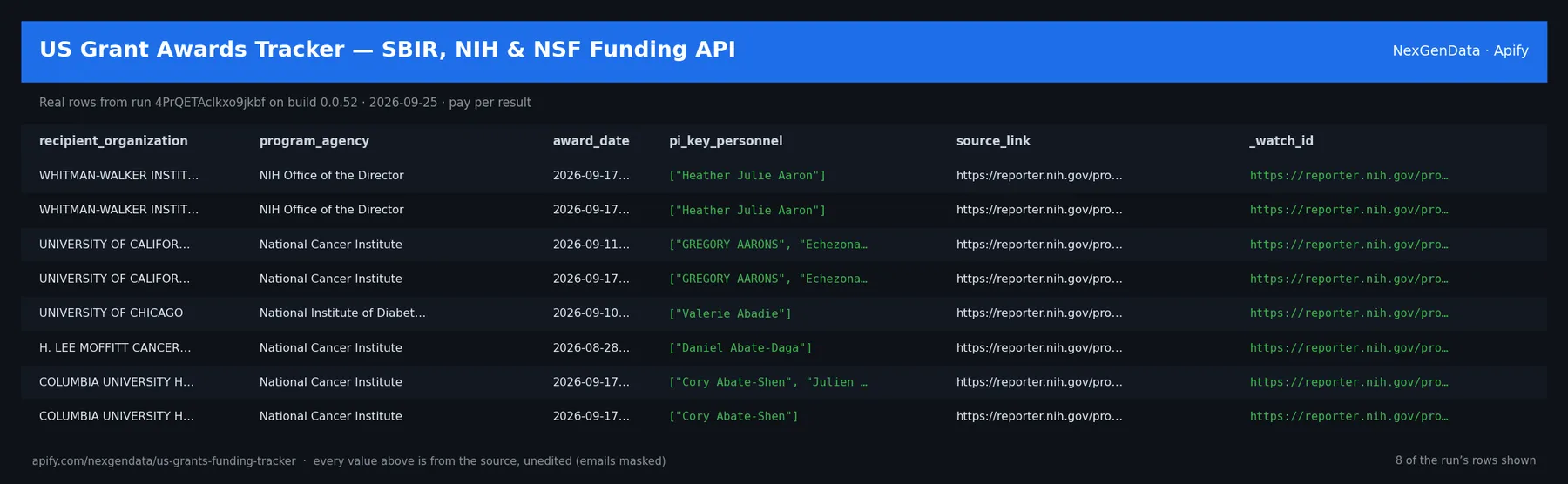
recipient_organization | program_agency | amount_usd | award_date | pi_key_personnel | source_link |
|---|---|---|---|---|---|
| WHITMAN-WALKER INSTITUTE, INC. | NIH Office of the Director | 499000 | 2026-09-17T00:00:00 | ['Heather Julie Aaron'] | https://reporter.nih.gov/project-details/11581448 |
| WHITMAN-WALKER INSTITUTE, INC. | NIH Office of the Director | 425054 | 2026-09-17T00:00:00 | ['Heather Julie Aaron'] | https://reporter.nih.gov/project-details/11581447 |
| UNIVERSITY OF CALIFORNIA, SAN DIEGO | National Cancer Institute | 331916 | 2026-09-11T00:00:00 | ['GREGORY AARONS', 'Echezona Edozie Ezeanolue'] | https://reporter.nih.gov/project-details/11406224 |
| UNIVERSITY OF CALIFORNIA, SAN DIEGO | National Cancer Institute | 458179 | 2026-09-17T00:00:00 | ['GREGORY AARONS', 'Echezona Edozie Ezeanolue'] | https://reporter.nih.gov/project-details/11535273 |
| UNIVERSITY OF CHICAGO | National Institute of Diabetes and Digestive and Kidney Diseases | 819998 | 2026-09-10T00:00:00 | ['Valerie Abadie'] | https://reporter.nih.gov/project-details/11465673 |
| H. LEE MOFFITT CANCER CTR & RES INST | National Cancer Institute | 589581 | 2026-08-28T00:00:00 | ['Daniel Abate-Daga'] | https://reporter.nih.gov/project-details/11319233 |
Real rows from run 4PrQETAclkxo9jkbf on build 0.0.52 (2026-09-25), unedited apart from masked emails/phones and shortened long text; fields the source does not publish are empty.
🧾 JSON sample record
One real record from run 4PrQETAclkxo9jkbf (emails/phones masked, long text shortened):
💰 Pricing
| Event | Price (USD) | When it is charged |
|---|---|---|
Actor Start (apify-actor-start) | $5e-05 | Charged when the Actor starts running. Number of events charged depends on Actor memory (one event per GB, minimum one event). |
Grant award record (apify-default-dataset-item) | $0.05 | Charged per federal grant/award record returned (NIH, NSF, SBIR) with funding agency, program, recipient organization, award title, amount,… |
Add-on: Email verification (addon-email-verify) | $0.05 | Not offered in the current build; this event is never charged. |
Add-on: Social profile enrichment (addon-social-enrichment) | $0.05 | Not offered in the current build; this event is never charged. |
Watch check (watch-check) | $0.05 | Charged once per watch-mode run that completes a change check against the tracked award set. Fires whether or not new awards are found; new… |
Pay-per-event: you pay only for what the run delivers. A run that delivers nothing bills no result events (only the actor-start event, when the actor defines one). Example: a run that delivers 100 results costs 100 × $0.05 = $5.00 plus the start fee.
🔗 Related Actors
More from the NexGenData US government, courts & regulators family:
- US Copyright Records Search — Registration Data API
- US Government Contracts — Open Data Procurement API
- US Government Records API — Official Source, No API Key
- US Legislation & Bill Tracker — Congress Data API
48 more in this family on the NexGenData Store page.
Who uses this
- Sales / BD teams — fresh, funded accounts to prospect the week they're announced.
- Grant consultants — track who's winning what, by agency and program.
- VCs & scouts — SBIR Phase II is a well-known diligence marker; NIH/NSF awards flag deep-tech traction pre-round.
- University tech-transfer — monitor peer institutions and PI activity.
What you get — one normalized record per award
| Field | Example |
|---|---|
source | NSF |
recipient_organization | BIOSTOREX LLC |
program_agency | NSF — STTR Phase I |
award_title | STTR Phase I: Novel Enzymatic DNA-Synthesis Technology for Scalable and Sustainable Data Storage |
amount_usd | 303998 |
phase_type | STTR Phase I |
award_date | 2025-06-15 |
state | CA |
pi_key_personnel | ["Jane Doe"] |
source_link | https://www.nsf.gov/awardsearch/showAward?AWD_ID=... |
Fields are identical across all three sources, so you can sort, filter and merge SBIR, NIH and NSF awards in one pass. (NSF's own feed also surfaces its SBIR/STTR small-business awards, so the non-dilutive small-business signal flows even when SBIR.gov's standalone API is throttled.)
Pricing
Pay-per-event: $0.05 per grant award record — about $1 ≈ 20 award records. You pay only for records returned. A run that matches nothing (tight filters, or a source temporarily rate-limited) costs effectively nothing.
Inputs
sources— any ofsbir,nih,nsf(default: all three)daysBack/dateFrom/dateTo— award-date windowminAmount— floor on award size (USD)state— 2-letter recipient statekeyword— match award title / research termsagency— SBIR agency filter (DOD, HHS, NASA, DOE, NSF)maxPerSource— cap per source
Two ready-to-run examples
1. This month's big awards nationwide
2. California AI/diagnostics awards
Use with AI agents
The unified schema is agent-friendly. Point an LLM agent at the dataset and ask:
- "List NSF STTR Phase I winners in the last 30 days over $200k, with recipient and PI."
- "Which NIH-funded orgs in MA just got their first award? Draft a one-line outreach note for each."
- "Cluster this week's awards by agency and flag any recipient that also appears in my CRM."
Callable over the Apify API/MCP, so it drops into agent tool-chains directly.
Part of the NexGenData funding-intelligence cluster — three money-in signals, one shelf
- Startup Funding Tracker — equity rounds (SEC Form D, TechCrunch, YC).
- SEC New VC Fund Tracker — new venture fund formations (Form D pooled-investment filings).
- US Grant Awards Tracker (this actor) — non-dilutive government money (SBIR/STTR, NIH, NSF).
Chasing government money specifically? Pair with Government Contracts Search and Federal Contract Spending to see grants and contracts for the same organization.
Honest limits
- Publication lag. Agencies post awards on their own timelines; a grant awarded today may appear in the API days to weeks later. This tracks published awards, not real-time decisions.
- Fiscal-year quirks. NIH and NSF operate on the federal fiscal year (Oct–Sep); date filters use published notice/award dates, which can straddle fiscal years.
- SBIR.gov API availability. SBIR.gov's public API is periodically rate-limited or offline; when it is, this actor logs a skip and continues on NIH + NSF (and NSF still carries its own SBIR/STTR awards) rather than failing the run.
- Amounts.
amount_usdreflects each source's reported obligated/award amount; multi-year or supplemental awards may report a single obligation, not lifetime total.
No login, no API key, no proxy required — all three sources are free official government APIs.
Watch mode — get only what's new
Set watchMode: true to turn a one-off search into a saved monitor. Instead of returning every grant award that matches your grant query, a watch run returns only the grant awards that are new since your last run.
- First run seeds a baseline: it records what currently matches and returns 0 records — nothing to alert on yet.
- Every later run returns only the newly-appearing grant awards (each tagged
change_type: "new_filing"), plus any whose status changed. - Point a Schedule at it (daily/hourly) and you have a standing "New grant award match" feed.
What a watch run charges: one Watch check — a flat $0.05 per run, whether or not anything new is found. You are not charged the per-grant award price on a run that finds nothing. When new grant awards do appear, each is billed at the normal per-record rate on top of the $0.05 check.
Inputs
| field | meaning |
|---|---|
watchMode | true to enable watch mode (default false = a normal one-off search) |
watchLabel | optional name; two watches with the same query but different labels keep separate memory |
Worked example — watch NIH awards in oncology:
Run 1 returns 0 records and reports "baseline established: monitoring N grant award(s)". Schedule it daily; from run 2 on, you receive only the new grant awards — a $0.05 check on quiet days, $0.05 + records on the days something lands.


