

EU Industrial Production Volume Records — EEA IED
Pricing
from $33.50 / 1,000 production volume records
EU Industrial Production Volume Records — EEA IED
Keyless pay-per-record EEA IED facility production volumes — volume and unit in source units, product label, facility-report id, country enriched. The intensity denominator for emissions. No person data. Gold $0.0335/record.
Pricing
from $33.50 / 1,000 production volume records
Rating
0.0
(0)
Developer
NexGen Signal
Maintained by CommunityActor stats
0
Bookmarked
2
Total users
1
Monthly active users
5 days ago
Last modified
Categories
Share
Keyless. Pay per record. Reported production volumes of Europe's industrial facilities — value, unit, and product, verbatim.
This actor turns the European Environment Agency (EEA) Industrial Emissions Directive (IED) registry into clean, per-record data — the production volumes reported by Europe's IED industrial facilities. Each run reads the EEA's keyless DiscoData SQL service and delivers one row per production-volume record, structured for industrial-output and intensity analysis, reusable with acknowledgement of the EEA, with no personal data of any kind.
What this is, in one paragraph
Under the Industrial Emissions Directive, facilities report their production volume alongside their emissions. This actor reads that production-volume table and delivers one record per facility-report production line: the production VOLUME and its UNIT in the source units verbatim, the free-text product/comment note (a product label such as a material name), and the facility-report and control-file identifiers — with the reporting country and year enriched from the facility report. It is the production-output layer of Europe's industrial register, the denominator behind emission-intensity analysis.
Who buys this and for what job
- Industrial-analytics and decarbonisation teams pairing production volumes with emissions for intensity metrics
- Materials and market analysts sizing facility-level output by product and country
- ESG products attributing production output to facilities across Europe
- Data engineers who want the IED production volumes table as clean rows from a keyless source.
EEA licence — reuse with acknowledgement
One licence rider travels on every record. EEA data may be reused, including commercially, provided the source is acknowledged: "Source: European Environment Agency (EEA)." Where third-party content is marked, it keeps its own terms. These are reported values as filed — not a compliance verdict.
Facility grain — no person data
The unit of every record is a reported production volume for a facility report — an output figure, never a person. There is no operator, contact, or responsible-person field in the source, and none is selected or emitted; a person-key guard runs on every record as a backstop. The product/comment note is a product label (e.g. a material name), not person data.
Sample output
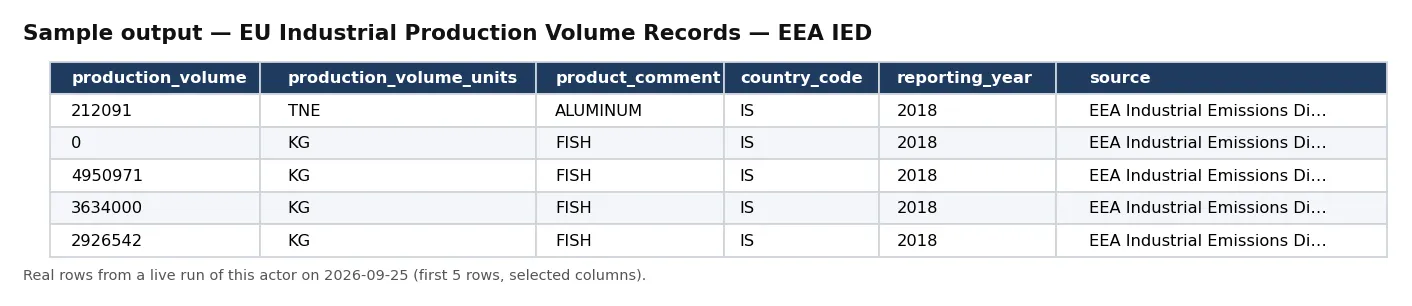
Real rows from a live run of this actor (first 5 rows, selected columns).
One full record from the same run, exactly as delivered:
Pricing
| Event | Free plan | Bronze | Silver | Gold / Platinum / Diamond |
|---|---|---|---|---|
production_volume_record | $0.05 | $0.045 | $0.04 | $0.0335 |
Delivered before charged. Blocked runs and empty results cost nothing.
Input
| Field | Type | Default | Description |
|---|---|---|---|
countryCode | string | — | Optional 2-letter country code of the facility (e.g. DE, FR). |
year | integer | — | Optional reporting year to filter. |
maxRecords | integer | 500 | Ceiling on records delivered and billed. |
Output
One JSON object per production-volume record. Real example (values as reported):
An unbilled RUN_RECEIPT records the robots check, the filters, rows seen and delivered, and whether charged equals delivered.
Field reference
Each record is one production volume. Value: production_volume and production_volume_units (source units, verbatim). Product: product_comment (a product label). Scope: country_code and reporting_year (enriched from the facility report). Keys: record_id, facility_report_id, and control_file_id. Provenance travels on every record: source, source_url, licence, attribution, disclaimer, and observed_at.
How a run works
A run first re-reads the source host's robots posture from your runtime — the EEA DiscoData host — and stops at the door if that ever changes. It pages the IED production volumes table (filtered to your optional countryCode and optional year), and flattens each row to one record — carrying every value verbatim, never anything person-shaped — delivered before it is charged, so a blocked or empty run costs you nothing. The actor stops at your maxRecords ceiling and records charge_equals_delivered in the receipt.
Coverage and scope
The table holds on the order of 41,406 rows. Because each record carries the production_volume, production_volume_units, and enriched country_code, segmenting is straightforward. Pull one slice, or the whole table to seed a warehouse.
Working with the data
The production volumes are a denominator, and the fields make them useful. Because every record pairs a production_volume with a production_volume_units and a product_comment, an analyst can size facility output by product and, joining on the facility_report_id, pair it with the facility's reported emissions to compute an emission intensity. The enriched country_code and reporting_year frame each volume in place and time.
Identifiers and joins
Every record carries the facility_report_id, the key back to the fleet's other IED cells — the facility report, its emissions, and its combustion parts — so a production volume becomes the denominator for an intensity metric on a stable identifier rather than a fuzzy name match.
The intensity denominator
Production volume is what turns an emissions figure into an emissions intensity. A facility emitting 1,000 tonnes of CO-equivalent tells you little until you know it produced 10,000 tonnes of product versus 100,000. Because this cell carries the production_volume and production_volume_units keyed to the same facility_report_id the fleet's emissions cells use, an analyst can compute per-facility intensity metrics directly, and the free-text product_comment (a material label such as ALUMINUM) lets outputs be grouped by product line for peer benchmarking within a sector.
Cost guidance
One production_volume_record per delivered row: cost = rows delivered × your plan's per-record price. Scope with countryCode and year to keep runs bounded. 1,000 rows is $50 (Free) / $33.50 (Gold).
Product labels and peer groups
The free-text product_comment is the only description of what a facility actually makes, and while it is unstructured, it is highly usable: material names, product families, and process notes recur across facilities, so a light normalisation groups facilities into peer sets for benchmarking. Because it is carried verbatim, no product context is lost, and a buyer can build their own crosswalk from these labels to a product taxonomy without this actor imposing one.
Honest limitations
- As reported. Values, flags, and thresholds are as filed; this actor reformats, it does not audit or recompute.
- A label, not a verdict. These are reported statistics/regimes/volumes/loads, not an independent compliance assessment.
- Acknowledge the EEA. The acknowledgement travels on every record.
- No person data of any kind.
Differentiation
It is distinct from eurostat-construction-production (a macro construction-sector output index) — this cell carries FACILITY-LEVEL industrial production VOLUMES from the IED registry, a micro, per-facility output figure paired with emissions, not a sector index. Its specific job is the IED facility production volumes.
The NexGen Signal family
Part of the NexGen Signal family of pay-per-record data products:
- EU Industrial Facility Report Records — EEA IED
- EU Industrial Emissions Records — EEA IED Facilities
- EU Industrial Permit Records — EEA IED
- EU Combustion Plant Fuel Input Records — EEA IED
- EU Industrial Waste Transfer Records — EEA IED
Source: European Environment Agency (EEA), Industrial Emissions Directive (IED) registry (discodata.eea.europa.eu). EEA data may be reused, including commercially, provided the source is acknowledged: "Source: European Environment Agency (EEA)"; marked third-party content keeps its own terms. Facility-report / product / volume grain; the ProductionVolume table carries no confidentiality flag, values carried as filed; no operator/contact/responsible-person field selected or emitted; country and year enriched from the facility report. No natural-person data of any kind. Values as filed, not a compliance verdict.


