

EU Job Vacancy Benchmark — Quarterly by Industry
Pricing
from $33.50 / 1,000 job vacancy records
EU Job Vacancy Benchmark — Quarterly by Industry
Eurostat quarterly job vacancy statistics (jvs_q_nace2): choose the vacancy rate, number of vacancies or occupied posts by industry, size class and country, newest quarter first. Official statistics, not job ads. CC BY 4.0, pay per record.
Pricing
from $33.50 / 1,000 job vacancy records
Rating
0.0
(0)
Developer

NexGen Signal
Maintained by CommunityActor stats
0
Bookmarked
2
Total users
1
Monthly active users
22 days ago
Last modified
Categories
Share
Turn Eurostat's quarterly job-vacancy cube into clean, per-record labour-demand benchmarks — one row per published observation, broken down by industry (NACE Rev.2), business size class, seasonal-adjustment status and country, ready to benchmark hiring demand across Europe.
Each row of the source multidimensional cube becomes one clean, flat record: every dimension is expanded into an explicit code and its human-readable label, the observation value is reproduced exactly as Eurostat published it, and each record is stamped with source, dataset code, licence, attribution, a UTC retrieval timestamp and an interpretation caveat. You get analysis-ready rows instead of a nested JSON-stat blob you have to unpack yourself.
What one record represents
The source dataset is Eurostat jvs_q_nace2 — quarterly job vacancy statistics by NACE Rev.2 economic activity. Eurostat publishes it as a
JSON-stat hypercube: a dense grid indexed by several dimensions (frequency, seasonal-adjustment, NACE Rev.2 activity, business size class, employment indicator, geography and time) with a sparse
map of observed values. This Actor unpacks that cube so that every present observation cell becomes
exactly one record. Cells that Eurostat does not publish (genuinely missing observations) are absent
from the source value map and are therefore neither invented nor delivered — you receive only real,
published numbers. Published zeros are kept as real values, never dropped.
For each record you get the composite record_id (a stable, source-native key built from every
dimension code), the dataset_code, the indicator name, then — for each dimension — the dimension
code and its label, plus time_period, the numeric value, and Eurostat's obs_status flag
when one is present. The dimension columns include nace_r2 (industry) with its label, sizeclas (enterprise size class), indic_em (the employment indicator — job vacancy rate, number of vacancies, number of occupied posts), s_adj (seasonal-adjustment status) and freq.
Coverage and volume
The live cube holds 463,569 licence-permitted, non-null observations from 2015 onward across 35 permitted territories, dozens of NACE Rev.2 activities and several employment indicators — that is the record capacity of a full pull from 2015. Narrow it with a later start period or a single country to sample cheaply.
Because the underlying cube is large, this Actor is built to pull it completely and safely. When the
full multi-territory request would exceed the dissemination API's single-response size limit, the
Actor automatically partitions the pull by territory and streams the partitions back, stopping as
soon as your Maximum records cap is met so you never wait for data you did not ask for. You can also pass a single country code (e.g. DE) to pull just that territory — useful for a focused benchmark or a fast sample.
Licence and attribution
This dataset is redistributed under the terms Eurostat publishes it with. The full notice travels on
every record in the licence field:
Eurostat, CC BY 4.0. Reformatted from Eurostat JSON-stat; values unmodified. Third-party content and logos excluded. Commercial-barred geographies removed.
In addition, a structural geography allow-list is applied at ingest: only EU member states,
EU/euro-area aggregates, EFTA members and official EU acceding/candidate countries are delivered.
Territories that Eurostat marks as commercial-reuse-barred (for example non-European reporting
countries that sometimes appear in a cube) are excluded at ingest and counted in the run receipt,
so the delivered set is licence-clean by construction rather than by trust. The required attribution
string — Source: Eurostat (dataset jvs_q_nace2) — is also present on every record.
Interpretation caveat
Job vacancy rates and counts are labour-demand indicators, not headcounts, salaries or individual job postings. A vacancy rate is the share of posts that are vacant, not a raw count — read the indic_em and unit dimensions to know which measure a row carries.
Eurostat values are reproduced verbatim: this Actor never rescales, re-bases, interpolates, seasonally
adjusts or otherwise transforms a number. Where a value is a rate, an index or a count is determined
by the dimension codes on the same record (read the unit / indicator dimensions), so always interpret
a value together with its dimension labels rather than in isolation.
Person-data policy
City, airport and market identifiers describe places and markets, not people. The redundant city geocode/postal-address columns present in the raw source are intentionally excluded so no address-shaped field ever reaches the record. This is a statistics product about economies, industries, territories and markets. If you need to enrich it with entity-level or contact data, do that in your own downstream systems under your own lawful basis — it is deliberately out of scope here.
Provenance, licensing and compliance
Every run begins with a live source-preflight: the Actor reads the exact host's robots.txt at
runtime and refuses to proceed if the crawl policy disallows the data path. The gate result — the URL
read, the HTTP status, the byte length and a SHA-256 of the policy document — is written to the run's
RUN_RECEIPT key-value record, so each run carries its own audit trail. The Actor identifies itself
with a transparent, non-impersonating User-Agent and never attempts to bypass a block, solve a
challenge, or fetch through a cache or mirror. When the door is genuinely unavailable the run fails
loudly and bills nothing rather than delivering a partial or stale set silently.
Records carry no natural-person or contact fields. The output schema is a fixed structural allow-list of statistical, geographic and organisational columns; there are no name, email, phone, address, or identifier-of-a-person fields anywhere in the record, and a per-record assertion enforces that allow-list at write time. This is a records product about places, industries, markets and organisations — never about people.
Choosing the series (search options)
Pick the series you want before the run, instead of paging through every combination. Codes are Eurostat's own; they are sent to Eurostat as filters (only matching series are read and billed) and checked against the dataset's live code list first, so a wrong code stops the run with the valid codes listed and nothing charged. With no option set the actor sends exactly the request it sent before.
| Input | Eurostat dimension | Codes |
|---|---|---|
| measure | indic_em | Optional but recommended. JOBVAC Job vacancies; JOBOCC Occupied (posts) jobs; JVR Job vacancy rate; JVRCH_Q Job vacancy quarterly rate of change. Without it every row type is mixed together (vacancies, occupied posts, rates). |
| industry | nace_r2 | Optional. NACE Rev.2 codes, e.g. A-S all activities, B-S industry, construction and services, C manufacturing, F construction, J information and communication, Q health. Full list in the README. |
| sizeClass | sizeclas | Optional. TOTAL Total; GE10 10 employees or more. |
| adjustment | s_adj | Optional. NSA Unadjusted data (i.e. neither seasonally adjusted nor calendar adjusted data); SA Seasonally adjusted data, not calendar adjusted data. |
| newestFirst | time | Most recent periods first, before cutting to maxRecords (monthly, quarterly and annual periods are ordered by the date they end). |
Example (the Store example):
First rows it returned when checked (Sep 2026):
These are official statistical series (vacancies, occupied posts, vacancy rate), not job advertisements. Without measure the rows mix all four measures; pick JVR for the vacancy rate (%) or JOBVAC for the number of vacancies. Some countries publish only the GE10 (10+ employees) size class.
Inputs
Default changed on 30 Sep 2026: if you leave maxRecords out, a run now returns up to 10 records (it was 500). Set maxRecords yourself to get more — the maximum is unchanged.
- Earliest period (
sinceTimePeriod) — return observations from this period onward. Accepts a year (2015), a quarter (2015-Q1) or a month (2015-01) depending on the dataset's frequency. An earlier start yields more records. Leave Country / territory blank to pull all licence-permitted territories, or set a single Eurostat geo code (e.g.DE) to focus on one. - Maximum records (
maxRecords) — hard cap on records delivered and billed. Raise it to pull the full set; lower it to sample cheaply.
Output
Records land in the Actor's default dataset and can be exported as JSON, CSV, Excel or fetched through the Apify API. A tabular overview view surfaces the most useful columns — geography, period, the key dimension labels and the value — for quick inspection, while the full record retains every code, label and provenance field for downstream joins.
Sibling Actors
This Actor is one cell of a broader per-record data fleet. It shares its engineering — the runtime robots gate, the push-then-charge billing, the verbatim-value discipline and the person-data allow-list — with the other Eurostat cells in the fleet (house prices, waste, migration, road freight, business confidence and more) and with the fleet's other public-data records Actors. Each Actor targets one dataset and one grain, so you pay only for the slice you need.
Sample output
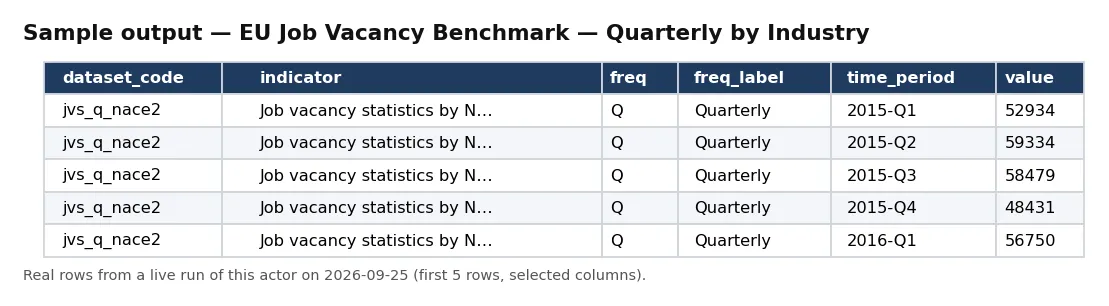
Real rows from a live run of this actor (first 5 rows, selected columns).
One full record from the same run, exactly as delivered:
Pricing
This Actor uses Apify's pay-per-event model. You are charged a flat $0.05 per record actually delivered to the dataset — nothing else. There is no monthly rental, no per-run base fee, and no charge for compute time. If a run delivers 40 records you pay $2.00; if it delivers 10,000 you pay $500.00. The billing is wired after delivery: each record is pushed to the dataset first and only then does the matching per-record event fire, so a mid-run failure can only ever under-charge you, never over-charge. Set Maximum records to cap spend precisely — you will never be billed for more than you asked for, and you will never be billed for records that were not delivered.
Typical uses
Benchmark hiring demand by industry and country; track how vacancy rates move through a cycle; compare labour-market tightness across member states; feed a macro or workforce-planning model with clean, licence-clean quarterly inputs; or build a recruitment-market dashboard without hand-unpacking JSON-stat.
What this Actor does not do
It does not forecast, model, seasonally adjust, or editorialise the numbers; it does not merge multiple Eurostat datasets into one record; and it does not deliver commercial-barred geographies. It gives you faithful, licence-clean, analysis-ready observation records — one row per published cell — with a provenance trail you can audit on every run.


