

GBIF Plant Occurrence Records - CC0 Georeferenced
Pricing
from $33.50 / 1,000 plant occurrence records
GBIF Plant Occurrence Records - CC0 Georeferenced
GBIF georeferenced plant-kingdom occurrences released under CC0 1.0 as clean per-record data - taxonomy, decimal coordinates, locality and dates. Collector/identifier names excluded. 100k accessible slice of ~76M. $0.05 per record.
Pricing
from $33.50 / 1,000 plant occurrence records
Rating
0.0
(0)
Developer
NexGen Signal
Maintained by CommunityActor stats
0
Bookmarked
2
Total users
1
Monthly active users
11 hours ago
Last modified
Categories
Share
GBIF-mediated georeferenced plant occurrences as clean, per-record biodiversity data. Every record is a GBIF occurrence the publisher released under CC0 1.0 (public-domain dedication) - taxonomy, institution codes, locality and dates - with collector and identifier person names structurally excluded.
What one record represents
The source is GBIF (the Global Biodiversity Information Facility) occurrence search API. This cell is filtered to the plant kingdom (kingdomKey=6) with coordinates (hasCoordinate=true), released under CC0. Each record is one occurrence: its GBIF id, publishing dataset key, basis of record, catalogue/occurrence identifiers and institution/collection codes; the full taxonomy (kingdom through species, plus the accepted scientific name, taxon rank and keys); locality (country, country code, state/province) and, where present, decimal latitude/longitude with coordinate uncertainty, elevation and depth; the event date (year, month, day and verbatim date); and type status, establishment means and individual count where recorded.
Sample output
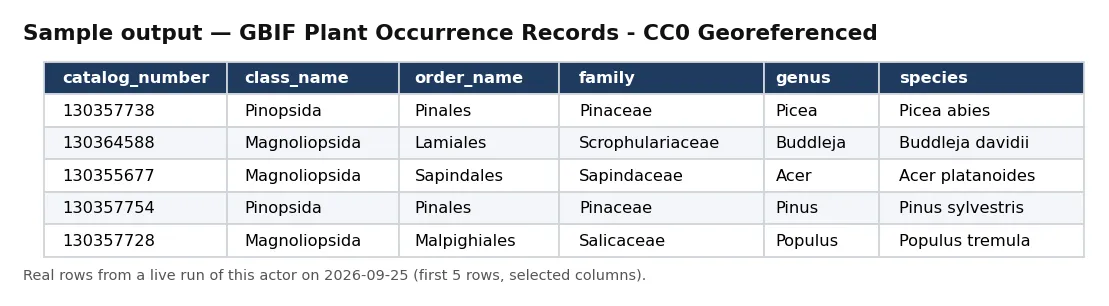
Real rows from a live run of this actor (first 5 rows, selected columns).
One full record from the same run, exactly as delivered:
Coverage and volume
About 75.98 million georeferenced CC0 plant occurrences match the filter live (measured at build time from the API's match count); every record carries decimal latitude and longitude.
Sol's Wave-3 index put this door at about 75,910,825 plant occurrences; measured live at build time 75,981,392 match under CC0 with coordinates - the live figure is what this listing quotes, delivered as a 100,000-record accessible slice.
GBIF caps offset paging at 100,000 (a request past that returns HTTP 400), so this Actor delivers the
first 100,000-record accessible slice of the match set. To reach records beyond the cap, narrow the query
downstream by a facet the API partitions on - year, country or datasetKey - each of which yields its
own sub-100,000 window; the Actor's baked filters (basis of record / kingdom / coordinates, plus the CC0
licence) always apply. The Actor pages 300 occurrences at a time and stops as soon as your Maximum records
cap or the 100,000 accessible-slice ceiling is met.
Licence and attribution
This Actor delivers only occurrences the publisher released under CC0 1.0 - a public-domain
dedication with no rights reserved on the data values. The licence filter (license=CC0_1_0) is baked into
every query, not a buyer option, and a per-record assertion rejects any occurrence whose licence is not
CC0 (verified with a planted-row test). The full notice travels on every record:
GBIF-mediated occurrence data. This cell delivers ONLY records the publisher released under CC0 1.0 (public-domain dedication; license=CC0_1_0); no rights are reserved on the data values. Use is governed by the GBIF Terms of Use (https://www.gbif.org/terms). GBIF asks that GBIF.org and the publishing datasets be cited; dataset_key identifies the publisher.
GBIF asks that GBIF.org and the contributing datasets be cited; dataset_key on every record identifies the
publisher so you can attribute or trace provenance per row.
Person-data policy
GBIF occurrences carry collector and identifier person names (recordedBy, identifiedBy, and every *By
/ *ByIDs field). This Actor structurally excludes all of them: they are never copied into a record.
Only institution and collection codes, taxonomy, locality, coordinates and dates are emitted, and a
per-record assertion rejects any collector/observer/person field (verified with a planted-field test). No
natural-person data is processed.
Interpretation caveat
Georeferenced plant-kingdom occurrence records released under CC0, each carrying decimal latitude/longitude. Taxonomy, institution codes, locality, coordinates and dates; a mix of observations and specimens.
Values are reproduced verbatim from the API; the Actor never rewrites a field. Coordinates are the
publisher's decimal degrees where present; a record without coordinates leaves those fields null (except in
the georeferenced cell, whose baked hasCoordinate=true filter guarantees every row has them).
Data quality and freshness
Numeric fields (coordinates, uncertainty, elevation, depth, year/month/day, taxon keys, individual count)
are delivered as real numbers; the licence label is normalised to CC0 1.0. Delivery is keyed on the stable
GBIF id, so the dataset is safe to diff, deduplicate or upsert. Every run re-reads the live API, so the data
is as fresh as GBIF's index, and each record's observed_at stamp dates the snapshot. The run's
RUN_RECEIPT records the live match count alongside how many records were delivered and charged, and the
100,000 hard cap.
Provenance and compliance
Every run reads api.gbif.org/robots.txt at runtime; the gate result (URL, status, byte length, SHA-256 of
the policy) is written to the run's RUN_RECEIPT, and the occurrence-search path is confirmed crawlable
before any data request. The API is keyless. The Actor never bypasses a block or fetches through a mirror.
Inputs
- Maximum records (
maxRecords) - hard cap on occurrence records delivered and billed (also ceilinged at the 100,000 accessible slice). You are billed only for records actually delivered.
Output
Records land in the Actor's default dataset and export as JSON, CSV, Excel or via the Apify API. A tabular overview view surfaces the GBIF id, scientific name, basis of record, country code, coordinates, year and institution code.
Fields in detail
The record leads with gbif_id and dataset_key, then the basis of record and identifiers
(occurrence_id, catalog_number, institution_code, collection_code, publishing_org_key); the
taxonomy block (kingdom, phylum, class_name, order_name, family, genus, species,
scientific_name, accepted_scientific_name, taxon_rank, taxon_key, kingdom_key); type/ecology
(type_status, establishment_means, individual_count); geography and time (country, country_code,
state_province, decimal_latitude, decimal_longitude, coordinate_uncertainty_m, elevation, depth,
year, month, day, event_date); and the normalised license. The provenance block closes every
record.
Scaling and limits
Set Maximum records low to sample cheaply or high to pull toward the 100,000 accessible slice. The Actor
pages the API 300 records at a time and delivers incrementally, so memory stays flat, and you are billed only
for what is delivered. Because the source holds far more than 100,000 matches, treat this cell as a windowed
feed: to assemble a larger panel, run it once per year, country or datasetKey window and concatenate -
the baked filters keep every window CC0 and on-grain. Re-running picks up GBIF's newly indexed occurrences,
and each record's observed_at stamp dates the snapshot.
A new door in the fleet
This is the fleet's first GBIF cell, and it establishes the door for its companion. GBIF aggregates hundreds of millions of biodiversity occurrences from museums, herbaria, survey programmes and citizen-science platforms, each published under the contributing dataset's own licence. This Actor commits to the cleanest slice of that: only CC0-dedicated records, only the structured occurrence fields, and never the collector or identifier person names. The 100,000-record accessible-slice cap is a property of the GBIF search API, not of this Actor - the API returns HTTP 400 once offset plus limit exceeds 100,000 - and the Actor treats that boundary as a clean terminal rather than an error, recording it in the run receipt.
Typical uses
Biodiversity, conservation and ecology teams use this cell to pull a windowed, licence-clean occurrence feed
without touching GBIF's Darwin Core archives or its download API. Because the taxonomy is fully expanded
(kingdom through species plus the accepted name) and coordinates are real numbers, the records feed straight
into species-distribution models, range maps and collection audits. To assemble a national or multi-year
panel that exceeds 100,000 records, run the cell once per year, country or datasetKey window and
concatenate - every window inherits the baked CC0 and occurrence filters, so the panel stays on-grain and
licence-clean. A scheduled run keeps a downstream biodiversity table current with GBIF's index, and the
stable GBIF id makes the dataset safe to upsert.
Sibling Actors
It sits beside its companion GBIF preserved-specimen cell (same door, specimen filter) and the fleet's protected-site species inventory. It shares its engineering - the runtime robots gate, offset paging with the licence filter baked in, push-then-charge billing and verbatim-value discipline - with the fleet's other public-data records Actors, and with its companion GBIF cell it shares the door while differing only in the baked occurrence filter.


