
UniProt Reviewed Proteins — Swiss-Prot
Pricing
from $33.50 / 1,000 reviewed protein records
UniProt Reviewed Proteins — Swiss-Prot
UniProt reviewed (Swiss-Prot) proteins: search by gene, protein name, keyword (Kinase, Ion channel...), organism, EC number, function words, length, evidence or any UniProt query - accession, names, organism, function, keywords. CC BY 4.0. Pay per record.
Pricing
from $33.50 / 1,000 reviewed protein records
Rating
0.0
(0)
Developer
NexGen Signal
Maintained by CommunityActor stats
0
Bookmarked
2
Total users
1
Monthly active users
22 days ago
Last modified
Categories
Share
Turn UniProt's reviewed (Swiss-Prot) protein set into clean, per-record target references - one row per manually curated protein entry with accession, protein and gene names, organism, function and status, ready for life-science data teams to enrich validated targets.
Each UniProtKB entry becomes one clean, flat record - accession, protein and gene names, organism,
review status, protein-existence evidence, sequence length, a function summary and keywords - with the
review status normalized to a real boolean, a stable record_id (the accession), and provenance stamped
on every row.
What one record represents
The source is UniProt (the UniProtKB REST API). This cell runs the reviewed:true query - the manually curated Swiss-Prot entries across all organisms. Each record is one protein
entry: its primary accession and entry name, the recommended protein name, gene name(s), organism and
NCBI taxonomy id, whether the entry is reviewed (Swiss-Prot) or unreviewed (TrEMBL), the protein-existence
evidence level, the sequence length, a function summary, and the UniProt keywords.
Search by gene, keyword, organism and more
Question: Which human proteins does Swiss-Prot class as ion channels (a drug-target shortlist)?
Run on 30 Sep 2026, UniProt reported 338 matching entries and the run returned 10 record(s) (10 × $0.05 = $0.50 on Apify's Free plan):
| Accession | Gene | Protein | Length | Evidence |
|---|---|---|---|---|
| O15399 | GRIN2D | Glutamate receptor ionotropic, NMDA 2D | 1336 | 1: Evidence at protein level |
| O60741 | HCN1 | Potassium/sodium hyperpolarization-activated cyclic nucleotide-gated channel 1 | 890 | 1: Evidence at protein level |
| P07510 | CHRNG | Acetylcholine receptor subunit gamma | 517 | 1: Evidence at protein level |
| P14867 | GABRA1 | Gamma-aminobutyric acid receptor subunit alpha-1 | 456 | 1: Evidence at protein level |
| P17787 | CHRNB2 | Neuronal acetylcholine receptor subunit beta-2 | 502 | 1: Evidence at protein level |
Search options (all optional; a record must match every option you set, and several values in one option match any of them):
- Gene names (
genes) — exact gene symbols, e.g.BRCA1,TP53. - Protein name (contains) (
proteinNames) — e.g.tyrosine kinase. - UniProt keywords (
keywords) — e.g.Kinase,Ion channel,Receptor, or ids likeKW-0418. - Organisms (
organisms) — NCBI taxonomy ids such as9606(human),10090(mouse); a name such asMus musculusalso works but matches loosely. - EC numbers (
ecNumbers) — e.g.2.7.11.1, or a class such as2.7.-.-. - Function mentions (
functionWords) — words in UniProt's function text, e.g.insulin,DNA repair. - Length (
lengthMin,lengthMax) — sequence length in amino acids. - Evidence level (
proteinExistence) —1protein level …5uncertain. - UniProt query (advanced) (
query) — any UniProt query, ANDed with the rest, e.g.cc_subcellular_location:"Cell membrane". An invalid query stops the run with UniProt's own message and no charge.
Every option is sent to UniProt as part of the query, so filtering happens before Maximum records. The status message gives UniProt's match count. "No records match" (nothing charged) is a successful run; an invalid advanced query fails with UniProt's message and no charge; if UniProt cannot be reached the run fails as a source failure. With no search option the actor sends exactly the query it always sent.
Coverage and volume
The reviewed (Swiss-Prot) set holds about 575,503 entries across all organisms - that is the record capacity of a full pull.
Live count: 575,503 reviewed entries - matches the Wave-3 index figure exactly.
About 20,431 of these reviewed entries are human (organism 9606) and therefore also appear in the sibling uniprot-human-proteome-records cell - that is 3.6% of this reviewed set. The two cells are distinct products (all reviewed organisms here; all human entries, mostly unreviewed, there) and the overlap is stated in both READMEs.
The Actor pages the UniProt REST API using its cursor (the Link header's rel="next"), 500 entries at
a time, and stops as soon as your Maximum records cap is met.
Licence and attribution
UniProt data is released under Creative Commons Attribution 4.0 (CC BY 4.0) - free to use and redistribute with attribution. The full notice travels on every record:
UniProt (UniProtKB), CC BY 4.0. Attribution required; reproduced from the UniProt REST API, values unmodified. No literature-author or contact fields are read.
The required attribution - UniProt Consortium (https://www.uniprot.org) - is present on every record, and the UniProt licence
page is the governing reference.
Interpretation caveat
Reviewed (Swiss-Prot) UniProtKB entries across all organisms - manually curated protein records. Only accession, protein/gene, organism and function/status fields are emitted.
Values are reproduced verbatim from the API; the Actor never rewrites a field. The function field is
the first UniProt function comment, which may cite PubMed identifiers - those are literature references,
not author names.
Person-data policy
This Actor emits only protein, gene, organism and function/status fields. UniProt entries carry a literature-references section with author names; that section is never requested and never delivered, and a per-record assertion rejects any author, submitter or contact field (verified with a planted-field test). No natural-person data is processed.
Data quality and freshness
reviewed is delivered as a real boolean and organism_id/sequence_length as real numbers. Every run
re-reads the live API, so the data is as fresh as UniProt publishes (updated on their release cycle), and
each record's observed_at stamp dates the snapshot. Delivery is keyed on the stable accession, so the
dataset is safe to diff, deduplicate or upsert. The run's RUN_RECEIPT records the API's total result
count alongside how many records were delivered and charged.
Provenance and compliance
Every run reads rest.uniprot.org/robots.txt at runtime; the gate result (URL, status, byte length,
SHA-256 of the policy) is written to the run's RUN_RECEIPT. The API is keyless. The Actor never
bypasses a block or fetches through a mirror.
Inputs
Default changed on 30 Sep 2026: if you leave maxRecords out, a run now returns up to 10 records (it was 500). Set maxRecords yourself to get more — the maximum is unchanged.
- Maximum records (
maxRecords) - hard cap on protein records delivered and billed. - Search options - see the search section above; all optional.
Output
Records land in the Actor's default dataset and export as JSON, CSV, Excel or via the Apify API. A tabular overview view surfaces accession, entry name, protein and gene names, organism, review status, protein existence, sequence length and keywords.
Fields in detail
The record leads with accession and entry_name, then protein_name, gene_names, organism and
organism_id, the boolean reviewed (and the verbatim entry_type), protein_existence,
sequence_length, function and keywords. The provenance block closes every record. Because the
accession is UniProt's stable primary key, this dataset joins cleanly onto any system that references
UniProt accessions.
Scaling and limits
Set Maximum records low to sample cheaply or high to pull the full set. The Actor pages the API with
its cursor (500 entries per request) and delivers incrementally, so memory stays flat regardless of how
many records you request, and you are billed only for what is delivered. The cursor is stable across a
run, so even a multi-hundred-thousand-entry pull proceeds without gaps or duplicates. Because UniProt
republishes on a fixed release cycle, re-running the Actor picks up new and updated entries automatically,
and each record's observed_at stamp dates the snapshot - schedule a run to keep a downstream reference
current. To build a cross-organism or cross-cut panel, run the relevant cells and join on the accession,
which is UniProt's stable primary key and never changes for an entry.
The reviewed / human overlap
The two UniProt cells in this fleet intentionally overlap on the reviewed-human entries and are otherwise distinct. The reviewed cell is every manually curated Swiss-Prot entry across all organisms; the human cell is every human entry, the large majority of which are unreviewed (TrEMBL) and appear only there. If you want only high-confidence human targets, take the intersection (reviewed and human); if you want the complete human universe including computationally annotated entries, use the human cell whole. Stating the overlap on both records means you can combine or subtract the two cells without double-counting.
Sibling Actors
It shares its engineering - the runtime robots gate, push-then-charge billing and verbatim-value discipline - with the fleet's other public-data records Actors.
Sample output
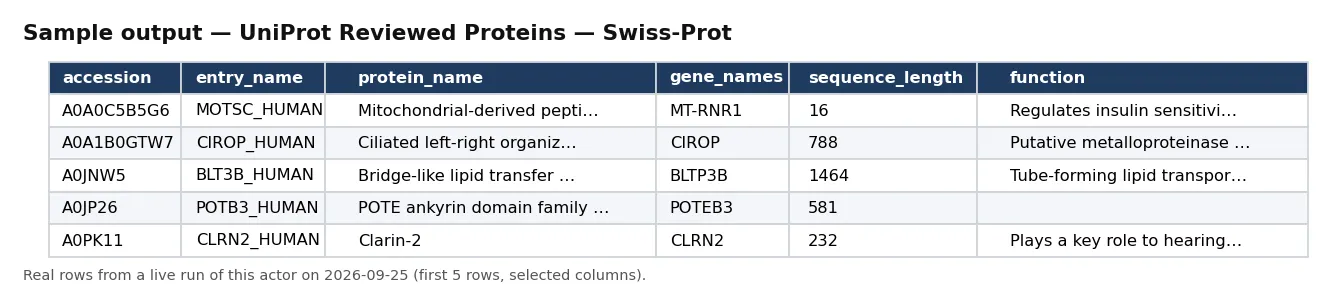
Real rows from a live run of this actor (first 5 rows, selected columns).
One full record from the same run, exactly as delivered:
Pricing
This Actor uses Apify's pay-per-event model: a flat $0.05 per record actually delivered to the dataset, and nothing else — no monthly rental, no per-run base fee, no compute charge. Deliver 40 records and you pay $2.00; deliver 10,000 and you pay $500.00. Billing is wired after delivery — each record is pushed first and only then does the per-record event fire — so a mid-run failure can only ever under-charge you, never over-charge. Use Maximum records to cap spend precisely.
Typical uses
Enrich a target list with curated protein and gene names, organism and function; filter validated targets by keyword or protein-existence evidence; build a cross-organism protein reference; or feed a bioinformatics, drug-discovery or annotation pipeline with clean reviewed-protein records.
What this Actor does not do
It does not deliver literature-author, submitter or contact fields; it does not include the full sequence or cross-reference dumps; and it does not alter any published value. It gives you a faithful, CC BY, analysis-ready protein reference - one row per entry - with a provenance trail you can audit on every run. Every value is UniProt's own, reproduced exactly, so the record is as authoritative as the source database.


