

Bulk Email List Hygiene Check (Syntax · MX · Disposable · Role)
Pricing
from $33.50 / 1,000 email verification checks
Bulk Email List Hygiene Check (Syntax · MX · Disposable · Role)
Clean an email list before you send — one email_verification_check row per address, answered from syntax and DNS alone: is the address well-formed, does the domain publish MX records (or an RFC-7505 null MX that says "no mail here").
Pricing
from $33.50 / 1,000 email verification checks
Rating
0.0
(0)
Developer

NexGen Watch
Maintained by CommunityActor stats
0
Bookmarked
2
Total users
1
Monthly active users
8 days ago
Last modified
Categories
Share
🔔 Bulk Email List Hygiene Check (Syntax · MX · Disposable · Role)
Clean an email list before you send — one email_verification_check row per address, answered from syntax and DNS alone: is the address well-formed, does the domain publish MX records (or an RFC-7505 null MX that says "no mail here"), does its primary mail host actually resolve, is the domain a known disposable / temporary-mailbox provider, and is the local part a role account (info@, support@ …) or a free consumer provider (gmail.com …). No third-party verification API, no key, nothing retained.
What it deliberately does not claim. It never says an address is deliverable. Confirming that a specific mailbox exists needs an SMTP conversation on port 25, and the platform blocks outbound port 25 — so instead of a guess dressed up as a verdict, every row carries mailbox_confirmed: null and a mailbox_note saying so. The definitive verdicts are INVALID_SYNTAX, NO_MX, NULL_MX, DISPOSABLE, MX_UNRESOLVED and MX_VALID — each one billed once, because each one is a real answer. DNS_FAULT (the resolver did not answer) and UNPARSEABLE are surfaced and never billed, and a batch with no definitive verdict fails loud and bills nothing.
Output is one email_verification_check row per result; billing is pay-per-event, the value event being one email verification check (a $0.02 start fee per run, then $0.05 per email verification check).
No login, no API key and no CAPTCHA solving are involved: the source is read logged-out with an identified contact User-Agent.
📊 Sample Output
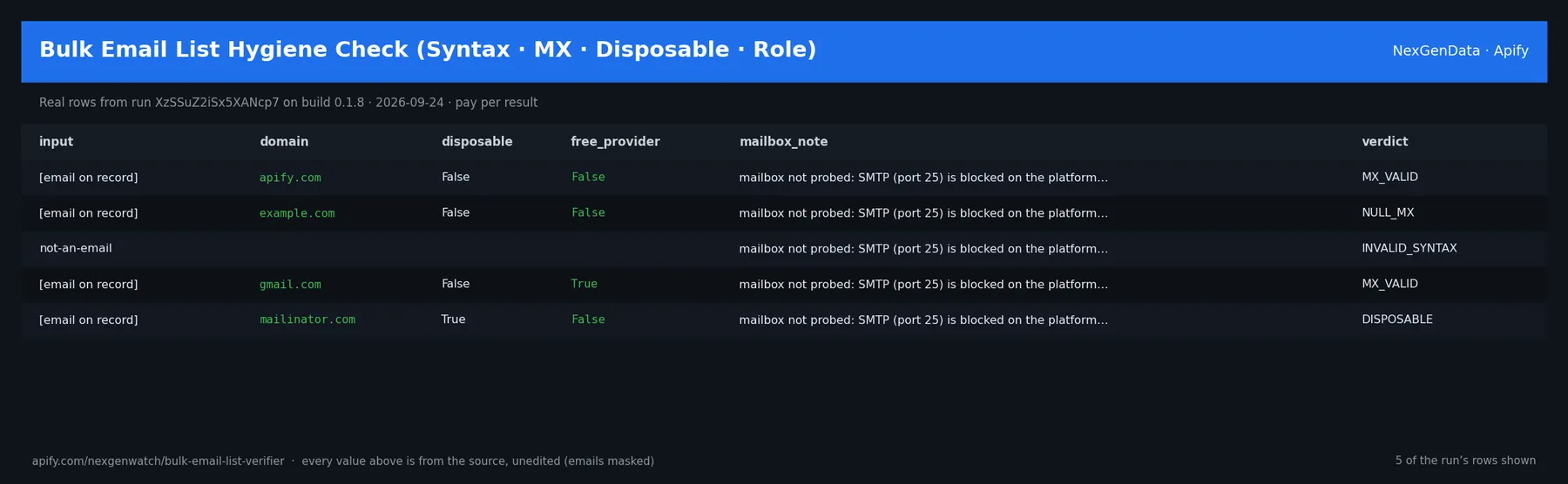
Real rows from run sdoJjtAhN6YdcOzwM on build 0.1.10 (2026-09-24), the same input as the Quick start below — every value is as the source published it (emails masked, long text shortened):
| input | domain | disposable | free_provider | mailbox_note | verdict |
|---|---|---|---|---|---|
| [email on record] | apify.com | False | False | mailbox not probed: SMTP (port 25) is blocked on the platform; this ve | MX_VALID |
| [email on record] | example.com | False | False | mailbox not probed: SMTP (port 25) is blocked on the platform; this ve | NULL_MX |
| not-an-email | mailbox not probed: SMTP (port 25) is blocked on the platform; this ve | INVALID_SYNTAX | |||
| [email on record] | gmail.com | False | True | mailbox not probed: SMTP (port 25) is blocked on the platform; this ve | MX_VALID |
| [email on record] | mailinator.com | True | False | mailbox not probed: SMTP (port 25) is blocked on the platform; this ve | DISPOSABLE |
The run finished with the status message: NORMAL: 5 resolved (0 not-found, 0 ambiguous, 0 service-fault, 0 unparseable) of 5 | answers billable=5 | email_verification_check charged=5
✅ What you get
Each row is flat JSON with these fields (from the dataset schema and the sample run; a field the source does not publish for a given row is null):
record_type(string/null) — e.g.email_verification_checkinput(string/null) — e.g.[email on record]domain(string/null) — e.g.apify.commx_host(string/null) — e.g.aspmx.l.google.commx_count— e.g.5mx_resolves— e.g.Truedisposable— e.g.Falsefree_provider— e.g.Falserole_account— e.g.Truemailbox_confirmed— null in every sample rowmailbox_note— e.g.mailbox not probed: SMTP (port 25) is blocked on the platform; this verdict is asource(string/null) — e.g.syntax + DNS (MX, A/AAAA of the primary MX) + bundled disposable/free-provider/rverdict(string/null) — e.g.MX_VALIDunbilled_reason(string/null) — null in every sample rowsmtp_code(string/null) — null in every sample rowcatch_all(boolean/null) — null in every sample row
⚙️ Sample inputs
1. Quick start — the Store example (this is what the sample above came from)
The sample run charged exactly: 1 × $0.02 apify-actor-start + 5 × $0.05 email_verification_check = $0.27 on the Free tier — every delivered row was billed.
This actor takes no size cap or filter beyond the input above, so the Store example is the one input to run; put it on a schedule to keep the data current.
🧾 JSON sample record
One real record from run sdoJjtAhN6YdcOzwM, exactly as it lands in the dataset (emails masked, long text shortened):
🔧 How it works
Transport. Plain HTTPS from the Apify platform, no proxy. Every request carries an identified contact User-Agent.
Charging. Each email verification check is charged at the moment it is pushed (email_verification_check); a row that fails to charge is not delivered, so the dataset count always equals the charged count.
1
·
·
=
;
=
3
·
=
=
4
·
6
;
;
What is not done. No login, no cookie or CAPTCHA bypass, no private or personal-account data, no browser automation.
💰 Pricing example
| Event | Free | Bronze | Silver | Gold |
|---|---|---|---|---|
Actor Start (apify-actor-start) | $0.02 | $0.02 | $0.02 | $0.02 |
Email verification check (email_verification_check) | $0.05 | $0.045 | $0.04 | $0.0335 |
Worked at the live Free-tier price:
- 5 email verification checks: $0.02 start + 5 × $0.05 = $0.27
- 25 email verification checks: $0.02 start + 25 × $0.05 = $1.27
- 100 email verification checks: $0.02 start + 100 × $0.05 = $5.02
A run that delivers zero rows charges the $0.02 start fee only. A BLOCKED run (source refused) fails loud and charges no value event. The start fee is charged once per GB of run memory; the default run memory is 4096 MB.
Yield on the sample run: NORMAL: 5 resolved (0 not-found, 0 ambiguous, 0 service-fault, 0 unparseable) of 5 | answers billable=5 | email_verification_check charged=5.
⚖️ Legal & ToS
This actor reads public data only. It collects only what the source publishes to any visitor, identifies itself with a contact User-Agent, and does not access accounts, private data or anything behind authentication. Use the output in line with the source's terms and your local law; the intended use is B2B research and monitoring.
❓ FAQ
Q: Do I need an API key or a login?
A: No. the input schema has no key field and the actor carries no secrets.
Q: Why did my run return 0 rows?
A: Read the run's status message. GENUINE_EMPTY means the source was read and had nothing in scope for your input; BLOCKED means the source refused and the run failed without billing a value event — retry later or narrow the input. A zero-row run bills the start fee only.
Q: How fresh is the data?
A: Every run reads the source live at run time; nothing is cached between runs. Put it on a schedule for a continuous feed.
Q: What formats can I export?
A: The dataset downloads as JSON, CSV, Excel, XML or RSS from the run's Dataset tab or the Apify API, and any run can push to a webhook or integration.
Q: How is this different from the other NexGen Watch actors actors?
A: Same output shape and billing model; this one covers Bulk Email List Hygiene Check (Syntax · MX · Disposable · Role). The siblings under Related Actors cover the other sources or slices — run several on one schedule for a combined feed.
Q: Are there rate limits?
A: The actor paces itself against the source; there is no per-buyer limit beyond your Apify plan's concurrency.
🆘 Troubleshooting
- Run FAILED with BLOCKED → the source refused the request or changed its page shape → nothing was billed beyond the start fee; retry after a while, and if it persists open an Issue with the run id.
- Fewer rows than expected → the source had fewer items in scope → widen the input.
- Input validation error on start → a field is outside the schema's allowed values → start from the Quick start block and change one field at a time.
- Run TIMED-OUT → a very wide request on a slow day → raise the run timeout in Run options or narrow the input; what was delivered before the timeout is still in the dataset.
🔗 Related Actors
- BTS International Report Departures (route operations) — Structured international airline departures performed between U.S. gateway airports and foreign airports, read directly from the official BTS Socrata…
- BTS International Report Seats (route capacity) — Structured international nonstop seat capacity from the U.S
- BTS T-100 Airport Traffic — Structured monthly airport traffic and capacity records from the U.S. DOT Bureau of Transportation Statistics (BTS) T-100 program, read directly from…
- Census Address Geography Check — A definitive check: does this business/property address resolve to an official U.S. Census geography, and which one?
- ChEMBL Biotherapeutic Sequence Master — One structured record per ChEMBL biotherapeutic — the molecule id, the HELM notation, the biocomponent array, and the description. A master index ove…
- ChEMBL Clinical-Stage Indication Screen — One structured clinical compound record per molecule at or above the clinical phase you set — max_phase, first approval year, molecule type, route fl…
- 🏢 About NexGenData — NexGen Watch is NexGenData's fleet of more than 300 public data actors built on official sources, pay-per-result. Browse the catalog at apify.com/nexgenwatch.
⭐ Found this useful?
If this actor saved you a manual check, a quick review on the Apify Store helps other teams find it. Feature request or a source that changed? Open it from the Issues tab — every one is read.


