

General Catalyst Portfolio Company Scraper
Pricing
from $33.50 / 1,000 portfolio company records
General Catalyst Portfolio Company Scraper
Clean, structured directory of General Catalyst's portfolio companies — one record per company, from the portfolio's public companies page.
Pricing
from $33.50 / 1,000 portfolio company records
Rating
0.0
(0)
Developer
NexGen Watch
Maintained by CommunityActor stats
0
Bookmarked
2
Total users
1
Monthly active users
2 days ago
Last modified
Categories
Share
🏢 General Catalyst Portfolio Company Scraper
Clean, structured directory of General Catalyst's portfolio companies — one record per company, from the portfolio's public companies page. Each portfolio_company record carries: name, description, funding stage, sector tags, all locations, current open-job count, the company's website, the board company page, the source listing, and when it was observed.
Output is one portfolio_company row per result; billing is pay-per-event, the value event being one portfolio company record (a $0.02 start fee per run, then $0.05 per portfolio company record). Source: jobs.generalcatalyst.com.
No login, no API key and no CAPTCHA solving are involved: the source is read logged-out with an identified contact User-Agent.
📊 Sample Output
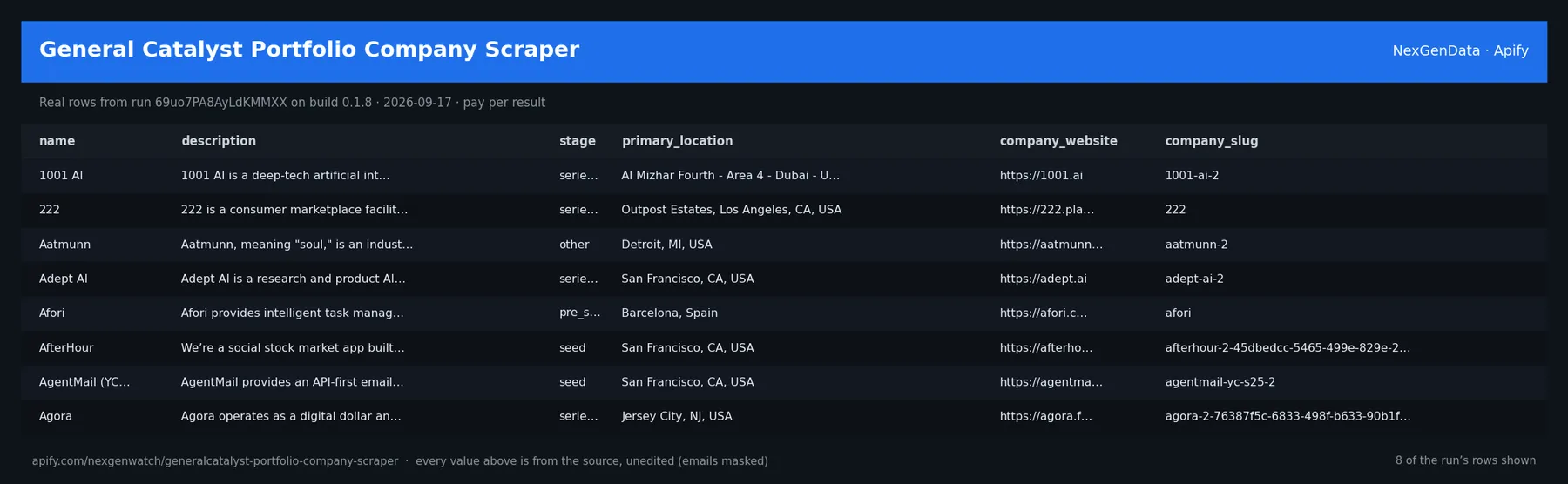
Real rows from run 69uo7PA8AyLdKMMXX on build 0.1.8 (2026-09-17), the same input as the Quick start below — every value is as the source published it (emails masked, long text shortened):
| name | description | stage | primary_location | company_website | company_slug |
|---|---|---|---|---|---|
| 1001 AI | 1001 AI is a deep-tech artificial intelligence startup that develops A | series_a | Al Mizhar Fourth - Area 4 - Dubai - United Arab Emirates | https://1001.ai | 1001-ai-2 |
| 222 | 222 is a consumer marketplace facilitating chance social experiences a | series_a | Outpost Estates, Los Angeles, CA, USA | https://222.place | 222 |
| Aatmunn | Aatmunn, meaning "soul," is an industrial technology company with a cl | other | Detroit, MI, USA | https://aatmunn.com | aatmunn-2 |
| Adept AI | Adept AI is a research and product AI lab that automates software proc | series_b | San Francisco, CA, USA | https://adept.ai | adept-ai-2 |
| Afori | Afori provides intelligent task management and workflow automation by | pre_seed | Barcelona, Spain | https://afori.com | afori |
| AfterHour | We’re a social stock market app built for everyday traders that want t | seed | San Francisco, CA, USA | https://afterhour.com | afterhour-2-45dbedcc-5465-499e-829e-257313249b45 |
| AgentMail (YC S25) | AgentMail provides an API-first email platform that enables AI agents | seed | San Francisco, CA, USA | https://agentmail.to | agentmail-yc-s25-2 |
| Agora | Agora operates as a digital dollar and an asset platform for businesse | series_a | Jersey City, NJ, USA | https://agora.finance | agora-2-76387f5c-6833-498f-b633-90b1f62fe59d |
The run finished with the status message: CAPPED: delivered 10 of 12+ unique companies (maxRecords=10) — a buyer-requested bound on the count, not an outage. read 1 page(s), 0 duplicates collapsed. portfolio-company-record billable=10
✅ What you get
A portfolio_company record (one per unique company, keyed by slug; a company in several places is one record with a location list) or a run_receipt. Fields the board does not publish are null.
Each row is flat JSON with these fields (from the dataset schema and the sample run; a field the source does not publish for a given row is null):
record_type(string) — Discriminator.name(string/null) — Portfolio company name.description(string/null) — Company description as published on the board.stage(string/null) — Funding stage tag when published.sector_tags(array/null) — Sector / industry tags (visible tags first), deduped.topics(array/null) — Topic tags when published.locations(array/null) — All locations for the company (one record, many locations), deduped.primary_location(string/null) — First/primary location.head_count(integer/string/null) — Head-count band when published.active_jobs_count(integer/null) — Current number of open jobs on the board.company_website(string/null) — The company's own website (from its domain), not fetched.company_url(string/null) — The board's company page.source_url(string/null) — The board's public companies listing.company_slug(string/null) — Company slug on the board (unique identity).company_id(integer/null) — Getro company id.source(string/null) — Board identifier.observed_at(string/null) — When this run observed the company (ISO 8601).terminal(string/null) — run_receipt: run terminal.pages_read(integer/null) — run_receipt: API pages read.raw_seen(integer/null) — run_receipt: raw companies scanned.duplicates(integer/null) — run_receipt: duplicates collapsed.unique_found(integer/null) — run_receipt: unique matching companies found.delivered(integer/null) — run_receipt: records delivered (== portfolio-company-record charges).
Every run also writes a RUN_RECEIPT record to its key-value store with the source checks it made and the counts it charged — diagnostics never land in the paid dataset.
⚙️ Sample inputs
1. Quick start — the Store example (this is what the sample above came from)
The sample run charged exactly: 1 × $0.02 apify-actor-start + 10 × $0.05 portfolio-company-record = $0.52 on the Free tier — every delivered row was billed.
2. A smaller, narrowed run
Caps the run at 5 rows — about $0.27 on the Free tier ($0.02 start + 5 × $0.05).
3. A full-size run
Up to 600 rows (the schema default for maxRecords) — about $30.02 on the Free tier ($0.02 start + 600 × $0.05) if the source has that many.
🧾 JSON sample record
One real record from run 69uo7PA8AyLdKMMXX, exactly as it lands in the dataset (emails masked, long text shortened):
🔧 How it works
Source. The actor reads jobs.generalcatalyst.com — endpoints: https://jobs.generalcatalyst.com. Public pages and feeds only; nothing behind a login.
Transport. Plain HTTPS from the Apify platform, no proxy. Every request carries an identified contact User-Agent.
Terminal states. A run ends NORMAL, CAPPED (your cap was reached), PARTIAL (something was withheld and the message says what), GENUINE_EMPTY (the source was read and truly had nothing in scope) or BLOCKED (the source refused or changed shape — the run FAILS loud and bills nothing). A zero-row run is never reported as a silent success.
Charging. Each portfolio company record is charged at the moment it is pushed (portfolio-company-record); a row that fails to charge is not delivered, so the dataset count always equals the charged count.
What it does
- Reads the portfolio board's public companies directory and returns one clean record per company.
- One company = one record. A company listed in several locations is a single record with a deduped location list, and each company appears — and bills — only once (identity is the company slug).
- Lets you bound a run by count (
maxRecords) or by filters (locationContains,sectorContains,stage,nameContains,minJobs,hiringOnly). - Reads the board's own company data only — the company website is never fetched.
- If the board is unreachable, changes shape, or its cards vanish (a redesign), it stops loudly — a broken board is never delivered as an empty success.
Notes
The active_jobs_count field is the company's current open roles on the board. Sector tags list the board's visible industry tags first, then any remaining tags, deduped. Descriptions, stage, sector and location are delivered exactly as the board publishes them; a field the board omits is left null.
What is not done. No login, no cookie or CAPTCHA bypass, no private or personal-account data, no browser automation.
💰 Pricing example
| Event | Free | Bronze | Silver | Gold |
|---|---|---|---|---|
Actor Start (apify-actor-start) | $0.02 | $0.02 | $0.02 | $0.02 |
Portfolio company record (portfolio-company-record) | $0.05 | $0.04 | $0.04 | $0.03 |
Worked at the live Free-tier price:
- 8 portfolio company records: $0.02 start + 8 × $0.05 = $0.42
- 25 portfolio company records: $0.02 start + 25 × $0.05 = $1.27
- 600 portfolio company records: $0.02 start + 600 × $0.05 = $30.02
A run that delivers zero rows charges the $0.02 start fee only. A BLOCKED run (source refused) fails loud and charges no value event. The start fee is charged once per GB of run memory; the default run memory is 1024 MB.
Yield on the sample run: CAPPED: delivered 10 of 12+ unique companies (maxRecords=10) — a buyer-requested bound on the count, not an outage. read 1 page(s), 0 duplicates collapsed. portfolio-company-record billable=10. maxRecords is a hard ceiling on what is delivered and billed, never a target.
⚖️ Legal & ToS
This actor reads public, logged-out pages and feeds published by jobs.generalcatalyst.com. It collects only what the source publishes to any visitor, identifies itself with a contact User-Agent, and does not access accounts, private data or anything behind authentication. Use the output in line with the source's terms and your local law; the intended use is B2B research and monitoring.
❓ FAQ
Q: Do I need an API key or a login?
A: No. The source (jobs.generalcatalyst.com) is read logged-out; the input schema has no key field and the actor carries no secrets.
Q: Why did my run return 0 rows?
A: Read the run's status message. GENUINE_EMPTY means the source was read and had nothing in scope for your input; BLOCKED means the source refused and the run failed without billing a value event — retry later or narrow the input. A zero-row run bills the start fee only.
Q: How many rows can one run return?
A: Up to maxRecords (default 600). Raise the cap for a bigger run; you pay per delivered row.
Q: How fresh is the data?
A: Every run reads the source live at run time; nothing is cached between runs. Put it on a schedule for a continuous feed.
Q: What formats can I export?
A: The dataset downloads as JSON, CSV, Excel, XML or RSS from the run's Dataset tab or the Apify API, and any run can push to a webhook or integration.
Q: How is this different from the other VC portfolio company lists actors?
A: Same output shape and billing model; this one covers jobs.generalcatalyst.com. The siblings under Related Actors cover the other sources or slices — run several on one schedule for a combined feed.
Q: Are there rate limits?
A: The actor paces itself against the source; there is no per-buyer limit beyond your Apify plan's concurrency.
🆘 Troubleshooting
- Run FAILED with BLOCKED → the source refused the request or changed its page shape → nothing was billed beyond the start fee; retry after a while, and if it persists open an Issue with the run id.
- Status says CAPPED → your cap (
maxRecords) was reached → raise it for a bigger run. - Input validation error on start → a field is outside the schema's allowed values → start from the Quick start block and change one field at a time.
- Run TIMED-OUT → a very wide request on a slow day → raise the run timeout in Run options or narrow the input; what was delivered before the timeout is still in the dataset.
🔗 Related Actors
- DCVC Portfolio Companies — One structured record per company in the DCVC portfolio,
- Felicis Portfolio Companies — One structured record per company in the Felicis portfolio, read from the fund's own portfolio
- First Round Portfolio Companies — One structured record per company in the First Round portfolio,
- Initialized Capital Portfolio Companies — One structured record per company in the Initialized Capital portfolio,
- Insight Partners Portfolio Company Scraper — Insight Partners Portfolio Company Scraper
- Khosla Ventures Portfolio Company Scraper — Khosla Ventures Portfolio Company Scraper
- 🏢 About NexGenData — NexGen Watch is NexGenData's fleet of 256 public monitoring and lookup actors built on official sources, pay-per-result. Browse the catalog at apify.com/nexgenwatch.
⭐ Found this useful?
If this actor saved you a manual check, a quick review on the Apify Store helps other teams find it. Feature request or a source that changed? Open it from the Issues tab — every one is read.
