
Google Play Reviews Scraper — All Countries, Filters, Replies
Pricing
from $0.10 / 1,000 review scrapeds
Google Play Reviews Scraper — All Countries, Filters, Replies
Scrape Google Play reviews for any Android app by package ID, URL or search term, across one or many countries per run: rating, text, thumbs-up, version, date, developer reply. Filter by stars, keywords, replies, date range or last N days before billing. Pay per review.
Pricing
from $0.10 / 1,000 review scrapeds
Rating
0.0
(0)
Developer
NexGen Watch
Maintained by CommunityActor stats
0
Bookmarked
1
Total users
1
Monthly active users
5 days ago
Last modified
Categories
Share
📱 Google Play Reviews Scraper — All Countries, Filters, Replies
Scrape Google Play reviews for any Android app — by package ID, Play Store URL or a search term — across one or many countries in a single run. Each row carries the star rating, text, thumbs-up count, app version, date, author handle and the developer's reply. Filter by rating, keywords, developer-reply state, a date range or the last N days before anything is billed. Watch mode on a schedule delivers only new reviews.
- Many markets at once:
languages: ["en","es","pt","de"]reads each language's reviews in one run (Google Play groups reviews by language, not country); addcountriesof the same length to set each storefront. - Rolling window:
recent_days: 7on a daily schedule gives you only the last week's reviews. - No login, no API key, no CAPTCHA solving: Google Play's public review pages, read logged-out.
Output is one row per review; billing is pay-per-event, the value event being one review scraped (a $0.02 start fee per run, then $0.0001 per review scraped). Source: play.google.com.
No login, no API key and no CAPTCHA solving are involved: the source is read logged-out.
Who buys this
- Android product teams reading Google Play reviews for their own app and competitors' apps without copying them by hand.
- App marketers and ASO teams tracking ratings and complaints in Android app reviews release by release.
- Customer-support teams finding unanswered Google Play reviews (
developer_reply: unanswered). - Analysts feeding Android app reviews into a sentiment or BI pipeline.
📊 Sample Output
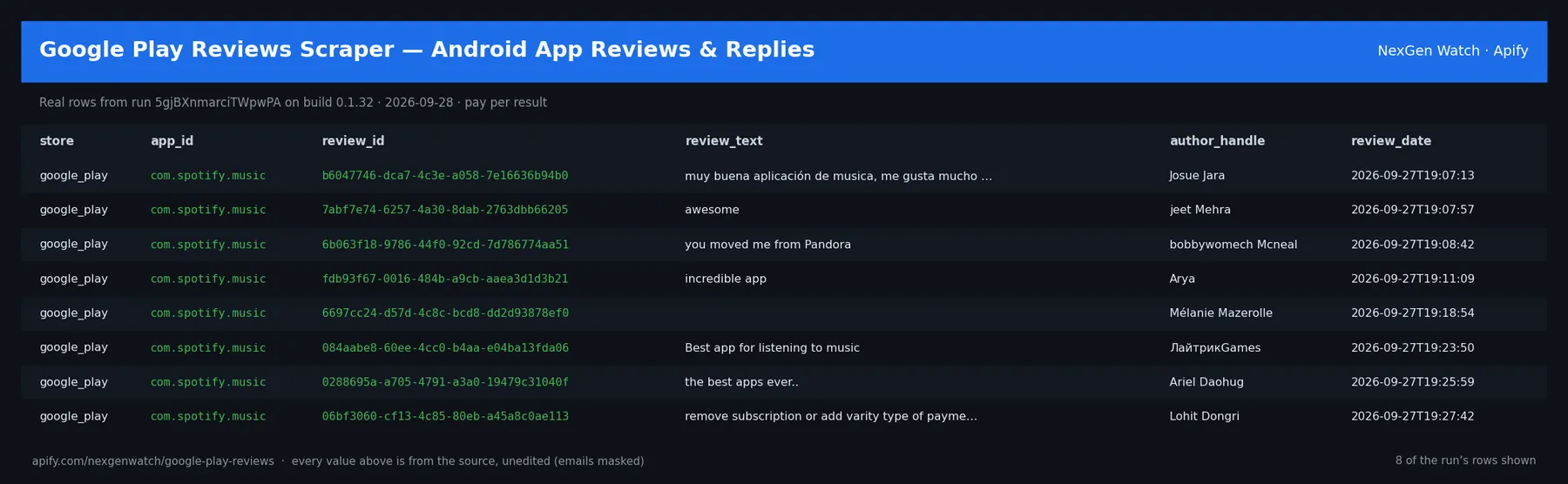
Real rows from run 5gjBXnmarciTWpwPA on build 0.1.32 (2026-09-28), the same input as the Quick start below — every value is as the source published it (emails masked, long text shortened):
| store | app_id | review_id | review_text | author_handle | review_date |
|---|---|---|---|---|---|
| google_play | com.spotify.music | b6047746-dca7-4c3e-a058-7e16636b94b0 | muy buena aplicación de musica, me gusta mucho que a fin de año te dic | Josue Jara | 2026-09-27T19:07:13 |
| google_play | com.spotify.music | 7abf7e74-6257-4a30-8dab-2763dbb66205 | awesome 😎 | jeet Mehra | 2026-09-27T19:07:57 |
| google_play | com.spotify.music | 6b063f18-9786-44f0-92cd-7d786774aa51 | you moved me from Pandora | bobbywomech Mcneal | 2026-09-27T19:08:42 |
| google_play | com.spotify.music | fdb93f67-0016-484b-a9cb-aaea3d1d3b21 | incredible app | Arya | 2026-09-27T19:11:09 |
| google_play | com.spotify.music | 6697cc24-d57d-4c8c-bcd8-dd2d93878ef0 | ☺️☺️ | Mélanie Mazerolle | 2026-09-27T19:18:54 |
| google_play | com.spotify.music | 084aabe8-60ee-4cc0-b4aa-e04ba13fda06 | Best app for listening to music | ЛайтрикGames | 2026-09-27T19:23:50 |
| google_play | com.spotify.music | 0288695a-a705-4791-a3a0-19479c31040f | the best apps ever.. | Ariel Daohug | 2026-09-27T19:25:59 |
| google_play | com.spotify.music | 06bf3060-cf13-4c85-80eb-a45a8c0ae113 | remove subscription or add varity type of payment app and for teenager | Lohit Dongri | 2026-09-27T19:27:42 |
The run finished with the status message: SUCCEEDED: emitted 25 item(s)
✅ What you get
Each row is flat JSON with these fields (from the dataset schema and the sample run; a field the source does not publish for a given row is null):
store(string/null) — Output field: storeapp_id(string/null) — Output field: app_idreview_id(string/null) — Output field: review_idtitle(string/null) — Output field: titlereview_text(string/null) — Output field: review_textrating(number/null) — Output field: ratingthumbs_up(number/null) — Output field: thumbs_upauthor_handle(string/null) — Output field: author_handlereview_date(string/null) — Output field: review_dateversion(string/null) — Output field: versiondeveloper_response(string/null) — Output field: developer_responsedeveloper_response_date(string/null) — Output field: developer_response_datecountry(string/null) — Output field: countrysource_url(string/null) — Output field: source_urlcollected_at(string/null) — Output field: collected_at
What you get
- Public Google Play reviews: rating, title, text, thumbs-up count, author, date, and app version
- Developer replies and reply dates where present
- A normalized 15-field record per review with source URL and collection timestamp
- An isolated open-source adapter with a fresh process and proxy environment on every retry
- Optional watch mode that emits only new reviews and status changes on later runs
⚙️ Sample inputs
1. Quick start — the Store example (this is what the sample above came from)
The sample run charged exactly: 1 × $0.02 apify-actor-start + 25 × $0.0001 review-scraped + 0 × $0.10 watch-check = $0.0238 on the Free tier — every delivered row was billed.
2. A smaller, narrowed run
Caps the run at 5 rows — about $0.0208 on the Free tier ($0.02 start + 5 × $0.0001). country narrows what the source is asked for.
3. Optional watch mode (changes only, for a schedule)
The first run seeds a private baseline and emits zero deltas; every later run emits one row per change, billed at $0.0001 each.
4. Several markets (languages), last 30 days, 1–2 stars only
Low-star reviews from the last 30 days across three countries — what is going wrong for users right now, per market.
🧾 JSON sample record
One real record from run 5gjBXnmarciTWpwPA, exactly as it lands in the dataset (emails masked, long text shortened):
🔧 How it works
Source. The actor reads play.google.com — endpoints: https://play.google.com/store/apps/details, https://play.google.com/store/search. Public pages and feeds only; nothing behind a login.
Transport. Requests go through Apify residential proxy.
Watch semantics. Snapshot mode (watchMode: false) returns a preview. Watch mode keys every record on a source-native id, stores a private baseline in a named key-value store, and on each later run emits one delta row per change (new / changed / removed). A blocked fetch is never diffed, so a source outage cannot show up as a mass removal.
Terminal states. A run ends NORMAL, CAPPED (your cap was reached), PARTIAL (something was withheld and the message says what), GENUINE_EMPTY (the source was read and truly had nothing in scope) or BLOCKED (the source refused or changed shape — the run FAILS loud and bills nothing). A zero-row run is never reported as a silent success.
Charging. Each review scraped is charged at the moment it is pushed (review-scraped); a row that fails to charge is not delivered, so the dataset count always equals the charged count.
🔧 How it works
Transport. Requests go through Apify residential proxy.
🔧 How it works
Transport. Requests go through Apify residential proxy.
🔧 How it works
Transport. Requests go through Apify residential proxy.
🔧 How it works
Transport. Requests go through Apify residential proxy.
How it works
Give it one or more Google Play package IDs (e.g. com.spotify.music). An isolated open-source adapter collects the public reviews for each — a fresh process and proxy per retry — and normalizes them into one 15-field schema that mirrors the Apple reviews actor. Public, logged-out surfaces only.
Compliance & honest limits
- Public Google Play review surfaces only — no login, CAPTCHA, paywall, or access-control defeating.
- Google Play exposes a bounded review window per app and country; full lifetime history is not reconstructed.
- A source-confirmed empty result is
SUCCEEDED-0: GENUINE_EMPTY; exhausted block retries fail and truncated runs arePARTIAL.
About
Part of the NexGen Watch App Intelligence cluster, sharing one honest contract across iOS and Android. Questions or need a custom feed? Open an issue on the Actor page.
Preview vs Watch mode
- Preview (watchMode = false): a one-shot pull of the current reviews — emitted and charged per
review-scrapedrecord. Keeps no baseline. - Watch (watchMode = true): change detection — seeds a private baseline on the first run (zero deltas, no
review-scrapedbilling), then on later runs emits only the new reviews since the baseline, plus onewatch-checkper run. A settled run with no new reviews reportsWATCH_NO_DELTAand charges only thewatch-check.
What is not done. No login, no cookie or CAPTCHA bypass, no private or personal-account data, no browser automation.
⏰ Optional: run it on a schedule
A single run returns the current records. If you also want to be told what changed over time, open the actor in Apify Console → Schedules → Create new, add this actor with the watch-mode input above (watchMode: true) so each run returns only the changes, and pick a cadence:
- Daily —
0 7 * * *(07:00 UTC): catch changes within a day. - Weekly —
0 7 * * 1: a Monday digest.
Each run is independent; keep the same input on the schedule so the results stay comparable. Schedules can also POST results to a webhook (Console → Integrations).
⏰ Optional: run it on a schedule
⏰ Optional: run it on a schedule
💰 Pricing example
| Event | Free | Bronze | Silver | Gold |
|---|---|---|---|---|
Actor Start (apify-actor-start) | $0.02 | $0.02 | $0.02 | $0.02 |
Review scraped (review-scraped) | $0.0001 | $0.0001 | $0.0001 | $0.0001 |
Watch check (watch-check) | $0.10 | $0.09 | $0.08 | $0.067 |
Worked at the live Free-tier price (watch mode, one delta per change):
- 8 review scrapeds: $0.02 start + 8 × $0.0001 = $0.0212
- 25 review scrapeds: $0.02 start + 25 × $0.0001 = $0.0238
- 100 review scrapeds: $0.02 start + 100 × $0.0001 = $0.035
A run that delivers zero rows charges the $0.02 start fee only. A BLOCKED run (source refused) fails loud and charges no value event. The start fee is charged once per GB of run memory; the default run memory is 1024 MB.
Yield on the sample run: SUCCEEDED: emitted 25 item(s). max_items is a hard ceiling on what is delivered and billed, never a target.
⚖️ Legal & ToS
This actor reads public, logged-out pages and feeds published by play.google.com. It collects only what the source publishes to any visitor, identifies itself, and does not access accounts, private data or anything behind authentication. Use the output in line with the source's terms and your local law; the intended use is B2B research and monitoring.
❓ FAQ
Q: Do I need an API key or a login?
A: No. The source (play.google.com) is read logged-out; the input schema has no key field and the actor carries no secrets.
Q: Why did my run return 0 rows?
A: Read the run's status message. GENUINE_EMPTY means the source was read and had nothing in scope for your input (in watch mode the first run always seeds the baseline and returns zero deltas); BLOCKED means the source refused and the run failed without billing a value event — retry later or narrow the input. A zero-row run bills the start fee only.
Q: How many rows can one run return?
A: Up to max_items (default 100). Raise the cap for a bigger run; you pay per delivered row.
Q: What does watch mode remember between runs?
A: A private baseline of source-native record ids in a named key-value store. Each later run diffs the live source against it and emits only changes.
Q: How fresh is the data?
A: Every run reads the source live at run time; nothing is cached between runs except the watch baseline. Put it on a schedule for a continuous feed.
Q: What formats can I export?
A: The dataset downloads as JSON, CSV, Excel, XML or RSS from the run's Dataset tab or the Apify API, and any run can push to a webhook or integration.
Q: How is this different from the other app store intelligence actors?
A: Same output shape and billing model; this one covers play.google.com. The siblings under Related Actors cover the other sources or slices — run several on one schedule for a combined feed.
🆘 Troubleshooting
- Run FAILED with BLOCKED → the source refused the request or changed its page shape → nothing was billed beyond the start fee; retry after a while, and if it persists open an Issue with the run id.
- Status says CAPPED → your cap (
max_items) was reached → raise it for a bigger run. - Input validation error on start → a field is outside the schema's allowed values → start from the Quick start block and change one field at a time.
- Run TIMED-OUT → a very wide request on a slow day → raise the run timeout in Run options or narrow the input; what was delivered before the timeout is still in the dataset.
- First watch run shows no deltas → expected: it seeds the baseline; changes appear from the second run.
🔗 Related Actors
- App Store Top Charts Scraper by Country — Scrape App Store top charts by country and category: rank, app, developer and rank movement. Every run returns the current records as a dataset. Opti…
- App Store & Google Play Metadata Scraper — One Schema — Scrape public Apple App Store and Google Play app metadata by app ID — title, developer, description, category, price, rating, rating count, version,…
- ASO Keyword Rank Scraper - App Store and Google Play — Scrape App Store and Google Play keyword rankings for any app: position per keyword, per country, per store. Every run returns the current records as…
- Apple App Store Reviews Scraper — Ratings, Text & Dates — Scrape Apple App Store reviews for any app by ID or URL: rating, title, text, version, date and the developer's reply. Filter by star rating, review-…
- 🏢 About NexGen Watch — NexGen Watch is a catalog of more than 300 public data actors built on official sources, pay-per-result. Browse the catalog at apify.com/nexgenwatch.
⭐ Found this useful?
If this actor saved you a manual check, a quick review on the Apify Store helps other teams find it. Feature request or a source that changed? Open it from the Issues tab — every one is read.


